



Community hub
Recent from talks
Knowledge base stats:
Talk channels stats:
Members stats:
Abhimanyu
Abhimanyu (Sanskrit: अभिमन्यु, IAST: Abhimanyu) is a character in the ancient Hindu epic Mahābhārata. He was a young and valiant warrior of the Kuru lineage, born to Arjuna—the third Pandava brother—and Subhadra—a Vrishni princess. He was also one of the few individuals, along with his father, who knew the technique to enter the Chakravyuha, a powerful military formation. Abhimanyu was raised by his maternal family in Dvārakā because the Pandavas had been exiled for thirteen years by their cousins, the Kauravas. After his father's return, his marriage was arranged with Uttarā, the princess of the Matsya Kingdom.
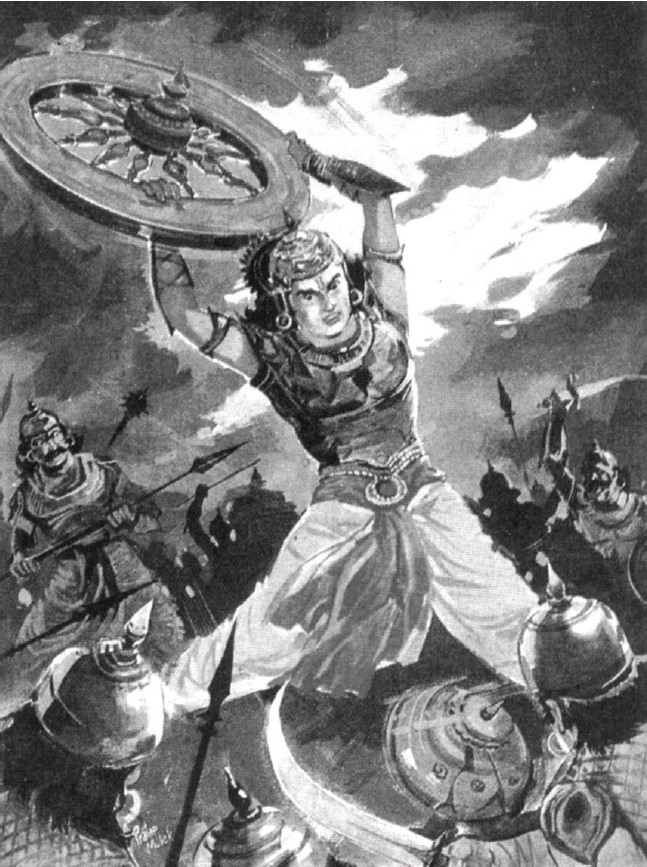
Abhimanyu played a significant role on the Pandava side during the Kurukshetra War. The Kaurava soldiers banded together on the thirteenth day of the battle to build the Chakravyuha in an effort to defeat the Pandavas. With Arjuna diverted to another part of the battlefield, Abhimanyu was the only one who was able to burst through the formation and take on the Kaurava soldiers. At that point, six maharathis (powerful warriors) launched simultaneous attacks on him while violating several kshatriya codes, and he was killed at the age of sixteen.
Abhimanyu's posthumous son Parikshit saved the Kuru lineage from extinction, and became a well known monarch celebrated both in the Mahabharata and the Bhagavata Purana.
Abhimanyu is a Sanskrit name that translates to "one who is with self-respect". It can alternatively be rendered as "heroic" or "fiery". In the Mahabharata, a number of epithets are used to describe Abhimanyu. The following is a list of some of them.
The Mahabharata, a Sanskrit epic from the Indian subcontinent, tells the tale of Abhimanyu. He is related to the epic's hero Arjuna, who was his father, and Krishna, his maternal uncle who is also a key figure in the Mahabharata. The text, which has undergone numerous modifications, edits, and interpolations over many years, is written in classical Sanskrit. The oldest passages in the text that has survived date back to perhaps around 400 BCE. Scholars have attempted to construct a critical edition, relying mostly on a study of the "Bombay" edition, the "Poona" edition, the "Calcutta" edition and the "south Indian" editions of the manuscripts. The most accepted version is one prepared by scholars led by Vishnu Sukthankar at the Bhandarkar Oriental Research Institute, preserved at Kyoto University, Cambridge University and various Indian universities.
The fight between the five Pandavas, and the one hundred Kauravas is at the heart of the narrative of the Mahabharata. The epic's main focus is on their great conflict, known as the Kurukshetra War. The majority of the text describes the various battles between the warriors of two sides during the war. The Mahabharata is divided into eighteen parva or 'books'. Like many other major characters, Abhimanyu is also introduced in the Adi Parva—the first of the 18 parvas. The seventh book's Abhimanyu-badha Parva focuses on Abhimanyu, who is lauded throughout, and has a thorough account of how he died.
The Sambhava Parva of the Adi Parva narrates the reason behind Abhimanyu's birth and his early demise. It was once proposed at a meeting of the gods that Varchas, the son of the lunar god Soma, take on the earthly form of Abhimanyu and aid in the annihilation of evil men. Soma, who was unwilling to give up his son, accepted to their proposal only on the condition that Varchas would come back to him once he (as Abhimanyu) became sixteen.
Abhimanyu was born to Arjuna—the third of the Pandava brothers—and his wife Subhadra, who belonged to the Yadava clan. Arjuna first instructed him in military education before the Pandavas were coerced into giving up their kingdom and banished for thirteen years by their cousin Duryodhana. During this time, Subhadra remained in the kingdom of Dvaraka, the home of her brother, and raised Abhimanyu there with the help of her family. Abhimanyu received military instruction from his uncles Balarama and Krishna as well as his maternal cousin Pradyumna. When the Pandavas returned from exile, Duryodhana refused to give them their kingdom back, which ultimately sparked the Kurukshetra War.
Hub AI
Abhimanyu AI simulator
(@Abhimanyu_simulator)
Abhimanyu
Abhimanyu (Sanskrit: अभिमन्यु, IAST: Abhimanyu) is a character in the ancient Hindu epic Mahābhārata. He was a young and valiant warrior of the Kuru lineage, born to Arjuna—the third Pandava brother—and Subhadra—a Vrishni princess. He was also one of the few individuals, along with his father, who knew the technique to enter the Chakravyuha, a powerful military formation. Abhimanyu was raised by his maternal family in Dvārakā because the Pandavas had been exiled for thirteen years by their cousins, the Kauravas. After his father's return, his marriage was arranged with Uttarā, the princess of the Matsya Kingdom.
Abhimanyu played a significant role on the Pandava side during the Kurukshetra War. The Kaurava soldiers banded together on the thirteenth day of the battle to build the Chakravyuha in an effort to defeat the Pandavas. With Arjuna diverted to another part of the battlefield, Abhimanyu was the only one who was able to burst through the formation and take on the Kaurava soldiers. At that point, six maharathis (powerful warriors) launched simultaneous attacks on him while violating several kshatriya codes, and he was killed at the age of sixteen.
Abhimanyu's posthumous son Parikshit saved the Kuru lineage from extinction, and became a well known monarch celebrated both in the Mahabharata and the Bhagavata Purana.
Abhimanyu is a Sanskrit name that translates to "one who is with self-respect". It can alternatively be rendered as "heroic" or "fiery". In the Mahabharata, a number of epithets are used to describe Abhimanyu. The following is a list of some of them.
The Mahabharata, a Sanskrit epic from the Indian subcontinent, tells the tale of Abhimanyu. He is related to the epic's hero Arjuna, who was his father, and Krishna, his maternal uncle who is also a key figure in the Mahabharata. The text, which has undergone numerous modifications, edits, and interpolations over many years, is written in classical Sanskrit. The oldest passages in the text that has survived date back to perhaps around 400 BCE. Scholars have attempted to construct a critical edition, relying mostly on a study of the "Bombay" edition, the "Poona" edition, the "Calcutta" edition and the "south Indian" editions of the manuscripts. The most accepted version is one prepared by scholars led by Vishnu Sukthankar at the Bhandarkar Oriental Research Institute, preserved at Kyoto University, Cambridge University and various Indian universities.
The fight between the five Pandavas, and the one hundred Kauravas is at the heart of the narrative of the Mahabharata. The epic's main focus is on their great conflict, known as the Kurukshetra War. The majority of the text describes the various battles between the warriors of two sides during the war. The Mahabharata is divided into eighteen parva or 'books'. Like many other major characters, Abhimanyu is also introduced in the Adi Parva—the first of the 18 parvas. The seventh book's Abhimanyu-badha Parva focuses on Abhimanyu, who is lauded throughout, and has a thorough account of how he died.
The Sambhava Parva of the Adi Parva narrates the reason behind Abhimanyu's birth and his early demise. It was once proposed at a meeting of the gods that Varchas, the son of the lunar god Soma, take on the earthly form of Abhimanyu and aid in the annihilation of evil men. Soma, who was unwilling to give up his son, accepted to their proposal only on the condition that Varchas would come back to him once he (as Abhimanyu) became sixteen.
Abhimanyu was born to Arjuna—the third of the Pandava brothers—and his wife Subhadra, who belonged to the Yadava clan. Arjuna first instructed him in military education before the Pandavas were coerced into giving up their kingdom and banished for thirteen years by their cousin Duryodhana. During this time, Subhadra remained in the kingdom of Dvaraka, the home of her brother, and raised Abhimanyu there with the help of her family. Abhimanyu received military instruction from his uncles Balarama and Krishna as well as his maternal cousin Pradyumna. When the Pandavas returned from exile, Duryodhana refused to give them their kingdom back, which ultimately sparked the Kurukshetra War.