Hubbry Logo
ArjunaArjunaMain
Open search
Arjuna
Community hub
Arjuna
logo
8 pages, 0 posts
0 subscribers
Be the first to start a discussion here.
Contribute something
Arjuna
Arjuna
from Wikipedia

Arjuna
Member of Pandavas
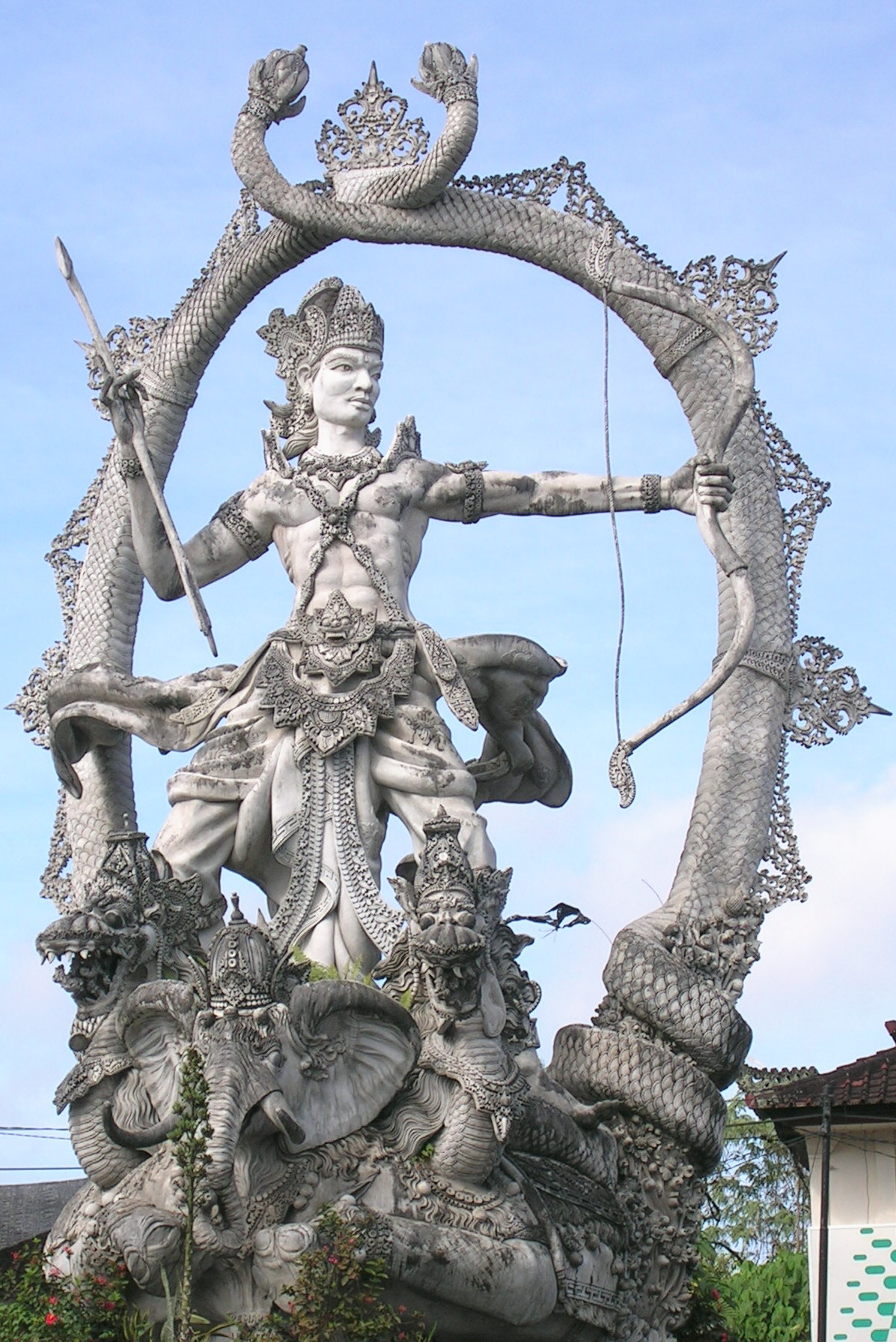
A statue of Arjuna in Bali
Other names
  • Kaunteya
  • Partha
  • Phalguna
  • Jishnu
  • Kiriti
  • Shvetavahana
  • Bibhatsu
  • Vijaya
  • Krishna
  • Savyasachi
  • Dhananjaya
Affiliation
WeaponGandiva (bow) and arrows
BattlesVirata War, Kurukshetra War
Texts
GenderMale
Genealogy
Born
Shatashringa forest
Died
Parents
Siblings (half-brothers)
Spouse
Children
DynastyLunar dynasty

Arjuna (Sanskrit: अर्जुन, IAST: Arjuna) is one of the central characters of the ancient Hindu epic Mahabharata. He is the third oldest of the five Pandava brothers and is widely recognised as the most distinguished among them. He is the son of Indra, the king of the gods, and Kunti, wife of King Pandu of Kuru dynasty—making him a divine-born hero. Arjuna is famed for his extraordinary prowess in archery and mastery over celestial weapons. Throughout the epic, Arjuna sustains a close friendship with his maternal cousin, Krishna, who serves as his spiritual guide.[1]

Arjuna is celebrated for numerous heroic exploits throughout the epic. From an early age, he distinguishes himself as an exceptional student under the tutelage of the revered warrior-sage Drona. In his youth, Arjuna secured the hand of Draupadi, the princess of Panchala, by excelling in an archery competition. Subsequently, during a period of temporary exile prompted by a breach of a fraternal agreement, Arjuna embarked on a journey during which he entered into matrimonial alliances with three princesses: Ulupi, Chitrangada, and Subhadra. From these unions, he fathered four sons: Shrutakarma, Iravan, Babhruvahana and Abhimanyu. Arjuna plays a major role in establishing his elder brother Yudhishthira’s sovereignty, subduing numerous kingdoms and setting fire to the forest of Khandavaprastha. When the Pandavas are deceitfully exiled after being tricked into forfeiting their kingdom by their jealous cousins, the Kauravas, Arjuna vows to kill Karna—a key Kaurava ally and Arjuna's main rival who is later revealed to be his elder half-brother. During exile, Arjuna undertakes a journey to acquire divine weapons and earns the favour of the god Shiva. Beyond his martial prowess, Arjuna was also skilled in music and dance, which enabled him to disguise himself as a eunuch teacher of princess Uttarā of Matsya during his final year of exile. During this period, he also defeats the entire Kuru army.

Before the Kurukshetra War, Arjuna—despite his valour—becomes deeply demoralised upon seeing his own relatives and revered teachers aligned with the opposing Kaurava side and struggled with the idea of killing them. Faced with a profound moral dilemma, he turns to Krishna, who serves as his charioteer. Krishna imparts him the knowledge of the Bhagavad Gita, counseling him on his duty (dharma) as a warrior, karma and liberation through devotion. In this moment of spiritual revelation, Arjuna is granted a vision of Krishna’s cosmic divine form, known as the Vishvarupa.[2] During the war, Arjuna—wielding the celestial bow Gandiva—emerges as a key warrior, responsible for the fall and death of several formidable foes, including Bhishma and Karna. After the war, he assists Yudhishthira in consolidating his empire through Ashvamedha. In this episode, Arjuna is slain by his own son, Babruvahana, but is revived through the intervention of Ulupi. Before the onset of the Kali Yuga, Arjuna performs the last rites of Krishna and other Yadavas. He, along with brothers and Draupadi, then undertakes his final journey to the Himalayas, where he ultimately succumbs. The Kuru dynasty continues through Arjuna's grandson, Parikshit.

Arjuna remains as an epitome of heroism, chivalry, and devotion in the Hindu tradition. He particularly holds a prominent place within the Krishna-centric Vaishnava sect of Hinduism, further elevated by his pivotal role in Bhagavad Gita, which becomes a central scripture of Hindu philosophy. Beyond the Mahabharata, Arjuna is mentioned in early works such as the Aṣṭādhyāyī (likely composed in the 5th or 6th century BCE), which mentions his worship alongside Vasudeva-Krishna,[3] as well as in the Puranas and a multitude of regional and folk traditions across India and Indonesia. His story has been an inspiration for various arts, performances and secondary literature.

Etymology and epithets

[edit]

According to Monier Monier-Williams, the word Arjuna means white, clear or silver.[4] But Arjuna is known by many other names, such as:[5][6]

  • Dhanañjaya (धनञ्जय) – one who conquered wealth and gold
  • Guḍākesha (गुडाकेश) – one who has conquered sleep (the lord of sleep, Gudaka+isha) or one who has abundant hair (Guda-kesha).
  • Vijaya (विजय) – always victorious, invincible and undefeatable
  • Savyasāchī (सव्यसाची)– one who can shoot arrows using the right and the left hand with equal activity; Ambidextrous.[7]
  • Shvetavāhana (श्वेतवाहन) – one with milky white horses mounted to his pure white chariot[8]
  • Bībhatsu (बीभत्सु) – one who always fights wars in a fair, stylish and terrific manner and never does anything horrible in the war
  • Kirīṭī (किरीटी) – one who wears the celestial diadem presented by the King of Gods, Indra[9]
  • Jiṣṇu (जिष्णु) – triumphant, conqueror of enemies[10]
  • Phālguṇa (फाल्गुण) – born under the star Uttara Phalguni (Denebola in Leo)[11]
  • Mahābāhu (महाबाहु) – one with large and strong arms
  • Gāṇḍīvadhārī (गाण्डीवधारी) – holder of a bow named Gandiva
  • Pārtha (पार्थ) – son of Pritha (or Kunti) – after his mother
  • Kaunteya (कौन्तेय) – son of Kunti – after his mother
  • Pāṇḍuputra (पाण्डुपुत्र) – son of Pandu – after his father
  • Pāṇḍava (पाण्डव) – son of Pandu – after his father
  • Kṛṣṇa (कृष्ण) – He who is of dark complexion and conducts great purity.[11]
  • Bṛhannalā (बृहन्नला) – another name assumed by Arjuna for the 13th year in exile

Literary background

[edit]

The story of Arjuna is told in the Mahabharata, one of the Sanskrit epics from the Indian subcontinent. The work is written in Classical Sanskrit and is a composite work of revisions, editing and interpolations over many centuries. The oldest parts in the surviving version of the text may date to near 400 BCE.[12]

The Mahabharata manuscripts exist in numerous versions, wherein the specifics and details of major characters and episodes vary, often significantly. Except for the sections containing the Bhagavad Gita which is remarkably consistent between the numerous manuscripts, the rest of the epic exists in many versions.[13] The differences between the Northern and Southern recensions are particularly significant, with the Southern manuscripts more profuse and longer. Scholars have attempted to construct a critical edition, relying mostly on a study of the "Bombay" edition, the "Poona" edition, the "Calcutta" edition and the "south Indian" editions of the manuscripts. The most accepted version is one prepared by scholars led by Vishnu Sukthankar at the Bhandarkar Oriental Research Institute, preserved at Kyoto University, Cambridge University and various Indian universities.[14]

Biography

[edit]

Birth and early life

[edit]

Arjuna is half-divine by birth, being the son of a human queen and the king of devas (gods).[15] He is one of the five Pandava brothers, who are recognized as the sons of Pandu. However, the Pandavas were each fathered by different devas through the practice of niyoga, a custom in which a revered man may father a child on behalf of another who is deceased or incapable of procreation. Although Pandu was of royal lineage, belonging to the Lunar dynasty and having once ruled as king of the Kuru kingdom, he was rendered impotent due to a curse that would result in his death were he to engage in sexual relations.[16][note 1] To circumvent this curse, Pandu's wife Kunti utilized a sacred mantra granted to her by the sage Durvasa during her maidenhood. This mantra enabled her to invoke various gods to beget children. At Pandu’s behest, she first summoned Dharma and Vayu, resulting in the births of Yudhishthira and Bhima respectively. Each child was born a year apart. Arjuna was the third son, conceived through the invocation of the god Indra, with whom he remains connected throughout his life.[19][20]

The Adi Parva, the first book of the Mahabharata, narrates Arjuna's birth. Prior to Arjuna’s birth, Pandu deduces that he would get the best son from Indra, the Vedic storm-sky god and king of the gods, and performs intense austerities to propitiate, desiring that the king of the gods father his third. Pleased by Pandu's devotion, Indra appears before him and promises to grant a son who will achieve fame across the three worlds. When Kunti invokes Indra through the mantra, Indra, assuming human form, approaches her and begets a son. His birth is marked by the appearance of a significantly greater number of sages and celestial beings—including adityas, rudras, saptarishis, gandharvas, apsaras, etc.—compared to those present at the births of his elder brothers, indicating his far-superior prominence in the narrative. A divine voice praises him and prophesizes his future heroic deeds and names him Arjuna, while drums are heard, and flowers fall from the sky.[21][22][23] Arjuna is born under the auspicious lunar constellation of Phalguna.[24]

Arjuna, along with his two elder brothers and two younger half-brothers, is raised in the forests of Shatashringa (lit. 'hundred peaked mountain') under the care of the resident sages.[25] Following the deaths of Pandu and his second wife, Madri, Kunti returns to Hastinapura—the capital of the Kuru Kingdom—with all five sons. According to the Southern Recension of the Mahabharata, Pandu dies on Arjuna’s birthday.

Education and training

[edit]
The Trial of the Princes by Nandalal Bose, depicting the toy-bird episode; Arjuna and Drona are in the center

In Hastinapura, Arjuna and his brothers are brought up alongside their paternal cousins, the Kauravas. Their early education in archery is entrusted to Kripacharya, the royal preceptor,[26] under the overall supervision of Bhishma, the grand patriarch of the Kuru dynasty.[27] Soon after, the Brahmin warrior Drona is appointed to instruct the princes in the arts of warfare and martial discipline. Upon his first encounter with them, Drona asks that they repay him a favour in the future. While the other princes remain silent, Arjuna alone gives his assent, which deeply pleases Drona. Arjuna quickly distinguishes himself as the most skilled and devoted among Drona’s pupils, eventually becoming his favourite and favoured student.[28] When Arjuna's preeminence is seemingly challenged by a tribal boy Ekalavya, Drona takes steps to ensure that Arjuna remains the greatest of his students.[29][30]

The Mahabharata presents several episodes that affirm Arjuna’s distinction as Drona’s most accomplished and devoted disciple. On one occasion, Drona is seemingly attacked by a crocodile, but Arjuna reacts the fastest, rescuing his teacher. Impressed by his presence of mind and alacrity, Drona rewards him with the Brahmashira, a powerful celestial weapon (astra). This marks the beginning of Arjuna’s acquisition of divine armaments, and it is at this moment that Drona declares, “No other man in the world will be an archer like you”.[31][28] In another episode, Drona tests the perceptiveness and concentration of his pupils through an archery trial. He places an artificial bird atop a tree and asks each student what they perceive. The princes respond by describing both the target and its surroundings, but Drona is dissatisfied with their answers. When Arjuna is questioned, he replies that he sees only the bird’s head—demonstrating absolute focus and singular vision. Drona is pleased, and this refined capacity for perception and precision becomes emblematic of Arjuna’s unique abilities.[32][note 2]

Once Drona is satisfied with the progress of his pupils, he organises a public exhibition of martial skills, attended by members of the royal court, the Kuru clan, and the citizens of Hastinapura. Arjuna makes a dramatic entrance, and Drona publicly proclaims him his favourite disciple. The crowd responds with enthusiastic acclaim, celebrating Arjuna, who demonstrates his command over divine weaponry, manipulating elemental forces such as fire, wind, water, and rain.[28] It is during this event that Karna, who later becomes Arjuna’s principal rival, first challenges him. From this moment onward, the two figures are consistently portrayed as adversaries within the epic’s narrative structure.[34][35][note 3]

The culmination of Arjuna's education is marked by his fulfilment of the teacher’s customary fee (gurudakshina), in accordance with Indian tradition. Drona requests as payment the defeat of his longstanding rival, King Drupada of Panchala. This task is accomplished collectively by the Pandavas—or, in some versions, by all of Drona's pupils. However, the Mahabharata underscores Arjuna’s central role in this achievement, also reminding that he alone, among Drona’s disciples, had pledged in advance to deliver the fee.[35][36]

Youth

[edit]

Following their victory over Drupada, the Adi Parva turns to the episode of The Lacquer House Fire, a decisive moment in a series of escalating efforts by the eldest Kaurava, Duryodhana, to eliminate the Pandavas, whose talents and growing influence provoke deep resentment. In this instance, Yudhishthira discerns a veiled warning from their uncle Vidura, alerting him to a murderous plot. When the house is set ablaze, Bhima takes the lead in ensuring their survival by carrying his brothers and mother to safety through a hidden passage. Author Ruth Cecily Katz notes that Arjuna plays no notable role in this sequence, which stands in contrast to the heroism he displays elsewhere. Nevertheless, the event acts as a narrative pivot: it compels the Pandavas into exile, living in concealment under the guise of ascetic Brahmins, and paves the way for Arjuna's forthcoming feats in bride-winning that dominate the later portions of the first book.[37][38]

The Pandava brothers and their mother, Kunti, reside in concealment in a village named Ekachakra disguised as Brahmins, and lead a quiet life in exile. Upon the advice of the sage Vyasa, they decide to go to the capital of Panchala. Arjuna’s first significant challenge as a fully initiated warrior occurs during this journey when he confronts Chitraratha, a hostile gandharva—a celestial being—who poses a threat to the Pandavas. In the course of this battle, Arjuna employs the Agneyastra, the divine missile associated with fire, to destroy his opponent’s chariot. This marks the first display of Arjuna’s martial prowess in his adult life. In recognition of his defeat, the subdued gandharva offers gifts to the five brothers, bestowing upon Arjuna the particular boon of visionary insight—a faculty in which Arjuna has already shown distinction.[39]

Svayamvara and marriage to Draupadi

[edit]
Arjuna piercing the eye of the fish as depicted in Chennakesava Temple.

Arjuna is central in the episode of svayamvara—or “bridegroom choice”—of Draupadi, the epic's heroine. Of all Arjuna’s marriages, his union with Draupadi is the most consequential for the heroic structure of the epic. It is not only the first among his four marriages but also foundational to the epic’s central conflict. The event also features first encounter between Arjuna and Krishna, who is the son of Vasudeva, Kunti's brother, making him the maternal cousin of the Pandavas.[40][41]

King Drupada, Draupadi’s father, designs the challenge for the syavamvara specifically with Arjuna in mind, having developed a strong admiration for the warrior after being defeated by him in battle. Determined to obtain Arjuna as a son-in-law, Drupada tailors the test to suit his extraordinary skills. The svayamvara features a ceremonial archery contest in which barons must perform a feat of bow-bending, a trial commonly found in Indo-European heroic marriage traditions.[40] Although the details of the contest vary across different recensions, all versions feature a target, often described as a suspended toy fish, which the suitor must strike. In more elaborate versions, which add a further degree of difficulty, the suitor is required to hit the eye of a rotating toy fish, while aiming only at its reflection in a vessel of water (or mirror) below.[42] The Pandavas attend Draupadi’s svayamvara still in disguise. Arjuna, like the other assembled nobles, is instantly captivated by the divine beauty of Draupadi at first sight. Krishna, who is present at the event as a spectator and sympathetic to the Pandavas, recognizes Arjuna. Arjuna, still in his assumed guise, successfully completes the archery challenge by striking the target with five arrows—an accomplishment in which all other princes, including renowned warriors like Duryodhana and Karna, had failed.[41][40]

Illustration of Draupadi garlanding Arjuna, c. 1899

This outcome provokes anger among the assembled princes, particularly the Kshatriyas who perceive the svayamvara to have been won by an unassuming brahmana. Despite his disguise, Arjuna’s exceptional skill makes it evident that he is no ordinary Brahmin. When challenged and asked to reveal his identity, Arjuna responds ambiguously, declaring only that he is “the best among fighters”. Karna, upon realizing that the victor is a Brahmin—or so he believes—chooses not to engage him further, stating that it would be improper to fight a Brahmin.[41] When Arjuna returns with Draupadi, Kunti—unaware of what exactly he has brought—unintentionally instructs her sons to share whatever has been obtained. Though spoken in ignorance, her words are interpreted as a binding directive. The situation is further complicated by Arjuna’s own refusal to marry Draupadi before his elder brother. Although Yudhishthira insists that Arjuna, having won her in the svayamvara, ought to be her husband, Arjuna declines on the grounds of seniority. This deference to fraternal hierarchy reinforces the Arjuna’ ethos of respect. Yudhishthira finally decides that she shall become the wife of all five brothers, to which they all agree. Later at the palace, Drupada joyfully welcomes the Pandavas, Kunti, and Draupadi, delighted that Arjuna has won her hand and promptly begins wedding preparations. However, upon learning she is to marry all five brothers, he vehemently objects. Vyasa intervenes, revealing that the Pandavas are partial incarnations of five Indras—Indra here being a divine office—and Draupadi is the incarnation of Shri, destined to be their common wife. After much reasoning, Drupada finally agrees, and Draupadi's wedding with each of the Pandavas is performed on successive days, with Arjuna's taking place on the third day.[43][44]

Although Draupadi becomes the wife of all five Pandava brothers, Arjuna occupies a distinct position as her principal husband. This status is supported by textual references within the Mahābhārata that suggest Draupadi favours Arjuna and holds a particular affection for him. From their union, Arjuna fathers a son—named in various sources as either Shrutakriti or Shrutakarman—who is one of the five sons Draupadi bears, one by each of the Pandavas.[45]

Pilgrimage

[edit]

After their marriage to Draupadi and their survival revealed, the Pandavas are granted half the kingdom by the Kuru King Dhritarashtra.[17][18] They then establish themselves at Khandavaprastha, where they oversee the construction of a great fortified city. This settlement is subsequently identified as Indraprastha, named in honour of Arjuna’s divine father, Indra. The brothers agree upon a code of conduct concerning Draupadi: none may intrude when she is alone with another. If this rule is breached, the offender must undergo a period of exile lasting one year—or twelve years, according to certain translations[46]—during which he is required to remain celibate. Arjuna is the one who ultimately violates the agreement—unintentionally and for a justifiable cause. He enters his brother’s chamber to retrieve weapons, intending to defend the cattle of a Brahmin under threat. Although Yudhishthira offers to exempt him from the exile, Arjuna declines, choosing instead to honour the commitment. However, this vow of celibacy is broken as Arjuna marries three women during the course of his journey.[47]

Encounter with Ulupi

[edit]
Arjuna encounters Ulupi, watercolour illustration, 1913

Upon leaving, Arjuna goes into pilgrimage, narrated in the Adi Parva. He eventually settles at a sacred site, Ganga-dvara, on the banks of river Ganga, where he makes offerings to his ancestors. While preparing to perform a fire ritual on the riverbank, he is suddenly seized during a bath and drawn beneath the waters by a Nāga (serpentine divine being) woman named Ulupi, who has developed a strong infatuation upon seeing him bathing in the river. In the enchanted underwater realm, Arjuna discovers a palace complete with a consecrated space where sacred fires are maintained, and it is here that he conducts a fire ceremony, or agnikarya. Ulupi, taking her human form, introduces herself as the daughter of the Nāga king Kauravya and expresses her longing for Arjuna, imploring him to have sex with her. Arjuna initially hesitates, determined to honour his vow of celibacy and explains his condition. However, Ulupi contends that his vow pertains solely to Draupadi, and declares that she would rather die than be refused. Invoking his role as protector of those in distress, Arjuna consents. Arjuna remains with Ulupi for a single night, fulfilling her desires, before continuing on his journey. Although no child is mentioned at the time of their encounter, it is later revealed that Ulupi had conceived and given birth to a son, Iravat, after Arjuna's departure. Further, Ulupi is later revealed to be a widow, when she sees first encounters Arjuna.[48][46][49]

Ulupi is not called Arjuna's "wife" until the fourteenth book of the epic, Ashvamedhika Parva, due to which few consider it as a paramour affair.[50] However, scholars state that their union is legitimised through what is traditionally identified as a gandharva marriage—a private, mutual agreement without formal rituals.[48]

Marriage to Chitrangada and tour to the south

[edit]

Arjuna continues his journey eastward, undertaking a pilgrimage to various sacred sites. In the course of his travels, he arrives at Manipura (also called Manalura), the capital of King Chitravahana. There, he becomes captivated by Chitrangada, the king’s only child. As a putrika—a daughter designated to carry forward the royal lineage through her own offspring—she is raised in the manner of a son. Arjuna formally approaches King Chitravahana to request her hand in marriage. The king consents, but only on the condition that any son born of the union must remain in Manipura to succeed the throne and preserve the matrilineal succession. This stipulation, whereby the offspring is effectively offered as the bride-price, renders the marriage an asura-type. Arjuna accepts the condition without protest. He resides in Manipura for a period described as three months—or, in the versions of the twelve-year exile narrative, three years—before continuing his journey southwards.[48][51][52]

During his journey to the south, Arjuna encounters five sacred waters inhabited by cursed crocodiles that frighten away ascetics. Ignoring warnings, he enters one of the waters, and is attacked by a crocodile, which he overpowers and drags to the shore. The creature transforms into Varga, an apsara (celestial nymph), who reveals that she and four other apsaras—Saurabhi, Samichi, Budabuda and Lata—had been cursed to become crocodiles for attempting to seduce a young ascetic. Grateful for her release, Varga asks Arjuna to free her companions. He obliges, defeating the remaining crocodiles and liberating the Apsaras.[52] He then revisits Manipura and is reunited with Chitrangada and their son, Babhruvahana. However, he neither attempts to settle there permanently nor seeks to take Chitrangada with him upon his departure.[48][51][52]

Marriage to Subhadra

[edit]
Painting by Raja Ravi Varma based on the Southern version of the story where Arjuna courts Subhadra before their elopement (see note).

Arjuna's pilgrimage goes westwards, eventually reaching the site of Prabhasa. Krishna, upon learning of Arjuna’s arrival, travels to Prabhasa to meet him. The two companions develop a strong bond.[53] Krishna then invites Arjuna to his capital Dvaraka. During a festival at Mount Raivataka, Arjuna sees Subhadra, the princess of the Vrishnis (a clan of Yadava lineage) who is also Krishna’s sister, and falls in love at first sight. Sensing his feelings, Krishna offers to intercede with their father but ultimately suggests abduction, arguing that a svayamvara would be uncertain in outcome. With Yudhishthira’s consent through messengers, Arjuna feigns a hunting trip on a chariot, seizes Subhadra on the Dwaraka–Raivataka road, and drives towards Indraprastha.[48][51][52][note 4] The Vrishnis convene in response. Balarama advocates war, but Krishna defends Arjuna’s conduct, emphasising the honour shown to their family and the political advantages of the alliance. He argues that Arjuna, recognising both the Vrishnis’ lack of greed for bride-price and the unpredictability of a bridegroom-choice ceremony, chose the most respectful course available. Krishna’s reasoning prevails, and Arjuna is invited back to Dvaraka for a formal wedding ceremony.[51][52]

The marriage with Subhadra is categorised as a rakshasa or capture-marriage—a form associated with heroic traditions across Indo-European literature. Arjuna spends the remaining period of his exile at Dvaraka, following which he returns to Indraprastha. While his brothers welcome him with his new bride, Draupadi reacts with jealousy. A reconciliation is achieved when Subhadra, on Arjuna's advice, wins over her with humility. Abhimanyu, described as Arjuna's favourite son, is born to Subhadra at Indraprastha. Although not central to the heroic arc in the way his marriage to Draupadi is, Arjuna’s union with Subhadra is of lasting importance, providing a key genealogical link in the epic’s structure, as the Kuru dynasty survives through Abhimanyu's descendants.[48]

Burning of Khandava Forest

[edit]
Burning of Khandava forest

One of the most enigmatic and controversial episodes in Arjuna's life is the burning of the Khandava Forest, recounted at the end of the Adi Parva. By this time, Arjuna and Krishna are close companions, often referred to collectively as "the two Krishnas". While resting along the Yamuna in the company of their wives, they are approached by a brahmin who is later revealed to be Agni, the god of fire, in disguise. Agni seeks their aid in consuming the Khandava Forest—a task he has repeatedly failed to complete due to the interference of Indra, who extinguishes the flames with rain, as the forest is inhabited by Takshaka, a Naga chieftain and Indra’s close ally. Bound by the kshatriya code to honour a brahmin's request, Arjuna and Krishna agree to help Agni regardless of the consequences. As a reward, Agni instructs the water-god Varuna to bestow upon Arjuna the celestial bow Gandiva, twin quivers of inexhaustible arrows, a divine chariot, and celestial steeds. Once committed, the two proceed with ruthless efficiency. As Agni sets the forest alight, Arjuna and Krishna slaughter all fleeing creatures, including demons, Asuras, Nagas, birds and other animals, ensuring none escape the inferno. Takshaka is notably absent during the massacre, but his wife is killed and his son, Ashvasena, narrowly escapes—vowing vengeance against Arjuna. When Indra arrives, joined by other Vedic deities, Arjuna repels them all, including his own divine father. The gods retreat—having been commanded by a mysterious celestial voice to stand down and observe, while also revealing that Arjuna and Krishna are incarnations of Nara and Narayana. After six days of relentless destruction, Indra promises Arjuna further divine weaponry in gratitude.[55]

Alf Hiltebeitel describes the episode as "one of the strangest scenes of the epic".[53] Katz notes its deep ethical dissonance with the overarching philosophy of the Mahabharata. The indiscriminate slaughter of innocents, and the blatant disregard for ahimsa (nonviolence) and the rules of war, sharply contrast with the epic’s didactic tone. Krishna and Arjuna, laughing as they destroy every creature in their path, evoke a frenzied, berserker-like ideal more aligned with archaic heroism than with the dharma-centred values often upheld elsewhere in the text. The episode is thought to preserve an older stratum of mythic storytelling—parallel to traditions found in the Iliad or the Epic of Gilgamesh—where absolute, even terrifying violence is valorised when enacted in service of a divine or cosmic imperative.

The game of dice

[edit]

As heir to the lordship of Kurukshetra, Yudhishthira had attracted the unwelcome attention of his Kaurava cousin, Duryodhana, who sought the throne.[56] The royal consecration involved an elaborate Vedic ceremony called rajasuya which extended over several years and included the playing of a ritualised game of dice.[57] This particular game, described as "Indian literature's most notorious dice game" by Williams,[58] was rigged by Duryodhana, causing Yudhishthira to gamble and lose everything, including his kingdom and his shared wife Draupadi.[59][60] He and his brothers only obtained their freedom because Draupadi offered herself to the Kauravas in exchange. She was then humiliated by them so much that revenge for her treatment became a further motivation for the Pandavas in the rivalry with their cousins.[59] During her humiliation, Karna called her an unchaste for marrying five men. This led Arjuna to take a vow of killing Karna.[61] The brothers, including Arjuna, were forced into a 12-year exile, to be followed by a year living incognito if Yudhishthira was to regain his kingdom.[60]

Exile of the Pandavas

[edit]

While in this exile, Arjuna visited the Himalayas to get celestial weapons that he would be able to use against the Kauravas. Thereafter, he honed his battle skills with a visit to Swarga, the heaven of Indra, where he emerged victorious in a battle with the Daityas and also fought for Indra, his spiritual father, with the Gandiva.[19]

After the battle at Khandava, Indra had promised Arjuna to give him all his weapons as a boon for matching him in battle with the requirement that Shiva is pleased with him. During the exile, following the advice of Krishna to go on meditation or tapasya to attain this divine weapon, Arjuna left his brothers for a penance on Indrakeeladri Hill (Vijayawada, Andhra Pradesh).[62]

When Arjuna was in deep meditation, a wild boar ran towards him. He realized it and took out an arrow and shot it at the boar. But, another arrow had already pierced the boar. Arjuna was furious and he saw a hunter there. He confronted the hunter and they engaged in a fight. After hours of fighting, Arjuna was not able to defeat him and realized that the hunter was Shiva. Shiva was pleased and took his real form. He gave him Pashupatastra and told that the boar was Indra as he wanted to test Arjuna. After gaining the weapon, Indra took him to heaven and gave him many weapons.[62][63]

During his exile, Arjuna was invited to the palace of Indra, his father. An apsara named Urvashi was impressed and attracted to Arjuna's look and talent so she expresses her love in front of him. But Arjuna did not have any intentions of making love to Urvashi. Instead, he called her "mother". Because once Urvashi was the wife of King Pururavas the ancestor of Kuru dynasty. Urvashi felt insulted and cursed Arjuna that he will be a eunuch for the rest of his life. Later on Indra's request, Urvashi curtailed the curse to a period of one year.[64][65]

At Matsya Kingdom

[edit]
Arjuna Sets Kama's Arrow Alight, folio from the Razmnama (Book of War)

Arjuna spent the last year of exile as a eunuch named Brihannala at King Virata’s Matsya Kingdom. He taught singing and dancing to the princess Uttarā. After Kichaka humiliated and tried to molest Draupadi, Arjuna consoled her and Bhima killed Kichaka. When Duryodhana and his army attacked Matsya, Uttara, Uttarā's brother, with Brihannala as his charioteer went to the army. Later that day, the year of Agyatavasa was over. Arjuna took Uttara away from the army to the forest where he had kept his divine bow, Gandiva, and revealed his identity to Uttara. He then fought Kaurava army and single-handedly defeated them including warriors like Bheeshma, Drona, Ashwatthama, Karna, Duryodhana etc. When Arjuna's identity was revealed to the court, Uttarā was married to Arjuna's son Abhimanyu.[64][66]

Kurukshetra War

[edit]

Bhagavat Gita

[edit]

The Bhagavad Gita is a book within the Mahabharata that depicts a dialogue between Arjuna and Krishna immediately prior to the commencement of the Kurukshetra War between the Pandavas and Kauravas. According to Richard H. Davis,

The conversation deals with the moral propriety of the war and much else as well. The Gita begins with Arjuna in confusion and despair, dropping his weapons; it ends with Arjuna picking up his bow, all doubts resolved and ready for battle.[67]

In the war

[edit]

Arjuna was a key warrior in Pandava's victory in the Kurukshetra. Arjuna's prowess as an archer was demonstrated by his success in slaying numerous warriors, including his own elder brother Karna and grandfather Bhishma.

  • Fall of Bheeshma: On the 10th day of battle, Arjuna accompanied Shikhandi on the latter's chariot and they faced Bheeshma who did not fire arrows at Shikhandi but battles Arjuna. He was then felled in battle by Arjuna, pierced by innumerable arrows, piercing his entire body.[64][68]
  • Death of Bhagadatta: On the 12th day of the war, Arjuna killed the powerful king of Pragjyotisha Bhagadatta, along with his mighty elephant Supratika.[69]
  • Death of Jayadratha: Arjuna learns that Jayadratha blocked the other four Pandavas, at the entrance of Chakravyuha, due to which Abhimanyu entered alone and was killed unfairly by multiple Kaurava warriors on the 13th day of the war. Arjuna vowed to kill him the very next day before sunset, failing which he would kill himself by jumping into a fire. Arjuna pierced into the Kaurava army on the 14th day, killing seven akshouhinis of their army, and finally beheaded Jayadratha on the 14th day of the war.
  • Death of Sudakshina: He killed Sudakshina the king of Kambojas on the 14th day using Indrastra killing him and a large part of his army. He also killed Shrutayu, Ashrutayu, Niyutayu, Dirghayu, Vinda, and Anuvinda during his quest to kill Jayadratha.
  • Death of Susharma: Arjuna on the 18th day killed King Susharma of Trigarta Kingdom, the main Kaurava ally.
  • Death of Karna: The much anticipated battle between Arjuna and Karna took place on the 17th day of war. The battle continued fiercely and Arjuna killed Karna by using Anjalikastra.[64][70]

Later life and death

[edit]

After the Kurukshetra War, Yudhishthira appointed Arjuna as the Prime Minister of Hastinapur. Yudhishthira performed Ashvamedha. Arjuna followed the horse to the land of Manipura and encountered Babhruvahana, one of his sons. None of them knew one another. Babhruvahana asked Arjuna to fight and injured his father during the battle. Chitrāngadā came to the battlefield and revealed that Arjuna was her husband and Babhruvahana's father. Ulupi, the second wife of Arjuna, revived Arjuna using a celestial gem called Nagamani.[71]

After Krishna left his mortal body, Arjuna took the remaining citizens of Dwaraka to Indraprastha. On the way, they were attacked by a group of bandits. Arjuna desisted from fighting seeing the law of time.

Upon the onset of the Kali Yuga, and acting on the advice of Vyasa, Arjuna and other Pandavas retired, leaving the throne to Parikshit (Arjuna's grandson and Abhimanyu's son). Giving up all their belongings and ties, the Pandavas, accompanied by a dog, made their final journey of pilgrimage to the Himalayas. The listener of the Mahabharata is Janamejaya, Parikshit's son and Arjuna's great-grandson.[72]

Outside Indian subcontinent

[edit]

Indonesia

[edit]
Krishna and Arjuna statue in Bali, Indonesia

In the Indonesian archipelago, the figure of Arjuna is also known and has been famous for a long time. Arjuna especially became popular in the areas of Java, Bali, Madura and Lombok. In Java and later in Bali, Arjuna became the main character in several kakawin, such as Kakawin Arjunawiwāha, Kakawin Pārthayajña, and Kakawin Pārthāyana (also known as Kakawin Subhadrawiwāha. In addition, Arjuna is also found in several temple reliefs on the island of Java, for example the Surawana temple.

Wayang story

[edit]
Arjuna wayang (puppetry) in Indonesian culture, especially Java

Arjuna is a well-known figure in the world of wayang (Indonesian puppetry) in Javanese culture. Some of the characteristics of the wayang version of Arjuna may be different from that of Arjuna in the Indian version of the Mahābhārata book in Sanskrit. In the world of puppetry, Arjuna is described as a knight who likes to travel, meditate, and learn. Apart from being a student of Resi Drona at Padepokan Sukalima, he is also a student of Resi Padmanaba from the Untarayana Hermitage. Arjuna was a Brahman in Goa Mintaraga, with the title Bagawan Ciptaning. He was made the superior knight of the gods to destroy Prabu Niwatakawaca, the giant king of the Manimantaka country. For his services, Arjuna was crowned king in Dewa Indra's heaven, with the title King Karitin and get the gift of magical heirlooms from the gods, including: Gendewa (from Bhatara Indra), Ardadadali Arrow (from Bhatara Kuwera), Cundamanik Arrow (from Bhatara Narada). After the Bharatayuddha war, Arjuna became king in Banakeling State, the former Jayadrata kingdom.

Painting of Bharatayudha war

Arjuna has a smart and clever nature, is quiet, conscientious, polite, brave and likes to protect the weak. He leads the Madukara Duchy, within the territory of the state of Amarta. For the older generation of Java, he was the embodiment of a whole man. Very different from Yudhisthira, he really enjoyed life in the world. His love adventures always amaze the Javanese, but he is different from Don Juan who always chases women. It is said that Arjuna was so refined and handsome that princesses, as well as the ladies-in-waiting, would immediately offer themselves. They are the ones who get the honor, not Arjuna. He is very different from Wrekudara. He displayed a graceful body and a gentleness that was appreciated by the Javanese of all generations.

Arjuna also has other powerful heirlooms, among others: The Kiai Kalanadah Keris was given to Gatotkaca when he married Dewi Gowa (Arjuna's son), Sangkali Arrow (from Resi Drona), Candranila Arrow, Sirsha Arrow, Sarotama Kiai Arrow, Pasupati Arrow (from Batara Guru), Panah Naracabala, Arrow Ardhadhedhali, Keris Kiai Baruna, Keris Pulanggeni (given to Abhimanyu), Terompet Dewanata, Cupu filled with Jayengkaton oil (given by Bagawan Wilawuk from Pringcendani hermitage) and Ciptawilaha Horse with Kiai Pamuk's whip. Arjuna also has clothes that symbolize greatness, namely Kampuh or Limarsawo Cloth, Limarkatanggi Belt, Minangkara Gelung, Candrakanta Necklace and Mustika Ampal Ring (formerly belonging to King Ekalaya, the king of the Paranggelung state).[73][74]

[edit]

References

[edit]

Bibliography

[edit]
[edit]
Revisions and contributorsEdit on WikipediaRead on Wikipedia
from Grokipedia
Arjuna is the archetypal hero of the ancient Indian epic Mahabharata, depicted as the third of the five Pandava brothers, a peerless archer, and a warrior prince whose moral dilemmas and divine guidance form the narrative core of the text. As the son of the goddess Kunti and the thunder god Indra, Arjuna embodies ideals of courage, skill, and devotion in Hindu tradition, most notably through his profound dialogue with Krishna in the Bhagavad Gita, where he grapples with the ethics of warfare against kin. His exploits, including mastering celestial weapons and leading the Pandavas to victory in the Kurukshetra War, underscore themes of dharma (duty) and self-realization that resonate across Hindu philosophy. Born under extraordinary circumstances due to a curse preventing his nominal father King from fathering children naturally, Arjuna was conceived when invoked , making him a endowed with martial prowess from birth. He grew up in Hastinapura alongside his brothers—Yudhishthira, , , and —under the tutelage of gurus like , who trained him in archery and the arts of war, recognizing his unparalleled talent. Arjuna's signature weapon, the divine bow gifted by the fire god , along with an inexhaustible quiver, symbolized his supremacy as a capable of striking with either hand. Throughout the Mahabharata, Arjuna's life unfolds through a series of trials that test his valor and loyalty, beginning with his victory at Draupadi's swayamvara, where he won her hand in marriage through a feat of , sharing her as a common wife among the . Later, alongside Krishna, he burned the to appease , acquiring divine weapons in the process. Exiled after the lost a rigged dice game to the Kauravas, Arjuna undertook a pilgrimage and acquired further divine boons. His deep bond with Krishna, an incarnation of , evolved from friendship to spiritual mentorship, culminating in the on the battlefield of , where Arjuna's hesitation to fight his relatives prompted Krishna's teachings on selfless action and the nature of the soul. This episode portrays Arjuna as a figure of vulnerability—a supreme warrior seeking guidance amid ethical turmoil—highlighting through divine counsel akin to modern therapeutic dialogue. Arjuna's role in the 18-day was pivotal, as he felled key adversaries like and , securing the ' triumph and restoring to the throne. Post-war, he continued as a guardian of the realm under Yudhishthira's rule, though his later years involved further quests and reflections on life's transience. In Hindu culture, Arjuna represents the ideal devotee and warrior, inspiring devotion () and ethical inquiry; his story in the and Gita remains a cornerstone for understanding karma, duty, and spiritual enlightenment.

Background

Etymology and epithets

The name Arjuna derives from the adjective arjuna, which means "white," "clear," or "shining," as defined in classical lexicons, and is often linked to the character's fair complexion and symbolic purity in epic narratives. This etymology underscores Arjuna's portrayal as a luminous and unblemished hero, reflecting ideals of moral clarity and divine favor in ancient . Arjuna bears numerous epithets that encapsulate his lineage, prowess, and attributes, each rooted in specific Sanskrit terms and tied to his exploits. Partha, meaning "son of Pritha" (his mother Kunti's maiden name), highlights his maternal heritage and Pandava identity. Dhananjaya, from dhana (wealth) and jaya (victory), signifies his role as a conqueror of riches, particularly during campaigns like the Rajasuya sacrifice where he subdued kingdoms to amass tributes. Kiriti, derived from kirita (diadem or crown), refers to the celestial crown bestowed upon him by Indra, symbolizing his exalted warrior status and divine endorsements. Shvetavahana, combining shveta (white) and vahana (chariot or horses), denotes his chariot drawn by white horses, a distinctive feature that marked his battlefield presence and agility. Among these, epithets like Gudakesha—from gudaka (sleep or ) and isha ( or conqueror)—emphasize Arjuna's vigilance and spiritual discipline, portraying him as one who masters drowsiness and through unwavering focus and yogic practice. This title, frequently used in the , ties to his ability to remain alert amid trials, reinforcing themes of self-control and enlightenment in his character arc. Such descriptors collectively illustrate how Arjuna's names function as multifaceted symbols, blending personal traits with narrative achievements to deepen his heroic .

Literary background

Arjuna is primarily depicted in the ancient Indian epic Mahabharata as the third of the five Pandava brothers, renowned for his unparalleled archery skills and as the intimate companion of Krishna, who serves as his charioteer and philosophical guide during the Kurukshetra war. This portrayal establishes Arjuna as a central heroic figure whose exploits drive much of the narrative, emphasizing themes of duty, valor, and divine intervention. In the Harivamsa, an appendix to the Mahabharata, Arjuna's role expands through his connections to Krishna's divine lineage, portraying him as part of the broader cosmic drama involving the Yadavas and Pandavas. Similarly, the Bhagavata Purana references Arjuna within the context of the Pandavas' lineage from the lunar dynasty, highlighting his involvement in key events tied to Krishna's earthly manifestations. In Puranic literature, such as the , Arjuna is explicitly identified as the human incarnation of Nara, the eternal ascetic companion of (Vishnu's form as Krishna), underscoring their inseparable bond as predestined allies in upholding . This divine linkage elevates Arjuna beyond a mere , positioning him as a partial avatar in the cosmic order. The 's critical edition reveals Arjuna's character development from a formidable driven by prowess and ambition to a reflective devotee seeking spiritual , particularly through his on the battlefield resolved by Krishna's teachings in the . This evolution reflects an integration of martial excellence with ethical , where Arjuna grapples with moral dilemmas, transitioning from doubt and inaction to resolute devotion. Scholars note that certain passages enhancing this philosophical arc, such as expanded dialogues on devotion, may stem from later interpolations added during the epic's textual growth, as identified in the Bhandarkar Oriental Research Institute's edition. Epithets like Phalguna serve as narrative devices to invoke these multifaceted traits, reinforcing his heroic yet humble persona. Composed over centuries from circa 400 BCE to 400 CE, the Mahabharata and associated texts like the Harivamsa originated in oral bardic traditions, allowing Arjuna's persona to evolve through regional retellings that blended heroic lore with emerging Vaishnava theology. This multifaceted portrayal, influenced by pre-existing Vedic motifs of divine companionship, transformed Arjuna into a philosophical archetype embodying the tension between action and surrender.

Early Life

Birth and early life

Arjuna was conceived through the invocation of the storm god by his mother , utilizing a divine boon granted to her by the sage , as her husband was unable to sire children due to a curse from sage . This made Arjuna the divine son of and the third brother, following (son of ) and (son of ). Born in a secluded forest hermitage on the slopes of the Satasringa mountain, his arrival was marked by celestial portents, including the sounds of divine music and a heavenly voice proclaiming his future prowess as a warrior unmatched in battle and capable of performing the sacrifice. named him Arjuna, meaning "bright" or "shining," reflecting his radiant complexion and innate vigor from birth. Following the death of and —Kunti's co-wife and mother to the twins and —the young , including the infant Arjuna, were brought from the forest to the royal palace in Hastinapura by , under the protection of their grandfather and uncle . There, amid the Kuru dynasty's growing internal rivalries between the and their hundred step-cousins, the Kauravas sired by and Gandhari, Arjuna grew up in a harmonious bond with his four brothers, sharing in their upbringing under 's vigilant care. The family dynamics were tense from the outset, as the Kauravas, led by the envious , viewed the ' exceptional qualities with jealousy, fostering an atmosphere of subtle antagonism within the palace. 's absence after her sati left as the primary maternal figure, guiding the brothers through these early years marked by the dynasty's power struggles. In his early childhood, Arjuna displayed initial signs of extraordinary talent, particularly an innate aptitude for that set him apart even before formal instruction, often playing with toy bows alongside his brothers in the palace gardens. The ' survival was threatened early on by schemes, including an attempt to poison during a river outing, where administered a potent in his food; not only survived by digesting the poison but gained enhanced strength after being revived by Naga serpents in the . This incident underscored the perilous environment of their upbringing, yet the brothers remained united, their close sibling ties providing resilience against the Kuru court's intrigues. Arjuna's divine parentage from later influenced boons such as access to celestial weapons.

Education and training

Arjuna's formal in began under the tutelage of Kripacharya in Hastinapura, where the and princes received instruction in , , and warfare. Kripacharya, a skilled warrior of divine origin, emphasized discipline and basic combat techniques, and Arjuna quickly distinguished himself through his natural aptitude and dedication, surpassing many of his peers in precision and agility. Following this foundational training, Arjuna apprenticed under , the renowned warrior invited by to elevate the princes' skills. Drona provided advanced lessons in celestial and earthly weapons, including mounted combat, multi-weapon handling, and strategies for engaging multiple foes. A defining moment came during a test of focus, where Drona suspended a wooden from a and instructed his pupils to aim at its eye while describing what they saw; Arjuna alone perceived only the target, declaring, "I see the , and only the ," before striking it flawlessly with an . This feat earned him Drona's highest regard, establishing him as the preceptor's favorite disciple and affirming his unparalleled concentration. Under Drona's guidance, Arjuna acquired potent divine astras, such as the , a weapon of immense destructive power invoked through sacred mantras. Drona imparted the knowledge of its invocation and retraction exclusively to Arjuna, along with strict ethical directives: it was not to be used against ordinary humans or inferior warriors, as its misuse could devastate the world, and Arjuna vowed to wield it responsibly. These teachings underscored the balance between martial prowess and moral restraint. During the grand tournament showcasing the princes' skills, Arjuna's rivalry with emerged prominently, foreshadowing their lifelong enmity. As Arjuna demonstrated extraordinary feats with divine weapons, , a skilled outsider, interrupted to match him for , challenging Arjuna to a that highlighted their equal prowess but was halted by protocol, igniting tensions among . This confrontation during training intensified 's resentment toward Arjuna, rooted in perceived favoritism and social barriers.

Youth and early adventures

Following the completion of his training under , Arjuna participated in a grand organized by his in Hastinapura to demonstrate the martial prowess of the Kuru princes. The event, held on an auspicious day in a specially prepared arena adorned with gold and jewels, drew King , , , and crowds of citizens. Arjuna, as the preeminent archer among the , showcased unparalleled skills in wielding various weapons, including feats of that left spectators in awe, with exclamations of admiration echoing through the assembly. His demonstrations highlighted his superiority over his peers, including the Kauravas, establishing his reputation as an exceptional warrior from a young age. During the tournament, , a skilled archer of unknown royal lineage who had trained under , entered the arena and directly challenged Arjuna to a after the latter's display. Eager to prove himself, Karna matched Arjuna's feats with equal dexterity, creating a tense rivalry that captivated the onlookers. However, intervened, stipulating that Karna must declare his lineage and bring a suitable challenger, as only equals could compete, which temporarily halted the confrontation and underscored the protocols of combat. This encounter marked the beginning of a lifelong antagonism between Arjuna and Karna, while affirming Arjuna's preeminence among the youth. In these early years, Arjuna also began forging key familial bonds that would shape his future alliances, notably with his cousin Krishna, son of and thus related through Arjuna's mother , who was Vasudeva's sister. As cousins from the and Kuru lineages, their relationship provided Arjuna with an early foundation of support and mutual respect, laying the groundwork for Krishna's role as a trusted advisor and ally. These connections, combined with his protective instincts toward his mother and brothers during their subsequent trials, demonstrated Arjuna's emerging leadership and commitment to family honor.

Marriages and Family

Svayamvara and marriage to Draupadi

The swayamvara of Draupadi, the princess of Panchala, was organized by her father, King Drupada, in an elaborate amphitheatre near his capital to select a suitable husband from among the assembled kings and princes. Draupadi, also known as Krishnaa or Yajnaseni, had been born miraculously from the sacrificial fire during one of Drupada's yajnas, emerging fully formed without a human mother, symbolizing her divine origin and exceptional status. The contest required participants to string a exceptionally stiff bow and then shoot arrows to hit a specific mark suspended above, a task designed to test superior archery skills. The brothers, living incognito after their escape from the lac house, attended disguised as Brahmins, with Arjuna particularly drawn to the challenge due to his renowned prowess in honed from youth. Numerous suitors, including prominent warriors like and , attempted the feat but failed; successfully strung the bow but was publicly rejected by , who declared she would not marry the son of a charioteer, prompting him to withdraw. Arjuna, rising from among the Brahmins, effortlessly strung the bow and accurately struck the target with five arrows, securing victory amid astonishment from the assembly and winning 's hand. When his identity as a was revealed through the ensuing chaos and inquiries by Drupada's court, the king accepted the match, having long desired an alliance with the , though initially wary of the disguise. Upon returning to their abode with Draupadi, the brothers announced their success to their mother , who, without turning to see, habitually instructed them from her routine of alms-sharing: "Whatever it may be, share it equally among yourselves, as per ." Realizing the import— that the "alms" was the —Kunti was distraught, but the brothers, bound by filial obedience and the irrevocability of her word, resolved to uphold the polyandrous marriage, with becoming the common wife of all five , starting with the eldest . This unusual arrangement, justified by Vyasa's counsel as fulfilling a divine linking to the five Indras, established the controversial practice of within the family. Following the wedding ceremonies, the relocated to , where they established their capital with as the chief empress, overseeing the household and embodying the prosperity of their emerging kingdom. Her fire-born purity and grace elevated her role, fostering unity among the brothers during their initial years of governance and expansion.

Pilgrimage and encounters

During the ' forest exile, Arjuna undertook a self-imposed journey of after inadvertently violating a fraternal by entering a chamber where and were together, necessitated by the need to retrieve his weapons to aid a distressed . This incident, occurring amid their collective banishment, prompted Arjuna to embark on a dedicated lasting approximately one year, aimed at acquiring celestial weapons essential for upholding in the impending conflict. Directed by , Arjuna departed from the , vowing rigorous austerities to seek boons from the gods, thereby reinforcing his commitment to kshatriya duties of and . Arjuna's pilgrimage took him to sacred sites, including the northern extremities of the , where he engaged in intense penances amid encounters with revered sages. Clad in bark garments and surviving on sparse sustenance—such as fruit every three days initially, progressing to air alone—he stood on tiptoes with arms raised for months, his body emaciated yet resolute. These interactions with rishis, who observed his devotion shaking the earth, underscored his spiritual discipline and deepened his understanding of isolation as a path to inner strength and moral clarity. The sages' guidance highlighted , emphasizing and devotion as prerequisites for divine favor. A pivotal encounter occurred when Arjuna, in deep on Mount Himavat, faced a disguised in the form of a hunter () during a hunt for a demonic boar. Mistaking the god for a rival, Arjuna engaged in a fierce battle, unleashing arrows and celestial missiles that proved ineffective against the hunter's invulnerability. Overpowered in hand-to-hand combat, Arjuna prostrated himself, invoking worship; then revealed his true form as Mahadeva, pleased by Arjuna's valor and tapasya. Granting the invincible —a weapon capable of unparalleled destruction— instructed its ethical use, only in dire necessity to preserve cosmic balance, thereby imparting lessons on dharma's restraint amid martial prowess. Following this boon, Arjuna continued to Indra's celestial realm, transported by the charioteer Matali in a divine vehicle adorned with thunderbolts and serpents. There, he received further astras from , , , and , including divine armor and illusions, after demonstrations of humility and further austerities. Indra, as Arjuna's divine father, revealed visions of the cosmic order, showcasing heavenly assemblies, virtuous souls, and the interplay of fate and action. These experiences prompted Arjuna's profound reflections on , contemplating the warrior's role in maintaining universal harmony through selfless duty, free from attachment to outcomes, and the isolation of the path as a forge for ethical resolve.

Additional marriages

During his exile, Arjuna's pilgrimage along the sacred rivers led to his encounter with , daughter of the Naga king Kauravya, while he bathed in the . Overcome by passion, drew the reluctant warrior into her underwater palace and implored him to unite with her, citing her distress and his duty to protect a supplicant despite his vow of celibacy toward . Arjuna acquiesced, and they spent the night together; then granted him a boon ensuring invincibility against all aquatic creatures in battle. Their union produced a son, (also called Iravat), who was raised among the Nagas and later joined the in the . This marriage cemented an alliance between the and the powerful Naga realms, providing supernatural support. Proceeding southward to the kingdom of , Arjuna arrived at the court of King Chitravahana and became enamored with his daughter, the princess Chitrangada, renowned for her beauty and grace. Seeking her hand, Arjuna received the king's consent under a strict condition dictated by a divine boon from : any son born to them would remain in to perpetuate Chitravahana's lineage, as he was fated to have only one male heir. Arjuna agreed, married Chitrangada, and resided with her for three years, during which she bore a son named Babhruvahana, who was groomed as the future ruler of . This union forged a vital political tie with the eastern kingdom, enhancing the ' regional influence. Arjuna's travels eventually brought him to Dwaraka, where he took refuge incognito in Krishna's temple. At a grand festival on Raivataka Hill, he glimpsed , Krishna's cherished sister, and was instantly captivated by her poise and charm. Consulting Krishna, who approved and devised a plan, Arjuna— with Yudhishthira's blessing—abducted in a rakshasa-style traditional for warriors, as she willingly mounted his . Though the Yadavas pursued in outrage, Krishna intervened to affirm the union. Returning to , gave birth to , a prodigious trained in arms by Arjuna and Krishna. Celebrated as a love match orchestrated by divine , this profoundly strengthened the Pandava-Yadava , uniting two formidable clans against common foes. These additional marriages not only expanded Arjuna's lineage but also wove strategic webs of kinship: with the Nagas for mystical aid, Manipur for territorial leverage, and the Yadavas for military prowess, all pivotal to the Pandavas' eventual triumph.

Pre-War Events

Burning of Khandava Forest

The Burning of Khandava Forest episode marks a pivotal alliance between Arjuna and Krishna, undertaken at the behest of Agni, the god of fire, who sought to cure his indigestion caused by excessive consumption of sacrificial offerings. Disguised as a Brahmana, Agni approached the two warriors while they rested by the Yamuna River near Indraprastha, requesting their aid to burn the demon-infested Khandava forest, which he intended to devour as remedy. The forest, a vast woodland teeming with nagas, asuras, and other creatures, had long been protected by Indra, the king of gods, due to his friendship with the naga Takshaka who resided there. Arjuna, drawing on his prior training in celestial weaponry under gurus like Drona, agreed to assist but stipulated the need for superior arms to counter Indra's inevitable intervention. Agni, pleased with their resolve, summoned , the god of water, who bestowed upon Arjuna the invincible bow—crafted by , passed through and Soma, and capable of summoning divine astras—along with two inexhaustible quivers of arrows. , though initially opposed, later granted Arjuna a celestial yoked to white horses of divine speed, adorned with a banner bearing the image of , ensuring its indestructibility in battle. With these divine endowments, Arjuna and Krishna positioned themselves on opposite sides of the forest; Agni then entered Khandava in a blazing form, igniting the trees and consuming the woodland in a purifying inferno meant to eradicate the demonic inhabitants. The fire raged for fifteen days, its flames reaching the heavens and filling the air with smoke, heat, and the cries of fleeing creatures including birds, beasts, and aquatic life in boiling ponds. Indra, enraged by the destruction of his protected domain, summoned massive clouds to unleash torrential rains, aiming to quench the blaze and rescue the survivors. However, Arjuna countered this by unleashing a barrage of arrows that formed an impenetrable canopy, evaporating the downpour through Agni's intensifying heat, while Krishna wielded his Sudarshana discus to repel the godly forces dispatched by , including the wind god and other devas. This fierce confrontation turned the burning into a cosmic battle, with Arjuna's resounding like thunder as he slew thousands of escaping denizens—birds pierced mid-flight, serpents charred, and s vanquished—ensuring Agni's feast proceeded unhindered. The ethical tensions arose as not all inhabitants perished; Arjuna spared the architect Maya, who sought refuge in the waters, at Krishna's urging, recognizing his potential utility. Further dilemmas emerged with the naga Ashvasena, son of , who hid within his mother's burning body to escape; Arjuna severed her head with an arrow, but Indra's whirlwind aided Ashvasena's flight to safety, an act that Arjuna, Krishna, and later cursed for its deceit. himself evaded the fire, having been absent in the , though the forest's purge was partly aimed at his kin. Four young sarngaka birds also attempted escape with their eggs, but only one succeeded after the others' heroic but fatal efforts to shield their young from the flames. These mercies amid widespread annihilation foreshadowed lingering enmities, particularly with the nagas. Upon the forest's complete consumption, was cured and departed in satisfaction, leaving the scorched expanse cleared for habitation. In gratitude, Maya, the spared , offered his services to the and constructed the magnificent assembly hall and palace of , transforming the site into their flourishing capital and symbol of prosperity. This event not only armed Arjuna with tools central to his future exploits but also solidified the ' territorial foundation, blending destruction with renewal.

The game of dice

The game of dice, held in the grand assembly hall of Hastinapura, represented a calculated scheme by to undermine the ' rising power and prosperity following Yudhishthira's sacrifice. Driven by jealousy over the ' splendor, enlisted his maternal uncle , a master manipulator skilled in , to rig the contest using loaded dice. , the blind king and father of , permitted the event despite repeated cautions from his wise minister , who foresaw its catastrophic potential and urged avoidance of such deceitful play. This intrigue exploited Yudhishthira's sense of duty, compelling him to accept the invitation as an honorable challenge among cousins. Upon arriving at the sabha, the Pandavas, including Arjuna, adhered to the established customs of royal assemblies by laying down their weapons at the entrance, a protocol designed to preserve peace and decorum during deliberations and prevent violence in the sacred space. Arjuna, the unparalleled archer and third Pandava brother, thus entered unarmed, bound by this pledge to honor the assembly's rules even as tensions simmered. The game unfolded between Yudhishthira and Shakuni, with the latter casting the dice for Duryodhana; through Shakuni's sleight of hand and prearranged throws, Yudhishthira rapidly lost vast stakes—jewels, horses, elephants, and his entire kingdom—each time declaring, "I have lost!" in mounting despair. As losses mounted, staked his brothers one by one, beginning with and , then , and finally Arjuna himself, proclaiming, "I stake the heroic son of , Arjuna, accomplished in arms!" won this throw as well, claiming Arjuna as a slave alongside his siblings. Arjuna, stripped of his and disarmed by both the prior protocol and the game's outcome, remained composed, recognizing that Kshatriya forbade interference in the sanctioned match. This disarmament period, though brief within the hall, symbolized the ' temporary subjugation to the Kauravas' will, heightening their vulnerability amid the rigged proceedings. The stakes reached their nadir when , having lost himself, wagered , their shared wife, losing her too in a final, fateful throw. commanded his brother to fetch her from the chambers, where she was observing her menstrual in a single garment; dragged her into the assembly by her unbound hair, attempting to disrobe her before the stunned gathering of elders, warriors, and courtiers. The watched in helpless rage, their earlier disarmament and the binding force of the lost stakes preventing immediate retaliation. Arjuna, seething with indignation, reacted by restraining from impulsive violence, emphasizing adherence to virtue and respect for their eldest brother: "The king was summoned by the foe, and remembering the usage of the Kshatriyas, he played at dice against his will." This intervention underscored Arjuna's commitment to over raw force, even as he inwardly vowed to restore their honor through rightful means in the future. Bhima, unable to contain his fury, uttered fierce oaths in the hall, vowing to rip open Dushasana's chest and drink his blood, to smash Duryodhana's thighs in battle, and declaring that would slay the boastful with his arrows. These pledges fueled the ' resolve for retribution, transforming personal humiliation into the seeds of . Draupadi's impassioned appeals to the assembly—questioning her status as staked property and invoking —shamed the elders, prompting and others to lament the injustice but offer no decisive aid. Dhritarashtra, swayed by her words and omens, initially restored the ' freedom and kingdom to avert further calamity. However, Duryodhana's defiance sparked a second rigged game, where lost irretrievably, enforcing the terms: twelve years of forest exile followed by one year incognito, or face . This outcome, born of deceit and Dhritarashtra's acquiescence, dismantled the ' dominion and initiated their arduous path to reclamation.

Exile of the Pandavas

Following the rigged game of dice orchestrated by the Kauravas, in which Yudhishthira lost his kingdom and freedom, the Pandavas were compelled to undertake a 12-year exile in the forest as per the terms of the wager. During this period, Arjuna embarked on an extensive pilgrimage and rigorous austerities to acquire divine astras essential for the impending conflict, departing from the Pandava camp in the Dvaitavana forest after entrusting his bow Gandiva to his brothers for their protection. He journeyed northward to the Himalayas, practicing severe penances—abstaining from food and water for months, standing on one leg amid blizzards, and meditating intensely—to invoke the gods. These austerities culminated in a profound vision where he encountered Shiva in the guise of a hunter (Kirata); after a fierce battle that shook the earth and demonstrated Arjuna's unyielding valor, Shiva revealed his true form and bestowed upon him the Pashupatastra, a devastating celestial weapon capable of annihilating creation if misused, along with instructions on its invocation and the return of Gandiva. This encounter not only armed Arjuna but also deepened his warrior ethos through Shiva's teachings on dharma and restraint in battle. Guided by Krishna, who visited the forest camp and counseled Arjuna on the strategic necessity of celestial arms while reinforcing their bond through discussions on and warfare, Arjuna ascended to 's via a celestial path arranged by his divine father. There, amid the opulent realms of the gods, he received further divine astras: from , the formidable mace; from , the unbreakable noose (pasha); from , the illusory Antardhana weapon for concealment; and from himself, a suite of thunderbolt-like astras including the and Antardhana variants, after further training under celestial gurus like . These boons, granted through Arjuna's proven tapasya and Krishna's intercession, equipped him to counter the Kauravas' formidable warriors. Arjuna's exploits extended to defending his brothers from forest perils, including a confrontation with , king of Sindhu, who, enamored with , led a tribal force to abduct her during the Pandavas' wanderings. Arjuna, returning briefly from his quest, single-handedly routed Jayadratha's army with precise , severing the Sindhu king's head in but sparing his life at Yudhishthira's plea, extracting a vow from Jayadratha never to challenge the again—save in the . He also repelled attacks from rakshasas and forest tribes threatening the camp, ensuring the safety of , , , , and through vigilant patrols and swift interventions. These protective actions, intertwined with visions of divine realms during his penances, fortified Arjuna's resolve and strategic insight, transforming the exile into a phase of profound spiritual and martial preparation.

Incognito period at Matsya Kingdom

During the thirteenth and final year of their exile, the sought refuge incognito in the Matsya kingdom under King to avoid detection by the Kauravas. Arjuna disguised himself as Brihannala, a proficient in the arts of and music, and served as a teacher to Virata's daughter, Uttarā, while concealing the calluses on his hands from years of with bangles and a braided . His brothers assumed complementary roles: as the advisor Kanka, as the cook Vallabha, as the stable master Damagranthi, as the superintendent of cattle Granthika, and as the maid Sairandhri. This period tested their ability to maintain anonymity amid daily court life, with Arjuna's role emphasizing humility and restraint as he instructed the royal women in . Tensions escalated when , suspecting the ' presence in , orchestrated a cattle raid to expose them, allying with the Trigarta kings who bore grudges against Arjuna from past conflicts. Leading a force including warriors like , , , and Ashwatthama, the invaders seized Virata's vast herds of and drove them away, prompting the young prince Uttara—Uttarā's brother—to pursue them in haste. Arjuna, still in disguise as Brihannala, volunteered to serve as Uttara's charioteer, retrieving his divine bow and quiver of celestial weapons hidden in a sami tree near the palace during . In the ensuing battle at the sands of the , Arjuna single-handedly routed the enemy army, employing astras such as the Sammohana to bewilder foes and defeating prominent champions, thereby recovering the cattle without sustaining losses to Matsya's forces. Arjuna's unparalleled valor led to his swift recognition during the clash, as identified the wielder of and proclaimed the archer's true identity, ending the ' incognito year successfully and fulfilling the exile's conditions. Uttara, witnessing the feats, hailed Arjuna as the "son of a god," confirming his heroism and dispelling doubts among the Matsya court. The bond formed between Arjuna and Uttarā through his tutelage deepened into familial affection, with Arjuna viewing her as a ; he subsequently arranged her marriage to his son , cementing an alliance between the and , and their union produced , who would later inherit the Kuru throne.

Kurukshetra War

Bhagavad Gita

On the battlefield of , Arjuna experiences profound despondency upon surveying the opposing armies, filled with his relatives, teachers, and friends, leading him to drop his bow and refuse to fight in what he perceives as a fratricidal conflict. This moment of , or complete surrender, marks Arjuna's , where for his kin overrides his instincts, prompting him to question the of the impending . Krishna, as Arjuna's charioteer and divine guide, responds with teachings that encompass (the path of selfless action), (devotion), and adherence to (righteous ), emphasizing —action performed without attachment to results—as essential for spiritual liberation. Central to this discourse is the nature of the atman, the eternal soul, which Krishna describes as indestructible and distinct from the perishable body, urging Arjuna to transcend grief by recognizing the impermanence of physical forms and the continuity of the self beyond birth and death. As a , Arjuna's compels him to uphold through battle, for abstaining from would lead to infamy and spiritual downfall, while selfless engagement aligns actions with cosmic order. In chapter 11, Krishna grants Arjuna a vision of his , the universal form encompassing all creation, time, and destruction, which overwhelms Arjuna with and terror, affirming Krishna's and the illusory nature of worldly attachments. This reinforces the teachings on , where unwavering devotion to the divine facilitates amid chaos. Key verses highlight life's transience, such as the assertion that the unreal has no existence and the real never ceases to be, guiding Arjuna toward detachment from outcomes while fulfilling his role. Through this , Arjuna's initial refusal transforms into renewed resolve; he declares his readiness to fight, signifying a pivotal spiritual awakening where yields to enlightened action, embodying the Gita's synthesis of , devotion, and .

Role in the war

Arjuna, serving as the foremost warrior of the forces with Krishna as his charioteer, was instrumental in numerous engagements across the 18-day , employing divine astras and tactical maneuvers to counter the army. His alliance with Krishna enabled miraculous interventions, such as protecting the chariot from destruction multiple times during intense battles. Throughout the conflict, Arjuna's prowess in breaking complex military formations and targeting key adversaries shifted the momentum toward the , culminating in their victory and the establishment of Yudhishthira's rule over Hastinapura. On the tenth day, under Bhishma's command, the Kauravas formed an impregnable array, but Arjuna exploited Bhishma's vow not to fight by positioning the latter in front as a shield, unleashing a barrage of arrows that felled the grandsire. This strategic use of neutralized Bhishma's invincibility, allowing Arjuna to pierce him with hundreds of shafts while Krishna guided the deftly. Bhishma's fall marked a turning point, weakening morale and leadership. The thirteenth day saw the Kauravas deploy the Chakravyuha formation under Dronacharya's leadership to trap the Pandavas; while Arjuna was engaged elsewhere, his son Abhimanyu penetrated it but was overwhelmed and slain by multiple warriors, including Karna and Drona. Enraged upon his return, Arjuna vowed to avenge Abhimanyu by killing Jayadratha, the Sindhu king who had blocked the Pandava reinforcements, declaring he would immolate himself if unsuccessful by sunset. Arjuna's grief-fueled assault demonstrated his mastery of astras, as he systematically dismantled seven akshauhinis of troops to reach the target. On the fourteenth day, as sunset approached, Krishna invoked a divine resembling a to deceive the Kauravas into believing the day had ended, prompting to emerge from hiding. Seizing the moment, Arjuna released a powerful that severed Jayadratha's head and carried it afar, fulfilling the and avenging Abhimanyu's . During this chaotic day, Arjuna also intervened in the duel between and , severing the latter's arm on Krishna's alert to save his ally, though Satyaki ultimately beheaded Bhurishravas. These actions, including breaking through protective arrays around Jayadratha, underscored Arjuna's role in high-stakes rescues and retaliations. Under 's command on the seventeenth day, Arjuna engaged in a fierce , exchanging devastating volleys that shattered each other's bows repeatedly. As 's chariot wheel sank into the earth due to an ancient from a whose cow he had killed, and his arms grew heavy from another by , Arjuna hesitated but was urged by Krishna to strike. Invoking the Anjalika astra—a crescent-shaped divine weapon gifted by —Arjuna decapitated , ending the rivalry and removing the Kauravas' mightiest champion. This victory, achieved through precise exploitation of vulnerabilities, propelled the toward final triumph. Arjuna's contributions extended to deploying astras like the sparingly to avoid cosmic destruction and leading charges in various vyuhas, such as the Krauncha formation, to protect . His relentless campaigns inflicted heavy losses on the Kauravas, reflecting on the war's toll through vows of vengeance that highlighted the personal stakes amid widespread devastation. With the war's conclusion, Arjuna supported the in consolidating their rule, though the victory brought somber reflections on the irreplaceable losses endured.

Later Life

Post-war events

Following the , Arjuna played a pivotal role in securing the victory by pursuing the fleeing Ashwatthama, who had massacred the camp in a nocturnal raid, targeting the surviving family members including the unborn in Uttara's womb. Accompanied by Krishna as his charioteer, Arjuna tracked Ashwatthama through chariot marks and confronted him in the forest, where the latter unleashed the devastating in desperation. Arjuna countered with his own , neutralizing the weapon and capturing Ashwatthama alive, thereby protecting and ensuring the continuity of the Kuru lineage. Krishna then intervened to revive the targeted , who was divinely shielded from the astra's effects, affirming his destined role as future king. To consolidate Pandava sovereignty and atone for the war's devastation, Yudhishthira commissioned the Ashvamedha Yajna, with Arjuna tasked as the protector of the sacrificial horse, leading expeditions across the land to subdue rebellious kings and affirm allegiance. Arjuna followed the horse through various kingdoms, defeating and capturing rulers such as Ketuvarman of the Trigartas, Vajradatta of after a three-day battle, Meghasandhi of , and Sarabha of the Chedis, compelling them to submit tribute and attend the sacrifice. In , he encountered his son Babhruvahana, who initially defeated him in combat due to a prior curse, but Arjuna was revived by his Naga wife using a mystical gem, highlighting divine interventions in his journey. These conquests successfully unified the realm under rule without further major conflicts. During the grand ceremony at Hastinapura, Arjuna witnessed encounters with divine figures, including the attendance of and other gods who blessed the rite, with extending symbolic invitations to celestial realms as recognition of Arjuna's valor, though Arjuna remained devoted to earthly duties. The restored and prosperity to the kingdom. In the ensuing years of at Hastinapura, Arjuna contributed significantly to administration under King , advising on military defense, territorial expansion, and justice, while serving as a protector against external threats and ensuring the stability of the realm for over three decades. His expertise in warfare and helped implement policies drawn from consultations with sages, fostering and economic recovery in the war-torn lands.

Death and ascension

In the aftermath of the Yadavas' destruction, Arjuna undertook the task of escorting the surviving women, children, and elders from Dwaraka to . During this journey, a band of Abhira tribesmen, driven by greed, launched a sudden assault on the caravan, attempting to seize the vulnerable members. Arjuna, stepping forward to defend them, attempted to string his celestial bow and invoke his divine weapons, but found himself unable to do so; his arrows ran out, and his once-infallible prowess had vanished, allowing many women to be abducted. This humiliating failure, attributed to the inexorable passage of time and the withdrawal of divine favor, filled Arjuna with profound grief and marked the symbolic decline of his warrior might. Recognizing the inevitability of their mortal end, Arjuna joined his brothers—Yudhishthira, , , and —in a collective renunciation of worldly life, installing as king of Hastinapura and as ruler of . Accompanied by and followed by a devoted (later revealed as in disguise), the embarked on the Mahaprasthana, a final pilgrimage northward toward the , practicing and forsaking all attachments, including Arjuna's surrender of to the sea at Agni's behest. As they ascended the treacherous peaks, fell first due to her lingering attachment to Arjuna; followed for his pride in wisdom, for vanity in beauty, and Arjuna himself succumbed to exhaustion on the slope, censured by a divine voice for his overweening pride in and bowmanship despite his noble deeds. fell last, undone by gluttony, leaving only to complete the ascent with the . Upon reaching Swarga, Yudhishthira was initially shown an illusory heaven where reveled in glory, prompting his refusal to stay without his brothers. Directed to a foul region resembling , he heard the anguished cries of his kin, including Arjuna's voice proclaiming, "I am Arjuna!"—a momentary torment for their minor flaws, such as Arjuna's brief arrogance in battle. The gods, including and , clarified this as a test and ; after purification in the celestial Ganga, Yudhishthira reunited with Arjuna, the other , , and their allies in the true heaven, where Arjuna assumed his divine form as Nara, affirming his righteousness and attainment of as the epitome of the dharma-abiding .

Cultural Legacy

Influence in Southeast Asia

In Indonesian and Javanese traditions, particularly through the art of shadow puppetry, Arjuna is portrayed as an alus (refined) hero whose character emphasizes grace, romance, and rather than brute warfare. His form features a slender, elegant with delicate features, graceful postures, and subtle movements that convey charm and nobility, often blending masculine strength with feminine poise to symbolize cultural . This depiction highlights Arjuna's romantic pursuits, such as his smooth eloquence and love for adornment, positioning him as an ideal lover and knight who navigates temptations with spiritual resolve during ascetic meditations. A key narrative adaptation appears in the 11th-century kakawin Arjunawiwaha, composed by Mpu Kanwa during the Hindu-Buddhist era of , which reimagines Arjuna's marriages and spiritual trials. In this epic poem, Arjuna undergoes severe asceticism on Mount Indrakila to gain divine weapons, resists seduction by seven celestial nymphs, and defeats the demon king Niwatakawaca to rescue the gods and marry the Supraba, blending Hindu themes of and devotion with Buddhist elements of and enlightenment. Variants of stories like the burning of the are incorporated into broader Javanese retellings, where Arjuna's quest for power underscores moral and cosmic balance rather than destruction alone. This portrayal reflects deep cultural in and , where Arjuna embodies the ideal of manhood through spiritual quests, combining ksatria (warrior) valor with inner wisdom and harmony, influenced by the fusion of Indian epics with local animist and Islamic traditions post-15th century. As a prototype of the Javanese , he represents not only physical handsomeness but also spiritual depth, romantic sensitivity, and cultural expertise, serving as a model for ethical living and self-mastery in performances that educate on moral dilemmas. In modern contexts, performances featuring Arjuna continue in and , often at cultural festivals and temples, adapting traditional stories with contemporary music or themes to engage younger audiences while preserving syncretic values. Temples like the complex, a 9th-century Hindu site, host such shows, and its reliefs depict scenes from Hindu epics like the , reinforcing the broader legacy of epic heroes in living rituals. Arjuna has been prominently featured in Indian television adaptations of the , where his internal conflicts and moral dilemmas are central to the narrative. In B.R. Chopra's iconic series Mahabharat (1988–1990), actor Feroz Khan portrayed Arjuna, capturing his warrior prowess and emotional turmoil, particularly during the discourse on the battlefield, which contributed to the show's enduring popularity and Khan's career-defining role. Similarly, the Star Plus adaptation Mahabharat (2013–2014) starred as Arjuna, emphasizing his dilemmas in episodes depicting the and his relationship with Krishna, earning acclaim for blending action with philosophical depth and boosting Sheikh's fame. In cinema, Arjuna's character underscores themes from the in both international and Indian productions. Peter Brook's multilingual film (1989), adapted from his stage play, cast Italian actor as Arjuna, portraying him as a virtuous hero navigating ethical quandaries amid the epic war, with a multicultural ensemble highlighting universal human struggles. In Indian films, the animated feature Arjuna: The Warrior Prince (2012), directed by Arnab Chaudhuri with co-directors Pavan Buragohain and , focuses on Arjuna's journey, including his divine weapons acquisition and Gita revelations, using vibrant visuals to appeal to younger audiences while stressing and self-doubt. Modern literature reimagines Arjuna through diverse perspectives, often exploring his psyche beyond traditional epics. Chitra Banerjee Divakaruni's novel (2008) retells the from Draupadi's viewpoint, vividly depicting Arjuna's exploits such as his exile adventures and battlefield hesitation, portraying him as a complex figure torn between duty and desire. Comics like Amar Chitra Katha's Tales of Arjuna (first published in the 1970s, with ongoing editions) illustrate key episodes, including his encounters with and , using accessible artwork to introduce his humility and archery skills to generations of readers. Arjuna appears in contemporary performing arts, particularly and global media. In performances, such as those by Sri Rama Nataka Niketan, sequences like Gitopadesam dramatize the Krishna-Arjuna dialogue from the Gita, with expressive mudras conveying Arjuna's anguish and enlightenment, often staged for festivals like Gita Jayanti. Music adaptations include fusion tracks inspired by the epic, such as electronic compositions evoking Arjuna's valor, though direct references remain niche. In video games, titles like Tales of Mahabharata (2018) on allow players to control Arjuna in conquests and trials, emphasizing strategic battles, while indie projects like Mahabharata: Arjun's Anguish (in development as of 2025) center on his personal growth and the conflict.

References

  1. https://en.wikisource.org/wiki/The_Mahabharata/Book_1:_Adi_Parva/Section_CCXXI
Add your contribution
Related Hubs
Contribute something
User Avatar
No comments yet.