


Community hub
Recent from talks
Knowledge base stats:
Talk channels stats:
Members stats:
Abu Kamil
Abū Kāmil Shujāʿ ibn Aslam ibn Muḥammad Ibn Shujāʿ (Latinized as Auoquamel, Arabic: أبو كامل شجاع بن أسلم بن محمد بن شجاع, also known as Al-ḥāsib al-miṣrī—lit. "The Egyptian Calculator") (c. 850 – c. 930) was a prominent Egyptian mathematician during the Islamic Golden Age. He is considered the first mathematician to systematically use and accept irrational numbers as solutions and coefficients to equations. His mathematical techniques were later adopted by Fibonacci, thus allowing Abu Kamil an important part in introducing algebra to Europe.
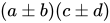
Abu Kamil made important contributions to algebra and geometry. He was the first Islamic mathematician to work easily with algebraic equations with powers higher than (up to ), and solved sets of non-linear simultaneous equations with three unknown variables. He illustrated the rules of signs for expanding the multiplication . He wrote all problems rhetorically, and some of his books lacked any mathematical notation beside those of integers. For example, he uses the Arabic expression "māl māl shayʾ" ("square-square-thing") for (as ). One notable feature of his works was enumerating all the possible solutions to a given equation.




The Muslim encyclopedist Ibn Khaldūn classified Abū Kāmil as the second greatest algebraist chronologically after al-Khwarizmi.
Almost nothing is known about the life and career of Abu Kamil except that he was a successor of al-Khwarizmi, whom he never personally met.
The Algebra is perhaps Abu Kamil's most influential work, which he intended to supersede and expand upon that of Al-Khwarizmi. Whereas the Algebra of al-Khwarizmi was geared towards the general public, Abu Kamil was addressing other mathematicians, or readers familiar with Euclid's Elements. In this book Abu Kamil solves systems of equations whose solutions are whole numbers and fractions, and accepted irrational numbers (in the form of a square root or fourth root) as solutions and coefficients to quadratic equations.
The first chapter teaches algebra by solving problems of application to geometry, often involving an unknown variable and square roots. The second chapter deals with the six types of problems found in Al-Khwarizmi's book, but some of which, especially those of , were now worked out directly instead of first solving for and accompanied with geometrical illustrations and proofs. The third chapter contains examples of quadratic irrationalities as solutions and coefficients. The fourth chapter shows how these irrationalities are used to solve problems involving polygons. The rest of the book contains solutions for sets of indeterminate equations, problems of application in realistic situations, and problems involving unrealistic situations intended for recreational mathematics.

A number of Islamic mathematicians wrote commentaries on this work, including al-Iṣṭakhrī al-Ḥāsib and ʿAli ibn Aḥmad al-ʿImrānī (d. 955-6), but both commentaries are now lost.
In Europe, similar material to this book is found in the writings of Fibonacci, and some sections were incorporated and improved upon in the Latin work of John of Seville, Liber mahameleth. A partial translation to Latin was done in the 14th century by William of Luna, and in the 15th century the whole work also appeared in a Hebrew translation by Mordekhai Finzi.
Hub AI
Abu Kamil AI simulator
(@Abu Kamil_simulator)
Abu Kamil
Abū Kāmil Shujāʿ ibn Aslam ibn Muḥammad Ibn Shujāʿ (Latinized as Auoquamel, Arabic: أبو كامل شجاع بن أسلم بن محمد بن شجاع, also known as Al-ḥāsib al-miṣrī—lit. "The Egyptian Calculator") (c. 850 – c. 930) was a prominent Egyptian mathematician during the Islamic Golden Age. He is considered the first mathematician to systematically use and accept irrational numbers as solutions and coefficients to equations. His mathematical techniques were later adopted by Fibonacci, thus allowing Abu Kamil an important part in introducing algebra to Europe.
Abu Kamil made important contributions to algebra and geometry. He was the first Islamic mathematician to work easily with algebraic equations with powers higher than (up to ), and solved sets of non-linear simultaneous equations with three unknown variables. He illustrated the rules of signs for expanding the multiplication . He wrote all problems rhetorically, and some of his books lacked any mathematical notation beside those of integers. For example, he uses the Arabic expression "māl māl shayʾ" ("square-square-thing") for (as ). One notable feature of his works was enumerating all the possible solutions to a given equation.
The Muslim encyclopedist Ibn Khaldūn classified Abū Kāmil as the second greatest algebraist chronologically after al-Khwarizmi.
Almost nothing is known about the life and career of Abu Kamil except that he was a successor of al-Khwarizmi, whom he never personally met.
The Algebra is perhaps Abu Kamil's most influential work, which he intended to supersede and expand upon that of Al-Khwarizmi. Whereas the Algebra of al-Khwarizmi was geared towards the general public, Abu Kamil was addressing other mathematicians, or readers familiar with Euclid's Elements. In this book Abu Kamil solves systems of equations whose solutions are whole numbers and fractions, and accepted irrational numbers (in the form of a square root or fourth root) as solutions and coefficients to quadratic equations.
The first chapter teaches algebra by solving problems of application to geometry, often involving an unknown variable and square roots. The second chapter deals with the six types of problems found in Al-Khwarizmi's book, but some of which, especially those of , were now worked out directly instead of first solving for and accompanied with geometrical illustrations and proofs. The third chapter contains examples of quadratic irrationalities as solutions and coefficients. The fourth chapter shows how these irrationalities are used to solve problems involving polygons. The rest of the book contains solutions for sets of indeterminate equations, problems of application in realistic situations, and problems involving unrealistic situations intended for recreational mathematics.
A number of Islamic mathematicians wrote commentaries on this work, including al-Iṣṭakhrī al-Ḥāsib and ʿAli ibn Aḥmad al-ʿImrānī (d. 955-6), but both commentaries are now lost.
In Europe, similar material to this book is found in the writings of Fibonacci, and some sections were incorporated and improved upon in the Latin work of John of Seville, Liber mahameleth. A partial translation to Latin was done in the 14th century by William of Luna, and in the 15th century the whole work also appeared in a Hebrew translation by Mordekhai Finzi.