Hubbry Logo
Acoustic Control Induction SystemAcoustic Control Induction SystemMain
Open search
Acoustic Control Induction System
Community hub
Acoustic Control Induction System
logo
8 pages, 0 posts
0 subscribers
Be the first to start a discussion here.
Acoustic Control Induction System
from Wikipedia
The ACIS/TVIS System

Acoustic Control Induction System, or ACIS, is an implementation of a variable-length intake manifold system designed by Toyota.

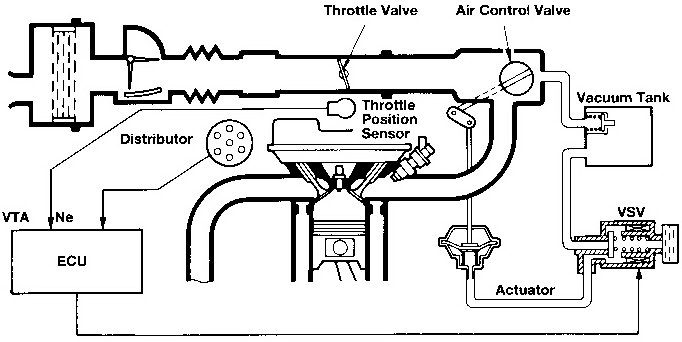
Simply put, the ACIS system uses a single intake air control valve located in the intake to vary the length of the intake tract in order to optimize power and torque, as well as provide better fuel efficiency and reduce intake "roar".

The engine control unit (ECU) controls the position of one or more air control valves based on input signals from throttle angle and engine RPM. The vacuum switching valve (VSV) which controls the vacuum supply to the actuator is normally closed and passes vacuum to the actuator when it is energized by the ECU. By energizing the VSV vacuum is passed to the actuator, closing the air control valve. This effectively lengthens the intake manifold run. By de-energizing the VSV, vacuum to the actuator is blocked and trapped vacuum is bled off of the actuator diaphragm. Toyota ACIS is an On/Off system. The valve (or valves in newer models with multiple valves to create more than 2 lengths) is either fully opened or fully closed. An example of early single-valve ACIS programming would be the 3.0L 3VZ-FE engine. The ECU actuates the VSV to close the valve when the throttle position is 60% or greater and engine speed is 3,900 RPM or more.[citation needed]

Applications:

See also

[edit]
[edit]

References

[edit]
Revisions and contributorsEdit on WikipediaRead on Wikipedia
from Grokipedia
The Acoustic Control Induction System () is a technology developed by Motor Corporation, designed to enhance performance by dynamically adjusting the effective length of the intake tract to optimize airflow and across different speeds. Introduced in 1984 as a world-first innovation, ACIS was first adopted in the 1S-iLU engine and has since been integrated into numerous and vehicle models, including the Land Cruiser, Sequoia, , and RAV4. ACIS operates by switching the manifold runner length in two primary stages, controlled by the 's (PCM) based on parameters such as RPM and angle. At low-to-medium speeds, the system closes an air —actuated by a vacuum switching valve (VSV) and diaphragm—to lengthen the path, promoting better air-fuel mixing, improved delivery, and reduced noise for enhanced low-end efficiency. At higher speeds, the opens to shorten the path, allowing for increased and power output, thereby broadening the 's curve and improving overall drivability. Key components include the VSV, which manages vacuum supply from the manifold; the assembly with its pushrod and bell crank; and the integral within the manifold plenum, often requiring full manifold replacement for servicing. This system contributes to , emissions reduction, and responsive acceleration in equipped engines, such as the 5.7-liter V8 in the Land Cruiser, which produces 381 horsepower and 401 lb-ft of torque with aiding torque optimization across the RPM range. Over its four decades of use, has evolved alongside other technologies like with intelligence (), appearing in both inline-four and V6/V8 configurations to support diverse applications from compact SUVs to full-size trucks.

Introduction

Definition and Purpose

The Acoustic Control Induction System (ACIS) is a proprietary technology developed by that implements a to optimize into the across different operating conditions. This system adjusts the effective length of the intake runners by switching between discrete configurations, enabling resonance tuning that enhances air charge density. The primary purpose of is to improve by varying intake runner length based on engine speed, which boosts low-end for better responsiveness and high-end power for sustained performance. By optimizing the effect of incoming air, it increases the volume of air delivered to the cylinders without significantly increasing fuel consumption, thereby supporting overall . ACIS typically employs a binary on/off mechanism that switches between two fixed runner lengths, though some variants, such as in certain V6 engines, incorporate three stages for further torque optimization; this provides a simpler yet effective means of performance balancing compared to continuous variable systems used by some other manufacturers. This design is applied to balance output across the RPM range in both inline and V-type engines, ensuring versatile torque delivery.

Basic Principles

The Acoustic Control Induction System (ACIS) leverages the physics of propagation in engine runners to optimize performance across varying operating conditions. In systems, pressure waves generated by the opening and closing of intake valves travel through the runners at the , reflecting back due to impedance mismatches at boundaries such as the valve or plenum. These waves can constructively interfere with motion, enhancing air inflow, a phenomenon modeled by , where the runner acts as a neck and the plenum or volume as a cavity, with determined by the system's . The timing of wave reflection is critical and depends on runner length; longer runners delay the return of reflected waves, aligning them favorably with lower engine speeds, while shorter runners enable quicker reflections suited to higher speeds. At low RPM, this exploits the inertial ram effect, where the momentum of incoming air column amplifies by increasing cylinder pressure during . Conversely, at high RPM, shorter paths minimize flow restrictions, allowing higher mass airflow rates to boost power output, with the transition governed by the engine's firing frequency matching the system's natural . Varying intake geometry, such as through adjustable runner lengths, improves —the ratio of actual air mass inducted to the theoretical maximum—by tuning wave dynamics to ensure better filling with air-fuel across the RPM range. This enhances overall breathing without relying on . The foundational Helmholtz frequency, which underpins these tuning effects, is given by f=c2πALVf = \frac{c}{2\pi} \sqrt{\frac{A}{L V}}
Add your contribution
Related Hubs
User Avatar
No comments yet.