Hubbry Logo
Toyota MZ engineToyota MZ engineMain
Open search
Toyota MZ engine
Community hub
Toyota MZ engine
logo
8 pages, 0 posts
0 subscribers
Be the first to start a discussion here.
Toyota MZ engine
Toyota MZ engine
from Wikipedia
Toyota MZ engine
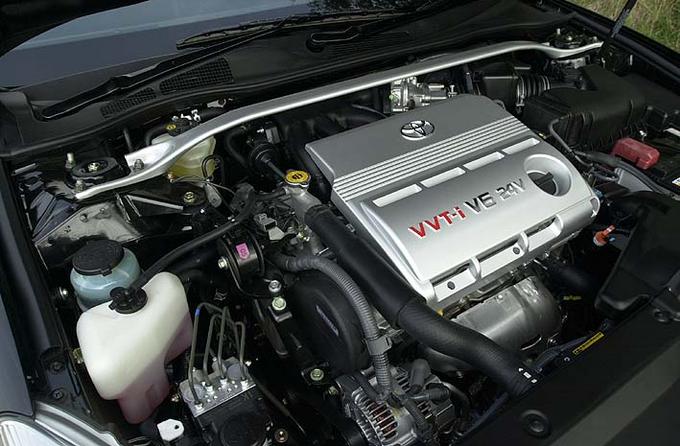
1MZ-FE engine in a Toyota Windom
Overview
ManufacturerToyota Motor Corporation
Production1993–2014
Layout
ConfigurationV6
Displacement2.5 L (2,496 cc)
3.0 L (2,994 cc)
3.3 L (3,310 cc)
Cylinder bore87.5 mm (3.44 in)
92 mm (3.62 in)
Piston stroke83 mm (3.27 in)
69.2 mm (2.72 in)
Cylinder block materialAluminium alloy
Cylinder head materialAluminium alloy
ValvetrainDOHC 4 valves x cyl.
Combustion
SuperchargerTRD (some versions)
Fuel systemMulti-port fuel injection
Fuel typeGasoline
Cooling systemWater cooled
Output
Power output194–242 hp (145–180 kW; 197–245 PS)
Torque output180–242 lb⋅ft (244–328 N⋅m)
Chronology
PredecessorToyota VZ engine
SuccessorToyota GR engine

The Toyota MZ engine family is a piston V6 engine series. It was the successor to the previous VZ engine family, and was Toyota's second V6 engine series. It is a lightweight V6 engine of an all-aluminium design, using lightweight parts than the previous heavy-duty VZ block engines in an effort to lower production costs and decrease engine and reciprocating weight without sacrificing reliability.

Toyota sought to enhance the drivability pattern of the engine (over the 3VZ-FE) at exactly 3000 rpm, since that was the typical engine speed for motors cruising on the highway. The result was less cylinder distortion coupled with the decreased weight of rotating assemblies, smoother operation at that engine speed, and increased engine efficiency.[citation needed]

The MZ series has an aluminium engine block and aluminium alloy DOHC cylinder heads. The cylinders are lined with cast iron, and is of a closed deck design (no open space between the bores). The engine is a 60 degree V6 design. It uses multi-port fuel injection (MFI), four valves per cylinder, a one-piece cast camshaft and a cast aluminium intake manifold.

This engine has been phased out in most markets, replaced by variants of the then-new GR series.

1MZ-FE

[edit]
Toyota 1MZ-FE engine without VVT-i

The 1MZ-FE is a 3.0 L (2,994 cc) dual overhead cam (DOHC) V6 engine, replacing the 3VZ-FE as the standard 3.0 L V6 engine in North America and later worldwide. Bore and stroke is 87.5 mm × 83 mm (3.44 in × 3.27 in). Output is 194–201 hp (145–150 kW; 197–204 PS) at 5,200–5,400 rpm with 183–209 lb⋅ft (248–283 N⋅m) of torque at 4,400 rpm. Horsepower ratings dropped after the Society of Automotive Engineers (SAE) implemented a new power measurement system for vehicle engines; Toyota engines rated on 87 octane dropped the most, compared to the same engines used by Lexus rated on 91 octane. It has bucket tappets and was designed for good fuel economy of 19 mpg‑US (12 L/100 km; 23 mpg‑imp) city and 25 mpg‑US (9.4 L/100 km; 30 mpg‑imp) highway without an overall performance trade-off.

Toyota Racing Development offered a factory supported bolt-on supercharger kit for the MY1997–2000 Camry, MY1998–2000 Sienna and MY1999–2000 Solara in North America. Power output was bumped to 242 hp (180 kW; 245 PS) and 242 lb⋅ft (328 N⋅m) of torque.

The 1MZ-FE was on Ward's 10 Best Engines list for 1996.[1]

Applications:

Beginning in 1998, VVT-i was added. This increased the output to 210 hp (157 kW; 213 PS) at 5800 rpm and 222 lb⋅ft (301 N⋅m) of torque at 4400 rpm. It was used on later models of the Avalon, Sienna and Camry. When installed in the Highlander, power was 220 hp (164 kW; 223 PS); torque and engine speeds did not change.[2] Early versions of the 1MZ-FE with VVT-i used a dual throttle body while later versions used a drive by wire system (or electronic throttle control). It also contains an EGR block off plate on the exhaust manifolds.

Applications:

2MZ-FE

[edit]
Toyota 2MZ-FE engine

The 2MZ-FE is a 2.5 L (2,496 cc) V6 engine, replacing the 4VZ-FE as the worldwide 2.5 L V6 engine. Bore and stroke is 87.5 mm × 69.2 mm (3.44 in × 2.72 in). Output is 197 hp (147 kW; 200 PS) at 6000 rpm with torque of 180 lb⋅ft (244 N⋅m) at 4600 rpm.

Applications:

3MZ-FE

[edit]
3MZ-FE in a 2004 Lexus ES330

The 3MZ-FE is a 3.3 L (3,310 cc) version. Bore and stroke is 92 mm × 83 mm (3.62 in × 3.27 in). Output is 225 hp (168 kW; 228 PS) with 240 lb⋅ft (325 N⋅m) of torque in the Camry and 230 hp (172 kW; 233 PS) with 242 lb⋅ft (328 N⋅m) of torque in the Sienna and Highlander. It also features VVT-i, ETCS-i (Electronic Throttle Control System — intelligent/DBW), PA6 plastic intake, and increased throttle body diameter over the 1MZ. The 3MZ uses a new flat-type knock sensor, which is a departure from the typical resonator type knock sensor used on the previous MZs. Previous MZs had poor knock control, or perhaps oversensitivity when detecting knock, and power loss up to 20 hp (15 kW) may be realized due to erratic ignition timing when using an octane lower than 91. The new flat-type knock sensor is a completely different design and detects more frequencies than the traditional resonator type. This provides the ECU with more accurate data. A bolt goes through the center of the knock sensor, which then mates the sensor to the block on each bank.

Applications:

Excessive oil consumption issues

[edit]

The MZ engines are notorious for excess oil consumption, otherwise known as "oil gelling"[3] or "engine sludge".[4][5] This is caused by several factors, including problems with the engine's PCV system, worn-off parts, or a bad or leaking valve cover gasket. This allowed oil to leak into the engine bay, with symptoms ranging from blue-grey smoke, bad spark plugs and sludge buildup in cylinder bank 2, to low compression on the second cylinder. This issue is widespread in many MZ engines produced, especially in later models, and as such affected many vehicles that used this engine in their configurations. It is very important to the life of these engines that oil changes should be done on a regular basis.[5] A class action lawsuit was filed because of this problem.[3] This particular issue remains a significant concern for MZ engines of that era.

See also

[edit]

References

[edit]
Revisions and contributorsEdit on WikipediaRead on Wikipedia
from Grokipedia
The Toyota MZ engine family is a series of all-aluminum V6 engines developed by in 1993 and introduced in 1994 as a lightweight successor to the VZ series, featuring displacements from 2.5 liters to 3.3 liters, double overhead camshaft (DOHC) design with 24 valves, and () in most variants for improved performance and efficiency. The MZ series includes three primary variants: the 1MZ-FE (3.0 L, 2,994 cc), which produces 188–220 horsepower and 275–304 Nm of depending on the application and was tuned for smooth operation at around 3,000 rpm; the 2MZ-FE (2.5 L, 2,496 cc), delivering 200 horsepower and 245 Nm primarily for select Japanese-market vehicles; and the 3MZ-FE (3.3 L, 3,310 cc), offering 211–234 horsepower and 288–328 Nm with enhancements like (ETCS-i) and a flat-type for better tolerance. These engines powered a wide range of mid-size sedans, minivans, SUVs, and luxury models from 1994 to the early 2010s, including the , Avalon, Sienna, Highlander, and 300, RX 300, and RX 400h hybrids, earning recognition such as award in 1996 for the 1MZ-FE due to its reliability and longevity, often exceeding 300,000 miles with proper maintenance.

Overview

History and development

The Toyota MZ engine family was developed in as Toyota's second-generation V6 series, succeeding the VZ engine family by emphasizing lighter construction for transverse mounting in front-wheel-drive vehicles. This shift addressed the need for more efficient engines in the , as the MZ series adopted an all-aluminum design to reduce weight compared to the heavier cast-iron blocks of the VZ engines, enabling better and economy in mid-size sedans and other platforms. Initial production began in 1994 at Toyota's facilities in , with later expansion to overseas plants such as Toyota Motor Kentucky (TMMK), targeting applications in mid-size vehicles. Key milestones included the MZ family's debut in the 1994 model year Toyota Camry (XV10 platform), marking its entry into the North American market as a refined V6 option. By the late 1990s, the series expanded to minivans and SUVs, powering a range of family-oriented vehicles through the mid-2000s. The 1MZ-FE variant earned recognition on list in 1996 for its balance of power, smoothness, and engineering innovation. Production of the MZ engines primarily occurred at Toyota's Kamigo Plant in , contributing to a cumulative total exceeding 3.35 million units at Kamigo alone before discontinuation. The family was gradually phased out by the mid-2010s, replaced by the more advanced GR series V6 engines.

Design features and technologies

The Toyota MZ engine family features a core configuration as a 60-degree V6 with an and heads, dual overhead (DOHC), four per , and sequential multi-port (MPFI). The block incorporates liners press-fitted into a closed-deck , enhancing while maintaining . Key components include one-piece cast driven by a timing belt, with the exhaust camshaft gear engaging the camshaft for synchronized operation, and bucket-and-shim tappets for actuation. The aluminum heads employ a cross-flow with pent-roof chambers and central spark plugs, while the cast aluminum manifold optimizes distribution. Introduced in later models starting around 1998, Variable Valve Timing with intelligence (VVT-i) became a standard technology across the MZ family, adjusting valve timing via oil-pressure-actuated camshaft phasers to improve torque delivery and efficiency across operating ranges. was incorporated in subsequent variants, such as the 3MZ-FE, replacing mechanical linkages with an electronic accelerator pedal position sensor and throttle actuator motor for precise air modulation and integration with vehicle stability systems. Flat-type knock sensors, positioned on the block, detect irregularities more sensitively than traditional piezoelectric types, enabling the engine control module to retard and prevent damage under varying fuel qualities. Engineering goals for the MZ series emphasized reduced weight and enhanced drivability, achieving approximately 20% lighter overall mass compared to the preceding VZ engines through extensive aluminum usage and optimized rotating assemblies, including sinter-forged connecting rods and a with nine semi-counterweights for inherent smoothness. The design was tuned for optimal performance at around 3,000 rpm, aligning with typical highway driving speeds to balance power, fuel economy, and low emissions. The sequential MPFI system delivers fuel precisely to each cylinder based on position, supporting compression ratios ranging from 10.0:1 to 10.8:1 across the family for efficient and compliance with emissions standards.

Variants

1MZ-FE

The 1MZ-FE is the foundational variant of the Toyota MZ engine family, featuring a displacement of 3.0 L (2,994 cc) with a bore of 87.5 mm and a of 83.0 mm. Produced from 1993 to 2008, it replaced the earlier 3VZ-FE in transverse front-wheel-drive (FWD) and all-wheel-drive (AWD) applications, offering improved efficiency and refinement through its all-aluminum construction and dual overhead cam (DOHC) design shared across the MZ series. This engine was engineered for smooth power delivery in mid-size sedans and SUVs, prioritizing balance and reduced weight over high-revving . Without Variable Valve Timing with intelligence (VVT-i), the 1MZ-FE delivered power outputs ranging from 194 to 201 hp (145 to 150 kW) and torque from 183 to 209 lb⋅ft (248 to 283 N⋅m), depending on market-specific tuning and emissions standards. The non-VVT-i version maintained a of 10.5:1, contributing to its responsive low-end torque suitable for everyday driving. Starting in 1998, the adoption of VVT-i enhanced intake valve timing for better across the rev range, boosting output to 210 to 220 hp (157 to 164 kW) and 222 lb⋅ft (301 N⋅m) of torque while lowering the to 10.0:1 for compatibility with varied qualities. This early integration of VVT-i marked a significant advancement in the MZ lineup, improving economy and emissions without sacrificing drivability. For performance-oriented applications, Toyota offered an optional TRD supercharger kit, which utilized a roots-type blower to increase boost and airflow, elevating output to 242 hp (180 kW) and 242 lb⋅ft (328 N⋅m) in select models such as the Camry Solara. The kit included electronic boost control for reliable operation under 5 psi, making it emissions-legal in applicable markets and appealing to enthusiasts seeking enhanced acceleration from the base V6. Overall, the 1MZ-FE's versatility in FWD/AWD configurations solidified its role as a reliable workhorse, balancing power, durability, and adaptability across global vehicle platforms.

2MZ-FE

The 2MZ-FE is a 2.5 L (2,496 cc) variant of the MZ engine family, designed specifically for the (JDM) with a focus on compact dimensions and efficiency in transverse front-wheel-drive configurations. It features a bore of 87.5 mm and a shorter stroke of 69.2 mm compared to larger siblings, enabling a more compact overall engine size suitable for mid-size sedans. This engine replaced the previous 4VZ-FE in select applications, offering improved performance and refinement for vehicles like the Gracia and Windom. Production spanned from 1995 to 2002, primarily equipping JDM models without widespread export. Equipped with Variable Valve Timing with intelligence () as standard, the 2MZ-FE delivers power outputs ranging from 197 to 210 hp (147–157 kW) and torque from 180 to 213 lb⋅ft (244–289 N⋅m), depending on the specific tuning and year. Its of 10.8:1 supports efficient combustion, while the System with intelligence (ETCS-i) enhances throttle response and fuel economy. Optimized for mid-size sedans, the engine prioritizes balanced power delivery and reduced emissions, with an aluminum cylinder block contributing to lighter weight and better packaging in front-wheel-drive layouts. The implementation is shared across the MZ family, improving intake valve timing for broader torque curves.

3MZ-FE

The 3MZ-FE is a 3.3-liter variant in Toyota's MZ family, developed as an enlarged evolution of the 1MZ-FE architecture to meet demands for higher displacement in larger vehicles such as minivans and SUVs. It features an increased bore diameter while retaining the same length from its predecessor, resulting in a displacement of 3,310 cc with dimensions of 92.0 mm bore by 83.0 mm stroke. Produced from 2003 to 2014, this engine was introduced to provide enhanced power and torque for applications requiring more robust performance in family-oriented and utility vehicles. Equipped with Variable Valve Timing-intelligent (VVT-i) on the camshafts and the Electronic Throttle Control System-intelligent (ETCS-i), the 3MZ-FE delivers power outputs ranging from 208 to 230 hp (155 to 172 kW) at approximately 5,600 rpm and from 240 to 242 lb⋅ft (325 to 328 N⋅m) at 3,600 to 4,400 rpm, depending on the application; hybrid variants are detuned to 208 hp for integration with electric motors. Its is set at 10.8:1, supporting efficient in a naturally aspirated configuration with sequential multiport . Unique to this variant is the use of a manifold, which contributes to reduction and improved through integration with the Acoustic Control Induction System (ACIS), alongside standard knock sensors for detonation control. In later production years, the 3MZ-FE saw adaptations for hybrid powertrains, such as in the Hybrid (2005–2010) and Lexus RX 400h (2005–2009), where it operated as the primary gasoline engine paired with electric motors and featured modifications including reduced power output, though the core design remained naturally aspirated. This positioning emphasized reliability and smooth operation in upscale, global-market vehicles, distinguishing it from smaller or forced-induction MZ variants.

Production and legacy

Vehicle applications

The MZ engine family found widespread application in and vehicles, primarily powering front-wheel-drive (FWD) and all-wheel-drive (AWD) sedans, minivans, and light SUVs across global markets from the mid-1990s to the early 2010s. The 1MZ-FE variant, the most commonly deployed, was featured in numerous North American and models, while the 2MZ-FE saw more limited use in Domestic Market (JDM) vehicles, and the 3MZ-FE extended the family's presence into later production runs.

1MZ-FE Applications

The 1MZ-FE powered a range of mid-size sedans and crossovers, starting with the Toyota Camry from 1997 to 2006 in various international markets. It also equipped the Toyota Avalon from 1995 to 2004, the Toyota Sienna minivan from 1998 to 2003, the Toyota Highlander SUV from 2001 to 2003, the Toyota Solara coupe/convertible from 1999 to 2003, and the Lexus RX 300 SUV from 1999 to 2003. In the Lexus lineup, it drove the ES300 sedan from 1997 to 2001, and the JDM Toyota Windom (a rebadged ES300) shared the same engine during overlapping years. Additionally, a supercharged version of the 1MZ-FE was offered in performance-oriented trims of the Solara and Camry through Toyota Racing Development (TRD) kits.

2MZ-FE Applications

The 2MZ-FE, a 2.5-liter variant tailored for JDM models, was installed in the Gracia wagon from 1996 to 2001. It also powered the Qualis wagon from 1997 to 2001, available in both FWD and AWD configurations. The Toyota Windom sedan received this engine from 1996 to 2001 in select trims.

3MZ-FE Applications

Introduced as an evolution with , the 3MZ-FE appeared in SE V6 models of the from 2004 to 2006, bridging to the next-generation powertrains. It was used in the from 2004 to 2006, the from 2004 to 2007, the Toyota Highlander Hybrid from 2006 to 2010, and the Toyota Solara from 2004 to 2008. Lexus applications included the ES330 sedan from 2004 to 2006, the RX330 SUV from 2004 to 2006, and the RX 400h hybrid from 2005 to 2009. Overall, the MZ series emphasized versatility in family-oriented vehicles, with heavier emphasis on North American and models for the 1MZ-FE and 3MZ-FE, contrasted by the 2MZ-FE's JDM exclusivity.

Reliability and successors

The MZ engine family demonstrates high durability with proper maintenance, routinely achieving smooth operation and longevity exceeding 200,000 miles. Key to this reliability is timely replacement of the timing belt every 90,000 miles or nine years, as recommended by and , to avoid potential drive system failures. A notable issue affected the 1MZ-FE variant produced between 1998 and 2002, where excessive oil consumption arose from design flaws and PCV failures, particularly in high-mileage examples. This problem prompted a class-action settled by in 2007, leading to engine replacements or reimbursements under extended warranties for affected vehicles. In contrast, the 2MZ-FE and 3MZ-FE variants exhibited no major widespread issues, benefiting from design refinements like improved knock sensors. For instance, the 3MZ-FE 3.3L V6 engine in the Lexus RX 330 (2004–2006) is highly reliable and durable with proper maintenance; owners report achieving 200,000–300,000+ miles without major failures. It is known for its smoothness and longevity, particularly with regular oil changes every 5,000–7,500 miles; owner satisfaction ratings are high, around 4.7–4.8 out of 5; and it is considered one of the more dependable V6 engines from that era. Maintenance practices for the MZ series emphasize oil changes every 6,000 miles using SAE 5W-30 synthetic oil to mitigate buildup, alongside clearance adjustments every 60,000 to 80,000 miles where applicable. Later models incorporate hydraulic lifters, reducing the frequency of adjustments, while regular flushes are advised to prevent degradation from overheating. Production of the MZ engine family was phased out by around 2015 in response to evolving emissions standards, with the GR V6 series—such as the 2GR-FE—beginning to replace it as early as 2005 in various applications. The MZ's legacy lies in its balance of power output and , which informed subsequent V6 architectures; the GR successors retained the aluminum block construction but introduced advancements like direct injection for enhanced performance and compliance.

References

Add your contribution
Related Hubs
User Avatar
No comments yet.