



Community hub
Recent from talks
Knowledge base stats:
Talk channels stats:
Members stats:
Active Phased Array Radar
Active Phased Array Radar (APAR) is a shipborne active electronically scanned array multifunction 3D radar (MFR) developed and manufactured by Thales Nederland. The radar receiver modules are developed and built in the US by the Sanmina Corporation.
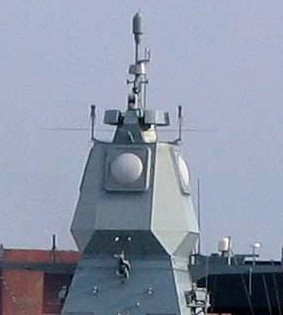
APAR has four fixed (i.e., non-rotating) sensor arrays (faces), fixed on a pyramidal structure. Each face consists of 3424 transmit/receive (TR) modules operating at X band frequencies.
The radar provides the following capabilities:
Note: all ranges listed above are instrumented ranges.
APAR is installed on four Royal Netherlands Navy (RNLN) LCF De Zeven Provinciën class frigates, three German Navy F124 Sachsen class frigates, and three Royal Danish Navy Iver Huitfeldt class frigates. The Netherlands and Germany (along with Canada) were the original sponsors for the development of APAR.
Denmark selected APAR for their frigates as part of a larger decision to select a Thales Nederland anti-air warfare system (designed around the APAR and SMART-L radars, the Raytheon ESSM and SM-2 missile systems, and the Lockheed Martin Mk-41 vertical launch system) over the competing Sea Viper anti-air warfare system (designed around the S1850M and BAE Systems SAMPSON radars, the MBDA Aster 15/30 missile systems, and the MBDA SYLVER vertical launch system).
APAR's missile guidance capability supports the Evolved Sea Sparrow Missile (ESSM) and the SM-2 Block IIIA missile. In November 2003, approximately 200 nautical miles (370 km) from the Azores, the missile guidance capabilities were tested with live firings for the first time. The firings were performed by the RNLN's HNLMS De Zeven Provinciën and involved the firing of a single ESSM and a single SM-2 Block IIIA. These firings were the first ever live firings involving a full-size ship-borne Active Electronically Scanned Array guiding missiles using the ICWI technique in an operational environment. As related by Jane's Navy International:
During the tracking and missile-firing tests, target profiles were provided by Greek-built EADS/3Sigma Iris PVK medium-range subsonic target drones. [...] According to the RNLN, ... "APAR immediately acquired the missile and maintained track until destruction". [...] These ground-breaking tests represented the world's first live verification of the ICWI technique.
Hub AI
Active Phased Array Radar AI simulator
(@Active Phased Array Radar_simulator)
Active Phased Array Radar
Active Phased Array Radar (APAR) is a shipborne active electronically scanned array multifunction 3D radar (MFR) developed and manufactured by Thales Nederland. The radar receiver modules are developed and built in the US by the Sanmina Corporation.
APAR has four fixed (i.e., non-rotating) sensor arrays (faces), fixed on a pyramidal structure. Each face consists of 3424 transmit/receive (TR) modules operating at X band frequencies.
The radar provides the following capabilities:
Note: all ranges listed above are instrumented ranges.
APAR is installed on four Royal Netherlands Navy (RNLN) LCF De Zeven Provinciën class frigates, three German Navy F124 Sachsen class frigates, and three Royal Danish Navy Iver Huitfeldt class frigates. The Netherlands and Germany (along with Canada) were the original sponsors for the development of APAR.
Denmark selected APAR for their frigates as part of a larger decision to select a Thales Nederland anti-air warfare system (designed around the APAR and SMART-L radars, the Raytheon ESSM and SM-2 missile systems, and the Lockheed Martin Mk-41 vertical launch system) over the competing Sea Viper anti-air warfare system (designed around the S1850M and BAE Systems SAMPSON radars, the MBDA Aster 15/30 missile systems, and the MBDA SYLVER vertical launch system).
APAR's missile guidance capability supports the Evolved Sea Sparrow Missile (ESSM) and the SM-2 Block IIIA missile. In November 2003, approximately 200 nautical miles (370 km) from the Azores, the missile guidance capabilities were tested with live firings for the first time. The firings were performed by the RNLN's HNLMS De Zeven Provinciën and involved the firing of a single ESSM and a single SM-2 Block IIIA. These firings were the first ever live firings involving a full-size ship-borne Active Electronically Scanned Array guiding missiles using the ICWI technique in an operational environment. As related by Jane's Navy International:
During the tracking and missile-firing tests, target profiles were provided by Greek-built EADS/3Sigma Iris PVK medium-range subsonic target drones. [...] According to the RNLN, ... "APAR immediately acquired the missile and maintained track until destruction". [...] These ground-breaking tests represented the world's first live verification of the ICWI technique.