Hubbry Logo
AzoresAzoresMain
Open search
Azores
Community hub
Azores
logo
8 pages, 0 posts
0 subscribers
Be the first to start a discussion here.
Contribute something
Azores
Azores
from Wikipedia

The Azores,[a] officially the Autonomous Region of the Azores,[b] is an autonomous region of Portugal, in the Atlantic Ocean about 1,400 km (870 miles) west of mainland Portugal. Together with Madeira, it's one of the two autonomous regions of Portugal and a special territory of the European Union. It is the westernmost point and region of Portugal.[c]

Key Information

The Azores is an archipelago composed of nine volcanic islands in the Macaronesia region of the North Atlantic Ocean. There are nine major Azorean islands and an islet cluster, in three main groups. These are Flores and Corvo to the west; Graciosa, Terceira, São Jorge, Pico, and Faial in the centre; and São Miguel, Santa Maria, and the Formigas islets to the east. They extend for more than 600 km (370 mi) and lie in a northwest–southeast direction. All the islands have volcanic origins, although some, such as Santa Maria, have had no recorded activity in the time since the islands were settled several centuries ago. Mount Pico on the island of Pico is the highest point in Portugal, at 2,351 m (7,713 ft). If measured from their base at the bottom of the ocean to their peaks, the Azores are among the tallest mountains on the planet. The Azores are located at the seismically active Azores triple junction plate boundary where the North American plate, Eurasian plate and Nubian plate meet.[9]

The climate is very mild for such a northerly location, being influenced by its distance from the continents and by the passing Gulf Stream. Because of the marine influence, temperatures remain mild year-round. Daytime temperatures normally fluctuate between 16 and 25 °C (61 and 77 °F) depending on season.[10][11] Temperatures above 30 °C (86 °F) or below 3 °C (37 °F) are unknown in the major population centres. It is also generally wet and cloudy.

Its main industries are agriculture, dairy farming, livestock, fishing, and tourism, which has become a major service activity in the region. In the 20th century and to some extent into the 21st, the Azores have served as a waypoint for refueling aircraft flying between Europe and North America. The government of the Azores employs a large percentage of the population directly or indirectly in the service and tertiary sectors. The largest city is Ponta Delgada. The culture, dialect, cuisine, and traditions of the islands vary considerably, because these remote islands were settled sporadically over a span of two centuries.

History

[edit]
Gaspar Frutuoso wrote Saudades da Terra, the first history of the Azores and Macaronesia, in the 1580s.

A small number of alleged hypogea (underground structures carved into rocks) have been identified on the islands of Corvo, Santa Maria, and Terceira by Portuguese archaeologist Nuno Ribeiro, who speculated that they might date back 2,000 years, implying a human presence on the islands before the Portuguese.[12] These structures have been used by settlers in the Azores to store grain. The suggestion by Ribeiro that they might be burial sites is unconfirmed. Detailed examination and dating to authenticate the validity of these speculations are lacking; thus it is unclear whether these structures are natural or human-made and whether they predate the 15th century Portuguese colonization of the Azores.[13]

According to a 2015 paper published in Journal of Evolutionary Biology, research based on mouse mitochondrial DNA points to a Scandinavian rather than Portuguese origin of the local mouse population.[14][15] A 2021 paper published in Proceedings of the National Academy of Sciences, using data from lake sediment core sampling, suggests brush-clearing was undertaken and animal husbandry introduced between 700 and 850 A.D.[16] These findings suggest a brief period of Norse settlement, and the 2021 paper further cites climate simulations that suggest the dominant westerly winds in the North Atlantic Ocean were weaker in that period, which would have made it easier for Viking ships to sail to the Azores from Scandinavia.[17]

Discovery

[edit]
Under the direction of Prince Henry the Navigator, the Azores were discovered and populated in the early 1400s.

In 1427 a captain sailing for Prince Henry the Navigator, possibly Gonçalo Velho, may have discovered the Azores, but this is not certain. In Thomas Ashe's 1813 work A History of the Azores, the author identified a Fleming, Joshua Vander Berg of Bruges, who made landfall in the archipelago during a storm on his way to Lisbon.[18] According to Ashe, the Portuguese explored the area and claimed it for Portugal.[18] Other writers note the discovery of the first islands (São Miguel, Santa Maria and Terceira) by sailors in the service of Henry the Navigator, although there are few documents to support such claims.[19]

Although it is commonly said that the archipelago received its name from açor (Portuguese for goshawk, a common bird at the time of discovery) it is unlikely that the bird ever nested or hunted on the islands.[20] There were no large animals on Santa Maria; after its discovery and before settlement began, sheep were let loose on the island to supply future settlers with food.

Early settlement

[edit]

The archipelago was largely settled from mainland Portugal, but settlement did not take place immediately. From 1433 Gonçalo Velho Cabral gathered resources and settlers, and he sailed in 1436 to establish colonies, first on Santa Maria and then on São Miguel. Settlers built houses, established villages and cleared bush and rocks to plant crops, grain, grapevines, sugar cane and other plants suitable for local use and for export. They brought domesticated animals, such as chickens, rabbits, cattle, sheep, goats and pigs. The settlement of the unoccupied islands began in 1439 with people mainly from the continental provinces of Algarve and Alentejo. São Miguel was first settled in 1449, the settlers – mainly from Estremadura, Alto Alentejo and Algarve – under the command of Cabral, who landed at the site of modern-day Povoação.

Flemish settlers

[edit]

The first reference to the island of São Jorge was made in 1439, but the date of discovery is unknown. In 1443 the island was already inhabited, but settlement began only after the arrival of Willem van der Haegen. Arriving at Topo, São Jorge, where he lived and died, he became known as Guilherme da Silveira to the islanders. João Vaz Corte-Real received the captaincy of the island in 1483. Velas became a town before the end of the 15th century. By 1490 there were 2,000 Flemings living on the islands of Terceira, Pico, Faial, São Jorge and Flores. Because there was such a large Flemish settlement, the Azores became known as the Flemish Islands or the Isles of Flanders.

Prince Henry the Navigator was responsible for this Flemish settlement. His sister Isabel was married to Philip the Good, Duke of Burgundy (Flanders at the time belonged to Burgundy). There was a revolt against Philip's rule, and disease and hunger became rampant. Isabel appealed to Henry to allow some of the unruly Flemings to settle in the Azores. He granted this and supplied them with means of transport and goods.

1522 earthquake and recovery

[edit]

In 1522, Vila Franca do Campo, then the capital of São Miguel, was devastated by an earthquake and landslide that killed about 5,000 people, and the capital was moved to Ponta Delgada. Vila Franca do Campo was rebuilt on the original site and today is a thriving fishing and yachting port. Ponta Delgada received its city status in 1546. From the first settlement, the pioneers applied themselves to agriculture, and by the 15th century Graciosa was exporting wheat, barley, wine and brandy. The goods were sent to Terceira largely because of the proximity of that island.

Portuguese succession crisis of 1580

[edit]
1584 map of the Azores Islands

Portugal fell into a dynastic crisis following the death of Cardinal-King Henry in 1580. Of the various claimants to the crown, the most powerful was King Philip II of Spain, who justified his rights to the throne by the fact that his mother was a Portuguese royal princess: his maternal grandfather was King Manuel I.[21]

On 19 July 1580, António, Prior of Crato was acclaimed King of Portugal in Santarém by his supporters, followed by popular acclamation in Lisbon and other towns,[22] as well as in the Azores (through his envoy António da Costa), to which he fled following his defeat at the Battle of Alcântara.[21] Although Philip became king, the Azoreans resisted Spanish attempts to conquer the islands (including specifically at the Battle of Salga) and were administered by Cipriano de Figueiredo, governor of Terceira (who continued to govern Terceira in the name of the ill-fated former King Sebastian).[23]

In 1583 Philip sent his fleet to clear the Azores of a combined multinational force of adventurers, mercenaries, volunteers, and soldiers who were attempting to establish the Azores as a staging post for a rival pretender to the Portuguese throne. Following the success of his fleet at the Battle of Ponta Delgada, captured enemies were hanged from yardarms, as they were considered pirates by Philip II. Opponents receiving the news variously portrayed Philip as a despot or "Black Legend", the sort of insult widely made against contemporary monarchs engaged in aggressive empire building and the European wars of religion. Figueiredo and Violante do Canto helped organize a resistance on Terceira that influenced some of the response of the other islands, even as internal politics and support for Philip's faction increased on the other islands (including specifically on São Miguel, where the Gonçalvez da Câmara family supported the Spanish claimant).[23]

English raids of 1589 and 1598

[edit]
The Battle of Terceira, part of the War of the Portuguese Succession

An English raid of the Azores in 1589 successfully plundered some islands and harbouring ships; eight years later, a second raid failed.

Iberian Union

[edit]

Spain held the Azores under the Iberian Union from 1580 to 1642 (called the "Babylonian captivity" in the Azores). The Azores were the last part of the Portuguese Empire to resist Philip's reign over Portugal (Macau resisted any official recognition), until the defeat of forces loyal to the Prior of Crato with the Conquest of the Azores in 1583. Portuguese control resumed with the end of the Iberian Union in 1640 and the beginning of the Portuguese Restoration War, not by the professional military who were occupied with warfare on the Portuguese mainland, but by local people attacking a fortified Castilian garrison.

Overpopulation and emigration

[edit]
King-Emperor Pedro IV & I planned and launched his campaign in the Liberal Wars from the Azores in name of his daughter Queen Maria II

In the late 16th century, the Azores and Madeira began to face problems of overpopulation. Responding to the consequent economic problems, some people of the Azores began to emigrate to the United States, Canada and Brazil.[24]

In 1902 the Dominion Line began operating a Mediterranean passenger service between Boston and Italy via Gibraltar and the Azores, with an established port of call at Sao Miguel. In 1904 the service was taken over by the White Star Line. Four ships formerly owned by Dominion were renamed and put into service under White Star, named Canopic, Romanic, Cretic and Republic, the last of which is best known for its 1909 sinking off the New England coast. Canopic and Romanic provided regular service to Boston, while Cretic and Republic operated on the service to both New York and Boston throughout their careers. By the time the service ended in 1921, these four ships had transported an estimated total of 58,000 Azorean Portuguese to the United States.[25]

Liberal Wars of 1828–1834

[edit]

The Portuguese Civil War (1828–1834) had strong repercussions in the Azores. In 1829 in Praia da Vitória, the liberals won over the absolutists, making Terceira Island the main headquarters of the new Portuguese regime and also where the Council of Regency (Conselho de Regência) of Maria II was established. Beginning in 1868, Portugal issued its stamps overprinted with "AÇORES" for use in the islands. Between 1892 and 1906, it also issued separate stamps for the three administrative districts of the time.

Arbitrary district divisions 1836–1976

[edit]

From 1836 to 1976, the archipelago was divided into three districts, equivalent (except in area) to those in the Portuguese mainland. The division was arbitrary and did not follow the natural island groups, rather reflecting the location of each district capital on the three main cities (none of which were on the western group).

  • Angra do Heroísmo consisted of Terceira, São Jorge, and Graciosa, with the capital at Angra do Heroísmo on Terceira.
  • Horta consisted of Pico, Faial, Flores, and Corvo, with the capital at Horta on Faial.
  • Ponta Delgada consisted of São Miguel and Santa Maria, with the capital at Ponta Delgada on São Miguel.

Modern period

[edit]
Symbol of the Azorean autonomist movement in the 19th century

In 1931 the Azores (together with Madeira and Portuguese Guinea) revolted against the Ditadura Nacional and were held briefly by rebel military.[26] In 1943 during World War II, Portuguese ruler António de Oliveira Salazar leased air and naval bases in the Azores to Great Britain.[27] The occupation of these facilities in October 1943 was codenamed Operation Alacrity by the British.[28] This was a key turning point in the Battle of the Atlantic, enabling the Royal Air Force, the U.S. Army Air Forces, and the U.S. Navy to provide aerial coverage in the Mid-Atlantic gap. This helped them to protect convoys and to hunt hostile German U-boats.

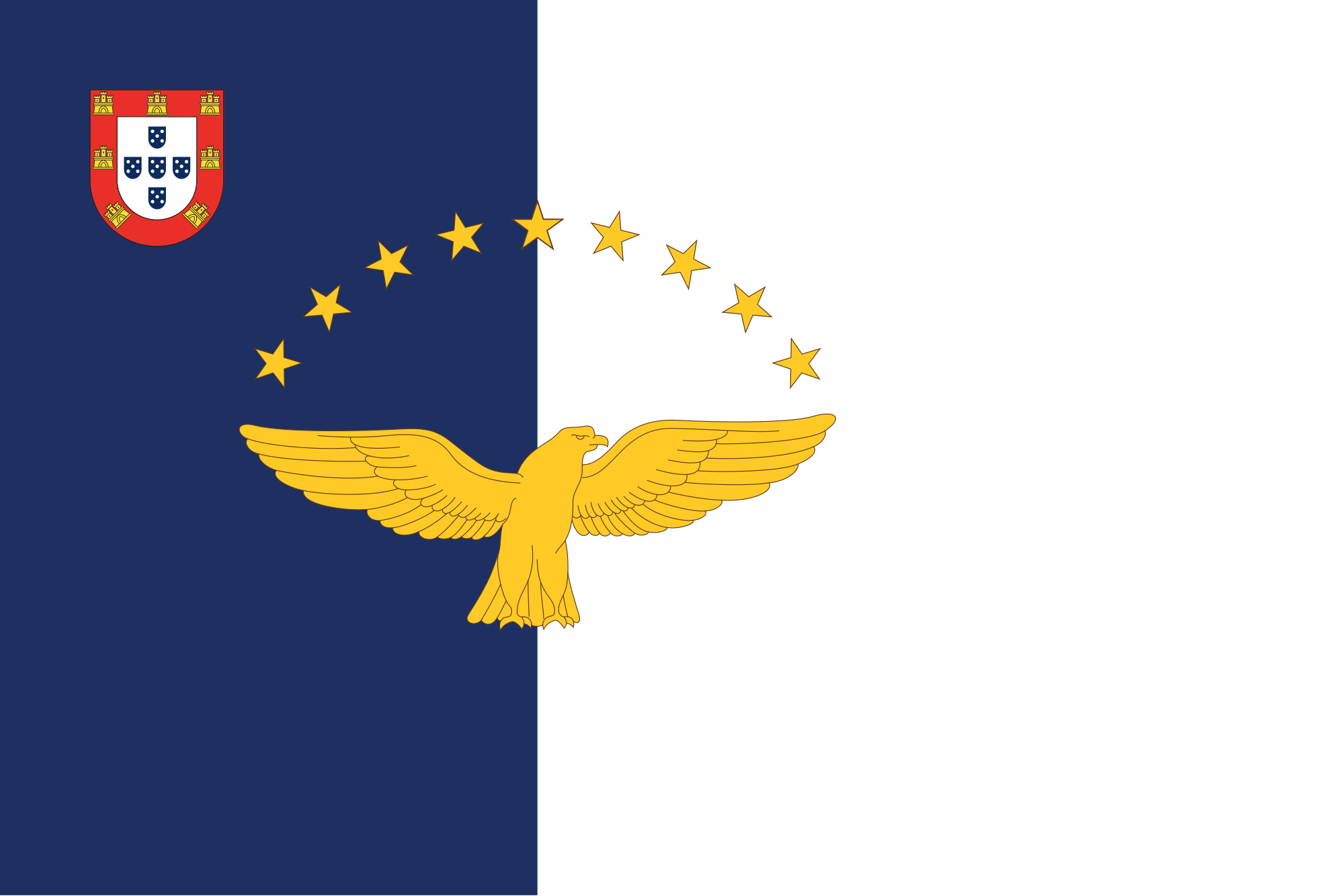
The Azores Liberation Front's flag preceded the modern Azorean flag.

In 1944 the U.S. constructed a small and short-lived air base on Santa Maria. In 1945 a base was constructed on Terceira, named Lajes Field. Lajes Field is a plateau rising out of the sea on the northeast corner of the island, which had been a large farm. The base is a joint American and Portuguese venture that continues to support American and Portuguese Armed Forces. During the Cold War, U.S. Navy P-3 Orion anti-submarine warfare squadrons patrolled the North Atlantic Ocean for Soviet Navy submarines and surface warships. Since its opening, Lajes Field has been used for refuelling American cargo planes bound for Europe, Africa, and the Middle East. The U.S. Navy keeps a small squadron of its ships at the harbor of Praia da Vitória, three km (1.9 mi) southeast of Lajes Field. The airfield also has a small commercial terminal handling scheduled and chartered passenger flights from the other islands in the Azores, Europe, Africa, and North America.

Following the Carnation Revolution of 1974 which deposed the Estado Novo dictatorship in Lisbon, Portugal and its territories across the world entered into a period of great political uncertainty. The Azorean Liberation Front attempted to take advantage of this instability immediately after the revolution, hoping to establish an independent Azores, until operations ceased in 1975.

In 1976, the Azores became the Autonomous Region of the Azores (Região Autónoma dos Açores), one of the autonomous regions of Portugal, and the subdistricts of the Azores were eliminated. In 2003 the Azores gained international attention when United States President George W. Bush, British Prime Minister Tony Blair, Spanish Prime Minister José María Aznar, and Portuguese Prime Minister José Manuel Durão Barroso held a summit there days before the commencement of the Iraq War.[29]

Geography

[edit]
Map of the Azores
Surface areas of the Azores Islands
Island Area
km2 sq mi
São Miguel 759 293
Pico 446 172
Terceira 403 156
São Jorge 246 95
Faial 173 67
Flores 143 55
Santa Maria 97 37
Graciosa 62 24
Corvo 17 7

The archipelago is located in the northern hemisphere within the Atlantic Ocean and extends along a west-northwest to east-southeast orientation (between 36.5°–40° North latitudes and 24.5°–31.5° West longitudes) in an area approximately 600 km (373 mi) wide. The islands of the Azores emerged from the Azores Plateau, a 5.8 million km2 region that is morphologically accented by a depth of 2,000 m (6,600 ft).[30][31]

Azores (blue), Madeira (green) and the Canary Islands (yellow) in the northern Atlantic

The nine islands that compose the archipelago occupy a surface area of 2,346 km2 (906 sq mi), that includes both the main islands and many islets located in their vicinities. They range in surface area from the largest, São Miguel, at 759 km2 (293 sq mi) to the smallest, Corvo, at approximately 17 km2 (7 sq mi). São Jorge, Pico and Faial are collectively called Ilhas do Triângulo ('Islands of the Triangle').

Each of the islands has its own distinct geomorphological characteristics that make them unique:

  • Corvo is a crater of a major Plinian eruption
  • Flores (its neighbor on the North American plate) is a rugged island carved by many valleys and escarpments
  • Faial is characterized for its shield volcano and caldera (Caldeira Volcano)
  • Pico has the highest point, at 2,351 m (7,713 ft), in the Azores and Portugal
  • Graciosa is known for its active Furnas do Enxofre and mixture of volcanic cones and plains
  • São Jorge is a long slender island, formed from fissural eruptions over thousands of years
  • Terceira, almost circular, contains one of the largest craters in the region
  • São Miguel is pitted with many large craters and fields of spatter cones
  • Santa Maria – the oldest island – is heavily eroded, being one of the few places to encounter brown sandy beaches in the archipelago.
The Lagoa das Sete Cidades, located within the Sete Cidades Massif, in Sete Cidades, São Miguel Island.

The islands can be divided into three recognizable groups located on the Azores Plateau:

  • The Eastern Group (Grupo Oriental) of São Miguel, Santa Maria and Formigas Islets
  • The Central Group (Grupo Central) of Terceira, Graciosa, São Jorge, Pico and Faial
  • The Western Group (Grupo Ocidental) of Flores and Corvo.

Several sub-surface reefs (particularly the Dollabarat on the fringe of the Formigas), banks (specifically the Princess Alice Bank and D. João de Castro Bank), as well as many hydrothermal vents and sea-mounts are monitored by the regional authorities, owing to the complex geotectonic and socioeconomic significance within the economic exclusion zone of the archipelago.

Geology

[edit]
Mount Pico, the highest mountain in Portugal, displays the remnants of its last major eruption on its northern flank

From a geostructural perspective, the Azores are located above an active triple junction between three of the world's major tectonic plates (the North American plate, the Eurasian plate and the African plate),[31] a condition that has translated into the existence of many faults and fractures in this region of the Atlantic.[32] The Western Group is located on the North American plate, while the remaining islands are located within the boundary that divides the Eurasian and African plates.[33]

The principal tectonic structures that exist in the region include the Mid-Atlantic Ridge, the Terceira Rift, the Azores Fracture Zone and the Glória Fault.[31] The Mid-Atlantic Ridge is the main frontier between the North American plate and the African-Eurasian plates that crosses the Azores Plateau between Flores and Faial from north to south then to the southwest; it is an extensive form crossed by many transform faults running perpendicular to its north–south orientation, that is seismically active and susceptible to volcanism. The Terceira Rift is a system of fractures that extends from the Mid-Atlantic Ridge to the Glória Fault that represents the main frontier between the Eurasian and African plates. It is defined by a line of submarine volcanoes and island mounts that extend northwest to southeast for about 550 km (342 mi), from the area west of Graciosa until the islets of the Formigas, that includes Graciosa, Terceira and São Miguel. Its northwest limit connects to the Mid-Atlantic Ridge, while the southeast section intersects the Gloria Fault southeast of Santa Maria. The Azores Fracture Zone extends from the Glória Fault and encompasses a relatively inactive area to the south the Central and Eastern groups north to the Terceira Rift, along a 45° angle. The Glória Fault extends 800 km (497 mi) along a linear line from the Azores to the Azores–Gibraltar transform fault.[34]

Mountains

[edit]
Five tallest mountains of the Azores:[35]
Mountain Height (meters) Height (feet) Island
Montanha do Pico 2,351 7,713 Pico Island
Pico da Vara 1,103 3,619 São Miguel
Pico da Esperança 1,053 3,455 São Jorge
Cabeço Gordo 1,043 3,422 Faial
Calderia de Santa Bárbara 1,023 3,356 Terceira

Volcanoes

[edit]

The islands' volcanism is associated with the rifting along the Azores triple junction; the spread of the crust along the existing faults and fractures has produced many of the active volcanic and seismic events,[36] while supported by buoyant upwelling in the deeper mantle, some associate with an Azores hotspot.[37] Most of the volcanic activity has centered primarily along the Terceira Rift.[33]

From the beginning of the islands' settlement around the 15th century, there have been 28 registered volcanic eruptions (15 terrestrial and 13 submarine). The last significant volcanic eruption, the Capelinhos volcano (Vulcão dos Capelinhos), occurred off the coast of Faial in 1957; the most recent volcanic activity occurred in the seamounts and submarine volcanoes off the coast of Serreta and in the Pico-São Jorge Channel.[38]

Algar do Carvão volcanic cave on Terceira Island

The islands have many examples of volcano-built geomorphology including caves and lava tubes (such as the Gruta das Torres, Algar do Carvão, Gruta do Natal, Gruta das Cinco Ribeiras), the coastal lava fields (like the coast of Feteiras, Faial, the Mistério of Prainha or São João on Pico Island) in addition to the inactive cones in central São Miguel, the aforementioned Capelinhos on Faial, the volcanic complexes of Terceira or Plinian caldeira of Corvo Island. The islands of the archipelago were formed through volcanic and seismic activity during the Neogene Period; the first embryonic surfaces started to appear in the waters of Santa Maria during the Miocene epoch (from circa 8 million years ago).

The sequence of the island formation has been generally characterized as: Santa Maria (8.12 Ma), São Miguel (4.1 Ma), Terceira (3.52 Ma), Graciosa (2.5 Ma), Flores (2.16 Ma), Faial (0.7 Ma), São Jorge (0.55 Ma), Corvo (0.7 Ma) and Pico (0.27 Ma).[39] All islands have experienced volcanism during their geological history, with Late Holocene volcanism being recorded from Flores[40] and Faial.[41] Within recorded "human settlement" history Santa Maria, Graciosa, Flores, and Corvo have not experienced any volcanic eruptions; in addition to active fumaroles and hot-springs, the remaining islands have had sporadic eruptions since the 14th century. Apart from the Capelinhos volcano in 1957–1958, the last recorded instance of "island formation" occurred off the coast of São Miguel, when the island of Sabrina was briefly formed.

Earthquakes

[edit]

Owing to its geodynamic environment, the region has been a center of intense seismic activity, particularly along its tectonic boundaries on the Mid-Atlantic Ridge and Terceira Rift. Seismic events although frequent, are usually tectonic or vulco-tectonic in nature but in general are of low to medium intensities, occasionally punctuated by events of magnitude 5 or greater.[42][43] The most severe earthquake was registered in 1757, near Calheta, which exceeded magnitude 7. In comparison, the 1522 earthquake that was mentioned by historian Gaspar Frutuoso measured 6.8, but its effects were judged to be X (Extreme) on the Mercalli intensity scale,[44] and was responsible for the destruction of Vila Franca do Campo and landslides that may have killed more than 5,000 of the inhabitants.

Usual biome of the islands. A mix of laurisilva, introduced Cryptomeria forests and agricultural fields, with usually small populated centers in between. Photo from Furnas, São Miguel Island

Biodiversity

[edit]

The archipelago lies in the Palearctic realm and has a unique biotic community that includes the Macaronesian subtropical laurissilva, with many endemic species of plants and animals.[45][46] There are at least 6,112 terrestrial species, of which about 411 are endemic. The majority (75%) of these endemics are animals, mostly arthropods and mollusks. New species are found regularly in the Azores (e.g., 30 different new species of land snails were discovered circa 2013[47]).

Human impact on the native flora of São Jorge can be seen by the hydrangeas (blue markings) and Pittosporum undulatum (centre-right)

Even though the Azores look very green and sometimes wild, the vegetation has been extremely altered. A great part of it has been wiped out in the past 600 years for its valuable wood (for tools, buildings, boats, fire wood, and so on) and to clear land for agriculture. As a result, it is estimated that more than half of insects on Graciosa have disappeared or will become extinct.[45]

Many cultivated places (which are traditionally dedicated to pasture or to growing taro, potatoes, maize and other crops) have been abandoned, especially as a result of emigration. Consequently, some invasive plants have filled these deserted and disturbed lands. Hydrangeas are another potential pest, but their threat is less serious. Hydrangeas were introduced from America or Asia, but some locals consider them a symbol of the archipelago and propagate them along roadsides. Cryptomeria, the Japanese cedar, is a conifer extensively grown for its timber. The two most common of these alien species are Pittosporum undulatum and Hedychium gardnerianum.[48] Reforestation efforts with native laurissilva vegetation have been accomplished successfully in many parts of the Azores.[49][50][51]

There are at least three endemic living bird species. The Azores bullfinch, or Priolo, is restricted to remnant laurisilva forest in the mountains at the eastern end of São Miguel[52] and is classified by BirdLife International as endangered. Monteiro's storm petrel, described to science as recently as 2008, is known to breed in just two locations in the islands but may occur more widely. The Azores chaffinch, formerly considered a subspecies of the common chaffinch, is an abundant and conspicuous resident on all the islands. An extinct species of owl, the São Miguel scops owl, has recently been described, which probably became extinct after human settlement because of habitat destruction and the introduction of alien species. Five species of flightless rail (Rallus spp.) once existed on the islands, as did a flightless quail (Coturnix sp.),[53] a species of gadfly petrel Pterodroma zinorum, and another species of bullfinch, the greater Azores bullfinch, but these also went extinct after human colonization. Eleven subspecies of bird are endemic.[54] The Azores has an endemic bat, the Azores noctule, which has an unusually high frequency of diurnal flight.

Lagoa do Fogo on São Miguel Island

The islets of the Formigas (the Portuguese word for "ants"), including the area known as the Dollabarat Reef, have a rich environment of maritime species, such as black coral and manta rays, different species of sharks, whales, and sea turtles. Seventeen marine reserves (with special conservation status) were added to the Azorean Marine Park (which covers around 900,000 km2 (350,000 sq mi)).[55] On São Miguel there are notable micro-habitats formed by hot springs that host extremophile microorganisms.[56]

Climate

[edit]
Partly cloudy counditions over the eastern and central groups; in this photo taken on June 17, 2013.

The archipelago is spread out at roughly the same latitude as the southern half of mainland Portugal, but its location in the mid-Atlantic Ocean gives it a generally tepid, oceanic, mild to warm subtropical climate, with mild annual oscillations.

'Azores High' anticyclone

[edit]

The Azores archipelago is located in a transition and confrontation zone between air masses of tropical origin and masses of cooler air of polar origin. The climate is largely determined by variations in the atmospheric pressure field over the North Atlantic. These variations, conditioned by the mass of the American continent and the Atlantic water mass, are overlapped by a semi-permanent subtropical Atlantic anticyclone, commonly known as the Azores High. This anticyclone experiences seasonal variations which can affect the archipelago in many ways.

In winter, the Azores High is positioned further south and allows for a descent of the Polar front, approaching it to the archipelago. In summer, the anticyclone's movement further north leads to the departure towards higher latitudes of the polar front and its associated disturbances. Far enough away from the mainland coasts, the continental air masses that reach the archipelago are weakened by the maritime influence.

Mount Pico covered with snow.

The same cannot be said for the higher altitudes (e.g. Mount Pico), where upper air masses of continental origin and with a more direct pathway can reach the surface and present those areas with drier air and more extreme temperatures. At the same time, this free atmosphere circulating air transports aerosols to the archipelago, namely volcanic ash or fine sands from the Sahara desert, which sporadically affect the radiation and air quality.[57]

Daily maximum temperatures at low altitudes usually range between 16 and 25 °C (61 and 77 °F). The average annual rainfall generally increases from east to west, ranging from 700 mm (28 in) in Santa Maria to 1,600 mm (63 in) in Flores and reaching values above 5,000 mm (200 in) on the highlands of Pico.[58]

Köppen classification

[edit]
Köppen map of Azores

Under the Köppen climate classification, the Eastern Group is usually classified as Mediterranean while the Central and Western Groups (especially Flores and Corvo) are more humid subtropical and overall rainier because of the effects of the Gulf Stream. This stream has a large effect over the sea temperature which varies between 16 °C (61 °F) in February and March, and 23 °C (73 °F) in August and September, and increases earlier in the Western Group.[59]

Salvador Rivas-Martínez data presents several different bioclimatic zones for the Azores.[60] Seasonal lag is extreme in the low-sun half of the year, with December being milder than April in terms of mean temperatures. During summer the lag is somewhat lower, with August being the warmest month, though September is usually as warm or warmer than July.

Temperatures, humidity, and sunshine

[edit]

Although temperatures as warm as 32.1 °C (89.8 °F) have been recorded on Pico, neither Ponta Delgada nor Angra do Heroísmo have ever been warmer than 30 °C (86 °F). No snowfall or temperatures below 0 °C (32 °F) have been recorded at sea level on any of the islands.[61][62][63] The coldest weather in winter usually comes from northwesterly air masses originating from eastern Canada. However, since those air masses are warmed up as they pass across the warmer Atlantic Ocean, temperatures by day even then exceed 10 °C (50 °F).

The average relative humidity can range from 80% at the coast to over 90% above 400 m (1,300 ft). However, higher elevations above the planetary boundary layer can experience extremely low values close to 10%.[57] Summers are especially humid in August and may increase the perceived temperature by a few degrees. Winters are not only very mild but also very humid and contribute substantially to the annual precipitation.[64]

Insolation is relatively low, with 35–40% of the total possible value for sunshine, and higher in topographically lower islands such as Graciosa or Santa Maria, inversely proportional to precipitation. This is directly caused by the orographic lift of humid air masses and is especially pronounced in islands marked by high orography.[57]

Flores Airport, Flores
Climate chart (explanation)
J
F
M
A
M
J
J
A
S
O
N
D
 
 
192
 
 
17
13
 
 
159
 
 
17
12
 
 
166
 
 
17
12
 
 
114
 
 
18
13
 
 
105
 
 
20
15
 
 
95
 
 
22
17
 
 
65
 
 
25
19
 
 
81
 
 
26
20
 
 
116
 
 
25
19
 
 
178
 
 
22
17
 
 
154
 
 
19
15
 
 
218
 
 
18
13
Average max. and min. temperatures in °C
Precipitation totals in mm
Imperial conversion
JFMAMJJASOND
 
 
7.6
 
 
63
55
 
 
6.3
 
 
62
54
 
 
6.5
 
 
63
54
 
 
4.5
 
 
65
56
 
 
4.1
 
 
67
58
 
 
3.7
 
 
72
62
 
 
2.6
 
 
77
67
 
 
3.2
 
 
79
69
 
 
4.6
 
 
76
67
 
 
7
 
 
71
63
 
 
6.1
 
 
67
59
 
 
8.6
 
 
64
56
Average max. and min. temperatures in °F
Precipitation totals in inches
Horta, Faial
Climate chart (explanation)
J
F
M
A
M
J
J
A
S
O
N
D
 
 
105
 
 
17
13
 
 
93
 
 
17
12
 
 
114
 
 
17
13
 
 
77
 
 
18
13
 
 
78
 
 
19
14
 
 
59
 
 
22
17
 
 
42
 
 
24
19
 
 
48
 
 
26
20
 
 
88
 
 
25
19
 
 
132
 
 
22
17
 
 
112
 
 
19
15
 
 
140
 
 
18
14
Average max. and min. temperatures in °C
Precipitation totals in mm
Imperial conversion
JFMAMJJASOND
 
 
4.1
 
 
62
55
 
 
3.7
 
 
62
54
 
 
4.5
 
 
62
55
 
 
3
 
 
64
56
 
 
3.1
 
 
67
58
 
 
2.3
 
 
71
62
 
 
1.6
 
 
76
66
 
 
1.9
 
 
78
68
 
 
3.5
 
 
76
67
 
 
5.2
 
 
71
63
 
 
4.4
 
 
67
59
 
 
5.5
 
 
64
56
Average max. and min. temperatures in °F
Precipitation totals in inches
Santa Maria Airport, Santa Maria
Climate chart (explanation)
J
F
M
A
M
J
J
A
S
O
N
D
 
 
86
 
 
17
12
 
 
72
 
 
17
12
 
 
65
 
 
17
12
 
 
56
 
 
18
13
 
 
39
 
 
20
14
 
 
22
 
 
22
16
 
 
26
 
 
24
18
 
 
37
 
 
25
19
 
 
60
 
 
25
19
 
 
77
 
 
22
17
 
 
113
 
 
20
15
 
 
78
 
 
18
13
Average max. and min. temperatures in °C
Precipitation totals in mm
Imperial conversion
JFMAMJJASOND
 
 
3.4
 
 
62
54
 
 
2.8
 
 
62
53
 
 
2.5
 
 
63
54
 
 
2.2
 
 
64
55
 
 
1.5
 
 
67
57
 
 
0.9
 
 
71
61
 
 
1
 
 
75
65
 
 
1.4
 
 
78
67
 
 
2.4
 
 
76
66
 
 
3
 
 
72
62
 
 
4.4
 
 
67
59
 
 
3.1
 
 
64
56
Average max. and min. temperatures in °F
Precipitation totals in inches

Hurricanes

[edit]

Despite the northern position that the archipelago occupies, the Azores can be affected by the passage of tropical cyclones, or tropical storms derived from them.Some can result from anomalies of low latitude systems, while others result from the return to the Atlantic after a route close to or even over the American continent. Though often small and in the process of dissipation, these cyclones result in many of the worst storms the archipelago is subject to.[57]

A total of 14 tropical or subtropical cyclones have affected the region in history. Most of them were either extratropical or tropical storms when they affected the region, although several Category 1 hurricanes have reached the Azores.

The following storms have impacted the region while at Category 1 strength:

Several tropical or subtropical storms have hit the region, including:

Storms that were extratropical when they impacted the region include:

Economy

[edit]

In order of importance, the main sectors of employment are services, agriculture, fishery, industry and tourism.[65][66] Agricultural products include São Jorge cheese. As of 2023, GDP stood at €5.4 billion, with a GDP per capita of €22,346, 88% of Portugal's average and 59% of the EU27 average.[3][4]

Sustainability

[edit]

The Azores are committed to sustainable tourism and have implemented various policies to preserve their natural, historical, and cultural resources. This approach has led to the designation of approximately 25% of the land area as protected areas for conservation and the establishment of vast marine reserves.[67] Key to the sustainability policy is the integration and participation of all societal members, ensuring equal opportunities in various sectors like health, social solidarity, education, culture, and employment. The harmony between people and nature is considered vital for sustainable development, enhancing the quality of life for residents and visitors.

The Azores Destination Management Organisation,[68] established in 2018, plays a crucial role in coordinating these sustainability efforts with public and private sectors, NGOs, and local communities. The policy aims to position the Azores as a leading sustainable tourist destination, aligning with the Sustainable Development Goals and gaining certification with the EarthCheck Sustainable Destinations program.[69][70] All with a focus on continuous improvement, prioritising the involvement of local communities and stakeholders in decision-making, and promoting sustainability across the tourism sector.[71][72]

Transport

[edit]
Country road on Flores Island

Aviation

[edit]
Lajes Air Base, on Terceira Island, is a joint Portuguese Air Force and United States Air Force military base.

Each of the nine islands has an airport, although the majority are airfields rather than airports. The full list of airports is:[73]

The primary (and busiest) airport of the island group is João Paulo II Airport. The commercial terminals at João Paulo II, Horta, Santa Maria and Flores airports are operated by ANA – Aeroportos de Portugal, a public entity that oversees the operations of airports across Portugal. The remaining, except for Lajes Airport, are operated by the Regional Government. Lajes is a military airbase, as well as a commercial airport, and is operated by the Portuguese Armed Forces in conjunction with the United States.

Marine transportation

[edit]
Marina of Angra do Heroísmo

The Azores has had a long history of marine transport to overcome distances and establish inter-community contacts and trade. Consequently, the shipbuilding industry developed in many islands, from small fishing boats to whaling sloops and larger passenger services.[74] Passenger traffic to the main islands (São Miguel, Santa Maria, Terceira and Faial) began in the 17th century, and between the 18th–19th century, the Pico Yacht controlled the lucrative summer traffic season.[74] After 1871, the Insulana Shipping Company was the only entity responsible for regular traffic between the islands (except Corvo), Madeira and the United States.[74] Cargo and passenger transportation ceased in the 1970s, and the ships were sold or converted into tuna fishing boats. For the next 20 years, commercial maritime service between the islands ceased (except between Faial-Pico and Lajes das Flores-Vila do Corvo).[74]

The port of Horta is famed worldwide as a trans-Atlantic stop for yachts and sailors.[75]

Transmaçor (Transportes Marítimos Açorianos, Lda.) was founded in 1987.[76][77] The shipping company operates four to six daily connections between Horta and Madalena throughout the year, using its small fleet of ships, in addition to inter-island connections between Faial, Pico, São Jorge and Terceira during the summer months.[76] New initiatives began in the late 1990s: the catamaran Iapetos began services, followed by Lady of Mann and Golfinho Azul (chartered by Açorline).[78]

Steve Jobs's yacht Venus at Horta Marina

In 2005, Atlânticoline was established, providing transport services.[74] In 2009, Atlanticoline was involved in a controversial rejection of a 750-passenger, 150-vehicle ship ordered from the Estaleiros de Viana do Castelo (ENVC).[79] The Atlantida, a 50 million Euro cruiser (as part of a two-ship deal with the other named Anticiclone) was rejected in 2009 by Atlanticoline for the under-performance of the power-plant.[79] Although it would result in only a five-minute delay between islands, the public company rejected the ship, and the contract was broken over the builder's inability to deliver the required ship on time.[79] While the ship was being shopped to other interested parties (Hugo Chávez once considered purchasing the ferryboat in 2010), no interested buyers appeared, and ENVC decided to cede the Atlantida to Atlânticoline as part of the latter's open international competition to charter two ships in 2012.[79]

In June 2011, the Regional Government announced that it would purchase 60% of Transmaçor, equivalent to 500,000 Euro of the company's capital. With this transaction the government took control of 88% of the capital of the company. The signed memorandum of understanding concluded negotiations between the various parties involved, under which the liability of Transmaçor (worth a total of 8 million Euro) was divided equally between the government and businessman José E. Almeida, who was previously the holder of a majority stake in the company.[80] Similarly, the Regional Government approved the consolidation of the three individual port authorities (Administração dos Portos do Triângulo e Grupo Ocidental, Administração dos Portos da Terceira e Graciosa and the Administração dos Portos das Ilhas de São Miguel e Santa Maria) and regional Portos dos Açores into one entity that resulted in a 2.2 million Euro cost savings, in addition to a reduction from 11 to three administrators.[81]

Demographics

[edit]
Historical population
YearPop.±%
1864 249,135—    
1878 263,305+5.7%
1890 255,487−3.0%
1900 256,673+0.5%
1911 242,941−5.3%
1920 231,543−4.7%
1930 255,464+10.3%
1940 287,080+12.4%
1950 318,459+10.9%
1960 327,476+2.8%
1970 289,096−11.7%
1981 243,410−15.8%
1991 237,795−2.3%
2001 241,763+1.7%
2011 246,772+2.1%
2021 236,413−4.2%
Azoreans during a religious festival

The Azores are divided into 19 municipalities (concelhos); each municipality is further divided into freguesias (civil administrative parishes), of which there is a total of 156 in all of the Azores.

There are six cities (cidades): Ponta Delgada, Lagoa and Ribeira Grande on São Miguel; Angra do Heroísmo and Praia da Vitória on Terceira, and Horta on Faial. Three of these, Ponta Delgada, Angra and Horta are considered capital/administrative cities to the regional government: homes to the president (Ponta Delgada), the judiciary (Angra) and the Regional Assembly (Horta). Angra also serves as the ecclesiastical centre of the Roman Catholic Diocese of Angra, the episcopal see of the Azores.

Island Group Population[82] Municipalities of the Azores Main Settlement
2021 % Total No Municipalities (Concelho)
São Miguel Eastern 133,295 56.38 6 Lagoa, Nordeste, Ponta Delgada, Povoação, Ribeira Grande, Vila Franca do Campo Ponta Delgada
Terceira Central 53,244 22.52 2 Angra do Heroísmo, Praia da Vitória Angra do Heroísmo
Faial Central 14,334 6.06 1 Horta Horta
Pico Central 13,883 5.87 3 Lajes do Pico, Madalena, São Roque do Pico Madalena
São Jorge Central 8,373 3.54 2 Calheta, Velas Velas
Santa Maria Eastern 5,408 2.29 1 Vila do Porto Vila do Porto
Graciosa Central 4,091 1.73 1 Santa Cruz da Graciosa Santa Cruz da Graciosa
Flores Western 3,428 1.45 2 Lajes das Flores, Santa Cruz das Flores Santa Cruz das Flores
Corvo Western 384 0.16 1 Vila do Corvo Vila do Corvo
Total 236,440 19

Population

[edit]
Ponta Delgada, on São Miguel Island, is the largest city in the Azores.
Angra do Heroísmo, on Terceira Island, is UNESCO World Heritage.

According to the 2019 census, population was 242,796.[83] The Azores were uninhabited when Portuguese navigators arrived in the early 15th century; settlement began in 1439 with migrants from mainland Portugal as well as Spaniards, Sephardic Jews, Moors, Italians, Flemings, and Africans from Guinea, Cape Verde and São Tomé and Príncipe.[84] The first Sephardic Jews in the Azores were slaves after their expulsion from Portugal by King Manuel I in 1496. The islands sometimes served as a waypoint for ships carrying African slaves.[85]

Emigration

[edit]

Since the 17th century, many Azoreans have emigrated, mainly to Brazil, Uruguay, the United States and Canada.[86] Rhode Island and southeastern Massachusetts are the primary destination for Azorean emigrants.[87] From 1921 to 1977, about 250,000 Azoreans immigrated to Rhode Island and Massachusetts.[88] Northern California was the final destination for many of the Massachusetts immigrants who then moved on to the San Joaquin Valley, especially the city of Turlock. In the late 19th century many Azoreans immigrated to the Hawaiian islands.[89] The tuna fishing industry drew a significant number of Azoreans to the Point Loma neighborhood of San Diego.[90] During the Great Recession of the early 21st century, Portugal was in a recession from 2011 until 2013, which resulted in high levels of unemployment across the mainland as well as the Azores.[91] The Great Recession led to an increase of emigration from the Azores.[92]

Florianópolis and Porto Alegre in the Southern Region of Brazil were founded by Azoreans, who accounted for over half of Rio Grande do Sul and Santa Catarina's populations in the late 18th century.[93] As late as 1960, mass immigration currents were registered to Brazil, and many were from the Azores.[89]

Politics

[edit]
Sant'Ana Palace is the seat of the President of the Azores.
Palace of the Capitães-Generais is a residence of the Azorean President.

Since 1976, the Azores has been an autonomous region integrated within the framework of the Portuguese Republic. It has its own government and autonomous legislature within its own political-administrative statute and organic law. Its governmental organs include: the legislative assembly, a unicameral parliament composed of 52 elected deputies, elected by universal suffrage for a four-year term; the regional government and presidency, with parliamentary legitimacy, composed of a president, a vice-president and seven regional secretaries responsible for day-to-day operations. It is represented in the Council of Ministers by a representative appointed by the president of the republic, which was created during the revision of the constitution of 2004 (which, among other things, removed the older Portuguese representative that was appointed by the president of the republic, beholden to the council of state and coincident with the president). Since becoming a Portuguese autonomous region, the executive branch of the regional authority has been located in Ponta Delgada, the legislative branch in Horta, and the judicial branch in Angra do Heroísmo.

Madre de Deus Manor is the seat of the Representative of the Republic.
Conceição Palace is the headquarters of the Azorean cabinet.

The islands do not have independent status in law, except in electoral law and are governed by 19 municipalities that subdivide the islands. In addition, until the administrative reform of the 19th century, the following civil parishes had municipal standing: Topo (today integrated into the municipality of Calheta, São Jorge); Praia (today integrated into municipality of Santa Cruz da Graciosa); São Sebastião (today an integral part of the municipality of Angra do Heroísmo); Capelas (now part of the municipality of Ponta Delgada); and Água de Pau (now a civil parish in the municipality of Lagoa). These civil parishes still retain their titles of "vila" in name only; the populations of Capelas and neighbouring parish still protest the change and promote the restoration of their status. The municipalities are further subdivided into several civil parishes, with the exception of Corvo (the only Portuguese municipality by law without a civil parish, owing to its size).

Politics is dominated by the two largest Portuguese political parties, the Socialist Party and Social Democratic Party, the former holding a majority in the Legislative Assembly. The Democratic and Social Center / People's Party, the Left Bloc, the Unitary Democratic Coalition and the People's Monarchist Party are also represented. As of the 2020 regional election, the president of the Azores is Social Democratic Party leader José Manuel Bolieiro. Although the Socialist Party dominates the regional politics, the Social Democratic Party is traditionally popular in city and town council elections.

Foreign relations and defence

[edit]

As an autonomous but integral region of Portugal, foreign affairs and defence are the responsibility of the national government. As is all of Portugal, the Azores are in the European Union and Schengen Area. They are also in the European Union Customs Union and VAT area[94] but levy a lower rate of VAT than applies on the mainland. The Azores, like Madeira and the Canary Islands, are among the European Union's state territories with special status, and are one of its designated "Outermost Regions".

The Azores Military Zone is the Portuguese Army's command for ground forces stationed in the archipelago.[95] The Air Force, in turn, maintains a base at Lajes Field, which is also home to the United States Forces Azores, while the Navy tasks the offshore patrol vessel Figueira da Foz, as well as a range of other patrol vessels, to patrol Portugal's large economic zone around the islands.[96][97]

Culture

[edit]
The architecture of the Azores is characterized by the contrast between black volcanic stone and white stucco.

Religious societies and festivals

[edit]

Religious festivals, patron saints, and traditional holidays mark the Azorean calendar. The most important religious events are tied with the festivals associated with the cult of the Holy Spirit, commonly referred to as the festivals of the Holy Spirit (or Espírito Santo), rooted in millenarian dogma and held on all islands from May to September. These festivals are very important to the Azorean people, who are primarily Roman Catholic, and combine religious rituals with processions celebrating the benevolence and egalitarianism of neighbours. These events are centred around treatros or impérios, small buildings that host the meals, adoration and charity of the participants, and used to store the artefacts associated with the events. On Terceira, for example, these impérios have grown into ornate buildings painted and cared for by the local brotherhoods in their respective parishes. The events focus on the members of local parishes, not tourists, but all are welcome, as sharing is one of the main principles of the festivals. Some limited events focus on tourists, including a public event that the city government of Ponta Delgada holds, which attracts visitors and locals.

Impérios of the Cult of the Holy Spirit are found throughout the Azores.
Procession of the Cult of the Holy Lord Christ of the Miracles

The Festival of Lord Holy Christ of the Miracles (Senhor Santo Cristo dos Milagres) in Ponta Delgada is the largest individual religious event in the Azores and takes place on Rogation Sunday. Pilgrims from within the Portuguese diaspora normally travel to Ponta Delgada to participate in an afternoon procession behind the image of Christ along the flower-decorated streets of the city. Although the solemn procession is only held on one day, the events of the Festival of Senhor Santo Cristo occur over a period of a week and involve a ritual of moving the image between the main church and convent nightly, ultimately culminating in the procession, which is televised within the Azores and to the Portuguese diaspora.

The Sanjoaninas Festivities in Angra do Heroísmo are held in June honoring Saint Anthony, Saint Peter and Saint John the Baptist, in a large religious celebration. The festival of Our Lady of Lourdes (Nossa Senhora de Lourdes), patron saint of whalers, begins in Lajes on Pico Island on the last Sunday of August and runs through the week—Whalers Week. It is marked by social and cultural events connected to the tradition of whale hunting. The Wine Harvest Festival (Festa das Vindimas), takes place during the first week of September and is a century-old custom of the people of Pico.

On Corvo, the people celebrate their patron saint Nossa Senhora dos Milagres (Our Lady of Miracles) on 15 August every year in addition to the festivals of the Divine Holy Spirit. The Festival da Maré de Agosto (August Sea Festival), takes place every year beginning on 15 August in Praia Formosa on Santa Maria. Also, the Semana do Mar (Sea Week), dedicated almost exclusively to water sports, takes place in August in Horta. Carnaval is celebrated in the Azores. Parades and pageants are the heart of the Carnaval festivities. There is lively music, colorful costumes, hand-made masks, and floats. The traditional bullfights in the bullring are ongoing as is the running of bulls in the streets.

International visitors

[edit]

During the 18th and 19th centuries, Graciosa was host to many prominent figures, including

  • Chateaubriand, the French writer who passed through upon his escape to America during the French Revolution
  • Almeida Garrett, the Portuguese poet who visited an uncle and wrote some poetry while there
  • Prince Albert of Monaco, the 19th century oceanographer who led several expeditions in the waters of the Azores. He arrived on his yacht Hirondelle, and visited the furna da caldeira, the noted hot springs grotto.
  • author Mark Twain published The Innocents Abroad in 1869 – a travel book, where he described his time in the Azores.

Sport

[edit]

Notable sports teams include Santa Clara (Primeira Liga), Lusitânia (Liga Portuguesa de Basquetebol), Fonte do Bastardo (Portuguese Volleyball First Division) and Sporting Clube da Horta (Portuguese Handball Second Division). The Rallye Açores is an international rally race held annually since 1965, which was part of the European Rally Championship and the Intercontinental Rally Challenge. The Azores Senior Open was a golf tournament held in 2008 as part of the European Seniors Tour.

See also

[edit]

Notes

[edit]

References

[edit]

Further reading

[edit]
[edit]
Revisions and contributorsEdit on WikipediaRead on Wikipedia
from Grokipedia
The Azores (Portuguese: Açores) is a archipelago of nine volcanic islands situated in the , roughly 1,500 km (930 mi) west of mainland and spanning three geographic groups: the Eastern Group (São Miguel and Santa Maria), Central Group (, , São Jorge, Pico, and Faial), and Western Group (Flores and Corvo). It constitutes one of 's two autonomous regions, possessing its own regional government and while integrated into the as an outermost region. The islands feature a subtropical climate, dramatic volcanic terrain including active stratovolcanoes like Pico ('s highest peak at 2,351 m), geothermal phenomena such as hot springs and lava tubes, and exceptional with over 400 endemic terrestrial of lichens, , and animals. Portuguese settlement commenced in the mid-15th century, sponsored by , transforming uninhabited islands into agricultural outposts that supported transatlantic exploration and trade. However, paleoenvironmental evidence from lake sediments and ancient mouse genetics reveals human impacts dating to around 900 CE, predating European records by over 500 years and suggesting transient Norse voyages rather than permanent colonization. Today, with a resident population of approximately 241,000 concentrated primarily on São Miguel, the economy relies on , , , and emerging from geothermal and wind sources, amid challenges like depopulation and volcanic hazards. The archipelago's isolation has preserved unique ecosystems, including UNESCO-designated biosphere reserves, underscoring its role as a natural laboratory for geological and biological studies.

Geography

Location and Physical Description

The Azores form an of nine volcanic islands located in the , approximately 1,360 kilometers (850 miles) west of mainland and part of the autonomous region of . Positioned between latitudes 36° and 43° N and longitudes 25° and 31° W, the islands extend over a distance exceeding 600 kilometers, straddling the . They are grouped into three clusters: the Eastern Group comprising São Miguel and Santa Maria; the Central Group including Terceira, , São Jorge, Pico, and Faial; and the Western Group consisting of Flores and Corvo. The islands exhibit dramatic volcanic topography, with terrain rising steeply from shores lined with rock and pebble debris to elevations surpassing 2,000 meters in several locations. on stands as the highest point at 2,351 meters (7,713 feet), marking the tallest peak in . Landscapes include shield volcanoes, large calderas such as the one on Faial, and numerous crater lakes, with notable examples like Sete Cidades and on São Miguel featuring geothermal features and hydrothermal activity. This rugged, verdant profile results from ongoing tectonic and volcanic processes, contributing to the archipelago's isolation and .

Geology and Volcanic Activity

The Azores archipelago lies at the of the North American, Eurasian, and Nubian plates, where the intersects a diffuse boundary between the Eurasian and Nubian plates, resulting in ongoing tectonic extension and volcanic activity. This position on the , a submarine volcanic feature, has led to the formation of nine islands through hotspot-influenced superimposed on spreading, with evidence suggesting a waning contributing to the plateau's structure. The islands consist primarily of basaltic to trachytic lavas and pyroclastic deposits, with central volcanoes, vents, and calderas dominating the landscape; for instance, hosts Portugal's highest peak at 2,351 meters on a . Volcanic activity has been persistent since the islands' emergence, with the Terceira Rift accommodating extension rates of 2-4 mm/year, punctuated by episodic rifting and basaltic eruptions beginning around 1.56 million years ago. Historical records document 28 eruptions since the , including subaerial and events; notable examples include the 1630 eruption at on São Miguel, which produced significant pyroclastic flows, and the 1957-1958 eruption on Faial, a Surtseyan-style event that added new land and caused tsunamis. Submarine activity persists, as seen in the 1998 Serreta eruption off Terceira, which emitted lava without surface impacts. Seismicity is intrinsically linked to this volcanotectonic regime, with 31 destructive earthquakes recorded since settlement, often preceding or accompanying eruptions due to migration and fault reactivation. Recent swarms, such as the 2022 event on São Jorge with thousands of low-magnitude quakes indicating possible deep unrest, and the 2018 swarm on São Miguel, highlight ongoing monitoring needs via networks tracking deformation and . These processes underscore the Azores' status as a natural for studying plate boundary , though the diffuse nature of deformation complicates precise hazard forecasting.

Climate Characteristics

The Azores features a temperate , classified predominantly as Cfb under the Köppen-Geiger system in the central and western island groups, with the eastern group exhibiting Csb characteristics featuring drier summers. This climate results from the islands' mid-Atlantic position, moderated by the Gulf Stream's warm waters and frequent westerly winds, yielding mild temperatures with low seasonal extremes and persistent humidity. Annual mean air temperatures typically range from 14°C to 18°C, with daily fluctuations rarely exceeding 10°C; minimums seldom drop below 7°C, and maxima above 30°C occur infrequently, confined mostly to brief summer heatwaves. Precipitation is abundant and evenly distributed but peaks from to due to cyclonic depressions tracking across the North Atlantic, averaging 800–1,500 mm annually archipelago-wide, though orographic enhancement on windward slopes elevates totals to over 2,000 mm on eastern and western islands like São Miguel and Flores. Eastern islands experience higher rainfall influenced by the Azores High's semi-permanent anticyclone, which suppresses summer but allows winter frontal systems to dominate, while central islands such as Terceira see relatively lower volumes around 700–1,000 mm. High relative humidity (75–85% year-round) and frequent , particularly in elevated terrain, contribute to overcast skies for 60–70% of days, with northeast strengthening in summer to enhance . Microclimatic variations arise from and exposure: windward coasts face stronger gales (up to 50–100 km/h in winter storms), with the Azores generally experiencing stronger winds than Madeira due to their further north location in the Atlantic, more exposed to prevailing westerly winds and storm tracks, resulting in higher average annual wind speeds around 18-22 km/h (e.g., Ponta Delgada) compared to 10-15 km/h in Funchal, and more frequent gusty conditions especially in winter, making them more challenging for some outdoor activities than the relatively calmer Madeira; this fosters lush , whereas leeward areas are drier and sunnier. Sea surface temperatures remain stable at 16–22°C, buffering continental extremes and supporting consistent that sustains despite erosion risks from heavy rains. Instrumental records from stations like (1981–2010 normals) confirm these patterns, with observed slight warming of 0.5–1°C per decade in recent decades attributable to broader Atlantic trends, though local volcanic activity minimally influences baseline conditions.

Biodiversity and Environment

Native Flora and Fauna

The Azores , originating from volcanic activity over the past few million years, hosts a shaped by its remote oceanic isolation, resulting in a depauperate native biota with moderate relative to older Macaronesian islands like the Canaries. Vascular number around 1,200 , of which approximately 60 are endemic to the , while indigenous total 197, with 70 (35.5%) classified as endemic; this pattern reflects limited evolutionary radiations due to the islands' youth and frequent disturbances from eruptions and eruptions. Native vegetation originally dominated by laurisilva (laurel forests) featuring Macaronesian elements such as Laurus azorica (Azorean laurel) and Erica azorica (Azores heather), alongside cedars (Juniperus brevifolia) and colicwood (Viburnum treleasei), covered higher elevations before extensive human modification. Endemic flora includes the Azores spurge (Euphorbia stygiana), restricted to all islands except , and ferns like azoricum, often adapted to humid, misty environments in craters and slopes. Terrestrial fauna is sparse, lacking native reptiles, amphibians, or land mammals beyond the endemic Azores noctule bat (Nyctalus azoreum), the archipelago's sole endemic mammal, which inhabits dry forests and relies on insects for foraging. Avifauna features two fully endemic species: the critically endangered Azores bullfinch (Pyrrhula murina), confined to São Miguel's laurel forests where habitat loss has reduced its range, and Monteiro's storm petrel (Hydrobates monteiroi), a seabird breeding on remote islets. Several subspecies, such as the Azores wood pigeon (Columba palumbus azorica), add to avian endemism, with the archipelago serving as a stopover for transatlantic migrants including shearwaters and terns; the common buzzard (Buteo buteo rothschildi) is the only resident raptor. Invertebrates exhibit higher diversity, with arthropods tallying 276 endemic taxa (232 species and 44 subspecies) across 22 orders, predominantly insects like ground beetles and spiders thriving in native habitats, though many face risks from invasive species and habitat degradation. Marine fauna around the Azores includes sperm whales and other cetaceans as year-round residents, but native terrestrial underscores the islands' isolation, with radiations compensating for paucity; overall, rates remain lower than in comparable archipelagos due to geological youth (up to 8 million years) and limited habitat heterogeneity.

Conservation Initiatives and Achievements

The Azores Regional Government has pursued habitat restoration through EU LIFE projects targeting removal and native vegetation recovery. The LIFE Priolo initiative, focused on , has restored habitats critical for the endangered (Pyrrhula murina), achieving population increases from around 400 individuals in the early 2000s to over 1,000 by 2020 through targeted invasive plant control and reforestation efforts. Similar actions under LIFE Beetles Azores on Flores Island eradicated invasives in pristine high-altitude zones by 2023, resulting in soil cover reaching nearly 100% within four years, with Erica azorica specimens growing to 20 cm in height. Marine conservation advanced significantly with the Blue Azores program, which in October 2024 designated a network of marine protected areas (MPAs) covering 287,000 km²—30% of the archipelago's surrounding waters and Europe's largest such network—half of which imposes full no-take protections to preserve deep-sea corals, hydrothermal vents, whales, dolphins, sharks, and manta rays. This builds on earlier efforts, including the expansion of sites, and secured €10 million in EU funding by February 2025 for monitoring and enforcement, positioning the Azores as a benchmark for North Atlantic safeguards amid global pressures. Terrestrial achievements include the establishment of over 20% of land as protected areas, such as regional parks and reserves, which have supported the recovery of endemic and via ongoing invasive control; for example, reductions in Pittosporum undulatum density have allowed native understory regrowth in monitored plots. The archipelago's transition from historical —ending in 1987—to regulated whale-watching has bolstered cetacean , with operator-funded studies tracking 28 and contributing to stability data. Sustainable tourism certification in 2018 marked the Azores as the world's first to meet over 400 EarthCheck criteria, integrating monitoring into visitor management and reducing from development. These efforts, while facing challenges from incomplete invasive eradications and enforcement gaps in remote MPAs, demonstrate causal linkages between targeted interventions and measurable ecological rebounds, as verified through regional monitoring schemes.

Environmental Threats and Human Impacts

The Azores archipelago is highly susceptible to volcanic hazards due to its position over the Azores Triple Junction, where tectonic plates interact, resulting in frequent earthquakes and eruptions. All nine islands feature active or dormant volcanoes, with historical events including the 1957 eruption on Faial, which buried villages under ash and lava, and seismic swarms causing structural damage. Pyroclastic flows, lahars, and ashfall pose risks to settlements, , and , while submarine eruptions can generate tsunamis; monitoring by the Azores Volcanological and Institute detects precursory signals, but population growth near vents increases vulnerability. Human activities since Portuguese settlement in the 15th century have profoundly altered the islands' ecosystems, primarily through of endemic laurel forests (Laurissilva) to establish pastures and croplands, reducing native woodland cover from near-total to fragmented remnants comprising less than 3% of land area today. , dominated by and , contributes to , nutrient runoff into lakes and coastal waters, and , exacerbating decline; for instance, has degraded high-altitude endemic grasslands. , while economically vital, amplifies pressures via expansion, waste generation, and trail in sensitive volcanic terrains, with coastal developments vulnerable to and storm surges. Invasive species, introduced via human transport, represent the primary driver of , outcompeting endemics and altering habitats; São Miguel hosts 116 non-indigenous freshwater species, while plants like and invade coastal zones, threatening arthropods and birds such as the (Pyrrhula murina), now critically endangered due to habitat encroachment by invasives like . Marine environments face threats from vessel collisions and affecting cetacean populations, including sperm whales and dolphins, while climate-driven warming induces regime shifts in volcanic lakes, promoting invasive proliferation and reducing endemic diversity. and further intensify these impacts through chemical inputs and , with threats like alteration affecting 92% of endemic terrestrial arthropods.

History

Pre-Discovery and Initial Settlement

The Azores archipelago remained uninhabited by humans according to traditional historical accounts, with no archaeological artifacts or structures indicating prior permanent settlement. Geological evidence places the islands' formation through volcanic activity over millions of years, but human absence persisted until European exploration in the Age of Discovery. Paleoenvironmental analyses of lake sediments from multiple islands, including charcoal influx, pollen shifts from native laurel forests to grasses, and geochemical markers of land clearance, suggest transient human activity between approximately 700 and 850 CE, predating Portuguese arrival by centuries. Genetic studies of remains indicate introduction from , potentially by Norse seafarers following known routes from , as mice do not naturally cross oceanic barriers. However, these disturbances appear episodic rather than indicative of sustained , with no corroborating recovered, leading some researchers to interpret the as evidence of brief visits rather than settlement; subsequent in sediments supports abandonment before 1000 CE. Portuguese exploration under Prince Henry the Navigator's initiative led to the archipelago's rediscovery, with navigator Diogo de Silves credited with sighting Santa Maria in 1427, followed by São Miguel. Further voyages mapped the remaining islands: Faial, Pico, Terceira, São Jorge, , and São Vicente (now part of Terceira) by the 1440s, and the westernmost Corvo and Flores by 1452 under Diogo de Teive. These efforts were driven by advancements in , including the ship and , amid Portugal's expansionist maritime strategy. Initial settlement began systematically from the 1430s, organized by the Crown to secure Atlantic outposts. Santa Maria saw the first permanent colonists around 1432, establishing the village of Anjos as the earliest community, with formalized by 1470. São Miguel followed in 1444, prioritized for its size and fertility. Settlers numbered in the hundreds initially, drawn from Portugal's southern regions like and , supplemented by Flemish immigrants recruited for skills via royal charters offering land and tax exemptions. Early economy centered on , cultivation, and woad production, with populations reaching several thousand by the late through natural growth and further migration; diverse elements including some Genoese and Jewish conversos contributed, though formed the core.

Medieval to Early Modern Period

Following initial settlement, the Azores were divided into hereditary captaincies-donatory granted by the Portuguese Crown to incentivize development and defense. These included allocations such as São Miguel and Santa Maria to Gonçalo Velho Cabral in 1444, Terceira to Jácome de around 1450, and Faial, Pico, and Flores to Josse van Huerter in the late 1460s, attracting settlers from , , and other regions. By the early , the population exceeded 4,000 on São Miguel alone, supporting agriculture focused on , barley, and introduced crops like and sweet potatoes. The islands served as vital waypoints during Portugal's Age of Discoveries, provisioning ships en route to , , and the routes. Returning fleets from the often resupplied in the Azores, facilitating the transatlantic exchange of goods including spices, dyes, and later products. wine production flourished, with exports to by the 1500s, while woad cultivation provided for textiles, contributing to the archipelago's integration into Atlantic commerce. Throughout the 16th and 17th centuries, the Azores faced recurrent threats from natural disasters and foreign incursions. Major earthquakes struck in 1522, causing over 5,000 deaths via collapse and tsunami; Horta in 1591, devastating Faial; and in 1672, damaging Terceira's infrastructure. Politically, the 1580 placed the islands under Spanish control until , during which Spanish fleets defended against Anglo-Dutch challengers, notably repelling a French force at the Battle of Salga on Terceira in 1581. Dutch privateers raided Faial and Terceira in 1597, underscoring the archipelago's strategic vulnerability amid European naval rivalries.

19th Century Challenges and Emigration

The Azores faced persistent economic stagnation in the , as the archipelago's earlier role as a vital provisioning stop for sailing ships diminished with the advent of steam-powered vessels during the , reducing demand for local agricultural exports like woad dye and wheat. This shift compounded reliance on subsistence farming and limited trade, fostering widespread poverty amid a growing population that strained resources. Natural disasters intensified these hardships, with recurrent earthquakes and volcanic activity disrupting agriculture and infrastructure, while periodic famines—exacerbated by poor harvests and isolation—further eroded livelihoods. Political instability from Portugal's in the and spilled over to the islands, where Terceira served as a liberal stronghold, leading to mobilizations and economic disruptions that diverted resources from development. These pressures triggered large-scale emigration, primarily driven by poverty and the search for opportunity, with Azoreans departing in waves to and . From the early 1800s to 1870, many young men were recruited by New England whaling ships docking in Azorean ports, initiating a steady outflow to the , where emigrants later joined the of 1849 onward. Emigration to persisted from earlier colonial patterns, targeting regions like Santa Catarina and for agricultural labor, though exact 19th-century figures remain elusive due to inconsistent records. While male predominated, reflecting gendered labor demands in and , significant female participation occurred, often through chains or independent migration, challenging assumptions of passive female roles in Azorean outflows. Overall, these migrations reshaped island demographics, alleviating short-term population pressures but instilling a cultural duality in Azorean identity, marked by ties to both homeland and communities.

20th Century Autonomy and Modern Developments

The of April 25, 1974, which overthrew 's authoritarian Estado Novo regime, intensified longstanding Azorean aspirations for enhanced self-rule, fueled by the archipelago's remote location—over 1,400 kilometers from mainland —chronic underinvestment, and distinct island-based identity. These factors, compounded by and emigration pressures, gave rise to separatist agitation, including calls for independence from groups wary of Lisbon's centralized control. To preempt fragmentation, the post-revolutionary government moved toward , culminating in the 1976 Constitution, which designated the Azores an autonomous region with dedicated political and administrative frameworks and self-governing bodies. Provisional autonomy measures were enacted on April 30, 1976, establishing appointed regional administrations under a minister nominated by Portugal's President, while reaffirming national and excluding full economic such as local currency or free ports to safeguard monetary unity. These steps directly countered separatist campaigns, with regional assemblies slated for election to refine statutes subject to parliamentary ratification; the U.S. at Lajes remained unaffected, despite local demands for associated economic gains. The inaugural Azorean elections followed on June 27, 1976, initiating elected regional representation and centering political competition around parties like the center-right Social Democratic Party (PSD). The Political and Administrative Statute of the Azores, formalized by Law No. 39/80 on August 5, 1980, codified the autonomy's structure, granting legislative competence over regional domains including , , , fisheries, , and , while centralizing defense, foreign affairs, and justice under . This framework created a unicameral of 57 deputies elected every four years, a Regional headed by a President, and 19 municipalities with delegated powers, enabling tailored responses to insular vulnerabilities like volcanic risks and connectivity deficits. Subsequent amendments, such as those in Law No. 2/, refined competencies without altering the unitary state's core. In contemporary governance, the Azores exercise within Portugal's framework and the —accessing structural funds as an outermost region since 1986—facilitating policies on , digital infrastructure, and demographic adaptation amid and aging. Political dominance has oscillated between PSD (governing 1976–1996 and post-2020 via coalitions) and Socialist Party (PS, 1996–2020), with PSD's José Manuel Bolieiro as current President emphasizing transitions in energy, climate, and technology. has mitigated some centralist inefficiencies, yet fiscal reliance on mainland transfers—exceeding 40% of the regional budget in recent years—spurs debates on self-sufficiency, with critics arguing devolved powers insufficiently address and productivity gaps.

Government and Politics

Regional Autonomy and Structure

The Azores form an autonomous region of with a distinct political-administrative framework that delegates significant powers while maintaining integration within the unitary Portuguese Republic. This status, endowed with public law personality, originated in the 1976 Portuguese Constitution following the , which established regional autonomy for the Azores and to address geographic isolation and historical demands for . The governing legal instrument is the Political-Administrative Statute of the Autonomous Region of the Azores, which delineates the competencies, organs, and operations of regional institutions. Legislative authority resides in the unicameral , established on September 4, 1976, and composed of 57 deputies directly elected every four years via , with guaranteed seats for each of the nine islands to reflect inter-island diversity. The Assembly exercises powers including legislation on infrastructure, transport, communications, and ; approval of the annual budget and multi-year plans; scrutiny of the Regional Government; and ratification of international agreements affecting regional interests when delegated by the national parliament. It convenes in plenary sessions and operates through specialized committees, ensuring accountability through mechanisms like censure motions that can topple the executive. Executive functions are carried out by the Regional Government, led by a President invested by the following elections and supported by up to four vice-presidents and regional secretaries managing portfolios such as economy, health, and environment. The President, deriving authority from the and , directs policy implementation, represents the region externally within national limits, and proposes to the Assembly. The government's structure, as of the XIII constitutional government, was formalized by Regional Implementing Decree no. 28/2020/A on December 10, 2020, emphasizing efficient administration across the dispersed . At the sub-regional level, the Azores comprise 19 municipalities across the nine islands, each with elected assemblies and executives handling local affairs like and basic services, coordinated by the regional framework to avoid fragmentation. This tiered structure balances centralized regional decision-making with localized responsiveness, though fiscal dependencies on national transfers—totaling about 60% of the regional budget—constrain full independence. Judicial matters fall under national courts, with regional representation in higher instances.

Political Controversies and Debates

Following the 1974 in , the Azores experienced heightened separatist sentiments amid fears of central government instability and potential communist influence from the mainland. The (Frente de Libertação dos Açores, FLA), a right-wing group advocating forceful , emerged during this period, organizing protests such as the June 6, 1975, demonstration in where 10,000 participants opposed mainland policies. The FLA's activities included symbolic actions like graffiti and calls for to the , reflecting local grievances over economic neglect and geographic isolation, though it remained less violent than similar movements in . These tensions prompted discussions of an , as reported in local discourse by mid-1975. The 1976 Portuguese Constitution granted the Azores significant through the Autonomous Region , establishing a regional and government, which quelled immediate separatist fervor but did not eliminate debates over the balance of power. Ongoing controversies center on the degree of fiscal and administrative decentralization, with critics arguing that post-1997 regional governments in pursued a centralist model within the , concentrating authority and exacerbating inter-island disparities. Proponents of reform, including constitutional scholars, advocate revisiting the autonomy framework ahead of its 50th anniversary in 2026 to enhance local decision-making and reduce dependency on subsidies, citing the archipelago's unique strategic and economic position. In recent years, political instability has manifested in recurrent budget disputes between the regional government and opposition parties, leading to early elections. The 2023 rejection of the proposed 2024 budget by the opposition triggered a crisis, prompting Regional President José Manuel Bolieiro to call snap elections for February 4, 2024, after failed negotiations. Similarly, the 2020 regional election saw the Socialist Party lose its absolute majority, introducing the far-right Chega party into the assembly for the first time and fostering fragmented coalitions that challenge stable governance. These events underscore debates over fiscal responsibility, with regional executives accusing opponents of undermining autonomy by blocking budgets reliant on central transfers, while critics highlight inefficiencies in resource allocation amid tourism dependency.

Foreign Relations and Strategic Role

The Azores, as an autonomous region of , conducts its foreign relations primarily through the national government in , with limited direct international engagements focused on regional cooperation and economic partnerships. Its geopolitical significance derives from its mid-Atlantic archipelago position, approximately 1,500 kilometers west of mainland , serving as a critical bridge between and . This location has historically facilitated transatlantic air and maritime operations, including surveillance, refueling, and rapid deployment for allies. Lajes Field, a joint Portuguese-American on , exemplifies the Azores' enduring strategic role. Established during and expanded in the , the base hosted Allied forces after Portugal's 1943 agreement permitting British and American use while maintaining neutrality. During , it helped secure the against threats, enabling convoy protection and air coverage essential to Allied victory in the . In the era, Lajes supported NATO's transatlantic reinforcement, providing logistical hubs for U.S. and allied aircraft en route to Europe. Post-Cold War, bilateral U.S.- defense agreements have sustained Lajes' operations, with a 2015 joint statement reaffirming its relevance for air mobility, reconnaissance, and contingency responses. The base remains vital for missions, including support for operations in , , and the , and has been highlighted for its role in great power competition amid reduced U.S. troop presence. In June 2025, Azores President José Manuel Bolieiro emphasized Lajes' importance as a hub for U.S., , and Portuguese security interests. As one of the European Union's nine outermost regions, the Azores benefits from special status under the , granting access to cohesion funds while influencing policies on maritime and in the Atlantic. This designation underscores its role in EU external projection, though foreign policy remains anchored in Portugal's commitments and transatlantic alliances, avoiding independent diplomatic initiatives.

Economy

Traditional and Primary Sectors

The primary sectors of agriculture and fisheries form the traditional economic backbone of the Azores, leveraging the archipelago's volcanic soils, mild climate, and extensive maritime exclusive economic zone, though they contribute modestly to overall GDP amid a shift toward services exceeding 70% of economic output in recent years. Dairy farming predominates in agriculture, accounting for the bulk of sectoral exports; in 2023, these reached 458.18 million euros, with dairy products comprising 396.48 million euros, followed by meat at 51.72 million euros. The region produces approximately 30% of Portugal's total milk supply, supported by over 2,000 dairy farms emphasizing pasture-based systems, yielding an average of 6,216 kg per cow annually. However, milk output has declined by 50 million liters over the two years prior to 2024, attributed to policy disincentives and structural challenges in small-scale, family-operated holdings. Livestock rearing, including for and , integrates with crop production limited by terrain; key non-dairy outputs include pineapples and on São Miguel, though these remain niche compared to . Fisheries sustain coastal communities through small-scale operations targeting demersal and pelagic within the Azores' vast EEZ; in 2022, total catches amounted to 10,201 tonnes, reflecting a 13.93% decrease from 2021 due to fluctuating stocks and regulatory pressures. Monthly landings, such as 1,463.6 tonnes valued at 4.4 million euros in September 2025, underscore seasonal variability and reliance on like via pole-and-line methods, which minimize but face economic constraints from low catch values. These sectors employ a significant rural , exceeding 50% in some estimates historically, yet confront vulnerabilities from variability, EU quotas, and eroding labor pools.

Tourism and Service Industries

Tourism constitutes a primary driver of the Azores' service-oriented economy, contributing approximately 17% to regional GDP and employing around 17-22% of the workforce in tourism-related activities. The sector has experienced robust growth, with 1.2 million hotel guests recorded in 2023, marking a 14.8% increase from 2022, and over 4.2 million overnight stays in 2024. This expansion generated revenues exceeding €175 million from hotels in 2023 alone, bolstering post-pandemic economic recovery. Visitors are drawn to the archipelago's volcanic landscapes, including —the highest elevation in at 2,351 meters—and geothermal sites like on , where hot springs and crater lakes support hiking, , and thermal bathing. Whale and watching tours capitalize on the region's marine biodiversity, while , the most populous island, hosts popular attractions such as Sete Cidades lagoon and tea plantations. International tourists, comprising 60-74.5% of overnight stays, primarily originate from the , , and , with American arrivals surging due to direct flights and promotional efforts. The broader service industries encompass hospitality, transportation, retail, and public administration, which together dominate employment, reflecting the Azores' shift from agriculture toward tertiary sectors. Regional policies emphasize to mitigate environmental pressures, earning the Azores certification as a leading sustainable destination through measures like visitor caps at sensitive sites and community involvement in planning. Despite growth, challenges include seasonal fluctuations and infrastructure strains, prompting investments in eco-friendly accommodations and diversified offerings.

Emerging Sectors and Sustainability

The Azores have pursued economic diversification into renewable energy as a key emerging sector, leveraging the archipelago's volcanic geology and isolation to develop geothermal power, which constitutes 60% of the region's 40% renewable electricity share as of recent assessments. The Energy Strategy 2030 targets a 50% reduction in butane gas usage, a 25% increase in land transport energy efficiency, and expanded deployment of wind, hydro, and solar sources across islands. On São Miguel, for instance, a 2023 microgrid project integrates battery storage with renewables to enhance grid resilience, reducing reliance on imported fuels that historically dominate the energy mix. In the blue economy, marine biotechnology and sustainable ocean resource utilization represent nascent growth areas, with initiatives like the Blue Azores program fostering ideation sprints for bio-based innovations from local marine biodiversity. Approximately five companies operate in marine biotech in the region, focusing on high-value products such as pharmaceuticals and cosmetics derived from deep-sea organisms, supported by EU-funded efforts to expand offshore aquaculture and wave energy. The archipelago's expansion of Marine Protected Areas, forming the largest network in the North Atlantic by 2024, underpins these sectors by safeguarding ecosystems while enabling regulated extraction, though direct competition persists between emerging activities like shark-diving tourism and traditional fisheries. Sustainability efforts integrate these sectors through the Azores Sustainability Charter, which mandates environmental impact assessments for development and promotes principles in and to mitigate from . Regional policies emphasize youth retention via creation in renewables and biotech, addressing demographic decline, while investments in digital infrastructure support and data-driven . Challenges include scaling small-scale biotech amid limited R&D funding and balancing MPA expansions with livelihoods, yet empirical gains in renewable penetration demonstrate causal links between geological assets and reduced carbon dependency.

Economic Challenges and Policy Responses

The Azores face persistent fiscal pressures, with regional public increasing by €190.8 million in 2024 amid ongoing deficits, including a €117.5 million shortfall that year, up €31 million from 2023 despite rising tax revenues. These challenges stem partly from heavy reliance on transfers from mainland and the , which constitute a significant portion of regional revenues, exacerbating vulnerability to external fiscal constraints. Demographic decline and aging further strain public finances, particularly in healthcare, where costs rise due to a shrinking tax base and increasing elderly dependency ratios. Poverty remains acute, with the Azores recording Portugal's highest at-risk-of-poverty rate of 24.2% and 12% severe material deprivation in recent data, linked to tourism-dominated economies that fail to distribute gains evenly. has fallen to 5.4% by late 2024, below the national 6.7%, but historical highs above 18% in 2014 highlight structural labor market fragilities tied to insularity and seasonal sectors. growth, while boosting GDP, poses risks of over-dependence and local discontent over housing affordability and environmental impacts. In response, the regional government has pursued fiscal consolidation, reducing the financing deficit to 8.5% of operating revenues in 2023 and committing to criteria by maintaining debt below 60% of GDP. Policies include budget adjustments emphasizing , with 40 consecutive months of growth in activity indicators by late 2024, alongside reduced inter-island and mainland travel costs (e.g., €119 to from January 2024) to enhance connectivity and consumption. Social measures like the PRISC program target and exclusion through enhanced local responses, while incentives aim to attract residents and businesses, though these incur high costs amid demographic pressures. The government also aligns with for long-term resilience, investing in despite comprising 24.9% of regional GDP in expenditures (€1.3 billion in 2023). Critics, including the Economic and Social Council, caution that debt trajectories undermine sustainability without deeper structural reforms.

Demographics

Population Dynamics and Distribution

The resident population of the Azores stood at 236,413 according to the 2021 conducted by Portugal's National Institute of Statistics (INE) and the Regional Statistics Service (SREA), reflecting a 4.2% decline from 246,772 in 2011. Recent estimates place the figure at approximately 241,718, indicating a partial stabilization amid ongoing demographic pressures. This decline, amounting to 2.7% from 2010 to 2023, stems primarily from net outmigration rather than natural decrease alone, with the under-14 population shrinking by about 25% while those aged 65 and over rose significantly. Population distribution is uneven across the nine islands, with São Miguel hosting over half of residents—around 137,000 in recent counts—concentrated in urban centers like . Terceira follows with roughly 55,000, while smaller islands such as Corvo support only about 500 inhabitants, mostly elderly, underscoring rural depopulation trends. The archipelago's average is 101 inhabitants per square kilometer, with higher concentrations on eastern and central islands due to economic opportunities in services and administration. Demographic dynamics reveal low and rising mortality, with live births dropping 3.3% year-on-year in the third quarter of 2024 and crude death rates at 9.8 per 1,000 in 2023. outmigration exacerbates this, registering a net rate of -8.1% for ages 15-39 from 2010 to 2023, driven by limited job prospects outside and roles. Projections from INE forecast a 17% drop by 2060 absent migration inflows, potentially halving to 122,831 without any net . Inbound migration, including from mainland and , has partially offset losses since the 2010s, but sustains an aging profile with youth exodus persisting as a core causal factor.

Emigration Patterns and Diaspora

Emigration from the Azores has been a persistent phenomenon driven primarily by economic constraints, including limited , relative to resources, and reliance on and , which offered scant opportunities for advancement. Natural disasters, such as the 1957 volcanic eruptions on that buried villages under ash and lava, further accelerated outflows by displacing thousands and rendering farmland unusable. These pressures were compounded by periodic droughts, , and the islands' isolation, prompting waves of departure from the onward, with males often leaving first to seek work abroad while families followed or remained behind. Historical patterns reveal peaks tied to external opportunities: in the mid-19th century, Azoreans joined New England whaling fleets and the California Gold Rush, establishing early footholds in the United States. By the late 19th century, overpopulation—exemplified by a surplus of 100,000 inhabitants in the 1890s beyond sustainable levels—drove further exodus, particularly from islands like Faial, which lost nearly one-third of its population. Twentieth-century emigration intensified post-World War II, with Azoreans comprising 12.23% of all Portuguese emigrants from 1950 to 1979, rising to about 20% in the 1980s, fueled by U.S. policy changes like the 1965 Immigration and Nationality Act amendments and the Azorean Refugee Act of 1958, which admitted over 30,000 refugees from the Capelinhos disaster. Brazil, Canada, and France also absorbed significant numbers, though North America dominated due to geographic proximity and labor demands in fishing, agriculture, and construction. Emigration rates declined after Portugal's 1986 European Economic Community accession improved infrastructure and subsidies, yet seasonal and temporary outflows persist. The Azorean diaspora numbers over one million individuals worldwide, approximately four times the archipelago's resident of around 236,000 as of , with 1.2 to 1.3 million concentrated in . In the United States, major communities thrive in (with dense clusters in Fall River and New Bedford), , ( dairy farming), , and , where Azoreans integrated into whaling and later agricultural sectors. Canadian hubs include and , while smaller groups settled in Brazil's Northeast and France's industrial regions. These expatriate networks sustain cultural ties through remittances—historically vital for island economies—and annual returns for festivals like the Festa do , reinforcing identity despite generational distance. Return migration and "emigrant tourists" have reshaped local class structures, injecting capital into housing and but also exacerbating .

Social and Housing Pressures

Rising housing prices in the Azores have created significant affordability challenges, particularly in urban centers like on , where demand from and foreign investment outstrips supply. In the first quarter of 2025, average prices per square meter increased by nearly 20% year-over-year, exacerbating pressures on young families and professionals. This trend mirrors broader dynamics but is intensified in the archipelago by limited land availability and geographic constraints across nine islands. Tourism expansion has amplified these issues, with nights spent in tourist accommodations tripling over the past 15 years, far exceeding and shifting housing stock toward short-term rentals. Local accommodations now account for a growing share of overnight stays, up 4.9% in July 2025 alone, often converting residential properties and displacing locals amid rising costs. Surveys indicate high resident satisfaction with tourism's economic contributions—90% rating its development as satisfactory or better—but widespread concern over its role in inflating home prices and eroding access for natives. Social strains compound woes, including an ageing —projected to intensify service demands on dispersed island communities—and uneven that concentrates pressures in coastal and main island areas despite an overall of about 105 inhabitants per km². of youth, historically high, persists alongside efforts to retain residents through initiatives like cooperatives on São Miguel, which partner with government for affordable ownership options. Regional investments in construction and rehabilitation aim to address an ageing stock and support stability, though critics argue national support measures must extend fully to the Azores to mitigate the crisis.

Culture

Linguistic and Ethnic Heritage

The ethnic composition of the Azores derives primarily from settlers who began colonizing the islands in the early , starting with Santa Maria around 1427–1432 and São Miguel by 1444, drawn from mainland Portugal's rural populations including farmers and fishermen seeking better opportunities away from feudal constraints. These settlers formed the core demographic, supplemented by smaller influxes of Flemish immigrants encouraged by for agricultural expertise, as well as French, Spanish, and Genoese individuals; genetic analyses confirm this Iberian foundation, with Y-chromosome haplogroups predominantly European and matching patterns, though minor contributions from Jews, Moorish prisoners, and African slaves introduced haplogroup J* at 13.4% frequency, likely reflecting Sephardic or North African admixture during the era of forced conversions and expulsions post-1496. studies further indicate maternal lineages largely of European origin, with limited sub-Saharan input under 5%, underscoring a homogeneous ethnic heritage shaped by isolation and rather than diverse mass migrations. While evidence from mouse genetics and lake sediments suggests transient Norse visits around 700–850 CE, potentially introducing brief human activity, no archaeological or genetic traces indicate lasting pre-Portuguese populations contributing to modern Azorean ethnicity; the islands were effectively uninhabited upon sustained Portuguese arrival, allowing for a settler society unencumbered by indigenous groups. Genetic profiling across X-chromosome markers and autosomal data reveals Azoreans cluster closely with mainland Portuguese, exhibiting high internal diversity but minimal differentiation from Iberia, with island-specific variations attributable to founder effects rather than external ethnic overlays. Linguistically, the Azores are monolingual in , with regional dialects diverging from continental due to geographic isolation since the , fostering phonetic innovations like front rounded vowels ( for /u/ and [ø] for /o/) particularly prominent in São Miguel's speech, which persist as emblematic features despite mainland standardization pressures. These dialects exhibit marked accents varying by island—e.g., faster rhythms and vowel reductions in the Western Group (Flores, Corvo)—often rendering them challenging for non-islanders to comprehend fully, though remains high within Portuguese. No indigenous or non-Romance substrates influence the language, reflecting the absence of pre-colonial societies; English loanwords emerged post-20th century from U.S. presence but constitute negligible heritage elements, confined to modern lexicon rather than core structure.

Religious and Festive Traditions

The Azores exhibit a deeply rooted Catholic , with approximately 90% of the population adhering to Roman Catholicism since the islands' settlement in the 15th century. Parish churches dedicated to patron saints serve as central community hubs, fostering expressions of through regular masses, novenas, and communal rituals that emphasize devotion, , and charity. This pervasive influence stems from early , where Franciscan and other orders established missions, integrating religious observance into daily life and social structures. A hallmark of Azorean religious culture is the Festas do Espírito Santo (Holy Spirit Festivals), held annually from Sunday through across all nine islands, with over 400 impérios—ornate chapels dedicated to the —serving as focal points. These celebrations, tracing origins to the 14th-century devotion promoted by Queen Isabel of , involve selecting annual stewards (mordomos) who distribute symbolic gifts of pão do Espírito Santo (sweet millet bread), red wine, and sopas do Espírito Santo (soup made from beef, cabbage, and spices) to participants, symbolizing charity and communal solidarity. On Monday, processions crown a girl as the "Empress of the Divine Holy Spirit," followed by feasts that reinforce social bonds in rural parishes. The tradition persists due to its role in maintaining community cohesion amid historical isolation and emigration. The Festa do Senhor Santo Cristo dos Milagres, the archipelago's largest religious event, occurs on the fifth Sunday after in on , drawing tens of thousands for a solemn carrying a 16th-century wooden image of Christ, reputed for miracles since a 17th-century eruption. Streets are adorned with flowers and lights, with participants in traditional attire reciting prayers; the event, formalized in the but rooted in earlier devotions, combines , vows, and public vows of faith, reflecting Catholicism's emphasis on amid volcanic perils. Similar processions honor other saints, such as the first Sunday after 's Procissão do Senhor dos Doentes in , featuring handmade flower carpets along pilgrimage routes. Pilgrimage traditions like the romeiros on São Miguel involve groups of men aged 10 to 50 undertaking week-long barefoot walks across the island during or , visiting over 80 churches to pray, fast, and seek forgiveness, often in fulfillment of vows for health or safety. This practice, unique to the island's rugged terrain, underscores themes of endurance and spiritual purification, with participants clad in white tunics and carrying staffs. Festive elements interweave with faith in events like Terceira's Sanjoaninas in late , honoring Saint John with reenactments of historical battles, folk dances, and bull runs, blending religious patronage with secular merriment. Such observances highlight how Azorean traditions adapt Iberian Catholic roots to insular geography and agrarian life, prioritizing empirical communal rituals over abstract theology.

Sports and Cultural Exports

Football remains the most prominent organized sport in the Azores, with regional leagues featuring clubs such as those from and competing in 's third division. The archipelago has produced international talent, including Pedro Pauleta, born in São Miguel in 1973, who scored 47 goals for the national team across two FIFA World Cups (2002 and 2006) and played professionally in , the , and before retiring in 2008. Other notable footballers include , a defender who played for Benfica and represented at UEFA Euro 2012. These exports of athletic talent underscore the islands' integration into mainland Portuguese sports structures despite geographic isolation. Adventure and water sports, leveraging the Azores' volcanic terrain and Atlantic swells, include , kitesurfing, , , and diving, attracting international participants and promoting the region as an extreme sports destination. Events like whale-watching tours and competitions draw global enthusiasts, with sites such as Santa Maria and São Miguel hosting consistent swells for surfing competitions. These activities, while primarily tourism-driven, have fostered local expertise exported through coaching and guiding services to visitors from and . Azorean cultural exports center on traditional handicrafts, including hand-embroidery, ceramics, wickerwork, and , which are produced artisanally and sold internationally, particularly to markets in and the . , featuring intricate floral and maritime motifs, constitutes a key non-agricultural export, with production rooted in 19th-century settler traditions from the mainland and . These items are marketed through cooperatives and online platforms, preserving techniques amid modernization pressures. Folk music and dance, characterized by the use of , , and rhythmic group dances like the "rancho folclórico," are performed at festivals such as the Semana dos Baleeiros and exported via communities in the United States, , and , where Azorean immigrants maintain cultural societies. Contemporary music exports include the Tremor festival on São Miguel, established in 2014, which blends local rap and electronic acts with international performers, fostering a scene that has gained recognition in European indie circuits for its remote, immersive format. This event, drawing over 10,000 attendees annually by 2023, highlights emerging Azorean artists performing abroad and contributes to the islands' branding as a creative outpost.

References

Add your contribution
Related Hubs
Contribute something
User Avatar
No comments yet.