Active Phased Array Radar
Main page
1869372

Active Phased Array Radar

logo
Community Hub0 subscribers
Read side by side
from Wikipedia
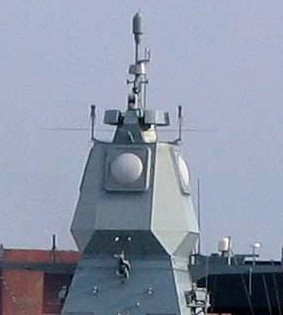
APAR mounted on top of the German Navy Sachsen class frigate Hamburg's superstructure
Rear side of APAR on board the German Navy Sachsen class frigate Hessen

Active Phased Array Radar (APAR) is a shipborne active electronically scanned array multifunction 3D radar (MFR) developed and manufactured by Thales Nederland.[1] The radar receiver modules are developed and built in the US by the Sanmina Corporation.[2]

Characteristics

[edit]

APAR has four fixed (i.e., non-rotating) sensor arrays (faces), fixed on a pyramidal structure. Each face consists of 3424 transmit/receive (TR) modules operating at X band frequencies.[3]

The radar provides the following capabilities:

  • air target tracking of over 200 targets out to 150 km[3]
  • surface target tracking of over 150 targets out to 32 km[3]
  • horizon search out to 75 km[3]
  • "limited" volume search out to 150 km[3] (in order to back up the volume search capabilities of the SMART-L)
  • cued search (a mode in which the search is cued using data originating from another sensor)
  • surface naval gunfire support[3]
  • missile guidance using the Interrupted Continuous Wave Illumination (ICWI) technique, thus allowing guidance of 32 semi-active radar homing missiles in flight simultaneously, including 16 in the terminal guidance phase[4]
  • "innovative" Electronic Counter-Countermeasures (ECCM)[3]

Note: all ranges listed above are instrumented ranges.

Usage

[edit]
APAR aboard the Royal Netherlands Navy De Zeven Provinciën class frigate HNLMS Tromp
APAR aboard the German Navy Sachsen class frigate Hessen at Kiel Week 2007

APAR is installed on four Royal Netherlands Navy (RNLN) LCF De Zeven Provinciën class frigates, three German Navy F124 Sachsen class frigates, and three Royal Danish Navy Iver Huitfeldt class frigates. The Netherlands and Germany (along with Canada) were the original sponsors for the development of APAR.

Denmark selected APAR for their frigates as part of a larger decision to select a Thales Nederland anti-air warfare system (designed around the APAR and SMART-L radars, the Raytheon ESSM and SM-2 missile systems, and the Lockheed Martin Mk-41 vertical launch system) over the competing Sea Viper anti-air warfare system (designed around the S1850M and BAE Systems SAMPSON radars, the MBDA Aster 15/30 missile systems, and the MBDA SYLVER vertical launch system).

Live missile firings

[edit]

APAR's missile guidance capability supports the Evolved Sea Sparrow Missile (ESSM) and the SM-2 Block IIIA missile. In November 2003, approximately 200 nautical miles (370 km) from the Azores, the missile guidance capabilities were tested with live firings for the first time.[4] The firings were performed by the RNLN's HNLMS De Zeven Provinciën and involved the firing of a single ESSM and a single SM-2 Block IIIA. These firings were the first ever live firings involving a full-size ship-borne Active Electronically Scanned Array guiding missiles using the ICWI technique in an operational environment.[5] As related by Jane's Navy International:

During the tracking and missile-firing tests, target profiles were provided by Greek-built EADS/3Sigma Iris PVK medium-range subsonic target drones. [...] According to the RNLN, ... "APAR immediately acquired the missile and maintained track until destruction". [...] These ground-breaking tests represented the world's first live verification of the ICWI technique.[4]

In August 2004, a German Navy Sachsen class frigate completed a series of live missile firings at the Point Mugu missile launch range off the coast of California that included a total of 11 ESSM and 10 SM-2 Block IIIA missiles.[4] The tests included firings against target drones such as the Northrop Grumman BQM-74E Chukkar III and Teledyne Ryan BQM-34S Firebee I, as well as against missile targets such as the Beech AQM-37C and air-launched Kormoran 1 anti-ship missiles.[4]

Further live firings were performed by the RNLN's HNLMS De Zeven Provinciën in March 2005, again in the Atlantic Ocean approximately 180 nautical miles (330 km) west of the Azores.[4] The tests involved three live-firing events including firing a single SM-2 Block IIIA at an Iris target drone at long range, a single ESSM at an Iris target drone, and a two-salvo launch (with one salvo comprising two SM-2 Block IIIAs and the other comprising two ESSMs) against two incoming Iris target drones.[4] The long-range SM-2 engagement apparently resulted in an intercept at a range of greater than 100 km from the ship, with a missile-target miss distance of 2,4m/8 feet (the warhead's proximity fuse having been disabled for the purposes of the test).[4]

Operational concept

[edit]

APAR is typically paired with Thales Nederland's SMART-L passive electronically scanned array radar (which operates at L band frequencies). SMART-L is a long-range Volume Search Radar (VSR) that is able to provide volume search and tracking out to 480 km. The whole system is called Anti-Air Warfare Systems (AAWS), and is based on the NATO Anti-Air Warfare (NAAWS) concept of the late 1980s. The principle behind this concept is that an X band MFR coupled with an L band VSR provides the optimal combination of complementary capabilities: the VSR is optimized for long range detection and tracking of targets, while the MFR is optimized for medium range high accuracy tracking of targets, as well as horizon search and missile guidance functions.[citation needed]

Counter-piracy operations

[edit]

Ships of the RNLN's De Zeven Provinciën class have been involved in counter-piracy operations off the Horn of Africa. The untraditional target set (i.e., small slow-moving or even static surface targets) can apparently be challenging for doppler radars designed to take on "high end" threats. However, according to Jane's International Defence Review:[citation needed]

[The RNLN has] reported great success using tailored surface-search software for the APAR sets fitted to the De Zeven Provinciën-class frigates deployed on anti-piracy roles. By sacrificing some of APAR's high-end anti-air warfare capabilities, which were deemed unnecessary for the anti-piracy role, its performance and resolution were improved in the surface-search role.[6]

The exploits of the RNLN's De Zeven Provinciën class frigate HNLMS Tromp in regards to counter-piracy operations — including the April 2010 rescue of the container ship MV Taipan — are described here. The counter-piracy exploits of the HNLMS Evertsen are outlined here.

Operators

[edit]

See also

[edit]

Notes

[edit]

Sources

[edit]
  • Jane's International Defence Review, September 2010, "Fighting the hydra: multinational piracy operations move inshore"
  • Jane's Navy International, August 2010, "Expanding coverage from sea to sky"
  • Jane's Radar and Electronic Warfare Systems, 2007–2008 Edition, Edited by Martin Streetly, ISBN 978-0-7106-2811-4
  • Jane's Navy International, October 2005, "Live firing tests rewrite the guiding principles"
  • Jane's International Defence Review, February 2004, "Active phased array multifunction radars go live for missile firings"
[edit]
Revisions and contributorsEdit on WikipediaRead on Wikipedia
from Grokipedia
An active phased array radar (APAR) is a radar system that utilizes a large array of antenna elements, each equipped with an individual solid-state transmit/receive (T/R) module, to electronically steer and shape its beam for detecting, tracking, and illuminating multiple targets without mechanical movement of the antenna.[1][2] Unlike traditional radars that rely on a single central transmitter and mechanical scanning, APAR distributes amplification and phase control across the array, allowing for instantaneous beam repositioning and simultaneous operation in multiple directions.[3] This architecture, often implemented with gallium arsenide (GaAs) or gallium nitride (GaN) monolithic microwave integrated circuits (MMICs) in the T/R modules, supports high-power output (typically around 10 W per module at X-band frequencies) and low noise figures (3–4 dB), enhancing sensitivity and reliability.[2][3] Development of APAR technology traces back to the 1960s, with early examples like the AN/FPS-85 radar, a large-scale system operating at 442 MHz with over 4,000 elements capable of tracking more than 200 targets at ranges up to 4,000 km.[4] Subsequent advancements in the 1970s and beyond, such as the U.S. Navy's AN/SPY-3 and the more recent AN/SPY-6 systems (deployed starting in the early 2020s), integrated APAR into shipboard applications for multifunction roles including air and surface surveillance, horizon search, and missile guidance against threats like cruise and ballistic missiles.[3][2][5] Key advantages include rapid beam agility for time-multiplexed search and tracking, graceful degradation if individual modules fail (due to the distributed nature of the system), and improved performance in cluttered environments through better clutter attenuation (up to 56.7 dB) and adaptive waveform flexibility.[1][3] These features enable digital beamforming for multiple simultaneous beams, making APAR essential in modern military platforms for space surveillance, air defense, and electronic warfare.[4][2]

Development and History

Origins and Requirements

Following the end of the Cold War, the Royal Netherlands Navy (RNLN) faced evolving maritime threats that demanded versatile surveillance and defense capabilities beyond the traditional focus on Soviet naval forces. These included asymmetric risks from regional conflicts, terrorism, and advanced anti-ship missiles, necessitating a multi-role radar system capable of simultaneous air defense, surface surveillance, and missile guidance to support NATO operations and power projection in uncertain environments.[6][7] The RNLN outlined specific requirements for the De Zeven Provinciën-class frigates in the mid-1990s, prioritizing an active phased array radar with gallium arsenide (GaAs) technology to achieve high power output and reliability in compact modules for shipboard integration. This emphasis on GaAs enabled efficient solid-state amplification, supporting robust performance against sea-skimming threats while minimizing size and weight constraints on the frigates.[8][9] Initial collaboration between Thales Nederland (formerly Hollandse Signaal Apparaten) and the RNLN began in 1993 with a development contract, building on earlier experimental work like the 1989 EXPAR demonstrator to define the APAR system's architecture tailored to these frigate needs. Key performance goals included simultaneous tracking of over 250 targets, enhanced resistance to electronic countermeasures through adaptive beamforming, and low sidelobe levels to reduce vulnerability to jamming and improve detection accuracy in cluttered maritime environments.[10][9]

Key Milestones

The development of the Active Phased Array Radar (APAR) originated from the Experimental X-band Phased Array Radar (EXPAR) demonstrator program initiated in the Netherlands in 1989 by Signaal (now Thales Nederland) and TNO-FEL. In 1993, the Royal Netherlands Navy awarded an $18 million contract to Signaal and TNO-FEL for APAR development, marking the start of formal prototype efforts. This was followed by a 1995 engineering and manufacturing development contract valued at $125 million, jointly funded by the Netherlands, Germany, and Canada, to advance the system's design and integration.[10] The prototype phase progressed with the installation of the Engineering Development Model (EDM) at the Royal Netherlands Navy's Land Based Test Site in December 1999, enabling initial ground-based tests in 2000 and 2001. These evaluations covered phases for search and detection (completed May 2000), tracking, and electronic countermeasures (completed September 2000), confirming the radar's multifunction capabilities. Sea trials integration on the HNLMS De Zeven Provinciën commenced in July 2001, with initial at-sea testing alongside the German Sachsen-class frigate in August and September 2001. Live missile firings were conducted in November 2003 from De Zeven Provinciën, and the system achieved initial operational capability in 2005, highlighted by a March demonstration where it simultaneously guided four missiles during trials.[10] International collaborations expanded APAR's adoption, including technology sharing with Germany for the Sachsen-class frigates, where installation began in January 2001 and live firings were completed at the U.S. Pacific Missile Range in August 2004. In December 2006, Thales Nederland secured a contract to supply three APAR systems for Denmark's Iver Huitfeldt-class frigates, with factory acceptance tests in 2011 and sea acceptance trials completed by 2013 on HDMS Peter Willemoes.[10][11] During the 2010s, Thales pursued upgrades through the APAR Block 2 variant, incorporating true digital beamforming, gallium nitride amplifiers, and enhanced multi-beam search for improved detection of low-elevation and small radar cross-section targets in littoral environments. This evolution addressed evolving naval requirements for robust air defense. In 2020, Thales was selected to supply APAR Block 2 for the German Navy's MKS-180 frigates. In June 2023, contracts were awarded to equip new Dutch and Belgian anti-submarine warfare frigates with APAR Block 2 integrated in an above-water sensors suite, with initial operational capability expected in 2028. From 2020 to 2025, ongoing maintenance and support contracts have sustained APAR operations across NATO platforms.[12][13][14]

Technical Design

Core Architecture

The core architecture of active phased array radars (APARs) typically features a large array of antenna elements, each connected to a solid-state transmit/receive (T/R) module, allowing electronic control of phase and amplitude for beam steering and shaping. Configurations vary, including planar arrays for limited field-of-view applications or multi-face designs like pyramidal structures for full 360-degree azimuthal coverage in naval systems. For example, the Thales APAR employs four fixed faces, each with 3,424 gallium arsenide (GaAs)-based T/R modules, enabling independent control for multifunction operations such as search, tracking, and illumination.[15][16] This distributed solid-state design replaces traditional centralized transmitters, enhancing reliability through redundancy and graceful degradation if individual modules fail. APARs commonly operate in frequency bands such as X-band (8–12 GHz) for high resolution or S-band for longer-range surveillance, achieving precise target discrimination in cluttered environments. The T/R modules support low-probability-of-intercept (LPI) modes by distributing transmit power across the array, reducing detectability compared to high-power single-source systems. Power requirements vary by system scale, with examples like the Thales APAR supported by dedicated AC/DC converters delivering up to 35 kW, and modular arrangements allowing efficient cooling and power management.[17][18] The architecture often employs modular backplanes interconnecting T/R modules, signal processing units, and power supplies, promoting scalability for upgrades and maintenance without full system disassembly. This modularity supports lifecycle extensions, as seen in planned upgrades like the Thales APAR Block 2 (under development as of 2025), which incorporates gallium nitride (GaN) elements for improved efficiency while maintaining core structure.[12] Integration with command and control systems occurs through standardized interfaces, such as NATO Link 16 for real-time data sharing in networked operations.[19] Beam steering in APARs is achieved electronically by applying phase shifts across the T/R modules, without mechanical movement. The steering angle θ\theta is given by the equation:
θ=arcsin(λΔϕ2πd) \theta = \arcsin\left(\frac{\lambda \cdot \Delta\phi}{2\pi \cdot d}\right)
where θ\theta is the steering angle, λ\lambda is the wavelength, Δϕ\Delta\phi is the progressive phase shift between adjacent elements, and dd is the element spacing (typically λ/2\lambda/2 to avoid grating lobes). This derivation follows from the path length difference for plane wave propagation: the phase shift Δϕ=2πdsinθλ\Delta\phi = \frac{2\pi d \sin\theta}{\lambda}, rearranged to solve for θ\theta. The equation assumes a linear array approximation but extends to the planar configuration via vector summation in two dimensions.[20][21]

Beam Steering and Signal Processing

Beam steering in active phased array radar (APAR) is achieved through electronic scanning using phase shifters integrated into each transmit-receive module (TRM), enabling rapid repositioning of the radar beam without any mechanical components.[22] This method allows beam steering times on the order of microseconds, far surpassing the limitations of mechanical systems that require seconds for repositioning.[23] By adjusting the phase of the signal fed to each TRM, the direction of constructive interference—and thus the beam—can be precisely controlled across a wide angular field. Adaptive beamforming techniques enhance APAR performance by dynamically shaping the antenna pattern to optimize signal reception. These methods include nulling, where deep nulls are placed in the direction of interference sources to suppress jamming signals while maintaining gain toward desired targets.[24] For instance, adaptive algorithms can form nulls with significant attenuation against jammers, as demonstrated in digital beamforming implementations.[25] This capability is particularly vital in contested electromagnetic environments, allowing the radar to maintain operational effectiveness against electronic countermeasures. Monopulse processing provides high-precision angle estimation in APAR systems by comparing signals from multiple simultaneous beams formed within the array. In a typical four-channel monopulse configuration, sum and difference patterns are generated digitally: the sum beam maximizes power on boresight, while azimuth and elevation difference beams detect angular deviations.[26] The angle error is computed as θΔΣΣ\theta \approx \frac{\Delta \Sigma}{\Sigma}, where ΔΣ\Delta \Sigma and Σ\Sigma are the difference and sum channel outputs, respectively, achieving sub-degree accuracy even for low signal-to-noise ratios.[27] This technique enables real-time tracking updates without sequential scanning, supporting rapid target acquisition. Digital signal processing (DSP) in APAR leverages field-programmable gate arrays (FPGAs) for high-speed, real-time operations such as waveform generation and clutter rejection. FPGAs handle parallel processing of digitized returns from the array elements, generating arbitrary waveforms on-the-fly to match mission requirements, including pulse compression for improved range resolution. For clutter rejection, adaptive filtering algorithms implemented on FPGAs suppress ground or sea clutter by estimating and subtracting interference covariance, often using space-time adaptive processing (STAP) to isolate moving targets.[28] This digital approach allows reconfiguration during operation, enhancing flexibility over analog systems. A key advantage of APAR is its multi-function operation, enabling simultaneous execution of search, track, and illuminate modes through time-multiplexed or independent beam scheduling. In search mode, a broad scanning beam surveys volumes for new detections; track mode maintains narrow beams on confirmed targets for position updates; and illuminate mode directs high-power beams to guide semi-active missiles.[4] This concurrency is facilitated by the array's ability to form multiple independent beams, governed by the array factor equation:
AF(θ)=n=0N1ej(kdnsinθ+ϕn) AF(\theta) = \sum_{n=0}^{N-1} e^{j (k d n \sin\theta + \phi_n)}
Here, NN is the number of elements, k=2π/λk = 2\pi / \lambda is the wavenumber, dd is the element spacing, θ\theta is the angle from broadside, and ϕn\phi_n is the progressive phase shift applied to the nn-th element. To derive this, consider the far-field approximation for a uniform linear array: the electric field contribution from the nn-th element at the observation point includes a propagation phase delay ejkdnsinθe^{j k d n \sin\theta} due to path length difference relative to the origin, plus the controlled steering phase ϕn=kdnsinθ0\phi_n = -k d n \sin\theta_0 for beam direction θ0\theta_0. Assuming equal amplitude excitation, the total field is the phasor sum, yielding the array factor as a measure of directional gain. For non-uniform ϕn\phi_n, the sum generalizes to arbitrary beam shapes, including multiple lobes.[20][29] Software-defined radar capabilities in APAR systems enable dynamic frequency agility, allowing adaptive selection of operating frequencies to evade interference or optimize propagation. These features, enhanced through upgrades incorporating programmable DSP architectures, permit real-time waveform and frequency adjustments without hardware changes.[30] For example, frequency hopping across the allocated band mitigates jamming by spreading energy, improving anti-jam performance in multifunction scenarios.[31]

Capabilities and Performance

Detection and Tracking Features

The Active Phased Array Radar (APAR), developed by Thales Nederland, provides robust detection and tracking capabilities optimized for simultaneous air and surface surveillance in complex naval scenarios. Its instrumented range reaches up to 150 km for aerial targets and approximately 32 km for surface targets, supported by a horizon search mode extending to 75 km for low-elevation threats such as sea-skimming missiles.[16] This performance envelope enables effective monitoring within medium-range engagements, complemented by the radar's X-band operation for enhanced resolution against small or fast-moving objects.[17] APAR supports tracking of up to 200 aerial targets simultaneously at its maximum air range, with capacity for 150 surface tracks at shorter distances, leveraging its active electronically scanned array architecture to maintain high update rates without mechanical rotation. The APAR Block 2 upgrade enhances this with a tracking capacity of ≥1000 targets and improved digital beamforming.[16][12] The system's high-power aperture in the X-band facilitates detection of low-observable (stealth) targets by improving signal returns from reduced radar cross-section objects, particularly in cluttered environments where traditional radars may struggle.[10] Angular resolution is superb, allowing precise discrimination of closely spaced targets through monopulse techniques and digital beamforming.[9] Key operational modes include volume search for broad airspace scanning, precision tracking for illuminated targets during intercepts, and horizon search for surface and low-altitude threats, all integrated within a single multifunction framework.[32] Resistance to chaff and decoys is achieved via advanced Doppler processing, which filters false targets based on velocity signatures, ensuring reliable discrimination in electronic warfare conditions.[9] For environmental adaptations, APAR operates effectively in high-sea states by employing adaptive thresholds that dynamically adjust for sea clutter and weather-induced noise, minimizing false alarms while preserving detection integrity.[33]

Integration with Weapon Systems

The Active Phased Array Radar (APAR) plays a critical role in guiding semi-active homing missiles such as the SM-2 and Evolved SeaSparrow Missile (ESSM) through terminal illumination using continuous wave (CW) and interrupted continuous wave illumination (ICWI) techniques.[34] This capability has been demonstrated in over 50 successful live firings involving ESSM and SM-2 missiles across NATO navies.[12] For the ESSM, APAR supports command midcourse guidance, where midcourse uplinks provide command updates to the missile based on radar-derived target data, enhancing accuracy against maneuvering threats.[35] APAR integrates seamlessly with weapon systems via the SEWACO (now evolved into TACTICOS) combat management system, enabling automated handoff of target tracks for engagement decisions and fire control.[36] This integration allows APAR to support up to 16 simultaneous illuminations for missile guidance, facilitating multi-target engagements in high-threat environments without dedicated illuminators.[9] TACTICOS automates the process by fusing APAR tracks with other sensor inputs, prioritizing threats, and directing weapons launches to optimize response times.[37] In addition to missile support, APAR provides real-time target data for gunfire integration, particularly with the 127mm Oto Melara gun on platforms like the De Zeven Provinciën-class frigates, enabling precise surface and air fire control.[38] The radar's high-resolution tracking feeds angular and velocity data directly into the combat management system, supporting rapid salvo fire against dynamic targets.[38] APAR enhances network-centric warfare through compatibility with data fusion from sonar and electronic warfare (EW) sensors, contributing to 360-degree situational awareness via the TACTICOS framework.[39] This multi-sensor integration correlates radar tracks with underwater and electromagnetic signatures for comprehensive threat pictures.[37] Furthermore, APAR adheres to MIL-STD-6016 protocols for Link 16 tactical data link integration, enabling cooperative engagement capability (CEC) by sharing real-time tracks with allied ships for distributed fire control.[40]

Operational Deployments

The primary naval deployment of the Active Phased Array Radar (APAR) is on the four De Zeven Provinciën-class frigates of the Royal Netherlands Navy (RNLN), where the system entered service starting with the lead ship HNLMS De Zeven Provinciën in April 2002.[38] These air defense and command frigates represent the first operational platform for APAR, providing multifunction radar capabilities integrated into the ship's combat management system for simultaneous air and surface surveillance.[17] The German Navy followed with integration on its three Sachsen-class frigates, beginning with FGS Sachsen commissioned in 2008, enhancing the fleet's anti-air warfare role through APAR's precise tracking and illumination functions. In the Royal Danish Navy, APAR variants were installed on the three Iver Huitfeldt-class frigates from 2012 onward, with the lead ship HDMS Iver Huitfeldt entering service that year; these flexible multimission ships utilize the radar for volume search and fire control in a modular configuration.[41] APAR's installation on these platforms emphasizes stealth and structural efficiency, typically mounted on an integrated mast that consolidates sensors to minimize the ship's radar cross-section (RCS) by reducing protrusions and optimizing geometry.[38] This design choice, prominent on the De Zeven Provinciën-class, lowers detectability while maintaining 360-degree coverage via the radar's four fixed antenna arrays. The total weight of the APAR system above deck is under 11 tons, facilitating integration without excessive structural demands on the host vessel.[32] As of 2025, all four RNLN De Zeven Provinciën-class frigates remain fully operational, supporting NATO missions and undergoing targeted modernizations such as enhanced missile compatibility, with no retirements planned until the mid-2030s.[42] The German Sachsen-class ships are in the midst of mid-life upgrades, including radar suite enhancements like replacement of complementary long-range sensors and electronic warfare improvements, ensuring continued service through the 2030s. The Danish Iver Huitfeldt-class continues active deployments, though integration challenges with APAR have prompted ongoing software refinements.[43] Beyond Europe, export interest in APAR has been noted from navies such as those of Australia and South Korea for potential upgrades to existing or future surface combatants, driven by its proven multifunction performance; however, no confirmed sales or integrations have occurred outside European fleets as of 2025.[10] The Canadian Surface Combatant program has evaluated APAR as a potential option for its 15 planned multi-role ships, though the program ultimately selected alternative radar systems like the SPY-7, leaving room for variant considerations in future enhancements.[44]

Testing and Live Exercises

The development of the Active Phased Array Radar (APAR) involved extensive testing to validate its multifunction capabilities, including surveillance, tracking, and missile guidance. Initial at-sea trials were conducted off Den Helder, the Netherlands, in the early 2000s, where the engineering development model was integrated with anti-air warfare systems to demonstrate 360-degree coverage and robust performance in maritime environments. These trials, supported by the Dutch Ministry of Defence, focused on pulse compression and low-altitude target detection, confirming the radar's ability to handle simultaneous tasks without mechanical scanning.[35][45] Further validation occurred during NATO exercises, highlighting APAR's role in providing real-time air and surface pictures and enhancing coordinated operations. Subsequent upgrades have been evaluated in Formidable Shield exercises, a NATO-led integrated air and missile defense demonstration, including the 2021 edition with HNLMS De Zeven Provinciën and the 2025 edition with HDMS Iver Huitfeldt, underscoring improvements in beam agility and signal processing for intercepts against anti-ship missiles.[10][46] Efforts to integrate with the U.S. Aegis combat system have included datalink demonstrations enabling APAR to share tracking data with SPY-1 radars for joint missile engagements.[47] Environmental trials in Arctic conditions were performed on Danish Iver Huitfeldt-class frigates, assessing performance in low-temperature and high-sea-state scenarios to ensure reliability for northern deployments. Key metrics from these trials include a mean time between failures (MTBF) exceeding 10,000 hours, achieved through redundant transmit/receive modules and graceful degradation protocols, with trial outcomes validating over 99% availability during extended operations.[17][34] These non-combat evaluations, often integrated with weapon systems like the Evolved SeaSparrow Missile, have consistently demonstrated APAR's reliability and seamless operation within NATO frameworks.[48]

Specific Missions

Missile Interception Trials

A significant missile interception trial involving the Active Phased Array Radar (APAR) occurred in August 2004 aboard the German Navy's F124-class frigate FGS Sachsen during live-fire tests at the Point Mugu missile range off the coast of California. In this event, APAR successfully guided SM-2 Block IIIA missiles to intercept aerial target drones such as the BQM-74E Chukar III at extended ranges, demonstrating the radar's precision in providing illumination and command guidance for semi-active homing missiles under operational conditions.[49] This trial marked a milestone in validating APAR's multifunction capabilities for simultaneous tracking and fire control in a naval environment.[50] Subsequent Dutch trials in March 2005 aboard HNLMS De Zeven Provinciën advanced APAR's integration with evolved Sea Sparrow Missiles (ESSM). The exercise involved firing ESSM missiles against subsonic aerial targets, with APAR providing continuous wave illumination (CWCI) guidance to achieve direct hits, confirming the radar's ability to handle multiple engagements without dedicated illuminators.[10] These tests highlighted APAR's robustness in guiding quad-packed ESSM launches from Mk 41 vertical launch systems, establishing it as a key enabler for high-volume missile salvos.[38] In May 2021, during the multinational Exercise Formidable Shield, HNLMS De Zeven Provinciën conducted firings of two ESSM missiles against aerial targets, where APAR provided illumination and guidance for successful intercepts, while also supporting ballistic missile tracking in coordination with SMART-L radar. This exercise showcased APAR's integration with NATO-standard weapon systems and its performance against complex threats in integrated air and missile defense scenarios.[51]

Maritime Security Roles

Active Phased Array Radar (APAR) systems have been integral to non-combat maritime security operations, enabling enhanced surveillance against asymmetric threats such as piracy and smuggling in high-risk areas like the Gulf of Aden and Indian Ocean. Equipped on Royal Netherlands Navy (RNLN) frigates, APAR's multifunction capabilities support persistent monitoring of surface vessels, including small, low-signature targets like pirate dhows, through its advanced surface search modes that leverage electronic beam steering for wide-area coverage.[52] Since the launch of EU NAVFOR Operation Atalanta in 2008, APAR has contributed to surface tracking of potential threats, allowing RNLN vessels such as HNLMS De Zeven Provinciën and HNLMS Tromp to detect and monitor pirate groups off the coast of Somalia, facilitating coordinated responses to deter piracy.[53] In 2010, during Gulf of Aden patrols by HNLMS Tromp, the frigate intercepted a pirate action group as part of Operation Atalanta efforts.[54] APAR's integration with unmanned aerial vehicles (UAVs) enhances persistent surveillance for maritime security, providing radar cues to extend detection horizons and verify targets in real-time.[55] To address asymmetric threats, APAR incorporates adaptations for slow-speed target discrimination, using Doppler processing to distinguish low-velocity vessels from sea clutter, and precise cueing for helicopter deployments, enabling rapid verification and interdiction in complex scenarios.[15] These features build on APAR's core surface detection capabilities, such as multi-beam tracking, to support non-kinetic security missions with minimal operator intervention.[56]

Limitations and Future Upgrades

Known Challenges

Active phased array radars (APARs), such as the Thales APAR system, exhibit high power consumption requirements that can strain naval platform generators and necessitate advanced cooling infrastructure. For instance, the APAR Block 2 demands electrical power starting from 300 kVA and coolant dissipation from 250 kW, depending on configuration, which imposes significant demands on shipboard power systems and thermal management to maintain operational reliability.[12] APARs face vulnerabilities to advanced jamming in contested electromagnetic environments, partly due to their operation in the X-band frequency range, which offers high resolution but can limit effectiveness against stealthy cruise missiles optimized for low-frequency detection challenges. Market analyses highlight that environmental interference and jamming susceptibility remain key hurdles for APAR deployment, potentially degrading performance in high-threat scenarios.[57][58] Maintenance of APAR systems is complex, particularly involving transmit-receive modules (TRMs), where faulty units typically require specialized repair facilities rather than at-sea fixes, often necessitating dry-dock access for comprehensive replacement and testing. The cost of an APAR unit is estimated at approximately $10-12 million, reflecting the intricate gallium arsenide-based TRM technology and integration demands that elevate overall lifecycle expenses.[10] Operational reports from the 2010s and beyond indicate intermittent performance issues, such as radar and combat system malfunctions during extended deployments in challenging conditions, including the Danish Iver Huitfeldt-class frigate's experiences in the Red Sea in 2023-2024, where APAR-linked problems affected detection and response capabilities. While specific high-sea state beam failures in the 2010s are not widely documented, broader analyses note that motion-induced distortions in rough seas can contribute to temporary signal degradation in shipborne active arrays.[59] Compared to passive phased array radars, APARs incur higher costs due to distributed amplification in each element but justify this through enhanced beam agility, redundancy, and multitasking capabilities, such as simultaneous search, tracking, and illumination without mechanical rotation. Passive arrays offer simpler power distribution and lower initial expenses but lack the graceful degradation and jamming resistance provided by active elements, creating a trade-off where APARs excel in dynamic naval environments despite elevated complexity and price.[60][2]

Planned Enhancements

To address known challenges such as limited power efficiency and tracking capabilities against emerging threats, the Active Phased Array Radar (APAR) is undergoing significant upgrades through the APAR Block 2 program, designed to extend its operational lifespan beyond 2030. A primary enhancement involves the adoption of gallium nitride (GaN) transmit/receive modules (TRMs) beginning in 2026, which will improve power output, overall efficiency, and thermal management compared to existing gallium arsenide-based systems.[61][62] Software upgrades incorporate advanced algorithms for clutter rejection and target tracking, building on a reconfigurable digital architecture that supports seamless integration with evolving sensor networks.[61] The upgrade timeline targets upgrades for two De Zeven Provinciën-class frigates in the Royal Netherlands Navy (RNLN) starting in 2028, while export variants are planned for integration into new frigates for partner navies such as those in Belgium and Germany. As of November 2025, initial deliveries of APAR Block 2 are expected in 2028.[63][64] Projected benefits include enhanced detection and tracking capabilities, alongside higher reliability and reduced maintenance demands in prolonged operations.[65]

References

User Avatar
No comments yet.