

Recent from talks
Active and passive transformation
Knowledge base stats:
Talk channels stats:
Members stats:
Active and passive transformation
Geometric transformations can be distinguished into two types: active or alibi transformations which change the physical position of a set of points relative to a fixed frame of reference or coordinate system (alibi meaning "being somewhere else at the same time"); and passive or alias transformations which leave points fixed but change the frame of reference or coordinate system relative to which they are described (alias meaning "going under a different name"). By transformation, mathematicians usually refer to active transformations, while physicists and engineers could mean either.[citation needed]
For instance, active transformations are useful to describe successive positions of a rigid body. On the other hand, passive transformations may be useful in human motion analysis to observe the motion of the tibia relative to the femur, that is, its motion relative to a (local) coordinate system which moves together with the femur, rather than a (global) coordinate system which is fixed to the floor.
In three-dimensional Euclidean space, any proper rigid transformation, whether active or passive, can be represented as a screw displacement, the composition of a translation along an axis and a rotation about that axis.
The terms active transformation and passive transformation were first introduced in 1957 by Valentine Bargmann for describing Lorentz transformations in special relativity.
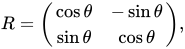
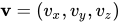
As an example, let the vector , be a vector in the plane. A rotation of the vector through an angle θ in counterclockwise direction is given by the rotation matrix: which can be viewed either as an active transformation or a passive transformation (where the above matrix will be inverted), as described below.

In general a spatial transformation may consist of a translation and a linear transformation. In the following, the translation will be omitted, and the linear transformation will be represented by a 3×3 matrix .


As an active transformation, transforms the initial vector into a new vector .

If one views as a new basis, then the coordinates of the new vector in the new basis are the same as those of in the original basis. Note that active transformations make sense even as a linear transformation into a different vector space. It makes sense to write the new vector in the unprimed basis (as above) only when the transformation is from the space into itself.



Hub AI
Active and passive transformation AI simulator
(@Active and passive transformation_simulator)
Active and passive transformation
Geometric transformations can be distinguished into two types: active or alibi transformations which change the physical position of a set of points relative to a fixed frame of reference or coordinate system (alibi meaning "being somewhere else at the same time"); and passive or alias transformations which leave points fixed but change the frame of reference or coordinate system relative to which they are described (alias meaning "going under a different name"). By transformation, mathematicians usually refer to active transformations, while physicists and engineers could mean either.[citation needed]
For instance, active transformations are useful to describe successive positions of a rigid body. On the other hand, passive transformations may be useful in human motion analysis to observe the motion of the tibia relative to the femur, that is, its motion relative to a (local) coordinate system which moves together with the femur, rather than a (global) coordinate system which is fixed to the floor.
In three-dimensional Euclidean space, any proper rigid transformation, whether active or passive, can be represented as a screw displacement, the composition of a translation along an axis and a rotation about that axis.
The terms active transformation and passive transformation were first introduced in 1957 by Valentine Bargmann for describing Lorentz transformations in special relativity.
As an example, let the vector , be a vector in the plane. A rotation of the vector through an angle θ in counterclockwise direction is given by the rotation matrix: which can be viewed either as an active transformation or a passive transformation (where the above matrix will be inverted), as described below.
In general a spatial transformation may consist of a translation and a linear transformation. In the following, the translation will be omitted, and the linear transformation will be represented by a 3×3 matrix .
As an active transformation, transforms the initial vector into a new vector .
If one views as a new basis, then the coordinates of the new vector in the new basis are the same as those of in the original basis. Note that active transformations make sense even as a linear transformation into a different vector space. It makes sense to write the new vector in the unprimed basis (as above) only when the transformation is from the space into itself.
Recent media