



Community hub
Recent from talks
Contribute something
Nothing was collected or created yet.
Adjusted ERA+
View on Wikipedia | This article is missing information about who coined the term adjusted ERA+. (September 2015) |
Adjusted ERA+, often simply abbreviated to ERA+ or ERA plus, is a pitching statistic in baseball. It adjusts a pitcher's earned run average (ERA) according to the pitcher's ballpark (in case the ballpark favors batters or pitchers) and the ERA of the pitcher's league.
Formula
[edit]ERA+ is calculated as:
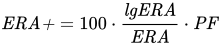
Where ERA is the pitcher's ERA, lgERA is the average ERA of the league, and PF is the park factor of the pitcher in question.
This formula is now standard,[1] although Baseball-Reference.com briefly used a different formula which took values strictly between 0 and 200 instead of between 0 and infinity, but the current website shows values above 200 so it is clearly no longer in use:[2][3]

The average ERA+ is set to be 100; a score above 100 indicates that the pitcher performed better than average, while below 100 indicates worse than average. For instance, imagine the average ERA in the league is 4.00: if pitcher A has an ERA of 4.00 but is pitching in a ballpark that favors hitters, his ERA+ will be over 100. Likewise, if pitcher B has an ERA of 4.00 but pitches in a ballpark favoring pitchers, then his ERA+ will be below 100.
As a result, ERA+ can be used to compare pitchers across different run environments. In the above example, while ERA will lead one to believe that both pitchers pitched at the same level due to their ERAs being equivalent, ERA+ indicates that pitcher A performed better than pitcher B. ERA+ can thus be used to neutralize the effects of some well-known advantages and disadvantages on pitchers' ERA scores.
Leaders
[edit]Pedro Martínez holds the modern record for highest ERA+ in a single season; he posted a 1.74 ERA in the 2000 season while pitching in the American League, which had an average ERA of 4.92, which gave Martínez an ERA+ of 291.[4] While Bob Gibson has the lowest ERA in modern times (1.12 in the National League in 1968), the average ERA was 2.99 that year (the so-called Year of the Pitcher) and so Gibson's ERA+ is 258, eighth highest since 1900. 1968 was the last year that Major League Baseball employed the use of a pitcher's mound at 15 inches (380 mm), since 10 inches (250 mm).[5]
The career record for ERA+ (with a minimum of 1,000 innings pitched) is held by Mariano Rivera, a closer whose career ERA+ is 205. Upon retirement in 2013, with an ERA+ of 194 in his final season, Rivera's career record of 205 surpassed the record among retired players of 154, held by Martínez, bumping Jim Devlin, a pitcher in the 1870s, to third with 151.[6] Among qualifying pitchers, Pedro Martínez has the most separate seasons with an ERA+ over 200, with five, and the most consecutive 200 ERA+ seasons (4), though the closer Rivera, with too few innings each year to qualify officially, has surpassed 200 ERA+ in 13 seasons of his 19 seasons, including 4 consecutive seasons twice and 5 consecutive seasons once and also surpassing 300 in 2004 and again in 2008. Roger Clemens topped a 200 ERA+ three times, and Greg Maddux had two such seasons.
Players in bold are active as of the end of the 2020 season and have not announced their retirement.
Single-season leaders include only pitchers eligible for the ERA title (a pitcher must throw a minimum of one inning per game scheduled for his team during the season to qualify for the ERA title).[7] Only pitchers with 1,000 or more innings pitched are shown in the career leader list.
References
[edit]- ^ "Adjusted Earned Run Average (ERA+)". MLB.com.
- ^ Forman, Sean. "We Goofed: ERA+ numbers » Baseball-Reference Blog » Blog Archive". www.baseball-reference.com. Retrieved 1 August 2016.
- ^ "Esoteric Ramblings About +". 28 March 2010.
- ^ Single season awards require a minimum of one inning pitched for each game played (thus usually 162 IP in today's game). Thus closers and other relievers will not generally acquire enough innings pitched to qualify.
- ^ Baseball Trivia (General) - Pitchers mound Archived 2009-04-18 at the Wayback Machine, allexperts.com.
- ^ Baseball Reference career ERA+ leaders, accessed June 6, 2021. Also the source for the corresponding table.
- ^ "Official Rules: 10.00 The Official Scorer". Major League Baseball. Retrieved 15 October 2016.
- ^ "Single-Season Leaders & Records for Adjusted ERA+". Baseball-Reference.com. Retrieved 2020-11-20.
Adjusted ERA+
View on GrokipediaOverview
Definition
Adjusted ERA+, often abbreviated as ERA+, is a normalized pitching statistic in Major League Baseball (MLB) that adjusts a pitcher's earned run average (ERA) to account for variations in ballpark dimensions, environmental factors, and league-wide offensive levels, providing a standardized measure of performance across different contexts.[8][1] Unlike raw ERA, which measures the average number of earned runs allowed per nine innings pitched without such adjustments, ERA+ enables fairer comparisons between pitchers who perform in diverse stadiums—such as hitter-friendly parks like Coors Field or pitcher-friendly venues like Oracle Park—by normalizing these external influences.[8][1] The metric is expressed on a scale where 100 represents the league average for a given season, with values above 100 indicating superior performance (e.g., 110 means 10% better than average) and values below 100 signifying below-average effectiveness.[8] This park- and league-adjusted framework ensures that a pitcher's ERA is contextualized relative to the run-scoring environment, highlighting true skill rather than circumstantial advantages or disadvantages.[1] For instance, a pitcher with a 3.00 ERA in a high-offense league and ballpark might have an ERA+ of 100, matching league average, while the same ERA in a low-offense setting could yield a higher ERA+ reflecting exceptional performance.[8] ERA+ was first introduced by sabermetricians Pete Palmer and John Thorn in their 1984 book The Hidden Game of Baseball to address the limitations of unadjusted ERA in an era of increasing statistical sophistication, becoming a staple in sabermetrics since its popularization in the late 20th century through resources like Baseball-Reference.[9][1] It focuses exclusively on earned runs, excluding those from errors or other defensive miscues, and is calculated using the pitcher's actual innings and runs allowed, adjusted post hoc for the specific conditions of play.[8] This adjustment process underscores ERA+'s role as a context-neutral evaluator, widely used by analysts, scouts, and front offices to assess pitching talent objectively.[1]Purpose and Significance
Adjusted ERA+, commonly referred to as ERA+, serves to normalize a pitcher's earned run average (ERA) by accounting for variations in ballpark dimensions and environmental factors that influence scoring, as well as differences in league-wide run production across seasons.[1] This adjustment creates a park- and league-neutral metric where 100 represents the league average, allowing pitchers with ERAs above or below this benchmark to be evaluated relative to their contemporaries regardless of venue.[10] The primary purpose of ERA+ is to mitigate biases inherent in raw ERA, such as those introduced by hitter-friendly parks like Coors Field, where elevated run totals can inflate a pitcher's ERA, or pitcher-friendly venues like Oracle Park, which suppress scoring and artificially lower it.[11] By incorporating park factors—derived from historical scoring data—and scaling against the league's average ERA, ERA+ isolates a pitcher's individual effectiveness from external influences, providing a more accurate gauge of skill.[1] This is particularly vital in an era of interleague play and universal designated hitter rules, where cross-league comparisons were once complicated by structural differences.[10] Its significance lies in facilitating equitable historical and cross-era analysis of pitchers, a cornerstone of sabermetric evaluation. For instance, without such adjustments, a dominant performer in a low-scoring dead-ball era might appear superior to one in a high-offense modern context, skewing legacy assessments.[12] ERA+ addresses this by standardizing performance, enabling metrics like career leaderboards to reflect true dominance—evidenced by all-time greats like Mariano Rivera posting a 205 career ERA+, indicating 105% better-than-average effectiveness over his tenure.[5] Widely adopted by analysts and award voters, it underscores pitching excellence beyond circumstantial advantages.[11]Calculation
Components of ERA
Earned Run Average (ERA) is a fundamental pitching statistic in Major League Baseball (MLB) that measures the average number of earned runs a pitcher allows per nine innings pitched. The core components of ERA are earned runs (ER), innings pitched (IP), and a scaling factor of 9 to standardize the metric across varying game lengths. Earned runs specifically exclude those scored due to defensive errors, focusing instead on runs resulting from hits, walks, hit by pitches, or other pitcher-related actions. Innings pitched represent the total number of innings a pitcher has been on the mound, with partial innings calculated to three decimal places (e.g., one out equals 0.333 innings). The formula for ERA is calculated as: This equation isolates the pitcher's responsibility by dividing earned runs by innings pitched and then multiplying by 9 to project performance over a full game. For example, if a pitcher allows 20 earned runs over 100 innings, their ERA is (20 / 100) × 9 = 1.80. Unearned runs, which arise from fielding mistakes, are not included in the numerator to ensure the metric reflects pitching skill rather than team defense. Additional nuances in ERA components include adjustments for relief pitchers, where inherited runners who score as earned runs are charged to the pitcher who allowed them on base, but only if they score without errors. Balks and wild pitches can also contribute to earned runs if they enable scoring without errors. These elements emphasize ERA's role in evaluating a pitcher's effectiveness in preventing runs through their own performance, serving as the foundational metric for advanced adjustments like ERA+.Adjustments for Park and League
The league adjustment in Adjusted ERA+ normalizes a pitcher's earned run average (ERA) relative to the league-wide average ERA for the specific season, compensating for fluctuations in overall scoring environments across different historical eras. This ensures fair comparisons between pitchers from high-scoring periods, such as the late 1990s when league ERAs often exceeded 4.50, and low-scoring eras like the early 1960s with averages around 3.50. By dividing the park-adjusted league ERA by the pitcher's ERA and multiplying by 100, the metric sets the league average at exactly 100, with values above 100 indicating superior performance.[8] Park adjustments further refine this by accounting for the unique characteristics of a pitcher's home ballpark, which can inflate or suppress run scoring due to factors like field dimensions, altitude, weather, and artificial turf. The core formula incorporates a park factor (PF), where a neutral park is 100; values above 100 denote hitter-friendly environments that increase runs (e.g., Coors Field at historically around 115 due to high altitude), while below 100 indicate pitcher-friendly parks (e.g., Oracle Park near 95). The park-adjusted league ERA is computed as the unadjusted league ERA multiplied by (PF / 100), effectively scaling the benchmark to simulate a neutral park environment for the pitcher. This adjustment is applied only to the home portion of the pitcher's games, typically weighted by the proportion of home starts.[8][3] Park factors are derived from multi-year data to mitigate seasonal variability, with methodologies varying slightly by source but generally relying on the ratio of home-to-road runs scored or allowed per game or per out. For instance, Baseball-Reference calculates factors using a three-year weighted average (70% current season, 20% prior, 10% two years prior) based on team runs per 27 outs from 1957 onward, excluding interleague games to prevent distortions from differing league styles; separate batters' and pitchers' park factors are iterated to isolate effects. FanGraphs employs a similar regressed approach over three to five years, focusing on runs per game and adjusting for opponent strength. These factors ensure that a pitcher's ERA+ reflects skill rather than venue luck—for example, a 3.50 ERA in a 110 PF park with a league average of 4.00 might yield an ERA+ of approximately 126 (100 × (4.00 × 1.10) / 3.50, assuming full home adjustment), versus 114 in a neutral park (PF=100). Actual values weight home/road splits. Quantitative impacts are modest but significant: across MLB from 2000–2020, park adjustments shifted average pitcher ERA+ by about 5–10 points in extreme venues like Coors Field.[3][13]Interpretation
Scale and Benchmarks
Adjusted ERA+, or ERA+, is a normalized statistic that scales a pitcher's performance relative to the league average, adjusted for ballpark effects, with 100 representing exactly average performance after those adjustments.[8][1] Values above 100 indicate better-than-average run prevention, while those below 100 signify worse-than-average performance; the metric is designed such that each point above or below 100 corresponds to a proportional deviation from the league norm, making cross-era and cross-park comparisons straightforward.[8][14] The scale is inverse to ERA itself: for instance, an ERA+ of 150 means the pitcher's adjusted ERA is two-thirds of the league average (or 50% better in relative terms), reflecting elite run prevention.[8][14] Similarly, an ERA+ of 200 implies the pitcher's performance is twice as effective as the league average. Benchmarks for interpretation typically classify pitchers as follows: 100 as average; 110–120 as solid or above-average contributors; 130–149 as excellent, often Cy Young contenders; and 150 or higher as historic elite, reserved for dominant seasons or careers.[8][1] These thresholds account for the rarity of extreme values, with league-wide averages equilibrating to exactly 100 each year by construction.[14] For leaderboard qualification, pitchers must meet a minimum of one inning pitched per scheduled team game in a season (e.g., 162 IP in modern eras), ensuring statistical reliability.[2] Such benchmarks emphasize ERA+'s role in identifying pitchers who outperform their environments, with values over 150 correlating strongly with award-winning seasons.[1]Comparison to Other Metrics
Adjusted ERA+, commonly referred to as ERA+, provides a normalized measure of a pitcher's run prevention relative to league average, accounting for park factors and league-wide scoring environments. Unlike raw Earned Run Average (ERA), which simply calculates earned runs per nine innings without adjustments, ERA+ enables fairer cross-era and cross-team comparisons by scaling the pitcher's ERA against the league average (where 100 indicates average performance, values above 100 are better, and below 100 are worse). For instance, a pitcher with a 3.00 ERA in a high-scoring league like 2000 (league ERA around 4.91) would have an ERA+ of approximately 164, highlighting their dominance more accurately than the raw ERA alone, which might undervalue them in a hitter-friendly context.[1][10] In contrast to Fielding Independent Pitching (FIP), which isolates outcomes primarily under the pitcher's control—such as strikeouts, walks, hit by pitches, and home runs—ERA+ incorporates the full spectrum of run-scoring events, including defensive support, batted-ball luck, and sequencing of events. FIP is scaled to resemble ERA in run environment and is often presented as FIP- (league- and park-adjusted with 100 as average and lower values better), considered more predictive of future performance because it minimizes external variables like fielding quality, whereas ERA+ better reflects a pitcher's actual contribution to preventing runs in games played. Studies and analyses show that while ERA+ and FIP correlate strongly (often around 0.8-0.9), discrepancies arise from defense; for example, pitchers with strong defenses behind them may post higher ERA+ than FIP, indicating potential overperformance due to team factors.[10][15] Compared to Walks plus Hits per Inning Pitched (WHIP), ERA+ offers a more comprehensive evaluation by directly tying performance to runs allowed rather than just baserunners created. WHIP, which measures (walks + hits)/innings pitched, excels at highlighting control and contact avoidance but ignores how baserunners translate into scores—such as through home runs or productive outs—making it less holistic for overall effectiveness. ERA+ thus provides a broader context for value, especially in park-adjusted terms, while WHIP remains a useful complementary metric for assessing command without run-scoring adjustments.[16][17] Variants like ERA- (the inverse of ERA+, where lower than 100 is better) and xFIP- (expected FIP normalizing home run rates) further refine these comparisons by emphasizing relative performance on a consistent scale, but ERA+ stands out for its inclusion of real-game outcomes, balancing descriptiveness with adjustability. Overall, ERA+ bridges traditional and advanced metrics, prioritizing observed results over isolated skills.[10]Historical Leaders
Career Leaders
The career leaders in Adjusted ERA+ are determined for pitchers with a minimum of 1,000 innings pitched, a threshold that ensures statistical reliability while encompassing both starters and relievers across MLB and Negro Leagues history.[5] This list highlights the metric's ability to normalize performance across different eras, ballparks, and leagues, often favoring dominant relievers who faced fewer inherited runners and benefited from late-inning leverage, as well as Negro League pitchers whose incomplete data still reveals exceptional run prevention.[5] Mariano Rivera, the all-time leader with an Adjusted ERA+ of 205, exemplifies this through his unparalleled consistency as a closer, allowing earned runs at a rate 105% below league average after park adjustments over 1,283.2 innings.[5] Negro League standouts like Bill Foster (164) and Bullet Rogan (161) rank highly, underscoring the talent in segregated baseball despite data limitations from incomplete records.[5] Modern pitchers such as Clayton Kershaw and Pedro Martínez, both at 154, demonstrate how the adjustment equalizes performance in pitcher-friendly parks like Dodger Stadium, where Kershaw pitched much of his 2,855.1-inning career.[5] The following table lists the top 10 career leaders as of November 2025:| Rank | Pitcher | Adjusted ERA+ | Innings Pitched |
|---|---|---|---|
| 1 | Mariano Rivera | 205 | 1,283.2 |
| 2 | Bill Foster | 164 | 1,499.2 |
| 3 | Bullet Rogan | 161 | 1,500.0 |
| 4 | Clayton Kershaw | 154 | 2,855.1 |
| 4 | Pedro Martínez | 154 | 2,827.1 |
| 6 | Jacob deGrom | 151 | 1,539.2 |
| 7 | Jim Devlin | 150 | 1,405.0 |
| 7 | Satchel Paige | 150 | 1,751.2 |
| 9 | Lefty Grove | 148 | 3,940.2 |
| 10 | Ray Brown | 147 | 1,480.2 |
Single-Season Leaders
The single-season leaders in Adjusted ERA+ highlight pitchers who achieved exceptional run prevention relative to their league and home park in a given year, often under qualifying thresholds of at least one inning per team game (typically around 162 innings for starters in a full season). These performances stand out for their dominance, frequently coinciding with Cy Young Awards or MVP honors, and provide benchmarks for evaluating peak pitching excellence. While early records include Negro League standouts due to integrated data, modern MLB examples from the post-1900 era emphasize sustained workloads amid evolving game conditions.[6] Among qualified MLB pitchers (minimum 162 innings pitched), Pedro Martínez holds the highest Adjusted ERA+ in the modern era with 291 in 2000 for the Boston Red Sox, where his 1.74 ERA was nearly three runs below the American League average of 4.92, adjusted for Fenway Park's hitter-friendly dimensions. This mark surpassed previous benchmarks and remains unmatched, underscoring Martínez's command and strikeout prowess (284 K's in 217 innings). Earlier, Bob Gibson's 1968 season with the St. Louis Cardinals posted a 258 ERA+, fueled by a league-record 1.12 ERA in 304⅔ innings during the "Year of the Pitcher," which prompted rule changes like lowering the mound. Dwight Gooden followed with 229 in 1985 for the New York Mets, his rookie-year 1.53 ERA and 268 strikeouts earning the NL Cy Young and Rookie of the Year.[18][19][20] Other notable modern single-season peaks include Greg Maddux's 271 in the strike-shortened 1994 campaign (1.56 ERA, 202 innings for Atlanta), Walter Johnson's 259 in 1913 (1.14 ERA, 346 innings for Washington), and Dutch Leonard's 279 in 1914 (0.96 ERA, 224⅔ innings for Boston), the latter setting an AL record for lowest ERA that endures. These seasons illustrate how Adjusted ERA+ captures context-adjusted brilliance, with values above 200 indicating a pitcher was at least twice as effective as league average. For a broader view incorporating Negro Leagues (where data availability varies), Slim Jones led with 323 in 1934 (0.96 ERA, 203 innings), though MLB-focused records prioritize integrated play. No pitcher has exceeded 300 in a qualified MLB season since 1920. Below is a table of the top 10 single-season Adjusted ERA+ marks for pitchers with at least 162 IP across MLB and Negro Leagues history:| Rank | Player | Year | ERA+ | IP | League |
|---|---|---|---|---|---|
| 1 | Slim Jones | 1934 | 323 | 203.0 | Negro Leagues |
| 2 | Pedro Martínez | 2000 | 291 | 217.0 | MLB (AL) |
| 3 | Dutch Leonard | 1914 | 279 | 224⅔ | MLB (AL) |
| 4 | Greg Maddux | 1994 | 271 | 202.0 | MLB (NL) |
| 5 | Walter Johnson | 1913 | 259 | 346.0 | MLB (AL) |
| 6 | Bob Gibson | 1968 | 258 | 304⅔ | MLB (NL) |
| 7 | Mordecai Brown | 1906 | 253 | 277⅓ | MLB (NL) |
| 8 | Christy Mathewson | 1905 | 233 | 338⅔ | MLB (NL) |
| 9 | Dwight Gooden | 1985 | 229 | 276⅔ | MLB (NL) |
| 10 | Sandy Koufax | 1966 | 227 | 323.0 | MLB (NL) |