
Recent from talks
Adolf Stoecker
Knowledge base stats:
Talk channels stats:
Members stats:
Adolf Stoecker
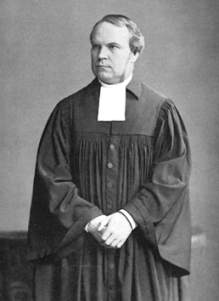
Adolf Stoecker (December 11, 1835 – February 2, 1909) was a German court chaplain to Kaiser Wilhelm I, a politician and a Lutheran theologian who founded the Christian Social Party to lure members away from the Social Democratic Party.
Stoecker was born in Halberstadt, Province of Saxony, in the Kingdom of Prussia. Stoecker's father was a blacksmith turned prison guard, and despite his poverty, Stoecker was able to attend university, which was unusual for a working-class man in the 19th century. An energetic and hardworking Protestant pastor who wrote widely on various social and political issues, Stoecker had a charismatic personality which made him one of Germany's best loved and most respected Lutheran clergymen. As a theology student at the University of Halberstadt, Stoecker was already known as the "second Luther" as his writings and speeches defending the Lutheran faith were considered outstanding.
After his ordination as a minister, Stoecker joined the Prussian Army as a chaplain. Stoecker came to national attention after delivering a sermon after the Siege of Metz in 1870, where he argued that Prussia's victories over France were the doing of God, and in 1874, Emperor Wilhelm I, who had been moved by Stoecker's sermons, had him appointed court chaplain in Berlin. Stoecker's position as a court chaplain gave him more power and prominence than his title of pastor would indicate, as everything Stoecker said was seen as expressing the opinion of Wilhelm. As early as 1875, Stoecker began to attack Jews in racial terms in his sermons. As a good Lutheran, Stoecker was impressed with Martin Luther's 1543 book On the Jews and their Lies, and throughout his life, Stoecker always held that to be a good Christian meant hating the Jews.
Besides working as a court chaplain, Stoecker also served as the head of a church mission in central Berlin that offered aid to the poorest families of the city. Stoecker was shocked by the extent to which the German poor and working classes had become estranged from Lutheranism and later wrote with horror: "During the years 1874–78, eighty percent of all marriages took place outside the church and forty-five percent of all children were not baptized". Furthermore, the staunchly-conservative Stoecker was worried about the way that the poor and the working class were voting for the "godless" Social Democratic Party (SPD), and to counter the growth of the SPD, he founded the Christian Social Worker's Party (CSP) in 1878. Though strongly critical of capitalism and demanding some social reforms like an income tax and reducing working hours, Stoecker was hostile to unions and supported the existing social structure in which the Junkers dominated Prussian society. Stoecker was not a Junker, but he always had the most profound admiration for them. The purpose of the CSP was to win over the working classes to a Christian conservatism in which ordinary people would learn to accept that God had created an ordered society with the Junkers on top, and that to challenge the ordered society was to challenge God. Stoecker believed that the capitalist system alienated workers from the proper, God-intended course, and what was needed were social reforms to hold off revolution.
Through Stoecker advocated social reforms, the main emphasis of the CSP was on winning workers over to loyalty to "the throne and altar", as Stoecker argued that misery of the workers was caused by a materialistic, atheist world view that had torn the working class from its proper reverence for God and the social order created. The message was rejected by most German workers as not addressing their main concerns. The German working class mostly wanted a higher standard of living and democracy, not to be told that it was their duty as Christians to accept their lot. Stoecker's hostility to unions and strikes limited his appeal to the working class. Stoecker called unions "the threatening danger which moves through our time like a flood between weak dykes". Stoecker believed that workers should not fight for higher wages and improve working conditions through strikes, but should deferentially ask "throne and altar" to improve working conditions and wages, a message that strongly limited his appeal to the working class. Stoecker's platform sounded very left-wing with its demand for an income tax, banning children and married women from working, making Sunday a holiday; subsidies for widows and those too injured to work, taxes on luxury goods and a government-supported health system for all. However, at same time, Stoecker's platform called for bringing unions under state control, as Stoecker viewed the purpose of unions was to teach their members to be loyal to "throne and altar", not to improve the lives of their members.
When Stoecker founded the Christian Social Party on 3 January 1878, he declared in his speech announcing his party:
"I have in mind a peaceful organization of labor and the workers.... It is your misfortune, gentleman, that you only think of your Social State and scornfully reject the hand extended to you for reform and help; that you insist on saying "we will not settle for anything less than the Social State". This way makes you enemies of the other social classes. Yes, gentleman, you hate the Fatherland! Your press shockingly reflects this hatred... you also hate Christianity, you hate the gospel of God's mercy. They [the Social Democrats] teach you not to be believe. They teach you atheism and these false prophets".
Stoecker followed his speech by presenting a former tailor who had been imprisoned for fraud, Emil Grüneberg, whom Stoecker had met while he was in prison, who proceeded to give a violently anti-Socialist speech. The American historian Harold Green commented that Stoecker associating with a disreputable individual like Grüneberg, a swindler and blackmailer showed the "demagogic and unsavory" character of Stoecker, who for his all self-righteousness often associated with disreputable people. Much to Stoecker's fury, a group of Social Democrats, led by Johann Most, showed up to hijack the meeting as Most gave a speech denouncing the Lutheran church for being subservient to the state and declared that only the Social Democrats represented the working class, which prompted loud cheers from the working-class audience. Most led the audience out of the meeting hall, all behind him, while Stoecker was left fuming, as his would be supporters had been taken away by Most. The German chancellor, Prince Otto von Bismarck, brought the first of the Anti-Socialist Laws later in 1878 with the aim of crushing the SPD, and Stoecker's foray into politics was secretly supported by the government, which hoped that Stoecker might be able to win the working class from the Social Democrats.
Hub AI
Adolf Stoecker AI simulator
(@Adolf Stoecker_simulator)
Adolf Stoecker
Adolf Stoecker (December 11, 1835 – February 2, 1909) was a German court chaplain to Kaiser Wilhelm I, a politician and a Lutheran theologian who founded the Christian Social Party to lure members away from the Social Democratic Party.
Stoecker was born in Halberstadt, Province of Saxony, in the Kingdom of Prussia. Stoecker's father was a blacksmith turned prison guard, and despite his poverty, Stoecker was able to attend university, which was unusual for a working-class man in the 19th century. An energetic and hardworking Protestant pastor who wrote widely on various social and political issues, Stoecker had a charismatic personality which made him one of Germany's best loved and most respected Lutheran clergymen. As a theology student at the University of Halberstadt, Stoecker was already known as the "second Luther" as his writings and speeches defending the Lutheran faith were considered outstanding.
After his ordination as a minister, Stoecker joined the Prussian Army as a chaplain. Stoecker came to national attention after delivering a sermon after the Siege of Metz in 1870, where he argued that Prussia's victories over France were the doing of God, and in 1874, Emperor Wilhelm I, who had been moved by Stoecker's sermons, had him appointed court chaplain in Berlin. Stoecker's position as a court chaplain gave him more power and prominence than his title of pastor would indicate, as everything Stoecker said was seen as expressing the opinion of Wilhelm. As early as 1875, Stoecker began to attack Jews in racial terms in his sermons. As a good Lutheran, Stoecker was impressed with Martin Luther's 1543 book On the Jews and their Lies, and throughout his life, Stoecker always held that to be a good Christian meant hating the Jews.
Besides working as a court chaplain, Stoecker also served as the head of a church mission in central Berlin that offered aid to the poorest families of the city. Stoecker was shocked by the extent to which the German poor and working classes had become estranged from Lutheranism and later wrote with horror: "During the years 1874–78, eighty percent of all marriages took place outside the church and forty-five percent of all children were not baptized". Furthermore, the staunchly-conservative Stoecker was worried about the way that the poor and the working class were voting for the "godless" Social Democratic Party (SPD), and to counter the growth of the SPD, he founded the Christian Social Worker's Party (CSP) in 1878. Though strongly critical of capitalism and demanding some social reforms like an income tax and reducing working hours, Stoecker was hostile to unions and supported the existing social structure in which the Junkers dominated Prussian society. Stoecker was not a Junker, but he always had the most profound admiration for them. The purpose of the CSP was to win over the working classes to a Christian conservatism in which ordinary people would learn to accept that God had created an ordered society with the Junkers on top, and that to challenge the ordered society was to challenge God. Stoecker believed that the capitalist system alienated workers from the proper, God-intended course, and what was needed were social reforms to hold off revolution.
Through Stoecker advocated social reforms, the main emphasis of the CSP was on winning workers over to loyalty to "the throne and altar", as Stoecker argued that misery of the workers was caused by a materialistic, atheist world view that had torn the working class from its proper reverence for God and the social order created. The message was rejected by most German workers as not addressing their main concerns. The German working class mostly wanted a higher standard of living and democracy, not to be told that it was their duty as Christians to accept their lot. Stoecker's hostility to unions and strikes limited his appeal to the working class. Stoecker called unions "the threatening danger which moves through our time like a flood between weak dykes". Stoecker believed that workers should not fight for higher wages and improve working conditions through strikes, but should deferentially ask "throne and altar" to improve working conditions and wages, a message that strongly limited his appeal to the working class. Stoecker's platform sounded very left-wing with its demand for an income tax, banning children and married women from working, making Sunday a holiday; subsidies for widows and those too injured to work, taxes on luxury goods and a government-supported health system for all. However, at same time, Stoecker's platform called for bringing unions under state control, as Stoecker viewed the purpose of unions was to teach their members to be loyal to "throne and altar", not to improve the lives of their members.
When Stoecker founded the Christian Social Party on 3 January 1878, he declared in his speech announcing his party:
"I have in mind a peaceful organization of labor and the workers.... It is your misfortune, gentleman, that you only think of your Social State and scornfully reject the hand extended to you for reform and help; that you insist on saying "we will not settle for anything less than the Social State". This way makes you enemies of the other social classes. Yes, gentleman, you hate the Fatherland! Your press shockingly reflects this hatred... you also hate Christianity, you hate the gospel of God's mercy. They [the Social Democrats] teach you not to be believe. They teach you atheism and these false prophets".
Stoecker followed his speech by presenting a former tailor who had been imprisoned for fraud, Emil Grüneberg, whom Stoecker had met while he was in prison, who proceeded to give a violently anti-Socialist speech. The American historian Harold Green commented that Stoecker associating with a disreputable individual like Grüneberg, a swindler and blackmailer showed the "demagogic and unsavory" character of Stoecker, who for his all self-righteousness often associated with disreputable people. Much to Stoecker's fury, a group of Social Democrats, led by Johann Most, showed up to hijack the meeting as Most gave a speech denouncing the Lutheran church for being subservient to the state and declared that only the Social Democrats represented the working class, which prompted loud cheers from the working-class audience. Most led the audience out of the meeting hall, all behind him, while Stoecker was left fuming, as his would be supporters had been taken away by Most. The German chancellor, Prince Otto von Bismarck, brought the first of the Anti-Socialist Laws later in 1878 with the aim of crushing the SPD, and Stoecker's foray into politics was secretly supported by the government, which hoped that Stoecker might be able to win the working class from the Social Democrats.
Recent media