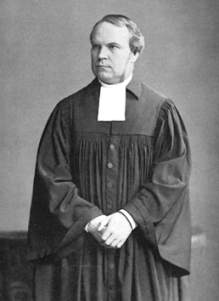
Adolf Stoecker
Adolf Stoecker
Main page
2073311

Adolf Stoecker

logo
Community Hub0 subscribers
Read side by side
from Wikipedia
Adolf Stoecker.

Adolf Stoecker (December 11, 1835 – February 2, 1909) was a German court chaplain to Kaiser Wilhelm I, a politician and a Lutheran theologian who founded the Christian Social Party to lure members away from the Social Democratic Party.

Early life

[edit]

Stoecker was born in Halberstadt, Province of Saxony, in the Kingdom of Prussia. Stoecker's father was a blacksmith turned prison guard, and despite his poverty, Stoecker was able to attend university, which was unusual for a working-class man in the 19th century.[1] An energetic and hardworking Protestant pastor who wrote widely on various social and political issues, Stoecker had a charismatic personality which made him one of Germany's best loved and most respected Lutheran clergymen.[2] As a theology student at the University of Halberstadt, Stoecker was already known as the "second Luther" as his writings and speeches defending the Lutheran faith were considered outstanding.[2]

After his ordination as a minister, Stoecker joined the Prussian Army as a chaplain.[1] Stoecker came to national attention after delivering a sermon after the Siege of Metz in 1870, where he argued that Prussia's victories over France were the doing of God, and in 1874, Emperor Wilhelm I, who had been moved by Stoecker's sermons, had him appointed court chaplain in Berlin.[2] Stoecker's position as a court chaplain gave him more power and prominence than his title of pastor would indicate, as everything Stoecker said was seen as expressing the opinion of Wilhelm.[2] As early as 1875, Stoecker began to attack Jews in racial terms in his sermons.[1] As a good Lutheran, Stoecker was impressed with Martin Luther's 1543 book On the Jews and their Lies, and throughout his life, Stoecker always held that to be a good Christian meant hating the Jews.[3]

Founding of CSP

[edit]

Besides working as a court chaplain, Stoecker also served as the head of a church mission in central Berlin that offered aid to the poorest families of the city.[2] Stoecker was shocked by the extent to which the German poor and working classes had become estranged from Lutheranism and later wrote with horror: "During the years 1874–78, eighty percent of all marriages took place outside the church and forty-five percent of all children were not baptized".[2] Furthermore, the staunchly-conservative Stoecker was worried about the way that the poor and the working class were voting for the "godless" Social Democratic Party (SPD), and to counter the growth of the SPD, he founded the Christian Social Worker's Party (CSP) in 1878.[2] Though strongly critical of capitalism and demanding some social reforms like an income tax and reducing working hours, Stoecker was hostile to unions and supported the existing social structure in which the Junkers dominated Prussian society.[2] Stoecker was not a Junker, but he always had the most profound admiration for them.[2] The purpose of the CSP was to win over the working classes to a Christian conservatism in which ordinary people would learn to accept that God had created an ordered society with the Junkers on top, and that to challenge the ordered society was to challenge God.[2] Stoecker believed that the capitalist system alienated workers from the proper, God-intended course, and what was needed were social reforms to hold off revolution.[2]

Through Stoecker advocated social reforms, the main emphasis of the CSP was on winning workers over to loyalty to "the throne and altar", as Stoecker argued that misery of the workers was caused by a materialistic, atheist world view that had torn the working class from its proper reverence for God and the social order created. The message was rejected by most German workers as not addressing their main concerns.[4] The German working class mostly wanted a higher standard of living and democracy, not to be told that it was their duty as Christians to accept their lot. Stoecker's hostility to unions and strikes limited his appeal to the working class.[2] Stoecker called unions "the threatening danger which moves through our time like a flood between weak dykes".[2] Stoecker believed that workers should not fight for higher wages and improve working conditions through strikes, but should deferentially ask "throne and altar" to improve working conditions and wages, a message that strongly limited his appeal to the working class.[2] Stoecker's platform sounded very left-wing with its demand for an income tax, banning children and married women from working, making Sunday a holiday; subsidies for widows and those too injured to work, taxes on luxury goods and a government-supported health system for all.[5] However, at same time, Stoecker's platform called for bringing unions under state control, as Stoecker viewed the purpose of unions was to teach their members to be loyal to "throne and altar", not to improve the lives of their members.[6]

When Stoecker founded the Christian Social Party on 3 January 1878, he declared in his speech announcing his party:

"I have in mind a peaceful organization of labor and the workers.... It is your misfortune, gentleman, that you only think of your Social State and scornfully reject the hand extended to you for reform and help; that you insist on saying "we will not settle for anything less than the Social State". This way makes you enemies of the other social classes. Yes, gentleman, you hate the Fatherland! Your press shockingly reflects this hatred... you also hate Christianity, you hate the gospel of God's mercy. They [the Social Democrats] teach you not to be believe. They teach you atheism and these false prophets".[7]

Stoecker followed his speech by presenting a former tailor who had been imprisoned for fraud, Emil Grüneberg, whom Stoecker had met while he was in prison, who proceeded to give a violently anti-Socialist speech.[7] The American historian Harold Green commented that Stoecker associating with a disreputable individual like Grüneberg, a swindler and blackmailer showed the "demagogic and unsavory" character of Stoecker, who for his all self-righteousness often associated with disreputable people.[7] Much to Stoecker's fury, a group of Social Democrats, led by Johann Most, showed up to hijack the meeting as Most gave a speech denouncing the Lutheran church for being subservient to the state and declared that only the Social Democrats represented the working class, which prompted loud cheers from the working-class audience.[7] Most led the audience out of the meeting hall, all behind him, while Stoecker was left fuming, as his would be supporters had been taken away by Most.[7] The German chancellor, Prince Otto von Bismarck, brought the first of the Anti-Socialist Laws later in 1878 with the aim of crushing the SPD, and Stoecker's foray into politics was secretly supported by the government, which hoped that Stoecker might be able to win the working class from the Social Democrats.[8]

Antisemitic agitator

[edit]

In 1879, Stoecker gave speeches blaming all of Germany's problems on the Jewish minority.[8] In his speech "Our Demands on Modern Jewry", delivered in Berlin on 19 September 1879, Stoecker in the words of the American historian Richard Levy "put antisemitism on the map in Germany", as his status as one of Germany most respected and best loved Lutheran clergymen made hatred for the Jews eminently respectable in a way that it never had been before.[4] It was only after Stoecker started to attack the Jews that the meetings of the CSP began to be well attended, but most of Stoecker's followers came from the Mittelstand (lower middle class), rather than the working class and the poor.[8] In September 1879, Stoecker's speech "Our Demands on Modern Jewry" caused a sensation and attracted much media attention, as it was widely assumed that Stoecker was speaking on behalf of Emperor Wilhelm I when he blamed all of Germany's problems on "Jewish capital" and the "Jewish press".[8] Stoecker, in particular, complained that 45,000 Jews living in Berlin were "too large a figure" and that Germany was taking in far too many poor Jewish immigrants from Russia and Romania. He argued that Jewish immigrants from the Russian empire and Romania should be "sunk on the high seas", rather be allowed to settle in Germany.[9] As early as 17 October 1879, the Board of Trustees of the Jewish community in Berlin had complained to the Prussian Ministry of the Interior that Stoecker should be silenced as his hate speeches were inciting violence against Jews, a request that was refused.[9] Stoecker's denunciations of the changes wrought by industrialization and urbanization appealed to the lower middle class, as he offered up an idealized, nostalgic vision of an ordered, rural society, where local craftsmen and small merchants did not have to compete with factories and large stores, of a simpler, better time now sadly gone.[10] Stoecker's critique of modernity and of the capitalist system under the guise of very nationalist and antisemitic message appealed to the Mittelstand, which was suffering very badly from the economic changes caused by the Industrial Revolution and felt their interests to be ignored by all of the existing parties.[10]

Traditionally, for over 1000 years, Jews were despised social outcasts, a people living in poverty and seen as accursed forever, and Jewish emancipation in Prussia in 1869 had been followed by the rise of a number of poor Jewish families to the middle class.[4] At the same time that Jews were joining the middle class, the fortunes of the Mittelstand had gone into decline, and Stoecker's antisemitic speeches appealed to what he called the "little people", as the Mittelstand's men and women who felt it was unfair and unjust that the traditionally-despised Jews were getting ahead both socially and economically while they were falling behind.[4] Jews were seen as outsiders in Imperial Germany, and the socio-economic success of the Jews seemed to be turning the traditional social order upside down just as at the same moment that many Mittelstand families were sinking into poverty.[4] Stoecker's speech "Our Demands on Modern Jewry" was full of a sense of victimization, as he accused Jews of behaving with outrageous arrogance to Germans, and he demanded that newly middle class Jewish families should "show respect" to the Germans.[11] Levy wrote that Stoecker understood the resentments and fears, the sense of victimization held by the "little people" of the mittelstand, as he explained that the "Jewish Press" and "Jewish capital" caused all their problems.[11] Typical of the sense of victimization that Stoecker encouraged was a speech from 1879 where he declared:

"If modern Jewry continues to use the power of capital and the power of the press to bring misfortune to the nation, a final catastrophe is unavoidable. Israel must renounce its ambition to become master of Germany. It should renounce its arrogant claim that Judaism is the religion of the future, when it is so clearly of the past...Every sensible person must realize the rule of this Semitic mentality means not only our spiritual, but also our economic impoverishment".[12]

Though Stoecker did not call for violence, he implied that violence would be acceptable if the Jews did not begin to "show respect" to the Germans, which they allegedly did not.[4] Stoecker fed the sense of victimization as with his speech "The Lousy Press" in which he argued to his supporters that the media was controlled by rich Jewish capitalists who disliked people like them and that the economic decline of the Mittelstand was being ignored because of the "lousy press".[13] Stoecker's speeches usually consisted of reading various out-of-context statements from Social Democratic newspapers, to be followed by statements like "Gentleman, that was a wish for murder!", "Gentleman that was truly murder!", or "That was mass murder!".[13] As the crowd would become more and more angry, Stoecker would present his usual caveat, "Don't think I present all this out of hatred. I don't hate anyone!", which the American historian Jeffery Telman observed was "highly ironic" since Stoecker would whip up his supporters into a state of fury.[13]

Though Stoecker professed to be motivated only by "Christian love", he always blamed antisemitism on the Jews and stated in a speech: "Already a hatred for the Jews—which the Evangelical Church resists—begins to blaze up here and there. If modern Judaism continues, as it thus far has, to use the force of capital as well the power of the press, to ruin the nation, it will be impossible to avoid a catastrophe in the end".[14] Though Stoecker professed to be speaking with "full Christian love" for the Jews, it was always counterbalanced with a violent attack on Judaism as when he warned in a speech that one should not allow "Jewish newspapers to attack our belief and for the Jewish spirit of Mammonism to sully our people".[15] As one of the first leaders of the Völkisch movement, Stoecker attacked the Jews as a "race" and said in a speech at the Prussian Landtag in 1879 that all Jews were "parasites" and "leeches", an "alien drop in our blood" and stated that battle between Germans vs. Jews was one of "race against race", as the Jews were "a nation unto themselves" with nothing in common with Germans, but instead were linked to the other Jewish communities around the world as "one mass of exploiters".[16]

Though Stoecker was very vague about the exact solution to the "Jewish Question" he wanted, in one of his pamphlets, he wrote "the ancient contradiction between Aryans and the Semites ... can only end with the extermination of one of them" and it was the responsibility of "the Germanentum ... to settle once and for all with the Semites".[17] Like everybody else in the völkisch movement, Stoecker was deeply influenced by the claim of the French writer Arthur de Gobineau that there was an ancient Aryan master race responsible for everything good in the world, of which the modern Germans were the best representatives, but Stoecker rejected Gobineau's conclusion that the Aryan race was doomed.[5] Stoecker seems to have regarded Jews as both a race and a religion as he stated in a speech:

"Race is, without a doubt, an important element in the Jewish Question. The Semitic-Punic type is, in all areas, in work as well in profit, in business as well in earnings, in the life of the state as well in worldview, in its spiritual as well as its ethical effects—so different from the Germanic morals and philosophy of life, that reconciliation or amalgamation is impossible, unless it takes the form of a sincere rebirth from the depths of the conscience from the upright Israelites".[18]

In another speech, Stoecker stated:

"The Jewish Question, insofar as it is a religious question, belongs to science and the missionaries; as a racial question, it belongs anthropology and history. In the form of which this question appears before our eyes in public life, it is highly complicated social-ethical, political-economic phenomena. ... This question has arisen and developed—under the influence of religion and race—differently in the Middle Ages from how it is today, different also in contemporary Russia from how it is with us. But the Jewish Question—always and everywhere—has to do with economic exploitation and the ethical disruption of the peoples among who the Jews have lived".[19]

In another speech, Stoecker linked his Christian work with his political work, saying:

"I found Berlin in the hands of the Progressives—who were hostile to the Church—and the Social Democrats—who were hostile to God; Judaism ruled in both parties. The Reich's capital city was in danger of being de-Christanized and de-Germanized. Christianity was dead as a public force; with it went loyalty to the King and love of the Fatherland. It seemed as if the great war [with France] had been fought so that Judaism could rule in Berlin. ... It was like the end of the world. Unrighteousness had won the upper hand; love had turned cold".[20]

Opposition from the Crown Prince and Crown Princess

[edit]

Together with another völkisch leader, the historian Heinrich von Treitschke, Stoecker launched the Antisemitic Petition in 1880 that was signed by a quarter of million Germans asking for Jewish immigration to Germany to be banned, Jews to be forbidden to vote and hold public office and Jews to be forbidden to work as teachers or attend universities.[21] The ultimate intention of Stoecker and Treitschke was the disemancipation of German Jews, and the Antisemitic Petition was only the planned first step. In response to the Antisemitic Petition, the Crown Prince Frederich attacked antisemitism in an 1880 speech as a "shameful blot on our time" and said on behalf of himself and his wife Victoria with clear reference to Stoecker: "We are ashamed of the Judenhetze which has broken all bounds of decency in Berlin, but which seems to flourish under the protection of court clerics".[21]

The British-born Crown Princess Victoria in a public letter said that Stoecker belonged in a lunatic asylum because everything he had to say reflected an unbalanced mind.[21] Victoria wrote that she was ashamed of her adopted country as men like Stoecker and Treitschke "behave so hatefully towards people of a different faith and another who have become an integral part (and by no means the worse) of our nation!"[21] The Crown Prince of Prussia, Frederich, delivered a speech at a Berlin synagogue, where he called Stoecker the "shame of the century" and promised that if he became Emperor, he would fire Stoecker as court chaplain, leading to enthusiastic cheers from the audience.[22]

The Bleichröder affair

[edit]

In 1880, Stoecker attacked the Chancellor, Prince Otto von Bismarck indirectly when he singled out Gerson von Bleichröder, the Orthodox Jew who served as Bismarck's banker, though not by name as the author of the problem of poverty in Germany.[23] In a speech delivered on 11 June 1880, Stoecker attacked an unnamed Orthodox Jewish banker to powerful people, by which he clearly meant Bleichröder, who he claimed had too much power and wealth.[23] Stoecker stated the solution to poverty was to confiscate the wealth from rich Jews, rather than have an "impoverished" Church minister to the poor, and said that the banker was "a capitalist with more money than all the evangelical clergy taken together".[24] Bleichröder complained to Bismarck that Stoecker's attack might lead him to leave Germany for another nation that would be more welcoming to him, and as Bleichröder's skills at banking had made both him and Bismarck very rich men, Bismarck was worried about losing his banker.[24] Bismarck saw the attack on Bleichröder as an attack on himself and seriously considered banning Stoecker from speaking, but he declined as Stoecker was too popular and his position as court chaplain made him unassailable as he had the Emperor's support.[23] Bismarck complained that Stoecker "was attacking the wrong Jews, the rich ones committed to the status quo rather than the propertyless Jews ... who had nothing to lose and therefore joined every opposition movement".[3]

In December 1880, under pressure from Bismarck, Wilhelm I formally admonished Stoecker for his attack on Bleichröder in a letter for having "incited rather than calmed greed, by having drawn attention to big individual fortunes and by proposing reforms that in light of the government's program were too extravagant".[24] The American historian Harold Green noted that Bismarck seemed to have a problem with Stoecker's anti-Semitism only when it was directed against Bleichröder, and as long as Stoecker attacked Jews in general, instead of singling out Bleichröder, Bismarck did not have an issue with Stoecker.[24] The letter from the emperor only attracted more attention to Stoecker, and more people continued to join the CSP.[24] Teachers and army officers were overrepresented in the CSP, and in 1881, Stoecker renamed his party the Christian Social Party, as very few workers had joined his movement, and the Worker's part of the title was offputting to his mostly lower middle-class supporters.[24] Bismarck ended his support for Stoecker in 1881 after the "Bleichröder affair" and because Stoecker had failed to win the working class from the SPD, instead attracting support from an already-conservative Mittelstand.[24]

In 1882, Stoecker attended the world's first anti-Semitic international congress in Dresden.[1] Stoecker was condemned most forcefully by Frederich, the Crown Prince of Prussia and his British-born wife Victoria. In 1882, Wilhelm agreed to receive Stoecker and other leaders of the Berlin movement, which as an enthusiastic Stoecker reported:

"His Imperial Majesty, the Kaiser agreed to receive delegates from the Berlin movement on the eve of his birthday, something that had never happened before in the case of a political party. I had the honor to deliver a speech ... [after the address] the Kaiser aptly replied that there had been very strange developments during the past year; that both the most autocratic monarch in the world, the Russian Emperor and the least authoritarian President of a Republic, the American Chief of State had been assassinated, that authority was in terrible danger everywhere and it necessary to be fully aware of this."[25]

In 1883, Stoecker attended a conference of evangelical Protestants in London, where the Lord Mayor forbade the "second Luther" from speaking at the Mansion House under the grounds his speech was going to be a threat to public order. When Stoecker spoke at an alternative venue, Social Democratic emigres showed up to disturb the speech, forcing Stoecker to flee from the stage and to sneak out via the backdoor, behavior that led many to condemn the "second Luther" as a coward.[26]

The Bäcker case

[edit]

In 1884, Stoecker sued a Jewish newspaper publisher, Heinrich Bäcker for libel after the latter had run an article, "Court Chaplain, Reichstag Candidate and Liar".[26] Because Stoecker was a court chaplain, Bäcker was prosecuted by the Prussian state for libelling a public official but he waged such a vigorous defense that his claim that Stoecker was a dishonest man was true that he effectively put Stoecker on trial.[27] As a witness, Stoecker was humiliated on a daily basis, as Bäcker's lawyers presented many examples from his speeches of him telling lies and having committed perjury in another court case when he testified that he never seen a Social Democrat named Ewald before, despite having repeatedly spoken with him during Reichstag sessions.[28] As Stoecker was repeatedly challenged by Bäcker's lawyers about various lies that he had told and contradictory statements that he had made over the years, Stoecker was put on the defensive more and more as he attempted to explain that he did not mean what he had said or he could not remember saying what he had said, making him appear dishonest and shifty.[29] Stoecker's reputation was so badly damaged that despite the fact it was Bäcker who was on trial, the judge, in a revealing Freudian slip, opened a session of the court with the remark: "I hereby reopen the proceedings against the defendant Stoecker", only to be reminded that it was Bäcker who was on trial.[30] The libel case attracted much media attention, and though Stoecker won the case, the judge gave Bäcker the lightest possible sentence of three weeks in prison, under the grounds that the publisher had been persistently attacked by Stoecker.[26] Bäcker won a moral victory, as even through the court had convicted him, Stoecker had been exposed on the stand as a man who was caught up in so many lies as to destroy his reputation.[31] The judges had given a convoluted and tortured ruling in the libel trial that seemed to suggest that they wanted to acquit Bäcker but had convicted him only because to acquit Bäcker would confirm his claims against Stoecker, which would damage the prestige of the monarchy, as Stoecker was the court chaplain.[32]

By 1885, Emperor Wilhelm, though an anti-Semite himself, had wanted to fire Stoecker, who had become a liability to the monarchy after the Bäcker libel case but kept him only after his grandson, Prince Wilhelm (the future Wilhelm II) had written him a letter on 5 August 1885 praising Stoecker and claiming that had been attacked unjustly by the "Jewish press".[22] Prince Wilhelm wrote that to dismiss Stoecker would be to strengthen the Social Democratic and the Progressive parties, who the prince claimed to be both controlled by the Jews.[22] Prince Wilhlem called Stoecker the victim of the "ghastly and infamous slanders of the damned Jewish press" and wrote "poor Stoecker" had been "covered with insults, slanders and defamation". He went on, "Now, after the judgement of the court, which is unfortunately far too much under Jewish control, a veritable storm of indignation and anger has broken out in all the levels of the nation".[33] Prince Wilhelm called Stoecker "the most powerful pillar, the bravest, most fearless fighter for Your Monarchy and Your Throne among the people! ... He has personally and alone won over 60,000 workers for you and your power from the Jewish Progressives and Social Democrats in Berlin! ... O dear Grandpa, it is disgusting to observe how in our Christian-German, good Prussian land, the Judenthum, twisting and corrupting everything, has the cheek to attack such men, and in the most shameless, insolent way to seek their downfall"."[33] Impressed with his grandson's arguments, the Emperor kept Stoecker on.[22] In November 1887, at a Christian Social event at the house of Field Marshal Alfred von Waldersee, Prince Wilhelm stood next to Stoecker, praised him as the "second Luther", declared his support for the CSP as bringing about the spiritual regeneration of Germany and urged men to vote for the CSP.[34]

Downfall

[edit]

In 1888, when the Emperor Wilhelm died, Frederick succeeded to the throne, but as he was already dying of throat cancer, he did not dismiss Stocker as he had promised.[22] Bismarck threatened to resign if Stoecker were dismissed, but Frederick ordered that Stoecker was to avoid speaking on political matters in public.[22] After a reign of 99 days, Frederick died and was succeeded by his son, Wilhelm II, who kept Stoecker on as court chaplain. Stoecker had long attacked the National Liberal Party as a "Jewish" party, and in 1890, Wilhelm II was informed by the leaders of National Liberals that they would not vote for his bills in the Reichstag unless he were to sack Stoecker.[35] It was to win the support of the National Liberals, not objections to Stoecker's antisemitism, that caused Wilhelm II to dismiss Stoecker as court chaplain in 1890.[35] The Christian Social Party failed, as many of the younger and more radical völkisch leaders from the Mittelstand found Stoecker too tame, too Christian (some of the völkisch activists rejected Christianity and wanted to bring back the worship of the old gods) and too deferential to the Junkers, and some of the Christian Socials, led by Friedrich Naumann, broke away because of his antisemitism.[2]

Stoecker's position as court chaplain from 1874 to 1890 made him one of the most influential Lutheran clergymen of the entire 19th century, and in 1891, the theologian Reinhold Seeberg called Stoecker "the most powerful church leader for pastors".[20] After his death in 1909, Pastor Johannes Haussleiter wrote, "Nobody has so lastingly influenced the rising generation of pastors and has put his mark on them for decades to come as he did".[36] Stoecker's insistence that Jews were a race, not a religion, and that Jewish "racial traits" were so repulsive that no proper Christian could ever love a Jew and to love Christ was to hate Jews, had a major impact on the Lutheran church well into the 20th century, and helped to explain the Lutherans' support of the Nazi regime.[37]

See also

[edit]

References

[edit]

Further reading

[edit]
[edit]
Revisions and contributorsEdit on WikipediaRead on Wikipedia
from Grokipedia
Adolf Stoecker (11 December 1835 – 2 February 1909) was a German Lutheran theologian, court chaplain to Kaiser Wilhelm I, and conservative politician who founded the Christian Social Workers' Party in 1878 to address the social question through Christian principles amid industrialization's challenges.[1][2][3] Stoecker's platform emphasized protecting workers from exploitation by advocating state intervention, ethical economics, and moral regeneration rooted in Protestant ethics, positioning it as an alternative to Marxist socialism and liberal capitalism.[1][4] However, his rhetoric increasingly incorporated anti-Semitic elements, portraying Jews as emblematic of usurious finance and cultural alienation, which helped legitimize political anti-Semitism within conservative and religious circles during the late 19th century.[3][4][1] As a prominent preacher and Reichstag member from 1879, Stoecker influenced Prussian court politics and evangelical discourse, though his career declined after conflicts with Jewish banker Gerson von Bleichröder and shifts in imperial favor under Wilhelm II.[2][1]

Early Life and Education

Family Background and Childhood

Adolf Stoecker was born on December 11, 1835, in Halberstadt, Prussia (now Halberstadt, Germany), into a modest working-class family.[5] [2] His father, initially a blacksmith by trade, advanced socially to become a prison warden, reflecting a degree of upward mobility that allowed the family to support Stoecker's education despite their humble origins.[6] [7] Little is documented about his early childhood, but the socioeconomic constraints of his background likely instilled a practical orientation that later informed his advocacy for social reforms among the working classes.

Theological Studies and Early Ministry

Adolf Stoecker pursued theological studies at the universities of Halle and Berlin following his early education.[2] These institutions, prominent centers for Protestant scholarship in mid-19th-century Prussia, shaped his Lutheran theological formation amid a period of confessional revival and rationalist critique.[2] Prior to formal ordination details, Stoecker worked as a tutor, gaining practical experience in religious instruction.[2] In 1863, he received his first pastoral appointment at Seggerda, a small parish near his birthplace of Halberstadt, where he began preaching and community engagement in a rural setting.[2] By 1866, he advanced to the pastorate at Hamersleben, continuing his ministry in provincial ecclesiastical roles focused on congregational care.[2] Stoecker's early clerical career intersected with national events during the Franco-Prussian War; in 1871, he served as pastor to a military division stationed at Metz, ministering to troops amid post-victory occupation duties.[2] These positions emphasized traditional Lutheran duties—sermons, sacraments, and pastoral counseling—without evident deviation toward the social reform themes that later defined his work.[2]

Rise in the Prussian Court

Appointment as Court Chaplain

Adolf Stoecker served as a military chaplain during the Franco-Prussian War from 1870 to 1871, delivering sermons noted for their patriotic emphasis on German unity and victory.[8] After the war's conclusion, he was stationed as Divisionspfarrer in Metz starting in 1871, continuing his pastoral duties within the Prussian military structure.[9] [8] On 4 October 1874, Stoecker received appointment as the fourth Hof- und Domprediger at Berlin Cathedral, a prestigious role combining court chaplaincy to Kaiser Wilhelm I with preaching responsibilities at the Domkirche.[8] This elevation stemmed from his wartime rhetorical impact and alignment with conservative Prussian values, positioning him among the elite clergy influencing the imperial court.[8] Concurrently, he joined the Generalsynodalvorstand of the Old Prussian regional church, further embedding him in ecclesiastical governance.[8] The appointment marked Stoecker's transition from military chaplaincy to a central platform in Berlin's religious and political spheres, where he held the position until 1890 amid growing controversies over his views.[9] It afforded direct access to the Kaiser and nobility, amplifying his voice on theological and national matters during the early years of the German Empire.[8]

Initial Engagements with Social Reform

Following his appointment as imperial court chaplain in 1874, Adolf Stoecker turned his attention to the social dislocations caused by rapid industrialization and the growing appeal of socialism among Prussian workers. Observing the alienation of artisans, small shop owners, and laborers in Berlin's working-class districts, he initiated preaching efforts aimed at reintegrating Christian principles into everyday economic and social life, emphasizing moral reform over materialist ideologies. These early activities, conducted through sermons in public halls rather than traditional churches, sought to counter socialist agitation by promoting a conservative vision of paternalistic state intervention, worker loyalty to the monarchy, and ethical labor relations grounded in Lutheran ethics.[1][3] Stoecker's involvement drew from the Inner Mission movement, which advocated practical Christian responses to urban poverty and moral decay, influencing his calls for church-led social engagement. In 1877, he published Die Leitung der Kirche: Ein Weckruf, a tract urging ecclesiastical reform to address contemporary social challenges, including the need for pastors to actively minister to the industrial proletariat and foster community solidarity against atheistic radicalism. His sermons during this period attracted crowds of up to several thousand in Berlin, where he critiqued liberal capitalism's excesses while rejecting class warfare, instead advocating hierarchical harmony under divine and monarchical authority. These efforts marked his shift from courtly duties to grassroots reform, positioning him as a bridge between conservative elites and the disaffected lower middle class.[10] By mid-1877, Stoecker's preaching had evolved into organized meetings focused on practical reforms, such as improved working conditions through voluntary associations and state oversight, without endorsing full socialism. This phase laid the groundwork for his later political organizing, as he identified the failure of existing conservative parties to address worker grievances as a causal factor in socialist gains, evidenced by the Social Democratic Party's rising vote shares in Prussian elections. His approach privileged empirical observation of urban misery—such as overcrowded tenements and wage disputes—over abstract theory, insisting that causal remedies lay in reviving Christian social bonds eroded by secular liberalism.[3][1]

Formation of Christian Social Ideology

Response to Industrialization and Worker Alienation

Adolf Stoecker observed that Germany's swift industrialization following unification in 1871 resulted in urban overcrowding, exploitative labor practices, and a deepening rift between workers and their cultural roots, fostering alienation manifested in rising socialist agitation and secularism.[10] This proletarianization, he contended, stemmed from unchecked capitalism's emphasis on profit over human dignity, leaving workers spiritually adrift and susceptible to Marxist materialism, which he viewed as antithetical to Christian ethics.[11][10] As court preacher from 1874, Stoecker critiqued the Protestant church's traditional inward focus on personal salvation, arguing it failed to address the "social question" (Sozialfrage) arising from industrial misery, where workers endured long hours in factories devoid of moral purpose or community ties.[10] He posited that true redemption required applying Gospel teachings to economic life, declaring that "Christianity belongs in political, social, and industrial life" to restore workers' sense of duty, family solidarity, and national loyalty.[10] This ideology emphasized ethical self-help, employer responsibility under divine law, and state intervention for welfare without endorsing class conflict, aiming to preempt socialism by fulfilling workers' legitimate grievances through faith-based solidarity.[10][11] Stoecker's response crystallized in the founding of the Christian Social Workers' Party on September 19, 1878, initially designed to attract alienated laborers by promoting reforms like regulated work hours, housing aid, and vocational training infused with Christian doctrine, thereby countering the Social Democratic Party's appeal amid events such as the 1878-1879 economic downturn and strikes.[11] In sermons and writings, such as those compiled in Christlich-sozialen Reden und Aufsätze (1890), he framed the Gospel as a "magna charta for the toilers and heavy laden," urging a "free folk church" to humanize industry and rebuild communal bonds eroded by mechanization.[10] This approach prioritized causal links between moral decay and economic distress, advocating preventive social ethics over revolutionary upheaval.[10]

Key Doctrinal Writings and Preaching

Stoecker's preaching emphasized the integration of Lutheran orthodoxy with responses to industrialization's social disruptions, delivered primarily in Berlin's prominent churches such as the Domkirche after his 1874 appointment as court chaplain. Beginning in the mid-1870s, his sermons addressed the "social question" by portraying worker alienation and poverty as moral failures addressable through Christian ethics rather than secular ideologies; he argued that true social reform required a "free folk church" unbound by state control yet rooted in national Protestant identity, rejecting both atheistic socialism and unchecked capitalism.[12] These addresses, often drawing on biblical texts like the Sermon on the Mount, urged ethical employer responsibilities and worker piety, amassing audiences of thousands and influencing conservative Protestant circles.[1] A doctrinal shift occurred in 1879, when Stoecker incorporated socioeconomic critiques of Jewish influence into his preaching, framing modern Judaism as incompatible with Christian social order due to alleged dominance in finance, press, and liberalism. On September 19, 1879, in a speech to the Christian Social Workers' Party, he declared the Jewish question central to resolving worker exploitation, asserting that Jewish economic practices exacerbated class divisions and undermined German Christian values.[3] This marked the infusion of antisemitism into his Christian social doctrine, positioning Judaism as a causal factor in moral decay rather than mere coincidence. Among his key writings, Das moderne Judenthum in Deutschland, besonders in Berlin (1880) compiled two party addresses expanding these themes, charging Jewish Berliners with monopolizing stock exchanges and journalism to promote materialism and socialism, thereby eroding Christian societal foundations; Stoecker called for protective measures without endorsing violence.[13] In Kann ein Christ Sozialdemokrat, kann ein Sozialdemokrat Christ sein? (circa 1880s), he doctrinally rejected social democracy as heretical, incompatible with Christian submission to authority and divine hierarchy, citing scriptural prohibitions against class warfare. Collections like Christlich-sozial: Reden und Aufs%C3%A4tze (1880s) aggregated these sermons and essays, systematizing his advocacy for state-supported Christian guilds, anti-usury laws, and national unity under Protestantism as antidotes to revolutionary threats.[14] These texts, disseminated via pamphlets and periodicals, shaped the ideological core of the Christian social movement, prioritizing empirical observation of urban poverty and causal links to irreligion over abstract egalitarianism.[12]

Political Organization and Activities

Founding of the Christian Social Workers' Association

On January 5, 1878, Adolf Stoecker established the Christlich-Soziale Arbeiterpartei (Christian Social Workers' Party) in Berlin as a conservative response to the rising influence of social democracy among urban laborers.[15] The initiative aimed to counteract worker estrangement from the church and state by promoting a Christian-monarchist framework for addressing industrialization's social ills, emphasizing loyalty to the Prussian throne, evangelical piety, and moderate reforms against both socialist radicalism and liberal individualism.[15] [16] The party's formation occurred amid heightened tensions following the antisocialist laws enacted by Otto von Bismarck in 1878, which suppressed the Social Democratic Party but left a vacuum for organizing discontented workers.[3] Stoecker, leveraging his position as court chaplain, positioned the group as a non-revolutionary alternative rooted in Protestant ethics, seeking to integrate workers into the existing social order rather than overthrow it.[5] Initial efforts focused on Berlin's proletariat, with programs advocating ethical capitalism, workplace ethics informed by biblical principles, and state intervention to mitigate poverty without class warfare.[8] Though modestly sized at inception, with Stoecker as its driving force, the party garnered support from artisans, small traders, and disaffected conservatives wary of secular liberalism.[16] It eschewed explicit antisemitism in its founding phase, prioritizing anti-Marxist agitation and church revivalism to reclaim proletarian allegiance from atheistic materialism.[3] By 1881, to expand beyond strict worker focus, it rebranded as the Christlich-soziale Partei, reflecting evolving tactics amid limited electoral success.[15]

Establishment of the Christian Social Party

In early 1878, Adolf Stoecker founded the Christlich-soziale Arbeiterpartei (Christian Social Workers' Party) in Berlin as a political vehicle to counter the growing influence of the Social Democratic Party among Protestant industrial workers.[17] The establishment occurred on January 5, amid Stoecker's efforts to organize a mass meeting at the Eiskeller venue, though initial attendance and cohesion faced challenges from competing socialist appeals.[15] The party's platform rejected Marxist class struggle, advocating instead for ethical social reforms grounded in Lutheran ethics, state intervention against exploitation, and loyalty to the Prussian monarchy, aiming to reintegrate alienated laborers into a Christian-national order.[8] The founding built directly on Stoecker's prior social preaching and the Central Committee for Social Reform established in 1877, transitioning from associational activities to formal political contestation in Reichstag elections.[17] By emphasizing workers' moral upliftment over materialistic socialism, the party sought to capture the Protestant petite bourgeoisie and skilled laborers in urban centers like Berlin, where industrialization had fostered discontent.[16] Initial organizational structure included local branches and a central committee under Stoecker's leadership, with programmatic documents outlining demands for Sunday rest laws, workplace protections, and anti-usury measures without endorsing full state socialism.[18] In 1881, the party rebranded as the Christlichsoziale Partei (Christian Social Party), dropping the "Workers'" designation to broaden its base toward middle-class conservatives wary of proletarian radicalism, reflecting a strategic pivot as membership diversified beyond manual laborers.[8] This evolution marked the party's maturation into a durable conservative force, securing its first Reichstag seats in subsequent elections and influencing Bismarck's anti-socialist legislation, though internal tensions over antisemitic rhetoric soon emerged.[16]

Electoral Campaigns and Parliamentary Role

Stoecker launched his electoral efforts through the Christian Social Workers' Party, established on September 15, 1878, primarily to draw Protestant workers away from the Social Democratic Party by emphasizing Christian ethics, monarchism, and opposition to class struggle.[3] In the lead-up to the October 27, 1881, Reichstag election, he conducted public preaching campaigns in Berlin and other cities, framing the vote as a moral battle against "godless" socialism and advocating state intervention for workers' welfare under conservative principles.[19] These efforts culminated in his election as a Reichstag deputy for the Westphalian constituency of Bochum, defeating the incumbent with support from conservative and artisan voters alienated by industrial liberalism.[1] He defended his seat in the 1884 and 1887 elections, leveraging alliances with the German Conservative Party while intensifying appeals to small traders and craftsmen through anti-usury rhetoric targeting Jewish financiers.[4] By 1887, the party's platform explicitly incorporated criticism of Jewish economic dominance, which Stoecker promoted in campaign speeches to consolidate a base beyond urban workers. However, internal divisions and backlash from liberal press limited broader gains, with Stoecker's personal victories relying on localized mobilization via church networks.[3] Stoecker lost his Reichstag seat in the 1893 election amid scandals involving his attacks on Jewish bankers and opposition from progressive conservatives, regaining it only in 1898 after moderating some rhetoric to rebuild support.[1] He held the position until 1908, when declining health and party fragmentation ended his tenure. In parliament, Stoecker focused on bills for Sunday rest laws, vocational training, and anti-Socialist measures, often clashing with Chancellor Bismarck's allies by pushing for ethical reforms over pure laissez-faire policies; his February 9, 1899, speech exemplified this by linking Jewish press influence to moral decay in labor relations.[4] Though influential in conservative caucuses, his interventions frequently isolated him, as evidenced by failed petitions against Jewish emancipation extensions in the 1880s.[20]

Core Positions and Advocacy

Anti-Socialist and Nationalist Stance

Stoecker vehemently opposed socialism, particularly the Marxist variant dominant in the German Social Democratic Party (SPD), viewing it as fundamentally atheistic, materialistic, and destructive to social order. In writings such as Der Hass der Sozialdemokratie gegen das Christentum (1878), he argued that socialism rejected Christian spiritual values in favor of economic determinism, fostering class antagonism that fragmented society rather than promoting organic unity under divine principles.[21] He critiqued its internationalist tendencies as undermining national loyalty, contrasting them with a Christian ethic that prioritized moral reform and communal solidarity over revolutionary upheaval.[21] To counter socialist appeal among workers, Stoecker founded the Christian Social Workers' Party on September 19, 1878, explicitly as an alternative that addressed industrial grievances through Christian ethics rather than Marxist ideology. In Unsere Stellung zur Sozialdemokratie (1879), he outlined the party's rejection of socialist unions and strikes, advocating instead for state-mediated reforms, income taxes, and reduced working hours while maintaining hostility to collective bargaining as a tool of agitation.[21] [3] This stance aligned with Otto von Bismarck's Anti-Socialist Laws of October 1878, which targeted the SPD, though Stoecker sought to differentiate his movement by offering a "true" socialism grounded in Protestant morality.[21] Stoecker's nationalism emphasized a distinctly German Protestant identity, integrating Christian social principles with loyalty to the Prussian monarchy and the newly unified Reich. He promoted a "free folk church" that fused religious piety with völkisch sentiments, portraying socialism's cosmopolitanism as a threat to the German national soul.[21] In speeches and essays like Die christliche Sittlichkeit in ihrer Bedeutung für Volks- und Völkerleben (1903), he argued for ethical nationalism rooted in Christian duty to the fatherland, opposing liberal individualism and socialist universalism as corrosive to communal and imperial cohesion.[21] This worldview positioned his party as a bulwark for conservative patriotism, appealing to artisans and lower-middle-class voters wary of both capitalist excess and proletarian radicalism.[10]

Analysis of Jewish Influence in Society and Economy

Stoecker posited that the emancipation of Jews following the 1871 unification of Germany had enabled their disproportionate influence in economic spheres, particularly finance and commerce, where they allegedly engaged in speculative practices that exacerbated class antagonisms. In a September 19, 1879, address to the Christian Social Workers' Party, he argued that Jews dominated banking and stock exchanges through usury and reckless speculation, avoiding productive manual labor and instead exploiting workers to amass capital, thereby intensifying the conflict between labor and capital central to the social question.[3] He claimed this economic dominance positioned Jews as the "moneyed power" behind both liberal capitalism and international socialism, portraying them as representatives of exploitative forces undermining Christian social order.[1] He extended this analysis to societal and cultural domains, asserting that Jews formed a "people within a people" resistant to assimilation, with approximately 45,000 residing in Berlin alone—equivalent to the total Jewish population in France or England—and wielding influence that threatened German national essence. Stoecker accused Jewish-controlled outlets, such as the Berliner Tageblatt, of monopolizing the press to shape public opinion, promote intolerance toward Christianity, and foster moral degeneration through their promotion of liberalism and secularism.[3] In his view, this cultural sway extended to education and judiciary roles, where Jewish participation allegedly prioritized Semitic interests over German ones, necessitating restrictions to preserve national cohesion.[1] Stoecker's rhetoric linked these influences causally to broader societal ills, including worker alienation and the rise of social democracy, which he saw as partly Jewish-orchestrated to erode traditional hierarchies. He advocated practical measures such as numerus clausus quotas in universities and high schools, exclusion from public offices and school faculties, and curbs on Jewish immigration to mitigate what he described as their alien dominance in economic and cultural life.[1] These positions, framed within his Christian social ideology, aimed to rally conservative Protestants against perceived Jewish overrepresentation, though they drew criticism for conflating religious prejudice with economic critique without empirical substantiation beyond anecdotal assertions.[3]

Major Conflicts and Scandals

The Bleichröder Affair

In June 1880, Adolf Stoecker publicly assailed Gerson von Bleichröder, the Jewish banker who managed Chancellor Otto von Bismarck's personal finances and had been ennobled as a Prussian in 1872, during a speech decrying Jewish dominance in economic spheres.[22] Stoecker portrayed Bleichröder's substantial wealth—derived from commissions on French war indemnities after 1871 and involvement in state loans—as evidence of exploitative practices tied to stock exchange manipulations and undue influence over Prussian policy.[23] This critique, framed within Stoecker's broader campaign against "modern Jewry" as a parasitic force in capitalism, indirectly implicated Bismarck's reliance on Jewish financiers for imperial funding.[24] Bleichröder, alarmed by the assault on his reputation and loyalty to the state, petitioned Emperor Wilhelm I on June 18 for "patriarchal protection" against such vilification, emphasizing his service to Prussia despite his faith.[24] Bismarck, viewing the remarks as a personal affront that threatened his financial arrangements and political stability, reacted with fury and pressured the court to distance itself from Stoecker's agitation.[25] The emperor, while sympathetic to Bleichröder's contributions—including facilitating Bismarck's iron-and-blood diplomacy—reprimanded Stoecker, highlighting the chancellor's indispensability amid ongoing fortification efforts and conservative alliances.[22] The incident exacerbated rifts within conservative circles, as Stoecker's Christian-social rhetoric clashed with Bismarck's Realpolitik, which tolerated Jewish economic roles for pragmatic gains like post-Franco-Prussian reparations.[26] No formal libel proceedings ensued against Stoecker, unlike later cases he initiated, but the affair curtailed his influence at court temporarily and fueled perceptions of his movement as destabilizing to the establishment.[25] It exemplified how Stoecker's targeted anti-Jewish polemics risked alienating key patrons, prioritizing ideological purity over political expediency.[23]

The Bäcker Case

In 1884, Adolf Stoecker initiated a libel suit against Heinrich Bäcker, the Jewish editor of the Freie Zeitung, following the publication of articles on October 11 and 15 that accused Stoecker of habitual lying, slandering Jews, misusing charitable funds such as 2,000 marks intended for a workers' asylum, and employing former convicts in his Christian Social Party operations.[27] The articles, titled variants like "Hofprediger, Reichstagskandidat und Lügner" (Court Preacher, Reichstag Candidate, and Liar), charged Stoecker with specific deceptions, including false claims about encounters with individuals like Ewald and distortions regarding the Antisemitenpetition.[27] The trial took place in June 1885 at the Landgericht Berlin I, with charges brought under sections of the Strafgesetzbuch (§§ 185 for insult, 186, 194, 200) and Preßgesetz (§§ 20, 21, 73, 74), focusing on defamation through printed materials.[27] Bäcker assumed responsibility for the content despite not authoring it personally, while Stoecker appeared as a key witness and effectively the complaining party.[27] Defense attorneys Hugo Sachs and Munckel cross-examined Stoecker rigorously, exposing contradictions in his testimony: for instance, Stoecker denied participation in the 1881 Eisenach Church Conference despite evidence to the contrary, and his accounts of the Antisemitenpetition and personal interactions varied from prior public statements.[27] Witnesses like Emil Grüneberg, a former Christian Social Party vice-president, and others such as Pastor Witte corroborated elements of the defense's claims about Stoecker's organizational practices.[27] Despite these revelations, the court convicted Bäcker on multiple counts of insult, sentencing him to imprisonment—accounts vary between three weeks and five months—along with orders for the destruction of offending plates and payment of court costs; mitigating factors included Bäcker's Jewish identity and Stoecker's prior public attacks on it.[27] The proceedings drew significant media scrutiny, amplifying perceptions of Stoecker's inconsistencies and ethical lapses, which undermined his authority as court chaplain and political figure even as the legal victory bolstered his narrative of victimhood against Jewish press influence.[27] Subsequent related libel trials against liberal newspapers stemming from coverage of the case further highlighted tensions between Stoecker's antisemitic advocacy and journalistic critiques.[28]

Opposition from Crown Prince Frederick and Victoria

Crown Prince Frederick, whose liberal constitutionalist views diverged from the conservative dominance under Emperor Wilhelm I, actively opposed the anti-Semitic agitation that gained traction in Germany from 1879 onward, including campaigns spearheaded by Stoecker as court chaplain. In particular, Frederick's public interventions helped thwart radical proposals, such as those by historian Heinrich von Treitschke and Stoecker, to revoke Jewish emancipation and enact discriminatory laws against Jews.[29] This stance aligned with his broader resistance to authoritarian tendencies and intolerance within Prussian society, positioning him as a counterweight to Stoecker's influence at court. Crown Princess Victoria, drawing from her British upbringing and commitment to religious tolerance, voiced even more pointed disapproval of Stoecker in personal letters to her mother, Queen Victoria. She described Stoecker's rhetoric—marked by fervent anti-socialism laced with anti-Jewish invective—as symptomatic of profound mental instability, declaring that he "belonged in a lunatic asylum" because "everything he had to say reflected an unbalanced mind." Victoria further lamented the permeation of such "fanatical" ideas into German public life, expressing shame that her adopted country harbored figures like Stoecker whose pronouncements she deemed irrational and detrimental to civilized discourse. In additional correspondence, she extended this critique to Stoecker's followers, implying their collective delusions warranted institutional restraint, thereby highlighting the chasm between the crown princess's enlightened liberalism and Stoecker's populist conservatism. This opposition from the heir apparent and his consort underscored tensions within the Hohenzollern family and Prussian elite, where Stoecker's proximity to Wilhelm I amplified his platform but alienated progressive elements. Their criticisms, though largely confined to elite circles during Frederick's lifetime, foreshadowed Stoecker's diminished standing upon Frederick's brief 1888 reign as Emperor Frederick III, when liberal reforms were anticipated but curtailed by the emperor's terminal illness after only 99 days.[25]

Fall from Power

Shift Under Wilhelm II

Upon the accession of Wilhelm II to the throne on June 15, 1888, Stoecker's position as court chaplain, which had afforded him significant influence under Wilhelm I, faced immediate challenges due to the new Kaiser's more independent and volatile temperament, coupled with Stoecker's ongoing entanglement in political controversies.[1] Wilhelm II, while harboring personal antisemitic sentiments, disapproved of Stoecker's inflammatory public agitation, viewing it as disruptive to court harmony and state stability; this led to mounting pressure on Stoecker to curtail his partisan activities or relinquish his clerical role.[30] By late 1889, Stoecker's political engagements were increasingly restricted, prompting a strategic pivot away from court-centric influence toward broader organizational efforts.[31] In 1890, Stoecker formally abandoned his primary clerical duties to concentrate on political and social reform initiatives, founding the Lutheran Social Congress and the United Lutheran Workers' League of Germany, which aimed to mobilize Protestant workers against socialism and perceived Jewish economic dominance through Christian ethical frameworks.[1] This shift marked a departure from reliance on imperial patronage, as Stoecker sought to sustain his Christian-social agenda via extra-parliamentary associations amid declining favor at court; he officially resigned as court chaplain in 1891, severing his direct tie to the Prussian monarchy.[1] [31] Despite retaining a Reichstag seat from 1898 to 1908 (following earlier terms), his legislative impact waned, exemplified by his role in infusing antisemitic elements into the Conservative Party's 1892 program before breaking with the party in 1896 over ideological divergences.[1] This transition under Wilhelm II reflected broader tensions between Stoecker's populist conservatism and the Kaiser's preference for controlled nationalism, ultimately relegating Stoecker to the margins of official power structures while he persisted in advocating for social Christianity as a bulwark against modern liberal and socialist forces.[31] His efforts post-resignation emphasized decentralized preaching and party-building, though they yielded limited electoral success, with the Christian Social Party securing only sporadic Reichstag representation amid factional splits.[1]

Resignation and Party Fractures

In November 1890, Adolf Stoecker was compelled to resign his position as Prussian court and cathedral preacher after delivering a series of inflammatory antisemitic speeches in Baden during October of that year. These addresses, which targeted Jewish influence in finance and politics, provoked backlash from liberal authorities, including the Grand Duke of Baden, and embarrassed the imperial court.[32] Kaiser Wilhelm II, who had ascended the throne in 1888, demanded the resignation to distance the monarchy from Stoecker's polarizing rhetoric and preserve broader public support, a stark contrast to Wilhelm I's earlier indulgence of his chaplain's activities.[32][33] Stoecker's fall extended to politics, where his affiliation with the German Conservative Party—through which he had entered the Reichstag in 1881—collapsed amid mounting internal opposition. By late 1890, tensions over his aggressive promotion of antisemitism as a core plank alienated moderate conservatives, who viewed it as detrimental to party unity and electoral prospects; this culminated in his effective expulsion or voluntary withdrawal from the party's parliamentary faction. The rift fractured the fragile alliance between Stoecker's Christian Social Workers' Party (reorganized as the Christian Social Party in 1881) and the Conservatives, as some Christian Social adherents prioritized coalition stability while others clung to Stoecker's radical nationalism and anti-Jewish economic critiques.[1] This division weakened the Christian Social movement's influence, reducing its Reichstag seats from a peak of around 13 in the 1880s to marginal representation by the mid-1890s, though Stoecker retained a core following among Protestant workers and artisans.[5]

Later Life and Death

Post-Court Activities and Reflections

Following his dismissal as court chaplain on November 19, 1890, Stoecker retained his position as director of the Berlin City Mission, which he had assumed in 1879 as part of the Inner Mission movement, where he oversaw charitable and evangelical efforts among the city's working-class population until his death.[10] He also took on the editorship of the Deutsche Evangelische Kirchenzeitung in 1892, leveraging the publication to advance his Christian-social program, emphasizing Lutheran piety, anti-socialist labor reforms, and critiques of liberal capitalism.[2] In 1895, Stoecker issued Dreizehn Jahre Hofprediger und Politiker (Thirteen Years as Court Preacher and Politician), a retrospective defending his court tenure and political interventions as necessary countermeasures to socialist agitation and Jewish overrepresentation in finance and press, which he argued eroded Christian moral order and German national cohesion.[2] The volume compiled key speeches and essays, portraying his antisemitism not as racial prejudice but as a theological imperative to protect evangelical values from materialist influences, while acknowledging tactical errors in alienating conservative elites without moderating his core positions. He followed this with Gesammelte Schriften in 1896, aggregating prior addresses, and sermon collections through 1901 that reiterated calls for a "free folk church" aligned with monarchical authority and social conservatism.[10][2] Stoecker's post-court political engagement included re-election to the Reichstag in 1898 for a Westphalian district, serving until 1908 amid ongoing party fractures, where he prioritized bills restricting Jewish immigration and professional access while advocating factory inspections and worker housing funded by state-church partnerships.[1] These efforts reflected his unrepentant view, expressed in later addresses, that his earlier scandals stemmed from court intrigues rather than flawed ideology, sustaining influence in Protestant circles despite diminished official favor under Wilhelm II.[1]

Final Years and Passing

Following his resignation as court chaplain in 1891, Stoecker maintained a diminished presence in politics, representing a Westphalian district in the Reichstag until 1908, excluding the period from 1893 to 1898.[1] His influence had declined markedly since the mid-1880s, amid opposition from former antisemitic allies such as Max Liebermann von Sonnenberg, Otto Böckel, and Hermann Ahlwardt, who pursued more radical agendas that alienated conservative supporters.[2] [1] In these years, Stoecker shifted focus to ecclesiastical journalism and writing, serving as editor of the Deutsche Evangelische Kirchenzeitung from 1892.[2] He published reflective works, including the second edition of Christlich-Social in 1890, Wach auf, Evangelisches Volk in 1893, Dreizehn Jahre Hofprediger und Politiker in 1895, Gesammelte Schriften in 1896, and collections of sermons spanning 1894 to 1901, which reiterated his Christian-social critiques of modernity and economic liberalism.[2] Stoecker died on 2 February 1909 at the age of 73.[1]

Enduring Impact

Contributions to Conservative Social Thought

Adolf Stoecker contributed to conservative social thought through his development of Christian socialism, which sought to address the social upheavals of industrialization by grounding reforms in Protestant ethics rather than secular ideologies. As court preacher in Berlin from 1874 to 1890, he founded the Christian Social Workers' Party on January 3, 1878, aiming to integrate Christian principles into political and economic life to counter the rise of Marxist socialism and liberal individualism.[34] Stoecker viewed the "social question" not as inherently problematic but as an opportunity for Christian intervention, advocating for humanization of labor through love, duty, and community rather than class conflict.[10] Central to his framework was the concept of a "free folk church," an independent Protestant institution that would remain rooted in Reformation traditions while actively engaging societal issues, fostering interpenetration of nationhood and Christendom.[10] He critiqued liberalism for confining Christianity to private spheres and socialism for its materialistic denial of spiritual redemption, proposing instead an organic social order where the Gospel served as a "great social force" to shape political, industrial, and communal relations toward the Kingdom of God.[34] In writings such as Christlich-sozial: Reden und Aufsätze (1890), Stoecker emphasized that true social progress required Christianity's permeation of all life domains, rejecting state-imposed secularism in favor of ethical paternalism aligned with divine order.[34] Stoecker's ideas influenced subsequent conservative Protestant circles by modeling a prophetic church role in social policy, distinct from both revolutionary upheaval and laissez-faire detachment, as evidenced in Weimar-era churchmen's appeals to his legacy for a socially engaged yet confessionally grounded institution.[10] His advocacy for workers' welfare within monarchical and national frameworks prefigured elements of corporatist conservatism, prioritizing communal solidarity over individualistic competition while upholding hierarchical stability.[34]

Assessments in Historical Context

Historians regard Adolf Stoecker as a foundational figure in the development of political antisemitism in Wilhelmine Germany, where he fused Christian social reform with anti-Jewish agitation to counter liberal capitalism and Marxist socialism amid the industrialization of the 1870s and 1880s. His establishment of the Christian Social Workers' Party in 1878 and introduction of explicit antisemitic planks in 1879 represented an innovative conservative strategy to mobilize Protestant workers, framing Jews as exploiters responsible for social ills like usury and cultural decay rather than structural economic forces.[3][7] This approach, while addressing genuine grievances such as proletarian poverty and urban alienation, scapegoated Jewish prominence in finance and media, achieving weekly sermon circulations exceeding 100,000 copies by the 1880s.[7] Stoecker's antisemitism blended religious imperatives—urging Jewish conversion to Christianity—with racial exclusions, such as calls to bar Jews from civil service, academia, and press dominance, positioning him as an "anti-Semite with a Christian mission" who sought to preserve a confessional Protestant order against perceived Jewish "modernity."[7][4] Scholar Jeremy Telman assesses this synthesis as profoundly shaping the German Evangelical Church's social doctrine, embedding anti-Jewish tropes in conservative rhetoric through over 200 public lectures from 1878 to 1906, though contemporaries like historian Heinrich von Treitschke amplified similar views independently.[7] Critics, including Martin Greschat, debate Stoecker's moderation, noting his rejection of pogroms but endorsement of discriminatory laws, which normalized antisemitism within bourgeois conservatism without direct causal links to later National Socialism.[7] In the broader context of German conservatism, Stoecker advanced a "true socialism" rooted in Christian ethics, critiquing Marxism's class warfare as atheistic materialism and advocating state intervention for moral welfare, such as labor protections and guild revivals, to preempt socialist gains—efforts that garnered initial support from Bismarck before his 1890 fall.[21] His legacy endures as a cautionary model of how religious conservatism co-opted populist grievances, yielding short-term electoral inroads (e.g., party seats in Reichstag by 1881) but fracturing alliances and alienating moderates, ultimately reinforcing völkisch undercurrents in Protestantism.[7][4] While some assessments credit him with pioneering non-Marxist social policy, the pervasive antisemitic framing—evident in his 1880s writings demanding Jewish "de-Judaization"—predominantly taints his contributions, reflecting era-specific tensions between tradition and emancipation rather than prophetic extremism.[7]

References

User Avatar
No comments yet.