Hubbry Logo
Advanced Ability CenterAdvanced Ability CenterMain
Open search
Advanced Ability Center
Community hub
Advanced Ability Center
logo
8 pages, 0 posts
0 subscribers
Be the first to start a discussion here.
Advanced Ability Center
from Wikipedia

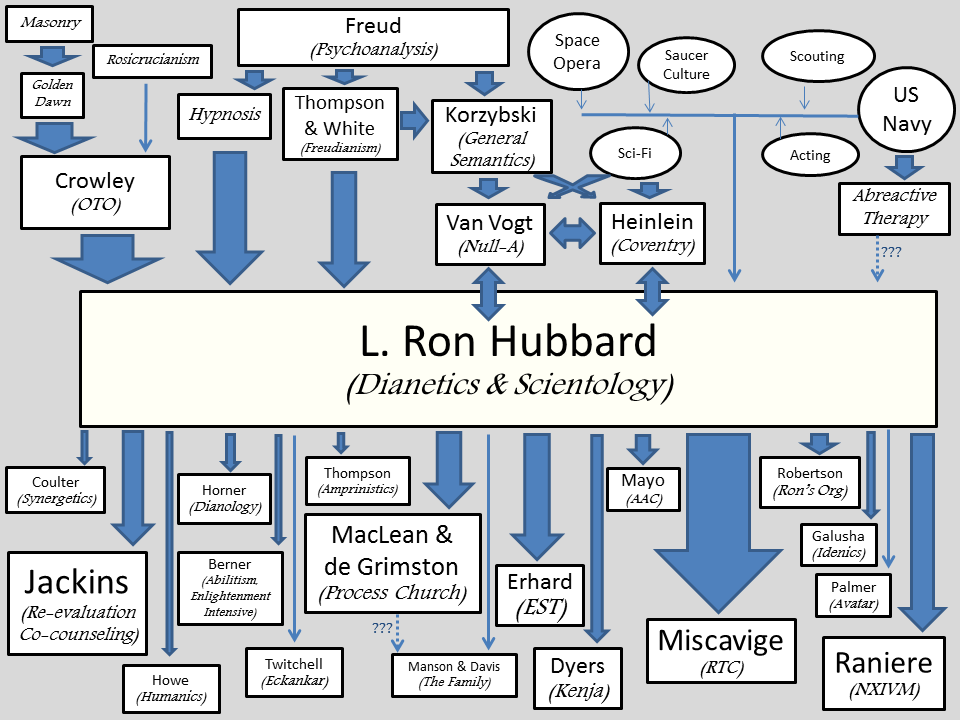
The arrows in the lower row point to the numerous offshoots, splinter groups, and new movements influenced by L. Ron Hubbard. The AAC is among these.

Key Information

The Advanced Ability Center was a breakaway organization from the Church of Scientology established by former Scientologist David Mayo after he left the Church in February 1983, a time when most of Scientology's upper and middle management was removed following the formation of the Religious Technology Center (RTC) and RTC head David Miscavige's restructuring of the church.[1] David Mayo had been Hubbard's own auditor.[1] The Advanced Ability Center later became the Theta International movement[2] and was also known as the Church of the New Civilization.[3]

Mayo taught material from the upper part of The Bridge of the Scientology organization in the Advanced Ability Center.[4]: 97  A division of the Advanced Ability Center was closed down again in 1984 under pressure from the main organization.[1] According to Perspectives on the New Age edited by James R. Lewis and J. Gordon Melton and published in 1992, the Advanced Ability Center formed in Milan was in competition with the Scientology organization in Italy.[5]

David Mayo

[edit]

Mayo joined Scientology in 1957 as a staff member, and joined the Sea Org in 1968. He trained with L. Ron Hubbard up to the level of Class XII auditor and worked with Hubbard on the OT levels 5 to 7.[6]: 36-7  Mayo had been L. Ron Hubbard's auditor and rose to the position of Senior Case Supervisor International in the Church of Scientology. He was ousted during David Miscavige's struggle for power, declared suppressive and sentenced to the "running program" (physical punishment) in 1982. Mayo escaped and founded the Advanced Ability Center.[7]: 99–101 [6]: 36-7  Religious Technology Center sued Mayo in Los Angeles federal court claiming intellectual property infringement, filed a RICO suit, and started an extensive harassment campaign against him and AAC. Mayo countersued, and RTC was sanctioned millions of dollars.[7]: 124–5 [8]: 157–8  In 1985, Scientology successfully enjoined Mayo from selling Scientology services and AAC was bankrupted and closed by 1986.[8]: 158 

See also

[edit]

References

[edit]
Revisions and contributorsEdit on WikipediaRead on Wikipedia
from Grokipedia
The Advanced Ability Center was an independent organization founded in 1983 by David Mayo, a former high-ranking auditor and executive in the Church of Scientology, to deliver advanced spiritual counseling and training services derived from L. Ron Hubbard's methodologies outside the church's hierarchical structure. Mayo, who had audited Hubbard and his wife Mary Sue Hubbard and contributed to the development of upper-level techniques such as New Era Dianetics for Operating Thetans (NOTs), established the center in Santa Barbara, California, emphasizing a less authoritarian environment that allowed for open communication and loyalty to Hubbard's original tenets. Unlike the Church of Scientology, which charged significantly higher fees—such as $12,100 for certain courses—the AAC offered comparable services at reduced prices, around $1,500, attracting former church members seeking alternatives. The center quickly became a focal point of contention, as the , through its , initiated lawsuits in 1985 alleging that Mayo and associates had stolen and disseminated confidential upper-level materials, including NOTs, from a church facility in . A preliminary issued by a U.S. District Court effectively halted the AAC's operations, but this was overturned in 1986 by the U.S. Ninth Circuit Court of Appeals, which unanimously ruled that 's teachings constitute religious scriptures rather than protectable trade secrets under law, thereby denying injunctive relief on those grounds. This legal victory underscored the challenges of enforcing secrecy over doctrinal materials in a religious context, though the church pursued further claims under and later statutes. The AAC ultimately ceased operations, representing an early prominent example of independent practice amid ongoing disputes over technology ownership and ecclesiastical authority.

Origins and Founding

David Mayo's Background in Scientology

David Mayo joined Scientology in late 1959 as an employee at the Hubbard Association of Scientologists International (HASI) in Auckland, New Zealand, where he began corresponding directly with L. Ron Hubbard. In 1962, he attended the Saint Hill Special Briefing Course at Saint Hill Manor in England, personally supervised by Hubbard, marking his early immersion in advanced training. By late 1967, Mayo transferred to the Sea Organization aboard the ship Royal Scotman in Valencia, Spain, entering Hubbard's flagship fleet and advancing through auditing and supervisory positions. He attained Class VIII auditor status, a high-level certification focused on delivering advanced processes, and later served as an auditor for Hubbard and his wife Mary Sue. Mayo's technical expertise elevated him to key oversight roles, including Senior Case Supervisor at the Flag Service Organization, where from 1973 he participated in research and supervised high-level auditing, including Hubbard's own sessions. In 1978, Hubbard personally appointed him Senior Case Supervisor International (Snr C/S Int), a position he held until 1982, responsible for standardizing and disseminating Scientology's core auditing technology across international orgs. This role underscored Mayo's adherence to Hubbard's directives, as he compiled and issued case supervision instructions aligned with Hubbard's original bulletins and policy letters to ensure technical purity. In September 1978, amid Hubbard's reported health decline in , Mayo audited him personally, applying processes that Hubbard credited with his rapid recovery within a week. Continuing sessions into early 1979 at a hideout, Mayo identified auditing errors from prior New Era Dianetics and OT III levels, leading to collaborative development of New Era Dianetics for Operating Thetans (NOTs). Mayo co-authored NOTs procedures with Hubbard as a targeted repair for body thetans affecting Operating Thetans, expanding it into a full series of advanced levels under Hubbard's guidance, reflecting Mayo's role as a trusted technical collaborator. Hubbard regarded Mayo as his technical successor in a 1982 memo, affirming his fidelity to unadulterated processes.

Break from the Church of Scientology

In August 1982, was removed from his position as Senior Case Supervisor International amid escalating internal power struggles within the 's Sea Organization, coinciding with the establishment of the (RTC) to safeguard the organization's core technologies. The removal took place on August 29, 1982, executed by and Steve Marlowe, who cited Mayo's alleged "anti-management" stance and purported role in prior executive offloads, though Mayo maintained these actions aligned with L. Ron Hubbard's directives. Following the ouster, Mayo was placed under 24-hour guard and subjected to a Committee of Evidence (CommEv) reviewing charges of ethical violations and technical deviations. Tensions intensified over interpretations of Hubbard's guidelines on auditing and case purity, with management accusing Mayo of unauthorized alterations while he contended that recent practices deviated from source materials. In early 1983, Mayo was designated a Potential Trouble Source (PTS) and then declared a Suppressive Person (), formalizing his expulsion and prohibiting contact with Church members under disconnection policies. The Church mounted retrieval operations to reintegrate Mayo, including offers in August 1983 to rescind the SP declare contingent on halting independent activities, but he refused amid unresolved grievances over pricing, delivery standards, and monopolistic control. Mayo evaded these efforts, facing claims of engaging in a "running program" by departing without completing official exit procedures, which prompted heightened security measures against him. Opting for autonomy, Mayo proceeded to deliver services faithful to Hubbard's foundational principles outside Church oversight.

Establishment of the AAC in 1983

The Advanced Ability Center (AAC) was established in July 1983 in Santa Barbara, California, by David Mayo following his expulsion from the Church of Scientology earlier that year. Mayo, who had served as a senior technical figure including Senior Case Supervisor International from 1978 to 1982, founded the group alongside a small number of defectors disillusioned with Church leadership under Mary Sue Hubbard and subsequent management. Operations began modestly from the home of associate Harvey Haber, reflecting the group's initial scale as an independent delivery point for Scientology practices amid internal Church purges. The AAC's formation aimed to provide advanced Scientology levels, including OT III through OT VII and the New OT levels (NOTs) processes that Mayo had originated while working closely with L. Ron Hubbard in the late 1970s. Mayo asserted that these materials, which the Church later attributed solely to Hubbard, derived from his direct contributions during Hubbard's seclusion period, enabling the AAC to offer them without what Mayo described as post-Hubbard alterations or suppressions imposed by Church policies. This positioning emphasized fidelity to Hubbard's original bulletins and tapes for auditing delivery, prioritizing measurable spiritual gains over administrative or financial mandates that had alienated practitioners within the Church. Early drew from experienced Scientologists, including trained auditors who shared Mayo's commitment to unaltered application, fostering an environment focused on technical purity rather than organizational expansion. The AAC attracted from those frustrated by Church "squirreling" accusations and actions, establishing itself as a haven for independent pursuit of Hubbard's methods in the immediate post-split period.

Practices and Operations

Auditing and Training Services

The Advanced Ability Center (AAC) delivered auditing services focused on upper-level processes, including (OT) levels and Solo New Era for Operating Thetans (Solo NOTs), utilizing L. Ron Hubbard's original bulletins as compiled from his handwritten materials by founder during his tenure as Senior Case Supervisor International. These sessions emphasized fidelity to Hubbard's exact procedures without alterations introduced by the , with nine dedicated NOTs auditors on staff to handle advanced case supervision. Participants in AAC auditing reported specific case gains, such as resolving 1.25 years of chronic agony in one hour or rehabilitating abilities dormant since prior OT II completion, outcomes attributed by attendees to the center's efficient case supervision and lower operational costs compared to Church facilities—approximately one-third the price for equivalent services. These improvements were linked to reduced pressures (known as "regging") and minimal administrative interference, allowing for more direct application of auditing rundowns. Independent accounts describe such gains as empirically verifiable through restored spiritual certainties and abilities, though remaining anecdotal without controlled studies. Training at the AAC included courses for auditors progressing to Class VIII certification, prioritizing practical proficiency in Hubbard's techniques over rote memorization or Church-mandated drills. Instruction maintained a high technical-to-administrative staff ratio, with 10 of 14 personnel dedicated to delivery roles, including two Class XII auditors trained directly by Hubbard and three former heads of his research team. This structure supported training in advanced auditing skills for upper levels, fostering independence from institutional over-regulation while adhering strictly to source materials for verifiable results in spiritual advancement.

Organizational Structure and Environment

The Advanced Ability Center (AAC) maintained a flat organizational structure led by , who guided operations through example and inquiry rather than top-down decrees or rigid protocols typical of the . This approach reflected Mayo's emphasis on respect, kindness, and technical efficacy in decision-making, allowing for open evolution of practices without adherence to Hubbard's policy letters that prescribed more formalized hierarchies. Participant reports describe the AAC's environment as markedly less punitive and more permissive than Church facilities, with no enforcement of aggressive measures like Committees of or mandatory disconnection from critics. Staff and clients experienced a of , where free expression—including humor, personal exploration of alternative practices, and candid discussions—was tolerated without judgment or . Waiting areas functioned as informal social spaces, and auditing sessions prioritized individual client inquiries over standardized routing forms or security checks. In operations, the AAC focused on auditor skill and tangible client outcomes, delivering services affordably without paywalls or expansion-driven quotas that characterized Church policies. This client-centered model, coupled with minimal ego in leadership, encouraged independent thinking and innovation in applying Hubbardian techniques, fostering human connections and a welcoming atmosphere distinct from the fear-based dynamics reported in official organizations.

Key Locations and Expansion Efforts

The Advanced Ability Center (AAC) established its primary operations in , operating from 1187 Coast Village Road beginning in 1983 as the core hub for David Mayo's independent activities. This location served as the central site for auditing and , drawing a small initial group of former members seeking advanced-level services outside official channels. By late 1983, the AAC had grown from this foundational base to include outreach initiatives, reflecting modest expansion amid interest from international independents. In November 1983, Harvey Haber, an affiliate of the AAC, traveled to the to deliver talks and field questions, signaling early efforts to extend influence beyond the . These activities culminated in the formation of the Advanced Ability Centre in January 1984, where Class VIII Burt Griswold became a founding member, aiming to replicate Mayo's model in . Additional exploratory ties emerged, such as visits to by figures like Robin Scott and attempts to establish a presence in Milano, , with participants traveling to for coordination in 1984. Despite these initiatives, the AAC's growth remained limited to a handful of satellite efforts, primarily constrained by aggressive legal actions from the , which targeted Mayo's operations through multiple lawsuits starting in 1983. The organization's footprint did not extend to permanent multiple centers, peaking in participant numbers and activity around 1984 before external pressures curtailed further proliferation.

Lawsuits from the Church of Scientology

In January 1985, the (RTC), a entity responsible for safeguarding its advanced materials, filed a in the U.S. District Court for the Central District of against , founder of the Advanced Ability Center (AAC), and associated individuals linked to the Church of the New Civilization. The suit alleged that defendants had engaged in a conspiracy to steal and disseminate confidential upper-level materials, specifically referencing NOTs (New Era for Operating Thetans) documents purportedly taken in December 1983 from a Church branch in , , by an individual named Robin Scott. Church filings claimed these actions violated federal statutes (RICO) and 's , seeking an injunction to halt AAC's distribution of the materials and asserting they constituted proprietary trade secrets derived from L. Ron Hubbard's writings. On November 22, 1985, District Judge Mariana R. Pfaelzer granted the request for a preliminary , prohibiting Mayo and the AAC from using or disclosing the contested materials after finding a sufficient "nexus" between the stolen Danish documents and the auditing processes offered at the AAC in . The ruling noted that while Mayo denied direct theft and claimed the materials were reconstructed from his memory (as he had contributed 80-90% to their original development), preliminary evidence supported the contention of misappropriation. This effectively suspended AAC operations pending trial, with the Church arguing the materials' was essential to prevent economic harm, as their official courses commanded fees up to $12,100 compared to the AAC's $1,500 equivalents. The 9th U.S. of Appeals reversed the on August 8, 1986, in a holding that Scientology's advanced teachings did not qualify as trade secrets under law, as they lacked sufficient economic value from secrecy and were primarily religious doctrines rather than commercial secrets. The panel remanded for further proceedings on potential damages under RICO but barred injunctive relief, allowing the AAC to resume activities. Court records from the extended litigation, which spanned multiple years and involved extensive discovery disputes, documented the Church's deployment of private investigators for of Mayo and AAC premises starting around 1983, including monitoring of operations in , as part of efforts to gather evidence of alleged theft—tactics Mayo characterized in affidavits as extensions of Scientology's "Fair Game" policy permitting harassment of perceived enemies. These measures, while not central to the injunction ruling, highlighted aggressive enforcement strategies amid the Church's broader campaign against splinter groups disseminating Hubbard's materials.

Allegations of Technology Theft and Squirreling

The Church of Scientology accused David Mayo, founder of the Advanced Ability Center (AAC), of conspiring with ex-Scientologist Robin Scott—who was convicted of burglary in Denmark in 1984—to steal confidential upper-level instructional materials from Church vaults in Copenhagen in 1983. The Church alleged that copies of these materials, including advanced auditing procedures attributed to L. Ron Hubbard, were disseminated to Mayo and used without authorization at the AAC, constituting theft of proprietary technology. Furthermore, the Church labeled Mayo's practices as "squirreling," a term originated by Hubbard to denote unauthorized deviations or alterations from his exact "standard tech," claiming that AAC operations modified Hubbard's original materials to suit independent delivery. In response, Mayo and the AAC maintained that their auditing and training adhered strictly to Hubbard's unaltered originals, positioning themselves as preservers of his intent against post-1980 Church corruptions introduced after Hubbard's seclusion. Mayo's 1987 affidavit asserted that he provided "full and complete credit to as the source" of procedures like Solo NOTs in lectures he delivered under Church authorization, denying any attempt to claim personal origination or issue materials independently. Documentary evidence cited by supporters includes Hubbard's April 14, 1982, memo acknowledging Mayo's role in developing advanced levels, which Mayo referenced to refute theft narratives propagated by Church publications like SO ED 2445 INT. Central to the dispute was the authorship of New Era for Operating Thetans (NOTs), with the Church insisting it derived solely from Hubbard's writings, while Mayo described collaborative development from 1978 to 1982, during which he audited Hubbard personally at a secret location and co-authored procedural descriptions to address auditing errors in prior levels like OT III. Mayo credited his research as conducted under Hubbard's direct oversight, including receiving and compiling Hubbard's notes into usable form, rather than independent invention, thereby defending NOTs delivery at the AAC as faithful to Hubbard's case gains and theoretical framework without post-Hubbard adulterations. This first-principles contention over origination—rooted in verifiable session logs and memos—underscored AAC's claim to technological purity amid mutual accusations of deviation.

Court Rulings and Outcomes

In August 1986, the U.S. Court of Appeals for the Ninth Circuit ruled in Religious Technology Center v. Wollersheim that the Church of 's confidential advanced teachings, including New Era Dianetics for Operating Thetans (NOTs), do not qualify as secrets under , as they lack independent economic value separate from their religious or spiritual significance. The decision reversed a district court's preliminary injunction against defendants, including and his associated splinter group, the Church of the New Civilization, thereby rejecting the Church's claims of monopoly over the dissemination of these materials and permitting independent practitioners to deliver auditing and training services using the tenets. This outcome directly benefited the Advanced Ability Center (AAC) by lifting restrictions that had halted its operations, allowing Mayo to resume offering advanced-level courses at reduced prices compared to the Church's fees. While the trade secrets ruling represented a significant victory for the AAC, the Church secured partial successes in related litigation through and claims, such as injunctions against unauthorized use of specific marks, which imposed ongoing compliance burdens and legal costs on Mayo's organization. These mixed judicial outcomes contributed to substantial resource depletion for the AAC, as protracted defenses against multiple lawsuits diverted funds and personnel from core activities, though no criminal convictions were obtained against Mayo or AAC principals. The 1986 established that religious doctrines like 's are not protectable as trade secrets, limiting the Church's ability to enforce exclusive control via that mechanism and facilitating broader independent use of the technology.

Reception and Legacy

Views from Independent Scientologists

Independent Scientologists have expressed appreciation for the Advanced Ability Center (AAC) as a venue that demonstrated the of L. Ron Hubbard's auditing technology in a non-institutional setting, emphasizing personal gains in spiritual awareness and . Participants reported achieving significant case progress through auditing sessions, often describing experiences of increased , clarity, and confront without the mandatory prerequisites or security checks typical of delivery. For instance, an Independent Scientologist reflected in late 2023 that AAC auditing provided "joy and progress without ," highlighting the center's focus on direct application of the technology to foster individual advancement. The AAC was frequently praised for its ethical and open environment, which contrasted with perceived Church rigidity by allowing free communication and minimal administrative hurdles. Attendees noted a "safe, open vibe" where individuals could express themselves freely, leading to genuine connections and effective ; one account described "no barriers or fear," with auditing accessible after brief preparation rather than extended routing forms. This atmosphere aligned with Hubbard's principles of respect and kindness, as evidenced by the center's ethos encapsulated in the view that "if it isn’t fun, it isn’t ." Independent practitioner Regina Dennison, writing from , affirmed her support for the AAC, stating it represented "the true spirit of what is all about," citing its high affinity, , and communication (ARC) levels alongside precise auditing results at affordable rates. In terms of preserving Hubbard's vision, the AAC attracted seasoned auditors, including Class VIII Burt Griswold, who joined as a founding member of its East Grinstead branch, contributing to sustained training programs that emphasized standard tech delivery outside coercive structures. Reflections from participants underscore the center's role as a "bright light" in the early Independent field, validating tech effectiveness through voluntary participation and ethical standards, which supported ongoing auditor development and spiritual gains for dozens of individuals in the 1980s. These accounts highlight the AAC's contributions to the broader Independent movement by prioritizing practical results over organizational control.

Criticisms and Internal Challenges

The Advanced Ability Center faced internal operational strains stemming from its limited scale, which constrained and long-term viability as a centralized delivery point for advanced services. Operating primarily from , starting in 1983, the center relied on a small staff and clientele drawn from disillusioned former Church members, making it vulnerable to resource shortages without the institutional backing of a larger . This modest footprint, while enabling a more flexible environment than Church facilities, ultimately contributed to its defunct status by the late 1980s, as fragmented support networks struggled to sustain comprehensive auditing programs. David Mayo's leadership approach, characterized by a low-key, tech-focused demeanor that emphasized individual auditing over hierarchical management, engendered some internal tensions regarding organizational direction and expansion. Mayo's eventual withdrawal from active leadership to prioritize technical refinement—allowing others to handle administration—exacerbated these issues, fostering disputes over strategic scaling and leading to the center's dispersal into disparate independent groups and solo practitioners. Participants noted a permissive atmosphere that encouraged open dialogue but also permitted divergences in application of Hubbard's materials, resulting in spinoffs and evolutions of practices such as Traumatic Incident Reduction, which some viewed as dilutions of core technology purity. Criticisms from segments of the independent field highlighted challenges in delivering complete upper-level services, including New Era for Operating Thetans (NOTs), due to barriers in accessing unaltered original materials amid constraints. To circumvent legal risks, early AAC levels were renamed and adapted—equating roughly to Church grades but with a less rigid progression tailored to individual needs—potentially introducing inconsistencies or incompletenesses relative to Hubbard's prescribed sequence. These adaptations, while pragmatically enabling some advanced delivery, fueled ongoing debates within independents about fidelity to source tech, with empirical outcomes varying by practitioner expertise rather than standardized institutional oversight.

Long-Term Impact on the Independent Movement

The Advanced Ability Center (AAC), established by in 1984, served as an early prototype for decentralized practice outside the Church's oversight, demonstrating viable delivery of advanced auditing processes such as and NOTs materials to clients in . This model emphasized adherence to L. Ron Hubbard's original writings without institutional mandates, attracting former Church members and fostering a template for subsequent free-field operations that prioritized individual auditing over hierarchical control. By operating successfully for several years despite Church opposition, the AAC empirically illustrated that Hubbard's techniques could sustain practitioner-client relationships absent centralized ecclesiastical structures, countering assertions of inherent dependency on Church . Legal confrontations between the Church and AAC yielded precedents that bolstered the broader independent field, particularly the 1986 U.S. federal court ruling declaring Scientology's core tenets and auditing methods non-proprietary and ineligible as trade secrets. This outcome, stemming from suits alleging unauthorized dissemination, invalidated the Church's monopoly claims and enabled splinter groups to openly distribute and apply Hubbard's materials without immediate legal reprisal, paving the way for entities like Ron's Org and later Free Zone networks. The AAC's resistance thus catalyzed a causal shift, as evidenced by the proliferation of independent delivery centers in the late 1980s and beyond, which adopted similar non-corporate frameworks to evade suppression tactics previously effective against defectors. Following intensified Church harassment and internal strains, the AAC effectively ceased operations by the late after Mayo curtailed public involvement, yet its legacy endured in validating autonomous tech application amid the independent movement's expansion. Mayo's passing on October 23, 2017, marked the end of his direct influence, but the center's prior successes provided tangible proof-of-concept for Hubbard methodologies functioning in diverse, uncontrolled environments, debunking narratives of inevitable decline without institutional backing. This evidentiary foundation supported the resilience of modern independents, who continue to reference early AAC precedents in justifying decentralized practice as causally efficacious for spiritual progress.

References

Add your contribution
Related Hubs
User Avatar
No comments yet.