
Recent from talks
Advection
Knowledge base stats:
Talk channels stats:
Members stats:
Advection
In the fields of physics, engineering, and earth sciences, advection is the transport of a substance or quantity by bulk motion of a fluid. The properties of that substance are carried with it. Generally the majority of the advected substance is also a fluid. The properties that are carried with the advected substance are conserved properties such as energy. An example of advection is the transport of pollutants or silt in a river by bulk water flow downstream. Another commonly advected quantity is energy or enthalpy. Here the fluid may be any material that contains thermal energy, such as water or air. In general, any substance or conserved extensive quantity can be advected by a fluid that can hold or contain the quantity or substance.
During advection, a fluid transports some conserved quantity or material via bulk motion. The fluid's motion is described mathematically as a vector field, and the transported material is described by a scalar field showing its distribution over space. Advection requires currents in the fluid, and so cannot happen in rigid solids. It does not include transport of substances by molecular diffusion.
Advection is sometimes confused with the more encompassing process of convection, which is the combination of advective transport and diffusive transport.
In meteorology it is the transfer by the wind of an atmospheric mass. Advection is important for the formation of orographic clouds and the precipitation of water from clouds, as part of the hydrological cycle.
The advection equation is a first-order hyperbolic partial differential equation that governs the motion of a conserved scalar field as it is advected by a known velocity vector field. It is derived using the scalar field's conservation law, together with Gauss's theorem, and taking the infinitesimal limit.
One easily visualized example of advection is the transport of ink dumped into a river. As the river flows, ink will move downstream in a "pulse" via advection, as the water's movement itself transports the ink. If added to a lake without significant bulk water flow, the ink would simply disperse outwards from its source in a diffusive manner, which is not advection. Note that as it moves downstream, the "pulse" of ink will also spread via diffusion. The sum of these processes is called convection.
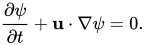
The advection equation for a conserved quantity described by a scalar field is expressed by a continuity equation: where vector field is the flow velocity and is the del operator. If the flow is assumed to be incompressible then is solenoidal, that is, the divergence is zero:and (by using a product rule associated with the divergence) the above equation reduces to





Hub AI
Advection AI simulator
(@Advection_simulator)
Advection
In the fields of physics, engineering, and earth sciences, advection is the transport of a substance or quantity by bulk motion of a fluid. The properties of that substance are carried with it. Generally the majority of the advected substance is also a fluid. The properties that are carried with the advected substance are conserved properties such as energy. An example of advection is the transport of pollutants or silt in a river by bulk water flow downstream. Another commonly advected quantity is energy or enthalpy. Here the fluid may be any material that contains thermal energy, such as water or air. In general, any substance or conserved extensive quantity can be advected by a fluid that can hold or contain the quantity or substance.
During advection, a fluid transports some conserved quantity or material via bulk motion. The fluid's motion is described mathematically as a vector field, and the transported material is described by a scalar field showing its distribution over space. Advection requires currents in the fluid, and so cannot happen in rigid solids. It does not include transport of substances by molecular diffusion.
Advection is sometimes confused with the more encompassing process of convection, which is the combination of advective transport and diffusive transport.
In meteorology it is the transfer by the wind of an atmospheric mass. Advection is important for the formation of orographic clouds and the precipitation of water from clouds, as part of the hydrological cycle.
The advection equation is a first-order hyperbolic partial differential equation that governs the motion of a conserved scalar field as it is advected by a known velocity vector field. It is derived using the scalar field's conservation law, together with Gauss's theorem, and taking the infinitesimal limit.
One easily visualized example of advection is the transport of ink dumped into a river. As the river flows, ink will move downstream in a "pulse" via advection, as the water's movement itself transports the ink. If added to a lake without significant bulk water flow, the ink would simply disperse outwards from its source in a diffusive manner, which is not advection. Note that as it moves downstream, the "pulse" of ink will also spread via diffusion. The sum of these processes is called convection.
The advection equation for a conserved quantity described by a scalar field is expressed by a continuity equation: where vector field is the flow velocity and is the del operator. If the flow is assumed to be incompressible then is solenoidal, that is, the divergence is zero:and (by using a product rule associated with the divergence) the above equation reduces to