
Recent from talks
Aeolian Islands
Knowledge base stats:
Talk channels stats:
Members stats:
Aeolian Islands
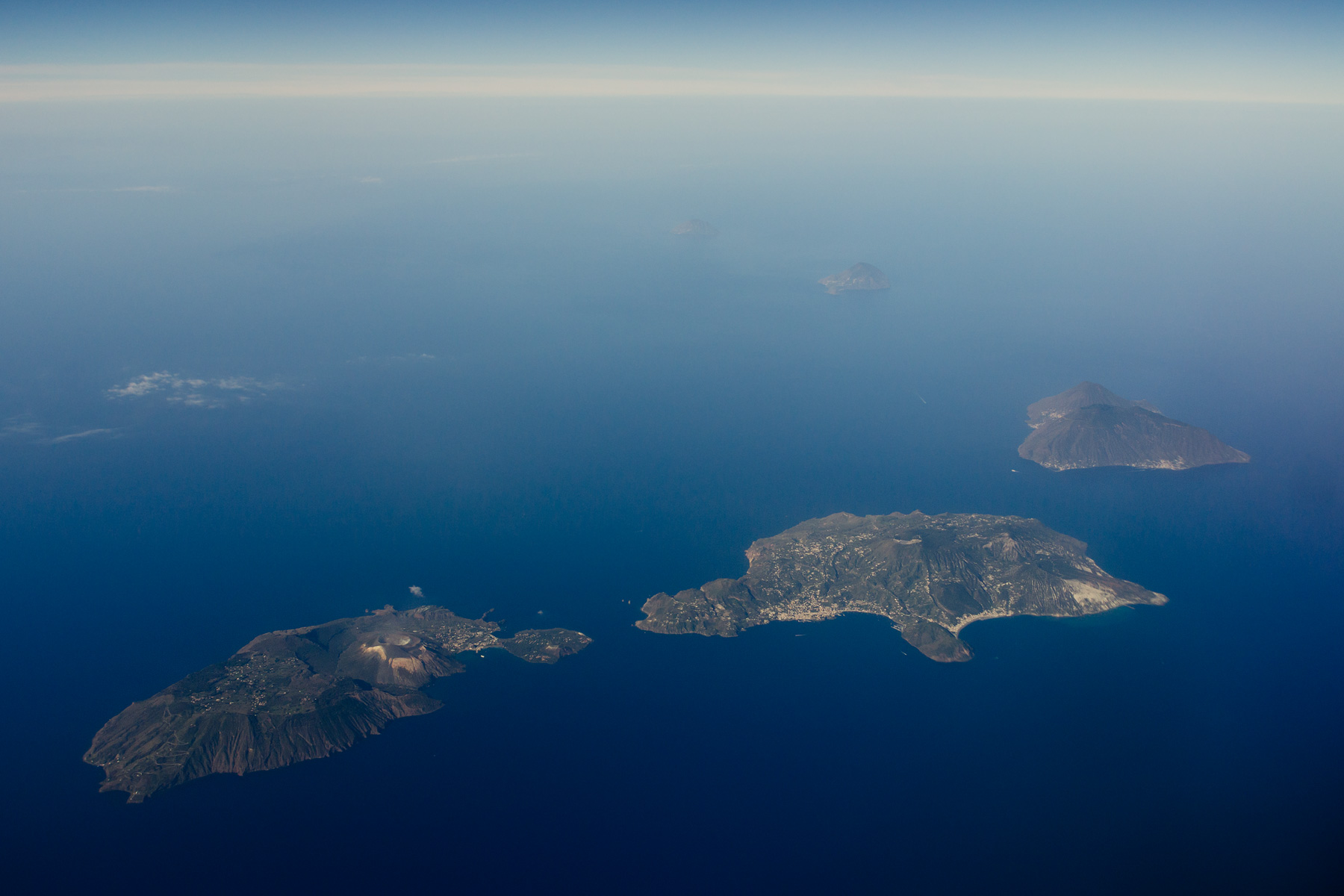
The Aeolian Islands (/iːˈoʊliən/ ee-OH-lee-ən; Italian: Isole Eolie [ˈiːzole eˈɔːlje]; Sicilian: Ìsuli Eoli), sometimes referred to as the Lipari Islands or Lipari group (/ˈlɪpəri/ LIP-ər-ee, Italian: [ˈliːpari]) after their largest island, are a volcanic archipelago in the Tyrrhenian Sea north of Sicily, said to be named after Aeolus, the mythical ruler of the winds. The islands' inhabitants are known as Aeolians (Italian: Eoliani). The islands had a permanent population of 14,224 at the 2011 census; the latest official estimate is 15,419 as of 1 January 2019. The Aeolian Islands are a popular tourist destination in the summer and attract up to 600,000 visitors annually.
There are seven significant islands: Lipari, Vulcano, Salina, Stromboli, Filicudi, Alicudi and Panarea, and a set of minor islands and rocks.
The Aeolian Islands are 30 to 80 kilometres (19 to 50 mi) off the north coast of Sicily in the Tyrrhenian Sea. Vulcano is located closest to the Sicilian coast. Lipari and Salina follow to the north, Filicudi and Alicudi to the west, and Panarea and Stromboli to the northeast. In addition to these seven inhabited islands, there are a number of smaller, uninhabited islands and rocky cliffs, such as Basiluzzo, Strombolicchio, Dattilo and Lisca Bianca.
The largest island is Lipari (37.5 km2 [14.5 sq mi]), followed by Salina (26.8 km2 [10.3 sq mi]), Vulcano (21.2 km2 [8.2 sq mi]), Stromboli (12.6 km2 [4.9 sq mi]), Filicudi (9.5 km2 [3.7 sq mi]) and Alicudi (5.2 km2 [2.0 sq mi]). The smallest island, at 3.4 km2 (1.3 sq mi), is Panarea. The highest elevation of the Lipari Islands is Monte Fossa delle Felci on Salina, which reaches a height of 962 m (3,156 ft).
The seven Aeolian Islands, covering an area of 1,600 km2 (620 sq mi), originated in the Tyrrhenian Basin, a great plain at the bottom of the Tyrrhenian Sea. Emissions of lava from depths of up to 3,600 m (11,800 ft) resulted in the formation of the Aeolian Islands, together with Ustica and a series of submarine volcanoes named Magnani, Vavilov, Marsili and Palinuro, as well as two that are unnamed.
The present shape of the Aeolian Islands is the result of volcanic activity over a period of 260,000 years. There are two active volcanoes – Stromboli and Vulcano. Steaming fumaroles and thermal waters are on most of the islands. The volcanic activity has also left the islands with a very fertile soil that is beneficial in the growth of natural flora.
Geologically the archipelago is defined as a volcanic arc. The origin of the Aeolian Islands is due to movement of the Earth's crust as a result of plate tectonics. The African continental shelf is in constant movement towards Europe. Its subduction underneath the Eurasian plate generates magma, which rises to the surface to form the volcanoes. The "Aeolian Arc" extends for more than 140 km (87 mi). It is a section of a larger area of geological instability across the Mediterranean region, caused by the collision of Africa and Europe, which includes Sicily, Calabria, and Campania together with Greece and the Aegean islands.
The islands form part of the Sicilian Metropolitan City of Messina. All the islands except Salina comprise the comune of Lipari within that province; Salina forms three separate comunes: Malfa, Leni and Santa Marina Salina.
Hub AI
Aeolian Islands AI simulator
(@Aeolian Islands_simulator)
Aeolian Islands
The Aeolian Islands (/iːˈoʊliən/ ee-OH-lee-ən; Italian: Isole Eolie [ˈiːzole eˈɔːlje]; Sicilian: Ìsuli Eoli), sometimes referred to as the Lipari Islands or Lipari group (/ˈlɪpəri/ LIP-ər-ee, Italian: [ˈliːpari]) after their largest island, are a volcanic archipelago in the Tyrrhenian Sea north of Sicily, said to be named after Aeolus, the mythical ruler of the winds. The islands' inhabitants are known as Aeolians (Italian: Eoliani). The islands had a permanent population of 14,224 at the 2011 census; the latest official estimate is 15,419 as of 1 January 2019. The Aeolian Islands are a popular tourist destination in the summer and attract up to 600,000 visitors annually.
There are seven significant islands: Lipari, Vulcano, Salina, Stromboli, Filicudi, Alicudi and Panarea, and a set of minor islands and rocks.
The Aeolian Islands are 30 to 80 kilometres (19 to 50 mi) off the north coast of Sicily in the Tyrrhenian Sea. Vulcano is located closest to the Sicilian coast. Lipari and Salina follow to the north, Filicudi and Alicudi to the west, and Panarea and Stromboli to the northeast. In addition to these seven inhabited islands, there are a number of smaller, uninhabited islands and rocky cliffs, such as Basiluzzo, Strombolicchio, Dattilo and Lisca Bianca.
The largest island is Lipari (37.5 km2 [14.5 sq mi]), followed by Salina (26.8 km2 [10.3 sq mi]), Vulcano (21.2 km2 [8.2 sq mi]), Stromboli (12.6 km2 [4.9 sq mi]), Filicudi (9.5 km2 [3.7 sq mi]) and Alicudi (5.2 km2 [2.0 sq mi]). The smallest island, at 3.4 km2 (1.3 sq mi), is Panarea. The highest elevation of the Lipari Islands is Monte Fossa delle Felci on Salina, which reaches a height of 962 m (3,156 ft).
The seven Aeolian Islands, covering an area of 1,600 km2 (620 sq mi), originated in the Tyrrhenian Basin, a great plain at the bottom of the Tyrrhenian Sea. Emissions of lava from depths of up to 3,600 m (11,800 ft) resulted in the formation of the Aeolian Islands, together with Ustica and a series of submarine volcanoes named Magnani, Vavilov, Marsili and Palinuro, as well as two that are unnamed.
The present shape of the Aeolian Islands is the result of volcanic activity over a period of 260,000 years. There are two active volcanoes – Stromboli and Vulcano. Steaming fumaroles and thermal waters are on most of the islands. The volcanic activity has also left the islands with a very fertile soil that is beneficial in the growth of natural flora.
Geologically the archipelago is defined as a volcanic arc. The origin of the Aeolian Islands is due to movement of the Earth's crust as a result of plate tectonics. The African continental shelf is in constant movement towards Europe. Its subduction underneath the Eurasian plate generates magma, which rises to the surface to form the volcanoes. The "Aeolian Arc" extends for more than 140 km (87 mi). It is a section of a larger area of geological instability across the Mediterranean region, caused by the collision of Africa and Europe, which includes Sicily, Calabria, and Campania together with Greece and the Aegean islands.
The islands form part of the Sicilian Metropolitan City of Messina. All the islands except Salina comprise the comune of Lipari within that province; Salina forms three separate comunes: Malfa, Leni and Santa Marina Salina.
Recent media