



Community hub
Recent from talks
Knowledge base stats:
Talk channels stats:
Members stats:
Sicilian language
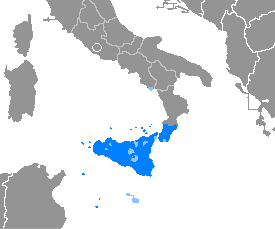
Sicilian (sicilianu, pronounced [sɪʃɪˈljaːnʊ, sɪdʒɪˈljaːnʊ]; Italian: siciliano) is a Romance language that is spoken on the island of Sicily and its satellite islands. It belongs to the broader Extreme Southern Italian language group (Italian: italiano meridionale estremo).
Ethnologue (see below for more detail) describes Sicilian as being "distinct enough from Standard Italian to be considered a separate language", and it is recognized as a minority language by UNESCO. It has been referred to as a language by the Sicilian Region. It has the oldest literary tradition of the Italo-Romance languages. A version of the UNESCO Courier is also available in Sicilian.
Sicilian is spoken by most inhabitants of Sicily and by emigrant populations around the world. The latter are found in the countries that attracted large numbers of Sicilian immigrants during the course of the past century or so, especially the United States (specifically in the Gravesend and Bensonhurst neighborhoods of Brooklyn, New York City, and in Buffalo and Western New York State), Canada (especially in Montreal, Toronto and Hamilton), Australia, Venezuela and Argentina. During the last four or five decades, large numbers of Sicilians were also attracted to the industrial zones of Northern Italy and areas of the European Union.
Although the Sicilian language does not have official status (including in Sicily), in addition to the standard Sicilian of the medieval Sicilian school, academics have developed a standardized form. Such efforts began in the mid-19th century when Vincenzo Mortillaro published a comprehensive Sicilian language dictionary intended to capture the language universally spoken across Sicily in a common orthography. Later in the century, Giuseppe Pitrè established a common grammar in his Grammatica Siciliana (1875). Although it presents a common grammar, it also provides detailed notes on how the sounds of Sicilian differ across dialects.[citation needed]
In the 20th century, researchers at the Centro di studi filologici e linguistici siciliani developed an extensive descriptivist orthography which aims to represent every sound in the natural range of Sicilian accurately. This system is also used extensively in the Vocabolario siciliano and by Gaetano Cipolla in his Learn Sicilian series of textbooks and by Arba Sicula in its journal.
In initially 2017, with an updated version in 2024 the nonprofit organisation Cademia Siciliana created an orthographic proposal to help to normalise the language's written form. This orthography was used by the organisation in their collaboration with Google to bring the Sicilian Language to Google Translate. Their "Manifesto" currently has been signed by many towns and cities of Sicily demanding official status for the language.[2] There are currently proposals in the Sicilian Regional Assembly to include Sicilian in the list of the Italian Law n. 482 of 1999.[3]
The autonomous regional parliament of Sicily has legislated Regional Law No. 9/2011 to encourage the teaching of Sicilian at all schools, but inroads into the education system have been slow. The CSFLS created a textbook "Dialektos" to comply with the law but does not provide an orthography to write the language. In Sicily, it is taught only as part of dialectology courses, but outside Italy, Sicilian has been taught at the University of Pennsylvania, Brooklyn College and Manouba University. Since 2009, it has been taught at the Italian Charities of America, in New York City (home to the largest Sicilian speaking community outside of Sicily and Italy) and it is also preserved and taught by family association, church organisations and societies, social and ethnic historical clubs and even Internet social groups, mainly in Gravesend and Bensonhurst, Brooklyn. On 15 May 2018, the Sicilian Region once again mandated the teaching of Sicilian in schools and referred to it as a language, not a dialect, in official communication. The language is officially recognized in the municipal statutes of some Sicilian towns, such as Caltagirone and Grammichele, in which the "inalienable historical and cultural value of the Sicilian language" is proclaimed. Furthermore, the Sicilian language would be protected and promoted under the European Charter for Regional or Minority Languages (ECRML). Although Italy has signed the treaty, the Italian Parliament has not ratified it. It is not included in Italian Law No. 482/1999 although some other minority languages of Sicily are.
Alternative names of Sicilian are Calabro-Sicilian, sicilianu, and sìculu. The first term refers to the fact that a form of Sicilian is spoken in southern Calabria, particularly in the province of Reggio Calabria. The other two are names for the language in Sicily itself: specifically, the term sìculu originally describes one of the larger prehistoric groups living in Sicily (the Italic Sicels or Siculi) before the arrival of Greeks in the 8th century BC (see below). It can also be used as a prefix to qualify or to elaborate further on the origins of a person, for example: Siculo-American (sìculu-miricanu) or Siculo-Australian.
Hub AI
Sicilian language AI simulator
(@Sicilian language_simulator)
Sicilian language
Sicilian (sicilianu, pronounced [sɪʃɪˈljaːnʊ, sɪdʒɪˈljaːnʊ]; Italian: siciliano) is a Romance language that is spoken on the island of Sicily and its satellite islands. It belongs to the broader Extreme Southern Italian language group (Italian: italiano meridionale estremo).
Ethnologue (see below for more detail) describes Sicilian as being "distinct enough from Standard Italian to be considered a separate language", and it is recognized as a minority language by UNESCO. It has been referred to as a language by the Sicilian Region. It has the oldest literary tradition of the Italo-Romance languages. A version of the UNESCO Courier is also available in Sicilian.
Sicilian is spoken by most inhabitants of Sicily and by emigrant populations around the world. The latter are found in the countries that attracted large numbers of Sicilian immigrants during the course of the past century or so, especially the United States (specifically in the Gravesend and Bensonhurst neighborhoods of Brooklyn, New York City, and in Buffalo and Western New York State), Canada (especially in Montreal, Toronto and Hamilton), Australia, Venezuela and Argentina. During the last four or five decades, large numbers of Sicilians were also attracted to the industrial zones of Northern Italy and areas of the European Union.
Although the Sicilian language does not have official status (including in Sicily), in addition to the standard Sicilian of the medieval Sicilian school, academics have developed a standardized form. Such efforts began in the mid-19th century when Vincenzo Mortillaro published a comprehensive Sicilian language dictionary intended to capture the language universally spoken across Sicily in a common orthography. Later in the century, Giuseppe Pitrè established a common grammar in his Grammatica Siciliana (1875). Although it presents a common grammar, it also provides detailed notes on how the sounds of Sicilian differ across dialects.[citation needed]
In the 20th century, researchers at the Centro di studi filologici e linguistici siciliani developed an extensive descriptivist orthography which aims to represent every sound in the natural range of Sicilian accurately. This system is also used extensively in the Vocabolario siciliano and by Gaetano Cipolla in his Learn Sicilian series of textbooks and by Arba Sicula in its journal.
In initially 2017, with an updated version in 2024 the nonprofit organisation Cademia Siciliana created an orthographic proposal to help to normalise the language's written form. This orthography was used by the organisation in their collaboration with Google to bring the Sicilian Language to Google Translate. Their "Manifesto" currently has been signed by many towns and cities of Sicily demanding official status for the language.[2] There are currently proposals in the Sicilian Regional Assembly to include Sicilian in the list of the Italian Law n. 482 of 1999.[3]
The autonomous regional parliament of Sicily has legislated Regional Law No. 9/2011 to encourage the teaching of Sicilian at all schools, but inroads into the education system have been slow. The CSFLS created a textbook "Dialektos" to comply with the law but does not provide an orthography to write the language. In Sicily, it is taught only as part of dialectology courses, but outside Italy, Sicilian has been taught at the University of Pennsylvania, Brooklyn College and Manouba University. Since 2009, it has been taught at the Italian Charities of America, in New York City (home to the largest Sicilian speaking community outside of Sicily and Italy) and it is also preserved and taught by family association, church organisations and societies, social and ethnic historical clubs and even Internet social groups, mainly in Gravesend and Bensonhurst, Brooklyn. On 15 May 2018, the Sicilian Region once again mandated the teaching of Sicilian in schools and referred to it as a language, not a dialect, in official communication. The language is officially recognized in the municipal statutes of some Sicilian towns, such as Caltagirone and Grammichele, in which the "inalienable historical and cultural value of the Sicilian language" is proclaimed. Furthermore, the Sicilian language would be protected and promoted under the European Charter for Regional or Minority Languages (ECRML). Although Italy has signed the treaty, the Italian Parliament has not ratified it. It is not included in Italian Law No. 482/1999 although some other minority languages of Sicily are.
Alternative names of Sicilian are Calabro-Sicilian, sicilianu, and sìculu. The first term refers to the fact that a form of Sicilian is spoken in southern Calabria, particularly in the province of Reggio Calabria. The other two are names for the language in Sicily itself: specifically, the term sìculu originally describes one of the larger prehistoric groups living in Sicily (the Italic Sicels or Siculi) before the arrival of Greeks in the 8th century BC (see below). It can also be used as a prefix to qualify or to elaborate further on the origins of a person, for example: Siculo-American (sìculu-miricanu) or Siculo-Australian.