Hubbry Logo
VulcanoVulcanoMain
Open search
Vulcano
Community hub
Vulcano
logo
8 pages, 0 posts
0 subscribers
Be the first to start a discussion here.
Vulcano
Vulcano
from Wikipedia

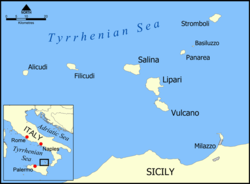
Vulcano (Sicilian: Vurcanu) or Vulcan is a small volcanic island belonging to Italy in the Tyrrhenian Sea, about 20 km (12 mi) north of Sicily and located at the southernmost end of the seven Aeolian Islands.[1] The island is known for its volcanic activity and contains several volcanic calderas, including one of the four active volcanoes in Italy that are not submarine. The English word "volcano", and its equivalent in several European languages, derives from the name of this island, which derives from the Roman belief that the tiny island was the chimney of Vulcan, the Roman god of fire. In November 2021, 150 people were evacuated from the island's harbour area due to increased volcanic activity and gases; an amber alert had been issued in October 2021 after several significant changes in the volcano's parameters.[2]. In the fall of 2025, volcanic unrest increased again with strong gas emissions reported on October 15, 2025.[3]

Key Information

Geography

[edit]

Vulcano is located approximately 20 km (12 mi) north of Sicily and is approximately 8 km (5 mi) long by 4 km (2 mi) wide. The island is 21 km2 (8 sq mi) in area and rises to 501 m (1,644 ft) above sea level. The island is separated by a 750 m (2,461 ft)-wide strait from Lipari to the north and is administratively part of the Commune of Lipari.[citation needed]

As of 2019, Vulcano had a population of 450 residents, a decrease from a population of 953 in 2011. The majority of the population resides in Vulcano Porto on the north side of the island, with secondary population centres at Vulcano Piano and Vulcanello.[4][5]

Geology

[edit]
Vulcano
Map
Highest point
Elevation501 m (1,644 ft)
Prominence501 m (1,644 ft)
Geography
LocationAeolian Islands, Italy
Geology
Mountain typeComplex stratovolcanoes
Last eruption1888 to 1890
Alternating views of fumaroles

Volcanic activity in the region is largely the result of tectonic activity, the northward-moving African Plate meeting the Eurasian Plate.[citation needed]

There are three volcanic centres on the island:

  • At the southern end of the island are old stratovolcano cones, Monte Aria (501 m (1,644 ft)), Monte Saraceno (481 m (1,578 ft)), and Monte Luccia (188 m (617 ft)), which have partially collapsed into the Il Piano Caldera.[citation needed]
  • The most recently active centre is the Gran Cratere at the top of the Fossa cone, the cone having grown in the Lentia Caldera in the middle of the island, and has had at least nine major eruptions in the last 6,000 years.[citation needed]
  • At the north of the island is the islet, Vulcanello (123 m (404 ft)), connected to Vulcano by an isthmus that may be flooded in bad weather. It emerged from the sea during an eruption in 183 BCE, as a separate islet. Occasional eruptions from its three cones with both pyroclastic flow deposits and lavas occurred from then until 1550, with the last eruption creating a narrow isthmus connecting it to Vulcano.[citation needed]

Vulcano has had no eruptions since the eruption of the Fossa cone on 2 August 1888 to 22 March 1890,[2] which deposited about 5 m (16 ft) of pyroclastic material on the summit. The style of eruption seen on the Fossa cone is called a Vulcanian eruption, being the explosive emission of pyroclastic fragments of viscous magmas caused by the high viscosity preventing gases from escaping easily. This eruption of Vulcano was carefully documented at the time by Giuseppe Mercalli. Mercalli described the eruptions as "...explosions sounding like a cannon at irregular intervals..." As a result, vulcanian eruptions are based on his description. A typical vulcanian eruption can hurl blocks of solid material several hundreds of metres from the vent. Mercalli reported that blocks from the 1888–1890 eruption fell into the sea between Vulcano and neighboring Lipari, and several that had fallen on the island of Vulcano were photographed by him or his assistants.[citation needed]

Volcanic gas emissions from this volcano are measured by a multicomponent gas analyzer system, which detects degassing of rising magmas before an eruption, improving prediction of volcanic activity.[6]

A survey on local groundwater from 1995 to 1997 found temperatures of 49–75 °C, sodium sulfate -chloride chemical composition, and near neutral pH in the water wells closest to the slopes of the volcanic cone. This is mainly due to condensation onto the slopes of the volcanic cone and water-rock interaction buffering.[7][8]

View from the island of Lipari of the northern profile of Vulcano on which the low Fossa cone is visible (center), the green islet in the foreground is Vulcanello and the isthmus connecting Vulcanello to Vulcano is barely visible

Microbiology

[edit]

Since Vulcano island has volcanic activity, it is a place where thermophiles and hyperthermophiles are found. The hyperthermophilic archaean Pyrococcus furiosus was described for the first time when it was isolated from sediments of this island.[9]

History

[edit]
Aerial view of the Fossa cone
The Gran Cratere

Classical period

[edit]

The Ancient Greeks named this island Therasía (Θηρασία) and Thérmessa (Θέρμεσσα, source of heat). The island appeared in their myths as the private foundry of the Olympian god Hephaestus, the patron of blacksmiths. Their myths noted two more of his foundries, at Etna and Olympus. Strabo also mentions Thermessa as sacred place of Hephaestus (ἱερὰ Ἡφαίστου), but it is not certain whether this was a third name for the island, or merely an adjective.[10]

Similarly, the Romans believed that Vulcano was the chimney of their god Vulcan's workshop and, therefore, named the island after him. According to the Roman myths, the island had grown due to his periodic clearing of cinders and ashes from his forge. They also explained earthquakes that either preceded or accompanied the explosions of ash as being due to Vulcan making weapons for their god Mars for his armies to wage war.[11]

The Romans used the island mainly for raw materials, harvesting timber, and mining alum and sulfur. These were the principal activities on the island until the end of the nineteenth century.[citation needed]

Medieval

[edit]

The first ascent of the volcanic cone is documented for the 13th century. The Dominican friar Burchard of Mount Sion, in his pilgrimage report to the Holy Land, tells of his return journey via Sicily, which probably took place in 1284. On Vulcano he had climbed the summit "crawling on his hands and feet".[12] His ascent can be considered authentic, as he reports in detail on his observations of the landscape and nature, for example describing the fumaroles or the diameter of the crater.[citation needed]

The island of Vulcano as well as the Aeolian Islands are already known to Isidor of Seville, the Gallic bishop Arculf, who dictated his journey to the Holy Land to the Irishman Adomnan (before 680), or Bartholomew Anglicus. They are an integral part of medieval knowledge of the geography of the Mediterranean, but none of them wrote about Vulcano on their own initiative.[citation needed]

Vulcano is also mentioned in the pilgrimage report (ca. 1350) by Ludolf von Sudheim, who, however, claims that he did not dare to climb it. Unlike Burchard of Mount Sion, Ludolf expected to find the entrance to hell at the crater. The Provençal knight Antoine de La Sale tells of an excursion to the island in 1406. His text is a didactic textbook for his pupil John of Calabria, the son of Duke Rene I of Anjou.[citation needed]

Modern period

[edit]

After Bourbon rule collapsed in 1860, the Scottish industrialist and philanthropist James Stevenson bought the northern part of the island. He then built a villa, reopened the local mines, and planted vineyards for making Malmsey wine. Stevenson lived on Vulcano until the last major eruption on the island, in 1888. This eruption lasted the better part of two years, by which time Stevenson had sold all of his property to the local populace. He never returned to the island. His villa is still intact.[13] [14]

Cultural significance

[edit]

American attorney and writer Richard Paul Roe asserts that the play The Tempest by William Shakespeare is set on the island of Vulcano, rather than the more authoritative interpretation that the setting was based on reports about Bermuda in the Americas because of the hurricane.[15]

An asteroid is named after this island, 4464 Vulcano.[16]

See also

[edit]

References

[edit]

Sources

[edit]
[edit]
Revisions and contributorsEdit on WikipediaRead on Wikipedia
from Grokipedia
Vulcano is a small located in the Aeolian archipelago, approximately 25 km north of , , and is the southernmost of the seven principal islands in this . It features the active La Fossa, rising to 391 meters, and is geologically complex, having evolved over approximately 120,000 years through multiple stages of formation, cone building, and eruptive activity. The island's name derives from Vulcan, the Roman god of fire, as ancient beliefs held it to be the site of his forge, giving rise to the English word "" and the classification of Vulcanian eruptions characterized by explosive events producing ash and pyroclastic material. The geological history of Vulcano includes early phases such as the South Vulcano (120,000–98,000 years ago) and the Piano collapse around 98,000–97,000 years ago, followed by post-caldera activity and the formation of the Lentia complex about 15,500 years ago. The current La Fossa cone began forming around 6,000–5,000 years ago, with subsequent cycles of eruptions, including the Vulcanello peninsula, which emerged as an island about 2,100 years ago before connecting to the main island. Eruptive history records at least 30 events in the last 1,100 years, predominantly from La Fossa and Vulcanello, with the most recent major eruption occurring between 1888 and 1890, involving Vulcanian explosions that ejected blocks, bombs, and ash. As of November 2025, Vulcano is in a phase of unrest that began in , exhibiting increased fumarolic emissions, ground deformation, shallow , and elevated soil CO₂ flux, though no eruptions have occurred since 1890; it continues to serve as a key site for volcanological research due to its diverse eruptive styles and ongoing geological processes. The island's significance extends to its cultural and scientific heritage, having been studied since the and exemplifying arc dynamics in the Aeolian chain.

Geography

Location and Topography

Vulcano is the southernmost island in the archipelago, situated in the about 25 km north of 's northern coast. Its central coordinates are approximately 38°23′ N, 14°57′ E, placing it at the southern edge of this group off the coast of . Administratively, Vulcano forms part of the commune within the , region. The island spans an area of roughly 21 km², measuring about 7-8 km in length from north to south and 3-4 km in width, with an elongated, irregular shape influenced by successive volcanic episodes. Its highest point is Monte Aria, reaching approximately 500 m above . The features steep slopes descending to coastal plains, including beaches formed from volcanic along the western and southern shores. Prominent landforms include three primary volcanic centers: the older Monte Aria in the south, rising to around 500 m and representing ancient edifices; the central La Fossa cone, a 391 m-high within a 3 km-wide ; and the Vulcanello to the north, a 123 m-high feature connected to the main island by a narrow sandy that formed during the . The eastern side hosts Porto di Levante, a natural harbor adjacent to areas of hydrothermal activity, including thermal mud pools rich in sulfurous sediments. These elements create a rugged, dynamic shaped by volcanic processes.

Climate

Vulcano possesses a hot-summer , classified as Köppen Csa, featuring pronounced seasonal contrasts with extended dry periods. Summers are hot and arid, while winters remain mild but experience the bulk of the region's rainfall. This climate pattern is typical of the Aeolian archipelago, where the island's position in the influences atmospheric conditions. In July, the warmest month, average high temperatures reach approximately 30°C, with low humidity and minimal cloud cover fostering intense solar exposure. Winters are cooler and more temperate, with January lows averaging around 10°C, though daytime highs often climb to 15°C under clear skies. Annual totals about 600 mm, concentrated primarily from October to March, when frequent rain events contribute to the ; summers, conversely, see scant rainfall, with July averaging less than 10 mm. These and regimes underscore the island's reliance on seasonal cycles for water availability. The island's coastal location moderates extremes, as surrounding waters absorb and release heat, stabilizing daily and nocturnal temperatures compared to mainland Sicily. Volcanic features, including porous soils and active fumaroles, generate localized microclimates; areas near emission vents exhibit elevated humidity due to steam release, contrasting with the drier ambient air elsewhere. Elevation variations across the terrain, such as the slopes of La Fossa cone, further nuance these patterns by creating cooler, more sheltered zones at higher altitudes. Wind dynamics play a key role in Vulcano's weather. During summer, prevailing winds from the southeast transport warm, dry air from , occasionally pushing temperatures above 35°C and exacerbating conditions. In winter, mistral winds from the northwest dominate, delivering cooler, gusty flows that enhance and improve air circulation. These winds contribute to the island's overall ventilation, mitigating stagnation but sometimes intensifying . Volcanic activity periodically disrupts the climate baseline through ash fallout, which can briefly impair visibility and degrade air quality during unrest episodes. Such events, though infrequent, highlight the interplay between geological processes and atmospheric conditions on this active island.

Geology

Formation and Structure

Vulcano is situated within the Aeolian volcanic arc in the southern Tyrrhenian Sea, a geodynamically active region resulting from the subduction of the Ionian oceanic slab—part of the African plate—beneath the Eurasian plate along the convergent boundary of the Calabrian Arc. This subduction process, ongoing since the Miocene, drives mantle melting through fluid release from the dehydrating slab, leading to the formation of the arc's volcanic edifices over thinned continental crust. The island itself emerged approximately 130,000 years ago as a composite structure built by successive volcanic episodes, progressively migrating from southeast to northwest. The 's primary volcanic centers include Monte Aria, the oldest and now extinct edifice in the southern sector, which formed around 78,000 years ago as part of the initial "Primordial Vulcano" phase and reaches a maximum of 500 m above . Central to the is La Fossa, an active rising to 391 m, characterized by a cone within a 3-km-wide structure that has hosted activity for the past 5,500 years. To the north, Vulcanello represents a younger pyroclastic cone system, approximately 123 m high, aligned NE-SW and formed between 1,000 and 2,000 years ago; it initially emerged as a separate before connecting to the main landmass via sediment deposition. These centers collectively define the 's NW-SE elongated morphology, with Vulcanello's connection manifesting as a low-lying sandy barrier. Geologically, Vulcano's is dominated by andesitic to dacitic lavas and pyroclastic deposits from the shoshonitic magmatic series, which includes latites, trachytes, and minor high-K calc-alkaline components, reflecting slab-derived fluid influence on mantle sources. comprises interlayered lava flows, explosive pyroclastic successions, volcaniclastic debris from lahars, and hydrothermally altered zones due to persistent fumarolic activity, with notable economic deposits of and formed through sublimate precipitation in fracture systems. Subsurface imaging from and geodetic data infers a polybaric magma storage system, including a shallow at 3.5–5 km depth beneath La Fossa, where andesitic magmas differentiate amid volatile-rich conditions.

Eruption History

Vulcano's eruptive history is characterized by frequent, relatively small-scale events over the epoch, with at least 37 documented eruptions in the past 10,000 years. These eruptions have primarily exhibited Strombolian and phreatomagmatic styles, involving the ejection of , , and bombs, with Volcanic Explosivity Indices (VEI) typically ranging from 1 to 3. The island's volcanic activity has been concentrated at the La Fossa cone and the Vulcanello peninsula, contributing to the formation of key topographic features like the Gran Cratere. Prehistoric eruptions laid the foundation for Vulcano's modern structure, with the La Fossa cone initiating around 6,000 years ago through phreatomagmatic explosions that built the initial edifice and associated deposits. By the 5th century BCE, major explosive events at La Fossa culminated in the creation of the Gran Cratere, the prominent summit crater that defines the cone's current morphology, as evidenced by ancient accounts of intense activity. In the classical period, volcanic activity continued with significant events at Vulcanello, including its full emergence around 200 BCE through phreatomagmatic and effusive processes that formed the initial cone and surrounding platform. A notable at La Fossa occurred in 1444 CE, producing ash plumes that dispersed across the and reached as far as , depositing fine layers and ballistic over distances up to several kilometers. These events highlighted the persistent explosive potential of the Vulcanello and La Fossa systems. The 19th century marked a climax in documented activity with the 1888–1890 eruption series at La Fossa, exemplifying classic Vulcanian explosions characterized by violent blasts that ejected meter-sized bombs to heights of up to 2 km. This sequence was preceded by precursory earthquakes, increased gas emissions, and hydrothermal unrest starting in 1886, prompting evacuations from Vulcano Porto and surrounding areas. The eruptions caused widespread health issues among residents due to inhalation of toxic fumes containing and other volatiles, with ashfall and block impacts damaging structures and agriculture.

Recent Activity and Monitoring

Since the last major eruption in 1888–1890, Vulcano has exhibited persistent fumarolic activity, characterized by ongoing gas emissions from the La Fossa crater and surrounding areas. A period of heightened unrest occurred from 2021 to 2023, beginning in September 2021 with a sudden increase in , including very long-period events linked to fluid circulation in the hydrothermal system. Ground deformation accompanied this, with up to 2 cm of uplift and 1.5 cm of horizontal displacement observed primarily on the La Fossa cone via GNSS and InSAR measurements. Spikes in soil CO2 flux and fumarolic emissions, including elevated temperatures reaching over 300°C, prompted partial evacuations, such as nightly relocations of residents from the harbor area in November 2021 due to toxic gas risks. The unrest peaked through 2022–2023 with continued and geochemical changes but subsided by late 2023 without eruption. In 2025, volcanic unrest resumed with a sharp increase in CO2 emissions starting in August, rising from typical levels of 5–10,000 g/m² per day to significantly higher values, alongside moderate SO2 increases, signaling renewed from the hydrothermal-magmatic system. On October 14, a strong episode occurred at La Fossa crater, accompanied by elevated H2S and CO2 concentrations, which led to the activation of a yellow alert level by Italian authorities to mitigate gas exposure hazards. INGV monitoring during mid-October confirmed ongoing elevated activity through gas sampling and geochemical analysis. The Istituto Nazionale di Geofisica e Vulcanologia (INGV) maintains a comprehensive surveillance network on Vulcano, including a temporary seismic array of broadband stations deployed since 2021 to track low-frequency events and volcano-tectonic seismicity. Tiltmeters in installations measure subtle ground tilting associated with fluid movements, while a GNSS network of continuous stations monitors deformation in real-time, detecting millimeter-scale changes. Geochemical monitoring involves regular gas sampling and analysis at La Fossa crater fumaroles, focusing on CO2, SO2, H2S, and isotopic compositions to assess magmatic input. These data inform probabilistic hazard maps developed by civil protection authorities, highlighting risks from ash fallout and lahars in proximal areas. Key hazards include the potential for explosive eruptions driven by shallow accumulation, which could produce pyroclastic flows and ash plumes affecting the island and nearby . Toxic gas exposure from CO2, H2S, and SO2 emissions poses asphyxiation risks, particularly in low-lying zones like Vulcano Porto, where concentrations can exceed safe limits during unrest. Flank instability on La Fossa cone raises concerns for tsunamis generated by partial collapses into the sea. Evacuation protocols, coordinated by the Department of Civil Protection, target the island's approximately 450 residents and transient tourists, emphasizing rapid maritime evacuation routes and gas monitoring for timely alerts.

Ecology

Flora and Fauna

The Aeolian , including Vulcano, hosts nearly 930 species, many of which are adapted to the islands' and volcanic substrates. On Vulcano specifically, the flora is dominated by drought-resistant , characterized by evergreen sclerophyllous species such as (Spartium junceum) and myrtle (), which form dense thickets on the island's slopes and provide stability in nutrient-poor environments. Near the coasts, halophytic plants thrive in saline conditions, including like Limonium spp. and Salsola kali, which stabilize sandy substrates and contribute to the island's littoral vegetation. Among , alien invasives such as (a casual observed in disturbed areas) and (a naturalized in coastal zones) have established populations, potentially altering native community dynamics. Vulcano also supports priority habitats under the EU , notably coastal dunes featuring embryonic shifting sands and psammophilous grasslands that harbor specialized flora resilient to erosion and salt spray. Vulcano's fauna lacks large mammals due to the island's small size and isolation, with terrestrial communities instead comprising reptiles, birds, , and surrounding . Reptiles include the (Hierophis viridiflavus, formerly Coluber viridiflavus), a non-venomous colubrid that preys on and rodents across the , including Vulcano's rocky terrains. The critically endangered Aeolian wall lizard (Podarcis raffonei) persists in remnant populations on Vulcano, though its typical phenotype declined dramatically by 2017 due to competition and hybridization with the invasive Italian wall lizard (Podarcis siculus), raising concerns of by 2020. As of 2024, remnant populations continue to persist, particularly on the Capo Grosso peninsula, supported by conservation initiatives such as the LIFE-EOLIZARD project. Avian diversity features such as Scopoli's shearwater (Calonectris diomedea) nesting on cliffs and foraging offshore, alongside migratory passerines in shrublands. , including pollinators like bees and butterflies, play a key role in supporting the island's flora through nectar and pollen interactions, with endemic taxa adapted to oligotrophic conditions. Marine fauna in surrounding waters includes diverse fish assemblages (e.g., mullets and groupers) and colonies that utilize coastal upwellings for foraging. Many Vulcano species exhibit adaptations to the island's poor, acidic volcanic soils (pH often below 5), which are rich in sulfur, metals like aluminum and manganese, and low in essential nutrients. Plants such as Cistus salviifolius in maquis formations employ exclusion mechanisms to limit uptake of toxic elements like iron and lead, while herbaceous species like Fumaria capreolata hyper-accumulate sulfur (up to 6.4 g kg⁻¹ dry mass) and manganese through enzymatic detoxification via plant sulfite oxidase or reductive pathways. These tolerances enable persistence in geothermal zones with elevated SO₂ and H₂S emissions. The Vulcano Piano area features remnant thermophilous forests and seasonal wetlands, preserving biodiversity hotspots with mixed woodland of oaks (Quercus ilex) and mastic trees (Pistacia lentiscus) that shelter reptiles and birds amid the volcanic landscape.

Microbiology

Vulcano Island hosts unique adapted to its extreme volcanic environments, particularly in shallow-sea hydrothermal vents at Baia di Levante, where temperatures range from 50°C to 100°C and levels drop to 2–5 due to acidic emissions of CO₂ and H₂S. These vents, along with fumarolic soils in La Fossa Crater (reaching up to 450°C at the surface but cooler subsurface zones) and hot springs, support diverse aerobic and anaerobic and that thrive under high-temperature, low-, and high-salinity conditions. Fumarolic soils favor heat-resistant spore-formers, while hot springs and vents harbor chemolithoautotrophic microbes reliant on geochemical gradients. Prominent hyperthermophiles include , an anaerobic archaeon isolated from geothermal marine sediments at Porto di Levante in 1986, capable of optimal growth at 100°C through carbohydrate fermentation. Another key species is Bacillus aeolius, a thermophilic, halophilic, aerobic spore-forming bacterium isolated from shallow-sea waters at Vulcano, growing optimally at 60–65°C and 3–5% NaCl. Diverse communities feature orders such as Aquificales (e.g., Hydrogenothermus marinus for hydrogen oxidation) and Thermoproteales within archaea like Euryarchaeota and Crenarchaeota, alongside bacteria from and Proteobacteria. Metagenomic analyses of these assemblages reveal gene pools encoding adaptations, including heat-shock proteins and acid-resistance mechanisms. These microbes play critical ecological roles in sulfur and iron cycling; for instance, sulfur-oxidizing bacteria like Sulfurimonas and Sulfurovum (from ) oxidize reduced sulfur compounds, while iron-oxidizers such as Mariprofundus aestuarium facilitate Fe(II) to Fe(III) transformations in acidic pools. Acidophiles, including and , dominate low-pH biofilms, contributing to biogeochemical stability by mitigating acidification through metabolic processes. Such communities in fumarolic soils may also influence gas fluxes, consuming or producing CO₂ and CH₄. Research on Vulcano's underscores its value as a model for life, where similar acidic, high-temperature hydrothermal systems may have fostered primordial ecosystems, and for , simulating conditions on Mars or Europa. Volcanic unrest from 2021–2023, marked by heightened fumarolic activity and vent chemistry shifts (e.g., increased SO₂ and acidity), has prompted studies showing potential impacts on microbial diversity, with metagenomic surveys indicating altered community structures and functional genes for stress response.

History

Ancient and Classical Periods

Evidence of human presence in the dates back to the period around 4000 BCE, with Middle communities on nearby exploiting volcanic resources like for tools and trade. activity is indicated across the , reflecting continuity in resource use amid the volcanic landscape. By the 6th century BCE, Greek settlers had established a presence in the , including Vulcano, which they named Therasia or Thermessa, meaning "hot land," due to its geothermal features. The island served as a strategic naval outpost for the Greeks, leveraging its position in the for maritime control. The Roman conquest of the in 252 BCE during the marked a shift, with Vulcano renamed after Vulcan, the Roman god of fire. Prior to Roman control, the island hosted a Carthaginian naval station, facilitating Punic maritime operations until their defeat. Under Roman rule, from the 3rd century BCE to the 5th century CE, Vulcano became a key site for intensive and mining, essential for dyes, processing, and pharmaceuticals, with operations centered on volcanic deposits. A notable event was the 183 BCE eruption at Vulcanello, where a new volcanic islet emerged amid submarine explosions and mud flows, an occurrence documented by in his as a fiery upheaval near the Sicilian coast. This activity briefly disrupted but ultimately enhanced the island's reputation as a volatile site, influencing Roman cultural perceptions of volcanic phenomena.

Medieval and Early Modern Periods

Following the fall of the , Vulcano and the broader fell under Byzantine control as part of the Theme of , a administrative district established in the to defend against incursions. The islands experienced frequent raids during the 8th and 9th centuries, culminating in the 836 destruction of nearby by Muslim forces from , which led to the of inhabitants and the near-total depopulation of the , including Vulcano, due to ongoing threats and limited resources exacerbated by occasional volcanic activity. Settlement remained sparse through the 10th and 11th centuries, with the island's deposits—exploited since antiquity—providing a modest monopoly for the few residents, primarily in dyes and tanning, though production was intermittent amid instability. The of Sicily beginning in 1061 marked a turning point, with the islands resettled under the Kingdom of Sicily established in 1130. Count founded the first Benedictine monastery on in 1083, encouraging migration from mainland and , which extended to Vulcano and boosted its population for agricultural and fishing activities. By the 12th to 15th centuries, under Norman-Sicilian rule, Vulcano saw expanded settlement focused on fishing and small-scale farming of olives, vines, and grains, while extraction from volcanic deposits became a key economic activity, supplying lightweight stone for construction in regional Arabic-Norman architecture, such as churches and fortifications. In 1284, Dominican friar Burchard of Mount Sion documented the first verified ascent of La Fossa cone, describing its steaming craters and sulfurous fumes in his travel account, highlighting the island's growing notoriety as a volcanic site. During the , Vulcano came under Spanish Habsburg rule as part of the from the late until 1713, followed briefly by and Austrian control before the Bourbon restoration in 1734. Lava flows from Vulcanello, a northeastern extension of the island, occurred in the mid-16th century, merging it fully with Vulcano and altering the landscape without major recorded casualties, though they reinforced perceptions of . The island's economy centered on fishing and , with capers and lentils as staples, while sulfur ramped up for export to , where it was refined into —a vital amid colonial wars—drawing from Vulcano's rich solfataric deposits alongside other Sicilian sources. Periodic depopulation occurred in the 17th and 18th centuries due to endemic in marshy coastal areas and seismic activity linked to regional , reducing the resident population to a few hundred by the mid-1700s and shifting activity toward seasonal exploitation of volcanic resources.

Modern and Contemporary Periods

In the , Vulcano, as part of the , was incorporated into the Kingdom of Italy following the led by in 1860, with official unification occurring in 1861 as was annexed to the new kingdom. The island's population, which had been around 800 prior to the event, faced a major crisis during the eruption of La Fossa cone from August 1888 to March 1890, when explosive activity deposited up to 5 meters of pyroclastic material and hurled meter-sized bombs into the village of Vulcano , prompting a mass exodus of residents to nearby and . Following the eruption's end, repopulation began gradually in the late 19th and early 20th centuries, supported by returning families and seasonal workers, with the island's population stabilizing at several hundred by the . The 20th century brought relative stability to Vulcano's human settlement, with minimal direct impact from the World Wars; the island, like others in the , had served as a place of political banishment during the Fascist era before , but avoided significant military disruption. began to emerge in the and gained momentum in the 1950s, facilitated by regular ferry services from on , which connected Vulcano as the southernmost and closest island to the mainland, drawing visitors to its volcanic landscapes and thermal springs. Geochemical crises in the 1980s, particularly the degassing unrest of 1978–1980 and 1988–1990 characterized by elevated emissions of CO2, SO2, and H2S, raised health concerns among residents and prompted scientific studies on gas exposure risks, including respiratory effects and in Vulcano Porto. These events led to temporary restrictions and enhanced monitoring, culminating in post-1980s conservation measures, such as the establishment of protected areas under Sicilian regional laws to safeguard the island's volcanic features. Vulcano's administrative status remained under the comune of Lipari, the largest island in the archipelago, which assumed regional oversight following Sicily's special autonomy statute in 1946, providing localized governance for the Aeolian Islands amid post-World War II reconstruction. In the 21st century, as part of Italy's integration into the European Union since 1957, Vulcano benefited from EU-funded initiatives for environmental protection, including designation as a Natura 2000 site in the early 2000s to preserve its biodiversity and volcanic heritage. Volcanic unrest from 2021 to 2023, marked by increased seismicity, ground deformation, and gas emissions peaking in early November 2021, led to evacuations and overnight prohibitions in Vulcano Porto to mitigate health risks from high CO2 concentrations. Unrest continued into 2025, with a notable increase in strong degassing observed in October 2025, prompting ongoing alerts from the Istituto Nazionale di Geofisica e Vulcanologia (INGV) that continued to influence daily life, with elevated gas plumes affecting air quality and tourism as of November 2025, while the resident population stabilized at approximately 500.

Society and Economy

Demographics and Administration

Vulcano maintains a small permanent of approximately 800 residents, primarily residing in the main settlement of Vulcano Porto on the northern side of the island. This figure has remained relatively stable in recent years, though it decreased from 953 in 2011 to around 450 by 2019 before a slight rebound. The resident demographic reflects broader Sicilian trends of an aging and out-migration to the mainland for and opportunities, contributing to a stable but shrinking core community. During the peak summer tourist season from to , the island's surges to 22,000–28,000, including seasonal workers and visitors, straining local resources. Historical population fluctuations, such as evacuations during 19th-century eruptions, have shaped this pattern of temporary influxes and resident caution. Administratively, Vulcano forms part of the larger Comune di Lipari, which encompasses six of the seven and serves as the central without a separate municipal structure for Vulcano itself. Essential services, including supplies and transportation, are accessed via regular connections from on the Sicilian mainland, approximately 25 km away. is closely integrated with alerts from the Istituto Nazionale di Geofisica e Vulcanologia (INGV), which monitors volcanic activity and coordinates responses through operational protocols, including restrictions on access during unrest periods as seen in 2021–2023. The social composition of Vulcano's residents is predominantly of Italian-Sicilian heritage, with families tracing roots to long-standing island communities shaped by the Aeolian archipelago's isolation. Education and healthcare options are limited on the island, lacking secondary schools or hospitals; residents depend on facilities in for advanced needs, supplemented by basic clinics and primary schooling in Vulcano Porto. A small number of expatriates, mainly from other European countries, integrate into the community, often drawn by the island's . Culturally, the population is bilingual, with Italian as the alongside dialect commonly spoken in daily interactions. Local festivals emphasize the island's volcanic identity, such as the annual Volcanic Attitude event, a contemporary culture festival held in the that explores themes of transformation and earth frequencies through performances and exhibitions.

Tourism and Local Economy

Tourism serves as the dominant on Vulcano, contributing the majority of local through visitor spending on accommodations, guided activities, and services, while supplementary activities include small-scale and focused on crops like capers and olives that thrive in the island's fertile volcanic . Remnants of historical operations persist on a minor scale, but these have largely been overshadowed by tourism's growth since the mid-20th century. The island's economy benefits from its World Heritage status as part of the , which underscores its geological significance and draws eco-conscious travelers. Key attractions revolve around Vulcano's volcanic features, including strenuous hikes to the summit of La Fossa crater, a 391-meter ascent offering panoramic views of the and active fumaroles. Thermal baths at Porto di Levante, featuring sulfur-rich mud pools, are renowned for therapeutic benefits such as alleviating skin conditions and respiratory issues through mineral-laden waters heated by geothermal activity. Black-sand beaches like Sabbie Nere and the secluded Piscina di Venere provide opportunities for swimming in turquoise coves, while boat tours explore coastal caves and the Vulcanello peninsula's eerie lava formations in the Valley of the Monsters. These sites attract tens of thousands of visitors annually, with daily peaks reaching thousands during the summer high season from June to August. Infrastructure supports tourism through reliable ferry connections from Sicilian ports like and from , with hydrofoils and ferries operating multiple daily routes in peak season, taking 1-4 hours depending on origin. A range of hotels, guesthouses, and vacation rentals caters to budgets, with many offering sea views and proximity to the port; eco-tourism initiatives in the island's protected areas emphasize low-impact and guided nature walks to preserve the environment. Volcanic unrest from 2021 to 2023, characterized by heightened gas emissions and , significantly disrupted by prompting restrictions on access and evacuations in high-risk zones, leading to a substantial decline in visitor arrivals during peak periods due to safety advisories. In September 2025, a sharp increase in CO2 emissions indicated a new episode of volcanic unrest, with ongoing monitoring by INGV. As of November 2025, the alert level remains at green, though safety guidelines such as recommendations near fumaroles continue to mitigate risks for tourists. Sustainable practices, including limits on visitor capacity and promotion of off-peak travel, are increasingly adopted to balance economic benefits with ecological protection amid these hazards.

Cultural Significance

Etymology and Mythology

The name Vulcano originates from the Latin Vulcanus, the Roman god of fire and , a designation that underscores the island's prominent volcanic features and their perceived connection to divine craftsmanship. This naming convention emerged during the Roman period, when the island was identified as the site of Vulcan's subterranean forge, with its fumaroles and eruptions interpreted as evidence of the god's ceaseless labor. In modern Sicilian dialect, the island is known as Vurcanu, a phonetic adaptation reflecting this enduring linguistic heritage. Ancient Greek sources provide earlier precursors to this nomenclature, referring to the island as Thérmessa ("hot island"), a term highlighting its thermal activity, or Hiera ("sacred"), denoting its sanctity in relation to , the Greek counterpart to Vulcan and god of fire and the forge. According to , a 1st-century BCE historian, Hiera was one of the explicitly linked to , serving as a mythical workshop where the forged divine weapons amid the islands' volcanic tumult. Greek mythology further ties the site to the legend of , who was cast into the sea by his mother near the Aeolian archipelago and subsequently established his forge in the region's fiery depths, a narrative that parallels Roman traditions but emphasizes the Greek god's resilience and ingenuity. Roman mythology solidified Vulcano's association with Vulcan's forge, positing the island as the chimney to his underworld workshop, where the billowing smoke and periodic eruptions represented the god hammering thunderbolts for Jupiter. This belief is documented by Pliny the Elder in his Natural History (circa 77 CE), where he describes the island—then called the "Holy Island" sacred to Vulcan—as featuring a hill that "vomits forth flames" at night, attributing these phenomena to the deity's fiery domain rather than natural causes. Such accounts framed the island's volatility as a manifestation of divine industry, blending observation with mythological explanation. Local perpetuated these themes, envisioning Vulcano's craters and caverns as portals to the , with the rumbling sounds and sulfurous exhalations interpreted as the echoes of imprisoned spirits or the labors of subterranean beings. Inhabitants and visitors alike shared legends of these entrances guarding ' realm, where volcanic outbursts signaled the unrest of chthonic forces. By the , such tales evolved into romanticized narratives of volcanic spirits—ethereal entities born from the island's heat—influencing European travel literature that portrayed Vulcano as a liminal space between the earthly and infernal. The island's mythological renown has left a lasting global imprint, serving as the etymological root for the term "," which entered English in the via Italian vulcano and now denotes all such geological formations worldwide. This legacy extends to the field of vulcanology, the scientific study of , named in homage to Vulcano's ancient ties to the fire god and formalized in the amid growing interest in the island's activity. Vulcano has been suggested as a possible inspiration for the enchanted island in William Shakespeare's The Tempest (1611), where descriptions of volcanic activity and isolation evoke the Aeolian archipelago's dramatic landscape in the Sicilian Sea. In cinema, the island features prominently in the 1950 Italian drama Vulcano, directed by William Dieterle and starring Anna Magnani as a woman returning to her harsh island home amid personal and environmental struggles. The film highlights the island's rugged terrain and social isolation, drawing on its volcanic setting to underscore themes of redemption and endurance. Documentaries have showcased Vulcano's geological dynamism, such as the production Volcano! Nature's Inferno (1997), which includes footage of the island's fumaroles and craters to illustrate global volcanic processes. In astronomy, 4464 Vulcano, discovered in 1966 and orbiting in the inner main belt, was named after the island to honor its volcanic legacy. Popular science literature, such as the 2013 volume The Volcanoes (Geological Society, London, Memoirs 37), edited by F. Lucchi et al., details Vulcano's eruptive and its role in understanding arc volcanism, making it accessible to broader audiences interested in Mediterranean . In contemporary culture, Vulcano appears in video games that model volcanic eruptions, such as survival simulations like Volcanoids (2019), where players navigate eruption-prone islands reminiscent of Vulcano's terrain and hazards. has amplified the island's appeal through on hikes to the Fossa crater, with travel platforms noting its rising popularity for immersive volcanic adventures.

References

Add your contribution
Related Hubs
User Avatar
No comments yet.