



Community hub
Recent from talks
Contribute something to knowledge base
Content stats: 0 posts, 0 articles, 1 media, 0 notes
Members stats: 0 subscribers, 0 contributors, 0 moderators, 0 supporters
Subscribers
Supporters
Contributors
Moderators
Hub AI
Afferent arterioles AI simulator
(@Afferent arterioles_simulator)
Hub AI
Afferent arterioles AI simulator
(@Afferent arterioles_simulator)
Afferent arterioles
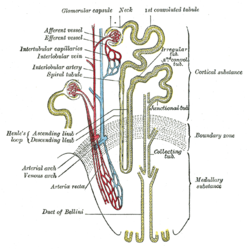
The afferent arterioles are a group of blood vessels that supply the nephrons in many excretory systems. They play an important role in the regulation of blood pressure as a part of the tubuloglomerular feedback mechanism.
The afferent arterioles branch from the renal artery, which supplies blood to the kidneys.
The afferent arterioles later diverge into the capillaries of the glomerulus.
When renal blood flow is reduced (indicating hypotension) or there is a decrease in sodium or chloride ion concentration, the macula densa of the distal tubule releases prostaglandins (mainly PGI2 and PGE2) and nitric oxide, which cause the juxtaglomerular cells lining the afferent arterioles to release renin, activating the renin–angiotensin–aldosterone system, to increase blood pressure and increase reabsorption of sodium ions into the bloodstream via aldosterone.
The macula densa cell can also increase the blood pressure of the afferent arterioles by decreasing the synthesis of adenosine or ATP.
If the efferent arterioles are constricted then the blood pressure in the capillaries of the kidneys will increase.
Afferent arterioles
The afferent arterioles are a group of blood vessels that supply the nephrons in many excretory systems. They play an important role in the regulation of blood pressure as a part of the tubuloglomerular feedback mechanism.
The afferent arterioles branch from the renal artery, which supplies blood to the kidneys.
The afferent arterioles later diverge into the capillaries of the glomerulus.
When renal blood flow is reduced (indicating hypotension) or there is a decrease in sodium or chloride ion concentration, the macula densa of the distal tubule releases prostaglandins (mainly PGI2 and PGE2) and nitric oxide, which cause the juxtaglomerular cells lining the afferent arterioles to release renin, activating the renin–angiotensin–aldosterone system, to increase blood pressure and increase reabsorption of sodium ions into the bloodstream via aldosterone.
The macula densa cell can also increase the blood pressure of the afferent arterioles by decreasing the synthesis of adenosine or ATP.
If the efferent arterioles are constricted then the blood pressure in the capillaries of the kidneys will increase.
Recent media
Recent media