


Community hub
Recent from talks
Contribute something to knowledge base
Content stats: 0 posts, 0 articles, 1 media, 0 notes
Members stats: 0 subscribers, 0 contributors, 0 moderators, 0 supporters
Subscribers
Supporters
Contributors
Moderators
Hub AI
Adenosine triphosphate AI simulator
(@Adenosine triphosphate_simulator)
Hub AI
Adenosine triphosphate AI simulator
(@Adenosine triphosphate_simulator)
Adenosine triphosphate
Adenosine triphosphate (ATP) is a nucleoside triphosphate that provides energy to drive and support many processes in living cells, such as muscle contraction, nerve impulse propagation, and chemical synthesis. Found in all known forms of life, it is often referred to as the "molecular unit of currency" for intracellular energy transfer.
When consumed in a metabolic process, ATP converts either to adenosine diphosphate (ADP) or to adenosine monophosphate (AMP). Other processes regenerate ATP. It is also a precursor to DNA and RNA, and is used as a coenzyme. An average adult human processes around 50 kilograms (about 100 moles) daily.
From the perspective of biochemistry, ATP is classified as a nucleoside triphosphate, which indicates that it consists of three components: a nitrogenous base (adenine), the sugar ribose, and the triphosphate.
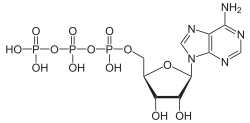
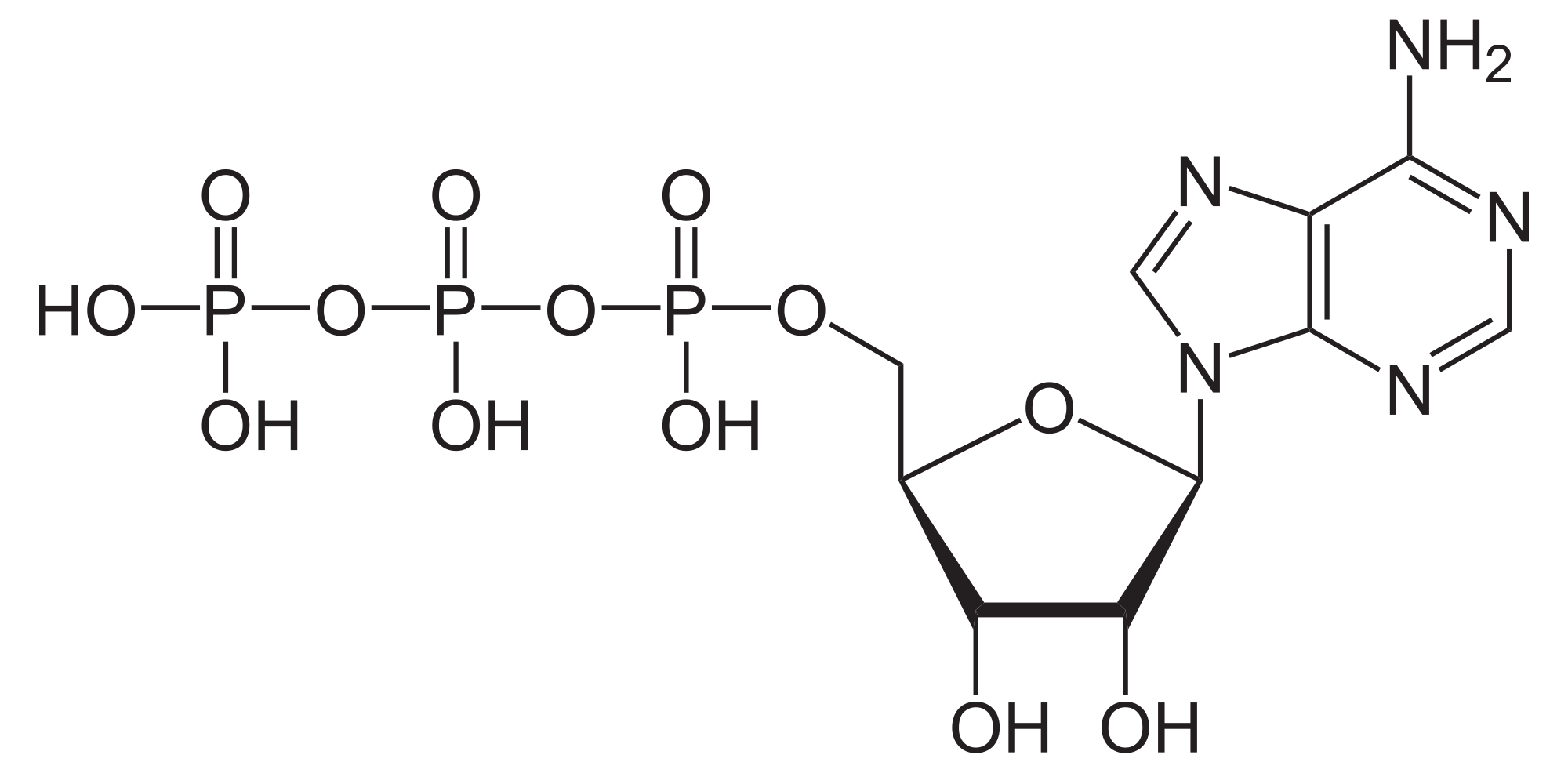
ATP consists of three parts: a sugar, an amine base, and a phosphate group. More specifically, ATP consists of an adenine attached by the #9-nitrogen atom to the 1′ carbon atom of a sugar (ribose), which in turn is attached at the 5' carbon atom of the sugar to a triphosphate group. In its many reactions related to metabolism, the adenine and sugar groups remain unchanged, but the triphosphate is converted to di- and monophosphate, giving respectively the derivatives ADP and AMP. The three phosphoryl groups are labeled as alpha (α), beta (β), and, for the terminal phosphate, gamma (γ).
In neutral solution, ionized ATP exists mostly as ATP4−, with a small proportion of ATP3−.
Polyanionic and featuring a potentially chelating polyphosphate group, ATP binds metal cations with high affinity. The binding constant for Mg2+ is (9554). The binding of a divalent cation, almost always magnesium, strongly affects the interaction of ATP with various proteins. Due to the strength of the ATP-Mg2+ interaction, ATP exists in the cell mostly as a complex with Mg2+ bonded to the phosphate oxygen centers.
A second magnesium ion is critical for ATP binding in the kinase domain. The presence of Mg2+ regulates kinase activity. It is interesting from an RNA world perspective that ATP can carry a Mg ion which catalyzes RNA polymerization.[citation needed]
Salts of ATP can be isolated as colorless solids.
Adenosine triphosphate
Adenosine triphosphate (ATP) is a nucleoside triphosphate that provides energy to drive and support many processes in living cells, such as muscle contraction, nerve impulse propagation, and chemical synthesis. Found in all known forms of life, it is often referred to as the "molecular unit of currency" for intracellular energy transfer.
When consumed in a metabolic process, ATP converts either to adenosine diphosphate (ADP) or to adenosine monophosphate (AMP). Other processes regenerate ATP. It is also a precursor to DNA and RNA, and is used as a coenzyme. An average adult human processes around 50 kilograms (about 100 moles) daily.
From the perspective of biochemistry, ATP is classified as a nucleoside triphosphate, which indicates that it consists of three components: a nitrogenous base (adenine), the sugar ribose, and the triphosphate.
ATP consists of three parts: a sugar, an amine base, and a phosphate group. More specifically, ATP consists of an adenine attached by the #9-nitrogen atom to the 1′ carbon atom of a sugar (ribose), which in turn is attached at the 5' carbon atom of the sugar to a triphosphate group. In its many reactions related to metabolism, the adenine and sugar groups remain unchanged, but the triphosphate is converted to di- and monophosphate, giving respectively the derivatives ADP and AMP. The three phosphoryl groups are labeled as alpha (α), beta (β), and, for the terminal phosphate, gamma (γ).
In neutral solution, ionized ATP exists mostly as ATP4−, with a small proportion of ATP3−.
Polyanionic and featuring a potentially chelating polyphosphate group, ATP binds metal cations with high affinity. The binding constant for Mg2+ is (9554). The binding of a divalent cation, almost always magnesium, strongly affects the interaction of ATP with various proteins. Due to the strength of the ATP-Mg2+ interaction, ATP exists in the cell mostly as a complex with Mg2+ bonded to the phosphate oxygen centers.
A second magnesium ion is critical for ATP binding in the kinase domain. The presence of Mg2+ regulates kinase activity. It is interesting from an RNA world perspective that ATP can carry a Mg ion which catalyzes RNA polymerization.[citation needed]
Salts of ATP can be isolated as colorless solids.
Recent media
Recent media