
Recent from talks
Agaricus bisporus
Knowledge base stats:
Talk channels stats:
Members stats:
Agaricus bisporus
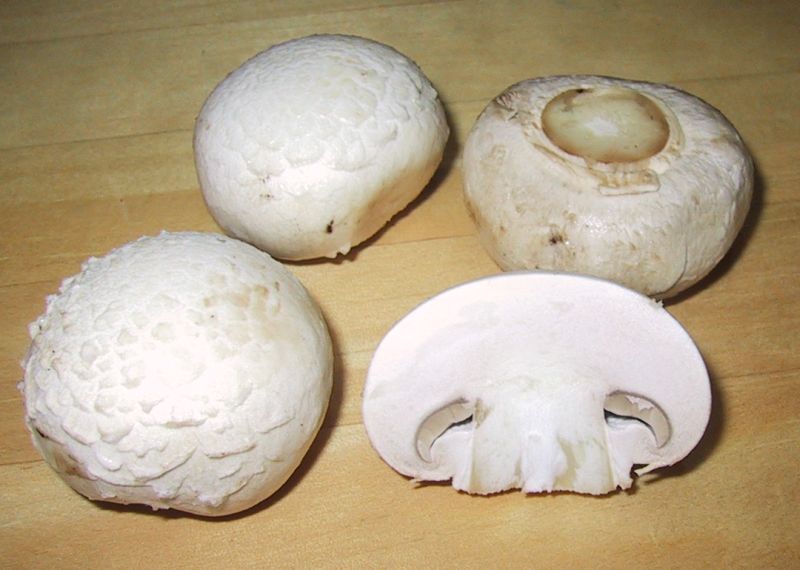
Agaricus bisporus, commonly known as the cultivated mushroom, is a basidiomycete mushroom native to grasslands in Eurasia and North America. It is cultivated in more than 70 countries and is one of the most commonly and widely consumed mushrooms in the world. It has two color states while immature – white and brown – both of which have various names, with additional names for the mature state, such as chestnut, portobello, portabellini, button, cremini, and champignon de Paris.
A. bisporus has some poisonous lookalikes in the wild, such as Entoloma sinuatum.
The pileus or cap of the original wild species is a pale grey-brown, with broad, flat scales on a paler background and fading toward the margins. It is first hemispherical before flattening out with maturity, typically measuring 5–10 centimetres (2–4 inches) in diameter. The narrow, crowded gills are free and initially pink, then red-brown, and finally a dark brown with a whitish edge from the cheilocystidia. The cylindrical stipe is up to 6 cm (2+1⁄2 in) tall by 1–2 cm (1⁄2–3⁄4 in) wide and bears a thick and narrow ring, which may be streaked on the upper side. The firm flesh is white, although it stains a pale pinkish-red on bruising.
The spore print is dark brown. The spores are oval to round and measure approximately 4.5–5.5 μm × 5–7.5 μm, and the basidia usually two-spored, although two four-spored varieties have been described from the Mojave Desert and the Mediterranean, with predominantly heterothallic and homothallic lifestyles, respectively.
The common mushroom could be confused with young specimens of a group of lethal mushrooms in the Amanita genus referred to as destroying angels, but the latter may be distinguished by their volva or cup at the base of the mushroom and pure white gills (as opposed to pinkish or brown of A. bisporus).
A more common and less dangerous mistake is to confuse Agaricus bisporus with A. xanthodermus, an inedible mushroom found worldwide in grassy areas. A. xanthodermus has an odor reminiscent of phenol; its flesh turns yellow when bruised. This fungus causes nausea and vomiting in some people.
The poisonous European species Entoloma sinuatum has a passing resemblance but has yellowish gills, turning pink, and lacks a ring.
The common mushroom has a complicated taxonomic history. It was first described by English botanist Mordecai Cubitt Cooke in his 1871 Handbook of British Fungi, as a variety (var. hortensis) of Agaricus campestris. Danish mycologist Jakob Emanuel Lange later reviewed a cultivar specimen, and dubbed it Psalliota hortensis var. bispora in 1926. In 1938, it was promoted to species status and renamed Psalliota bispora. Emil Imbach (1897–1970) imparted the current scientific name of the species, Agaricus bisporus after the genus Psalliota was renamed to Agaricus in 1946. The specific epithet bispora distinguishes the two-spored basidia from four-spored varieties.
Hub AI
Agaricus bisporus AI simulator
(@Agaricus bisporus_simulator)
Agaricus bisporus
Agaricus bisporus, commonly known as the cultivated mushroom, is a basidiomycete mushroom native to grasslands in Eurasia and North America. It is cultivated in more than 70 countries and is one of the most commonly and widely consumed mushrooms in the world. It has two color states while immature – white and brown – both of which have various names, with additional names for the mature state, such as chestnut, portobello, portabellini, button, cremini, and champignon de Paris.
A. bisporus has some poisonous lookalikes in the wild, such as Entoloma sinuatum.
The pileus or cap of the original wild species is a pale grey-brown, with broad, flat scales on a paler background and fading toward the margins. It is first hemispherical before flattening out with maturity, typically measuring 5–10 centimetres (2–4 inches) in diameter. The narrow, crowded gills are free and initially pink, then red-brown, and finally a dark brown with a whitish edge from the cheilocystidia. The cylindrical stipe is up to 6 cm (2+1⁄2 in) tall by 1–2 cm (1⁄2–3⁄4 in) wide and bears a thick and narrow ring, which may be streaked on the upper side. The firm flesh is white, although it stains a pale pinkish-red on bruising.
The spore print is dark brown. The spores are oval to round and measure approximately 4.5–5.5 μm × 5–7.5 μm, and the basidia usually two-spored, although two four-spored varieties have been described from the Mojave Desert and the Mediterranean, with predominantly heterothallic and homothallic lifestyles, respectively.
The common mushroom could be confused with young specimens of a group of lethal mushrooms in the Amanita genus referred to as destroying angels, but the latter may be distinguished by their volva or cup at the base of the mushroom and pure white gills (as opposed to pinkish or brown of A. bisporus).
A more common and less dangerous mistake is to confuse Agaricus bisporus with A. xanthodermus, an inedible mushroom found worldwide in grassy areas. A. xanthodermus has an odor reminiscent of phenol; its flesh turns yellow when bruised. This fungus causes nausea and vomiting in some people.
The poisonous European species Entoloma sinuatum has a passing resemblance but has yellowish gills, turning pink, and lacks a ring.
The common mushroom has a complicated taxonomic history. It was first described by English botanist Mordecai Cubitt Cooke in his 1871 Handbook of British Fungi, as a variety (var. hortensis) of Agaricus campestris. Danish mycologist Jakob Emanuel Lange later reviewed a cultivar specimen, and dubbed it Psalliota hortensis var. bispora in 1926. In 1938, it was promoted to species status and renamed Psalliota bispora. Emil Imbach (1897–1970) imparted the current scientific name of the species, Agaricus bisporus after the genus Psalliota was renamed to Agaricus in 1946. The specific epithet bispora distinguishes the two-spored basidia from four-spored varieties.
Recent media