Hubbry Logo
BasidiumBasidiumMain
Open search
Basidium
Community hub
Basidium
logo
8 pages, 0 posts
0 subscribers
Be the first to start a discussion here.
Basidium
Basidium
from Wikipedia
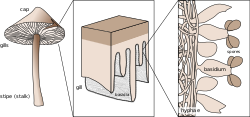
Diagram showing a basidiomycete mushroom, gill structure, and spore-bearing basidia on the gill margins.

A basidium (pl.: basidia) is a microscopic spore-producing structure found on the hymenophore of reproductive bodies of basidiomycete fungi. The presence of basidia is one of the main characteristic features of the group. These bodies are also called tertiary mycelia, which are highly coiled versions of secondary mycelia. A basidium usually bears four sexual spores called basidiospores. Occasionally the number may be two or even eight. Each reproductive spore is produced at the tip of a narrow prong or horn called a sterigma (pl. sterigmata), and is forcefully expelled at full growth.

The word basidium literally means "little pedestal". This is the way the basidium supports the spores. However, some biologists suggest that the structure looks more like a club. A partially grown basidium is known as a basidiole.

Structure

[edit]

Most basidiomycota have single celled basidia (holobasidia), but some have ones with many cells (a phragmobasidia). For instance, rust fungi in the order Puccinales have phragmobasidia with four cells that are separated by walls along their cross section. Some jelly fungi in the order Tremellales also have phragmobasidia with four cells that are separated by walls and are shaped like a cross. Sometimes the basidium develops from a probasidium, which is not elongated like a typical hypha. The basidium may be stalked or attached directly to the hyphae[citation needed].

The basidium is normally club-shaped: narrow at the stem and wide near its outer end. It is widest in the middle hemispherical dome at its apex, and its base is about half the size of the widest diameter at the highest point. Basidia with a short and narrow base are shaped like an inverted egg, and occur in genera such as Paullicorticium, Oliveonia, and Tulasnella. Basidia with a wide base are often shaped like a barrel.[1]

How basidiospores are expelled

[edit]

In most basidiomycota, the basidiospores are forcibly expelled. The propulsive force is derived from a sudden change in the center of gravity of the discharged spore. Important factors in forcible discharge include Buller's drop, a drop of fluid that builds up at the nearer tip (hilar appendage) of each basidiospore; the offset attachment of the spore to the extending narrow prong, and the presence of hygroscopic regions on the basidiospore surface. Basidiospore discharge can only succeed after sufficient water vapor has condensed on the spore.

When a basidiospore matures, sugars present in the cell wall begin to serve as condensation loci for water vapour in the air. Two separate regions of condensation are critical. At the pointed tip of the spore (the hilum) closest to the supporting basidium, Buller's drop builds up as a large, almost spherical water droplet.

At the same time, condensation occurs in a thin film on the stalk-facing part of the spore. When these two bodies of water combine, the release of surface tension and the sudden change in the center of gravity suddenly expels the basidiospore. Remarkably, the initial acceleration of the spore is estimated to be about 10,000 g.[2]

Evolutionary loss of expulsion by force

[edit]

Some basidiomycetes do not have a means to forcibly expel their basidiospores, although they still form them. In each of these groups, spore dispersal occurs through other means of expulsion.[citation needed]

For example:

In these cases the basidiospore typically lacks a hilar appendage, and expulsion by force does not occur. Each example is thought to represent an independent evolutionary loss of the forcible discharge that comes before all basidiomycetes.[citation needed]

References

[edit]
[edit]
Revisions and contributorsEdit on WikipediaRead on Wikipedia
from Grokipedia
A basidium is a specialized, typically club-shaped microscopic cell characteristic of fungi in the phylum , serving as the site for the production and external attachment of basidiospores during . In the fungal life cycle, the basidium forms at the end of dikaryotic hyphae following and , where two compatible haploid nuclei fuse to create a diploid nucleus that undergoes , resulting in four haploid nuclei that migrate into developing basidiospores borne on slender projections called sterigmata. These basidiospores are forcibly discharged in a process known as ballistospore ejection upon maturity, facilitating dispersal and germination into new hyphae. The structure terminates the dikaryotic phase, which is a hallmark of , often maintained by clamp connections during hyphal growth. Basidia exhibit morphological variations across Basidiomycota taxa; while most are holobasidia that produce four spores without internal septa, some groups like the rusts and smuts feature phragmobasidia with transverse septa or other modifications. Found in diverse fruiting bodies such as mushrooms, brackets, and , basidia are integral to the ecological roles of these fungi, including of lignocellulosic materials and formation of mycorrhizal associations with . With approximately 30,000 described species in the , the basidium underscores the reproductive and adaptive success of in terrestrial, freshwater, and marine environments.

Definition and Occurrence

Definition

A basidium is a microscopic, typically club-shaped cell characteristic of fungi in the phylum , serving as the specialized cell where exogenous basidiospores are produced. The plural form is basidia. The term "basidium" derives from the New Latin diminutive of the Greek word basis, meaning "base" or "pedestal," which reflects its function as a supportive structure for bearing spores. Unlike the sac-like asci in , in which spores form internally, a basidium generates basidiospores externally, with attachment occurring via sterigmata. Basidia are generally located on the hymenophore within basidiocarps, the fruiting bodies of these fungi.

Taxonomic Distribution

Basidia are characteristic reproductive structures exclusively found within the phylum , one of the two major divisions of the subkingdom in the kingdom Fungi, alongside . This phylum encompasses more than 40,000 described species (as of 2022), representing a significant portion of fungal diversity, and is defined by the production of sexual spores on basidia. Within , basidia occur across three main subphyla: , Ustilaginomycotina, and Pucciniomycotina. , the largest subphylum comprising about two-thirds of all basidiomycetes, includes familiar forms such as mushrooms, , and wood-decaying species, where basidia are typically borne on macroscopic fruiting bodies like gills or pores. Ustilaginomycotina primarily consists of smut fungi, which are obligate parasites producing basidia in sori (spore masses) on host tissues, often in modified, non-fruiting structures. Pucciniomycotina features rust fungi, another group of pathogens, in which basidia develop within telia on infected surfaces, facilitating complex life cycles involving multiple hosts. Ecologically, basidia play key roles in nutrient cycling and host interactions, typically forming on basidiocarps in diverse habitats such as forest soils, decaying wood, and parasitic associations with plants. For instance, in saprotrophic species like Agaricus bisporus (the button mushroom), basidia contribute to the decomposition of organic matter in humic-rich leaf litter and compost environments, recycling nutrients in terrestrial ecosystems. In contrast, parasitic rust fungi such as Puccinia graminis, which causes wheat stem rust, produce basidia as part of their biotrophic lifestyle, influencing plant community dynamics and agriculture through host-specific infections that can lead to significant crop losses.

Morphology

Basic Structure

The basidium is a specialized, microscopic fungal cell unique to the , characterized by its club-shaped (clavate) form, which consists of a swollen apex serving as the sporogenous region and a narrower base for attachment to the subtending hyphae of the fruiting body. This morphology allows the basidium to function as a reproductive unit embedded within tissues such as the of gills, pores, or other spore-bearing surfaces. At the apex, the basidium typically bears four narrow, elongated projections known as sterigmata, each of which supports a single ; while four is the standard number, occasional variations from two to eight sterigmata occur across . The sterigmata arise from the outer wall of the swollen apex and elongate to position the developing spores externally. The base attaches to subtending hyphae and typically features a clamp connection at the . Basidia generally measure 10–30 μm in length, varying slightly by fungal group but maintaining compact dimensions suited to dense packing in reproductive layers.

Types of Basidia

Basidia in basidiomycetes exhibit structural diversity that reflects adaptations to different taxonomic groups and ecological niches. The primary classification distinguishes between holobasidia and phragmobasidia based on the presence or absence of (cross-walls), with additional variants such as promycelia and auricularioid forms occurring in specific lineages. Holobasidia are unseptate, single-celled structures that maintain a continuous throughout their development, typically adopting a club-shaped (clavate) morphology. They are characteristic of the Hymenomycetes, including agarics (gilled mushrooms like those in the genus ) and other fleshy fungi such as boletes and polypores. In these basidia, and occur within the undivided cell, leading to the production of four sterigmata at the apex, each bearing a . This type represents the prototypical basidium in many macroscopic fruiting bodies. In contrast, phragmobasidia are septate, featuring transverse cross-walls that divide the basidium into multiple cells following . These are prevalent in groups such as rusts (Pucciniomycotina) and smuts (Ustilaginomycotina), as well as certain . The septation often results in a linear arrangement of 2–4 cells, with each compartment developing sterigmata to produce . Phragmobasidia enable compartmentalization of nuclear divisions, supporting formation in elongated or fragmented structures. Other notable variants include promycelia, which are elongated, yeast-like structures functioning as basidia in smuts (Ustilaginomycetes). Upon germination of teliospores in species like Ustilago maydis, a septate promycelium emerges, undergoing to bud off haploid basidiospores (sporidia) sequentially from its cells. This form facilitates infection cycles in pathogens. Auricularioid basidia, found in of the Auriculariales (e.g., Auricularia species), are curved or Y-shaped with transverse , often longitudinally divided in mature stages, and bear elongated, sometimes branched sterigmata. These basidia occur in gelatinous basidiocarps, adapting to moist environments. The presence of in phragmobasidia and related variants has key functional implications, primarily allowing sequential maturation and release of basidiospores without requiring complete cellular division of the entire structure. This compartmentalization reduces compared to holobasidia, preventing explosive spore discharge and instead promoting passive dispersal through budding or elongation, which is advantageous in parasitic or gelatinous fungi.

Development and Cytology

Formation Process

In species that form basidiocarps with hymenia, such as many , the formation of basidia begins with the differentiation of terminal cells from fertile hyphae within the , the spore-bearing layer of basidiocarps. These hyphal branches arise during fruiting body development, where specific hyphal tips are induced to specialize, transitioning from elongated, cylindrical forms to broader, club-shaped precursors of basidia. This initiation occurs in the context of the maturing , often embedded among supportive structures like paraphyses. The developmental stages proceed through hyphal swelling, where the terminal cells inflate and elongate, accumulating and becoming vacuolated to support structural expansion. Preparation for dikaryotic fusion follows, involving the positioning of the two unfused nuclei within the swelling cell, setting the stage for later nuclear events without immediate fusion. Subsequently, sterigmata—narrow projections that will bear spores—outgrow from the apex of the maturing basidium, emerging as broad bumps that elongate via apical growth mechanisms similar to hyphal tips, often curving toward the hymenial surface. These stages are modulated by environmental factors, particularly high , which is essential for maintaining turgor and facilitating the hydration-dependent expansion of hyphal tissues during basidiocarp maturation. Under microscopic observation, basidia appear as distinctly inflated cells protruding from the hymenial surface, with their walls thickening in a layered manner to accommodate outgrowths. In species with rapid development, such as cinereus, this entire morphogenetic process, from initial differentiation to full structural maturity prior to production, spans 24-48 hours, allowing synchronization with the rapid expansion of the fruiting body. In contrast, in other groups such as rusts (Pucciniomycotina) and smuts (Ustilaginomycotina), basidia develop from the germination of teliospores, often forming septate phragmobasidia externally without complex hymenia or basidiocarps.

Nuclear Processes

In the basidium of fungi, nuclear processes begin with , the fusion of two haploid nuclei derived from the dikaryotic hyphae that terminate in the basidium. This fusion occurs as the basidium matures and swells, forming a single diploid nucleus (2n) from the paired haploid nuclei ( + ). For example, in cinereus, the process is highly synchronized and triggered by environmental cues such as light, and precedes essential for subsequent divisions. Following , the diploid nucleus undergoes , a reduction division that restores the haploid state and generates through recombination. I separates homologous chromosomes, while II divides , resulting in four haploid nuclei within the basidium. These nuclei then migrate to the tips of sterigmata, where they become incorporated into developing basidiospores. In model organisms like Coprinus cinereus, is confined within an intact and exhibits precise timing, with I involving formation for . In certain taxa, such as some and Ustilaginales, a post-meiotic occurs after the formation of the meiotic tetrad, producing eight haploid nuclei per basidium instead of four. This additional division, which takes place in the basidium or sterigmata, leads to binucleate basidiospores and is observed in species like and , contributing to heterokaryotic spores that maintain genetic variability. However, this is not universal across , where the standard outcome remains four uninucleate spores.

Function in Reproduction

Spore Production

Basidiospore development initiates following within the basidium, where four haploid nuclei are generated. In many species, these undergo a post-meiotic , producing eight haploid nuclei that migrate into developing basidiospores, often resulting in four binucleate spores; however, some taxa produce four uninucleate spores. Each nucleus migrates individually into one of the typically four sterigmata—narrow, elongated outgrowths extending from the basidium's apex—accompanied by a portion of . This migration is facilitated by that extend through the sterigmata, guiding the nuclei to their positions at the sterigma tips. Upon reaching the sterigma apex, cytoplasmic delimitation occurs through the formation of a , which separates the incoming and nucleus to create a distinct . The typically appears electron-lucent under and marks the boundary between the spore and the sterigma. As the spore matures, its develops in multiple layers, often including an outer electron-lucent layer and inner dense components, with bodies accumulating within the . Basidiospores are characteristically and thin-walled, with dimensions generally ranging from 5 to 10 μm in length and 4 to 7 μm in width, though sizes vary across species—for instance, 9.5–13 μm by 6–7 μm in Coprinus cinereus. Typically, four spores form per basidium, but numbers can range from two to eight in certain taxa. Ornamentation of the spore surface is diverse, including smooth, warty, or spiny patterns; for example, (iodine-reactive) ornamentation occurs in genera like . Maturation of basidiospores can proceed synchronously, with 60–85% of basidia in the same developmental phase as observed in Coprinus cinereus, or metachronously in species like Agaricus brasiliensis, where spore formation occurs asynchronously during basidiocarp development. This temporal variation contributes to the overall reproductive strategy, with synchronous maturation often synchronized by environmental cues such as light.

Spore Expulsion

In basidiomycetes, the predominant mechanism for spore expulsion is ballistospory, a ballistic discharge process that propels away from the basidium using forces generated by the growth and coalescence of fluid droplets on the spore. The spore remains attached to the basidium via a narrow sterigma until maturity, at which point a small spherical droplet known as Buller's drop forms at the spore's hilar appendix due to the secretion of hygroscopic osmolytes such as and . This drop rapidly absorbs from the surrounding humid air, swelling to a critical size of approximately 0.3–10 μm in radius and creating a high meniscus. The expulsion occurs when Buller's drop coalesces asymmetrically with a flattened adaxial drop on the spore's surface, releasing stored in a rapid momentum transfer that launches the perpendicular to the basidium at initial velocities of 0.6–1.4 m/s over distances of 0.04–1.3 mm. This violent discharge is facilitated by hygroscopic swelling from water uptake, which builds internal pressure within the droplet system and enables the to escape the of still air near the for effective wind dispersal; the process is characteristic of most Hymenomycetes, where exposed basidiomata facilitate humidity-dependent activation. The launch imparts directional motion along the 's long axis, with trajectories typically within ±20° of horizontal to optimize packing and escape from gill-like structures in agarics. In contrast, non-ballistic mechanisms predominate in gasteroid basidiomycetes, where active discharge is absent, and spores are released passively through the enzymatic dissolution or mechanical collapse of sterigmata following maturation inside enclosed basidiomata. This allows spores to accumulate in the gleba and disperse via external forces such as splash, animal vectors, or peridial rupture, without the energy-intensive catapult.

Evolutionary Aspects

Origin and Evolution

The basidium, a defining reproductive structure of the phylum, emerged evolutionarily within the subkingdom , which encompasses both and , sharing a common ancestor estimated to have diverged around 600–1000 million years ago based on analyses. This ancestral lineage was likely terrestrial and nonflagellated, with the dikaryotic phase—a hallmark of where two unfused nuclei coexist in hyphal cells—evolving prior to the split, possibly as an adaptation for enhanced in terrestrial environments. Direct for , including clamp connections indicative of the dikaryotic state, first appears in the period around 330-346 million years ago, with indirect from decay patterns in wood; more definitive records of septate hyphae and basidia-like structures from the Pennsylvanian (298–323 million years ago). A pivotal in basidium was the shift to exogenous, post-meiotic spore production, contrasting with the endogenous spores enclosed within asci in . In basidia, and occur at the hyphal tip, followed by the external formation of four haploid basidiospores on sterigmata, facilitating efficient dispersal in diverse ecological niches such as wood decay and . This transition likely enhanced reproductive success in early terrestrial fungi, supported by fossil hyphae from wood like Callixylon newberryi showing decay patterns consistent with basidiomycete activity around 370 million years ago. The phase, maintained by clamp connections and having evolved in the common ancestor of prior to the divergence into and , preceded and enabled this exogenous strategy, while retained internal spore maturation. Comparatively, basidia are thought to have arisen from modifications at hyphal tips, where terminal cells swell to accommodate and , a process regulated by conserved genetic mechanisms including homologs of meiosis-specific genes like DMC1. Gene duplications in meiosis regulators, observed across lineages such as , contributed to this specialization, allowing precise coordination of recombination and formation distinct from pathways. These molecular adaptations, building on the ancestral , underscore the basidium's role as a key evolutionary step in fungal diversification by the late .

Adaptations and Variations

In secotioid and gasteroid basidiomycetes, such as truffles and , the forcible expulsion of basidiospores has been evolutionarily lost, with spores instead retained internally in a gleba for dispersal by animal vectors, facilitating adaptation to subterranean or enclosed fruiting bodies. This loss is associated with modifications in septal development within the basidium, where incomplete fail to support the Buller's drop mechanism for spore launch, as observed in hypogeous taxa that rely on mycophagy for . Other adaptations include variations in spore production tailored to parasitic lifestyles; in rust fungi (Pucciniales), basidia often produce four or more basidiospores per cell, enhancing propagule output to support repeated infection cycles on host plants and counter host defenses in biotrophy. In Tremellomycetes, yeast-like basidia predominate in haploid stages, enabling unicellular growth and reproduction suited to fluid or aquatic microhabitats, such as within lichens or on damp substrates, where filamentous forms are less viable. Molecular evidence reveals genetic underpinnings for these variations, with transcription factors like Srr1 regulating sterigma formation and post-meiotic morphogenesis across basidiomycetes, showing sequence divergence that correlates with ballistospory loss in gasteroid lineages. Recent genomic studies highlight how genes maintaining stability, such as those controlling clamp cell fusion and nuclear pairing, vary in expression to support adaptive radiations, as seen in comparisons of dikaryotic versus monokaryotic states that underscore enhanced growth and resilience in specialized environments.

References

Add your contribution
Related Hubs
User Avatar
No comments yet.