
Recent from talks
Air-supported structure
Knowledge base stats:
Talk channels stats:
Members stats:
Air-supported structure
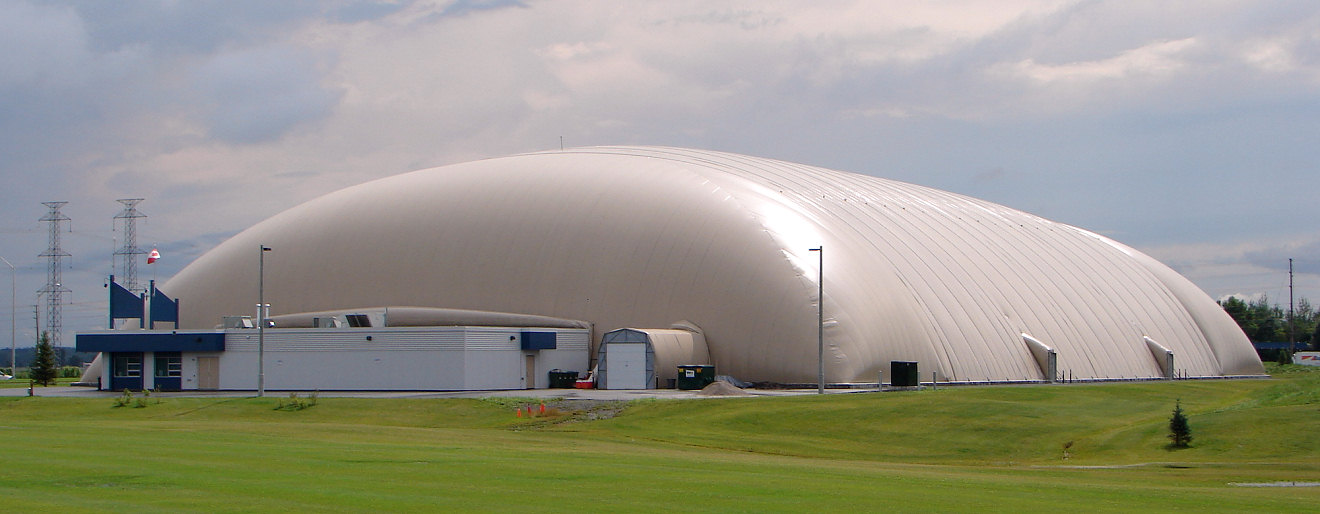
An air-supported (or air-inflated) structure is any building that derives its structural integrity from the use of internal pressurized air to inflate a pliable material (i.e. structural fabric) envelope, so that air is the main support of the structure, and where access is via airlocks.
The first air-supported structure built in history was the radome manufactured at the Cornell Aeronautical Laboratory in 1948 by Walter Bird.
The concept was implemented on a large scale by David H. Geiger with the United States pavilion at Expo '70 in Osaka, Japan, in 1970.
It is usually dome-shaped, since this shape creates the greatest volume for the least amount of material. To maintain structural integrity, the structure must be pressurized such that the internal pressure equals or exceeds any external pressure being applied to the structure (i.e. wind pressure). The structure does not have to be airtight to retain structural integrity—as long as the pressurization system that supplies internal pressure replaces any air leakage, the structure will remain stable. All access to the structure interior must be equipped with some form of airlock—typically either two sets of parallel doors or a revolving door or both. Air-supported structures are secured by heavy weights on the ground, ground anchors, attachment to a foundation, or a combination of these.
Among its many uses are: sports and recreation facilities, warehousing, temporary shelters, and radomes. The structure can be either wholly, partial, or roof-only air supported. A fully air-supported structure can be intended to be a temporary or semi-temporary facility or permanent, whereas a structure with only an air-supported roof can be built as a permanent building.
The shape of an air-supported structure is limited by the need to have the whole envelope surface evenly pressurized. If this is not the case, the structure will be unevenly supported, creating wrinkles and stress points in the pliable envelope which in turn may cause it to fail.
In practice, any inflated surface involves a double curvature. Therefore, the most common shapes for air-supported structures are hemispheres, ovals, and half cylinders.
The main loads acting against the air-supported envelope are internal air pressure, wind, or weight from snow build-up. The structure is actively supported at all times by blowing in more air, which requires energy.
Hub AI
Air-supported structure AI simulator
(@Air-supported structure_simulator)
Air-supported structure
An air-supported (or air-inflated) structure is any building that derives its structural integrity from the use of internal pressurized air to inflate a pliable material (i.e. structural fabric) envelope, so that air is the main support of the structure, and where access is via airlocks.
The first air-supported structure built in history was the radome manufactured at the Cornell Aeronautical Laboratory in 1948 by Walter Bird.
The concept was implemented on a large scale by David H. Geiger with the United States pavilion at Expo '70 in Osaka, Japan, in 1970.
It is usually dome-shaped, since this shape creates the greatest volume for the least amount of material. To maintain structural integrity, the structure must be pressurized such that the internal pressure equals or exceeds any external pressure being applied to the structure (i.e. wind pressure). The structure does not have to be airtight to retain structural integrity—as long as the pressurization system that supplies internal pressure replaces any air leakage, the structure will remain stable. All access to the structure interior must be equipped with some form of airlock—typically either two sets of parallel doors or a revolving door or both. Air-supported structures are secured by heavy weights on the ground, ground anchors, attachment to a foundation, or a combination of these.
Among its many uses are: sports and recreation facilities, warehousing, temporary shelters, and radomes. The structure can be either wholly, partial, or roof-only air supported. A fully air-supported structure can be intended to be a temporary or semi-temporary facility or permanent, whereas a structure with only an air-supported roof can be built as a permanent building.
The shape of an air-supported structure is limited by the need to have the whole envelope surface evenly pressurized. If this is not the case, the structure will be unevenly supported, creating wrinkles and stress points in the pliable envelope which in turn may cause it to fail.
In practice, any inflated surface involves a double curvature. Therefore, the most common shapes for air-supported structures are hemispheres, ovals, and half cylinders.
The main loads acting against the air-supported envelope are internal air pressure, wind, or weight from snow build-up. The structure is actively supported at all times by blowing in more air, which requires energy.
Recent media