Hubbry Logo
AirlockAirlockMain
Open search
Airlock
Community hub
Airlock
logo
8 pages, 0 posts
0 subscribers
Be the first to start a discussion here.
Contribute something
Airlock
Airlock
from Wikipedia

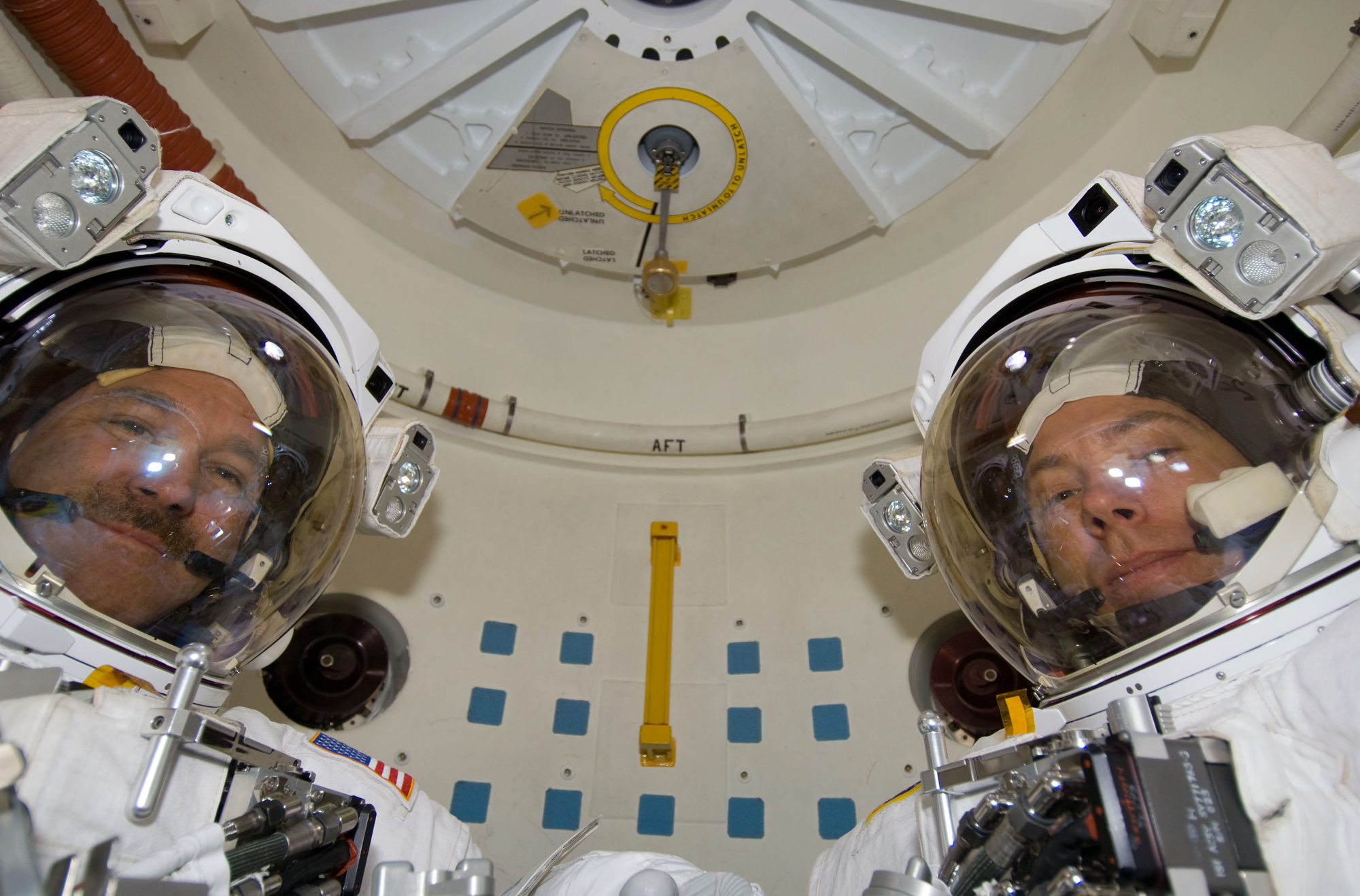
An airlock on board Space Shuttle Atlantis

An airlock[a] is a room or compartment which permits passage between environments of differing atmospheric pressure or composition, while minimizing the changing of pressure or composition between the differing environments.

An airlock consists of a chamber with two airtight doors or openings, usually arranged in series, which do not open simultaneously. Airlocks can be small-scale mechanisms, such as those used in fermenting, or larger mechanisms, which often take the form of an antechamber.

An airlock may also be used underwater to allow passage between the air environment in a pressure vessel, such as a submarine, and the water environment outside. In such cases the airlock can contain either air or water. This is called a floodable airlock or underwater airlock, and is used to prevent water from entering a submersible vessel or underwater habitat.

Operation

[edit]

The procedure of entering an airlock from the external or ambient pressure environment, sealing it, equalizing the pressure, and passing through the inner door is known as locking in. Conversely, locking out involves equalizing pressure, unsealing the outer door, then exiting the lock compartment to enter the ambient environment. Locking on and off refer to transfer under pressure where the two chambers are physically connected or disconnected prior to equalizing the pressure and locking in or out.

Before opening either door, the air pressure of the airlock chamber is equalized with that of the environment beyond the next door. A gradual pressure transition minimizes air temperature fluctuations, which helps reduce fogging and condensation, decreases stresses on air seals, and allows safe verification of critical equipment.

When a person who is not in a pressure suit moves between environments of greatly different pressures, an airlock changes the pressure slowly to help with internal air cavity equalization and to prevent decompression sickness. This is critical in underwater diving, and a diver or compressed air worker may have to wait in an airlock for a number of hours in accordance with a decompression schedule. A similar arrangement may be used for access to airtight clean spaces, contaminated spaces, or unbreathable atmospheres, which may not necessarily involve any differences in pressure; in these cases, a decontamination procedure and flushing are used instead of pressure change procedures.

History and research

[edit]

19th century

[edit]
An early airlock, with decompression instructions

The first airlock patent was granted in 1830 to Thomas Cochrane, who came up with the idea to help facilitate underground tunnel construction. It was put into use in 1879 during an attempt to dig a tunnel under the Hudson river.[1][2]

20th century

[edit]

The Apollo program involved developments in airlock technology, as airlocks are critical to allow humans to enter and exit the spacecraft while on the Moon without losing too much air due to its scant atmosphere.

During the 1969 Apollo 11 mission, there was no room that was primarily designed to be an airlock; instead, they used the cabin as an airlock. It had to be evacuated and depressurized before the door was opened, and then once the door was closed it had to be re-pressurized again before anyone could safely reenter the cabin without a space suit.[3]

In 1989 the Kvant-2 module, which included an airlock, was added to the Mir space station being assembled by the Soviet Union.[4] Prior spacewalks from Salyut space stations were conducted without dedicated airlocks.

21st century

[edit]

When the International Space Station (ISS) first began to house humans in November 2000,[5] it did not include an airlock, and all extravehicular activity had to be facilitated by the airlock on the Space Shuttle[6] until the Quest Joint Airlock module was installed in July 2001.[7]

The first ever commercial space airlock was the Nanoracks Bishop Airlock, installed on the ISS in December 2020. It is "bell-shaped" and is designed to transfer payloads out from the ISS interior and into space. As of July 2023 it is the largest airlock of its kind on the station, capable of fitting "payloads as large as a refrigerator."[8]

Air environments

[edit]

Airlocks are used in air-to-air environments for a variety of reasons, most of which center around either preventing airborne contaminants from entering or exiting an area, or maintaining the air pressure of the interior chamber.

One common use of airlock technology can be found in some cleanrooms, where harmful or otherwise undesired particulates can be excluded by using positive pressure, i.e. maintaining the room at a higher pressure than the surroundings, alongside other measures. Conversely, particulates are prevented from escaping hazardous environments, such as nuclear reactors, laboratories of biochemistry, and medical centers, by keeping negative room pressure - maintaining the room at a lower pressure than the surroundings, so that air (and any particulates that it carries) cannot escape easily.

A lesser-known application of an airlock is in architecture: inflatable buildings and air-supported structures such as pressurized domes require the internal air pressure to be maintained within a specific range so that the structure doesn't collapse. Airlocks are generally the most cost-efficient way to allow people to enter and exit these structures.

Airlocks are utilized to maintain electron microscope interiors at near-vacuum so that air does not affect the electron path. Fermentation locks, such as those used in alcohol brewing, are a type of airlock which allow gases to escape the fermentation vessel while keeping air out. Parachute airlocks are necessary because airfoil collapse due to depressurization can result in dangerous loss of altitude.

Since the 1980s, airlock technology has been used to explore newly detected chambers in the Egyptian pyramids, to prevent the contents from beginning to decompose due to air contamination.[9]

Underground

[edit]

Civil engineering projects that use air pressure to keep water and mud out of the workplace use an airlock to transfer personnel, equipment, and materials between the external normabaric environment and the pressurized workplace in a caisson or sealed tunnel. The airlock may need to be large enough to accommodate a whole working shift at the same time.

Locking in is usually a quick procedure, taking only a few minutes, while the decompression required for locking out may take hours.

Underwater

[edit]
US Navy submarine diving lock out

Underwater applications include:

Saturation diving

[edit]

In saturation diving, airlocks are crucial safety elements; they serve as pressurized gateways to safely manage the transfer of divers and support personnel between the saturation system (living quarters) and the diving bell, which shuttles divers to their underwater worksite.

Airlocks in saturation diving are equipped with safety features such as pressure gauges, manual overrides, and interlocks.

Saturation systems typically feature a variety of airlocks, including a stores lock for the transfer of supplies and a medical lock for secure passage of medical necessities or emergency evacuations. Complex "split-level" systems, which house divers at different pressure levels for varied work depths, may necessitate additional airlocks.

Decompression post-dive is a gradual process, often taking a full week. During this time, the airlocks allow divers to shift to a decompression chamber where pressure is progressively reduced back to surface levels. In emergencies, airlocks can facilitate transfer to a hyperbaric escape chamber or lifeboat without significant pressure changes.

Hyperbaric treatment chambers

[edit]

In any hyperbaric treatment chamber capable of accommodating more than one person, and where it may be necessary to get a person or equipment into or out of the chamber while it is pressurized, an airlock is used. There will usually be a large airlock at the chamber entry capable of holding one or more persons, and a smaller medical lock for locking in medical supplies and food, and locking out waste.

Outer space

[edit]
STS-103 closing the airlock

Airlocks are used in outer space, especially during human spaceflight, to maintain the internal habitable environment on spacecraft and space stations when persons are exiting or entering the spacecraft. Without an airlock (or similar technology, such as a suitport) the air inside would be rapidly lost upon opening the door due to the expansive properties of the gases that comprise breathable air, as described by Boyle's law. An airlock room is needed to decompress astronauts after they suit up in specialized space suits in preparation for extravehicular activity, and then to recompress them upon return.[6] Airlocks such as the Nanoracks Bishop Airlock also allow payloads to be released into space with minimal air loss.

Skylab orbital workshop trash disposal airlock

The Skylab orbital workshop included a manually operated trash disposal airlock to transfer trash from the pressurized habitable compartment to the unpressurized waste tank.[10]

Other examples of airlocks currently used in space include the Quest Joint Airlock and the airlock on Kibō (ISS module).

Spartan Space and Airbus have an airlock design with features specifically addressing use on the lunar surface, including dust mitigation.[11]

See also

[edit]

Notes

[edit]

References

[edit]
[edit]
Revisions and contributorsEdit on WikipediaRead on Wikipedia
from Grokipedia
An airlock is an intermediate chamber equipped with two airtight doors or openings that permits the safe passage of personnel or materials between two spaces with differing atmospheric pressures or compositions, preventing the unwanted exchange of air or contaminants. Airlocks have been integral to engineering since the mid-19th century, with the term first recorded around 1855–1860 in contexts like civil engineering for underwater construction. They are widely used in high-stakes environments where maintaining pressure differentials is critical, such as spacecraft, submarines, caissons for bridge foundations, and hyperbaric chambers for diving operations. In space exploration, airlocks enable astronauts to conduct extravehicular activities (EVAs), or spacewalks, by allowing them to transition from the pressurized interior of a vehicle to the vacuum of space without risking the loss of breathable air from the habitat. A prominent example is the Quest Joint Airlock on the International Space Station (ISS), installed in 2001, which serves as the primary egress point for U.S. spacesuited astronauts and supports both American Extravehicular Mobility Unit (EMU) suits and Russian Orlan suits for spacewalks. Beyond , airlocks play vital roles in controlled industrial settings. In cleanrooms and , they act as interlocked vestibules to minimize particulate contamination during personnel entry, often featuring independent air supplies and filtration systems. Nuclear facilities, such as CANDU reactors, employ airlocks to maintain integrity while allowing access for , modeled probabilistically for assessments using tools like Petri nets. In underwater , airlocks facilitate worker transitions in pressurized environments like tunnels or dams, originally pioneered for harbor works and bridge pilings. These applications underscore the airlock's design principle of sequential door operation—ensuring one door remains sealed—to uphold and efficiency across diverse pressure-sensitive operations.

Fundamentals

Definition and Purpose

An airlock is a chamber or compartment equipped with two airtight doors that enables the passage of personnel, equipment, or materials between two environments differing in gas pressures, compositions, or contamination levels while preventing the mixing of those environments. This design typically incorporates interlocked doors to ensure only one opens at a time, maintaining isolation and allowing for controlled environmental transitions. The primary purpose of an airlock is to mitigate risks associated with abrupt environmental changes, such as rapid pressure shifts that can lead to injuries like or . In pressurized settings, it facilitates gradual decompression or pressurization, reducing the formation of gas bubbles in bodily tissues that cause , as seen in caisson work where workers use airlocks for staged exits to avoid such harm. Additionally, airlocks control contamination in sterile or controlled atmospheres by acting as a buffer that minimizes the ingress of particulates, microbes, or pollutants, thereby safeguarding sensitive operations. This enables safe transfers without compromising the integrity of either space. The term "airlock" originated in the 1840s, derived from "air" and "lock," drawing from canal engineering concepts where locks regulate levels; it initially referred to airtight chambers for operations to manage safely. Overall, airlocks provide essential safety in high-risk environments such as diving, , and laboratories by serving as a transitional that preserves environmental separation and human well-being.

Principles of Operation

An airlock operates through a basic mechanism consisting of two airtight doors or hatches separating environments of differing pressures, equipped with electronic or mechanical interlocks that prevent both from opening simultaneously to maintain isolation between the compartments. This interlock system ensures that one door remains closed until the other is fully sealed, avoiding unintended pressure loss or contamination transfer. Pressure management in an airlock involves controlled pumping of air or gas into or out of the chamber to gradually equalize pressures between the inner and outer environments, with pumps and valves regulating the flow to prevent rapid changes. In decompression scenarios, such as those in hyperbaric or applications, air is released slowly to mitigate the risk of nitrogen bubble formation in the bloodstream, a condition known as . The key physical principle governing these processes is , which states that for a fixed of gas at constant temperature, the and are inversely proportional, expressed as P1V1=P2V2P_1 V_1 = P_2 V_2 where P1P_1 and V1V_1 are the initial and , and P2P_2 and V2V_2 are the final values. This law is critical for safe transitions in low- or high-pressure environments, as it explains how gas volumes expand or contract with pressure changes, influencing the need for gradual equalization to protect occupants from . The entry procedure begins with an individual or object entering the chamber through the inner door, which is then sealed, followed by equalization via pumps, a process that may take minutes to hours depending on the differential. Once equilibrium is achieved, the outer door can be opened for access to the target environment; the reverse cycle—sealing the outer door, equalizing to the inner , and opening the inner door—facilitates re-entry. Safety features include alarms triggered by imbalances or failures in the equalization process, override mechanisms to allow manual intervention, and continuous monitoring systems for oxygen levels, contaminants, and overall chamber integrity to ensure occupant protection. These elements, often integrated with redundant gas supplies and communication systems, help prevent hazards during operations.

Types of Airlocks

Airlocks are categorized by their primary function, physical scale, and operational environment, with designs emphasizing structural , management, and control to suit diverse applications from controlled facilities to extraterrestrial habitats. Personnel airlocks prioritize accommodation, while material variants focus on goods transfer; environmental adaptations include rigid, flexible, or hybrid structures tailored to atmospheric, , or pressurized settings. Personnel airlocks (PALs) are engineered for safe human transit between pressure differentials, typically featuring interlocked doors, gowning or suiting areas, and amenities such as benches for seating during depressurization, integrated lighting for visibility, and communication systems for coordination with external teams. These structures accommodate 1 to 10 individuals, depending on the mission scale—for instance, the International Space Station's measures 18 feet in length and 13.1 feet in diameter, supporting up to four suited astronauts with dedicated equipment for U.S. and Russian suits. In cleanroom contexts, PALs serve as buffer zones for donning protective gear, maintaining ISO cleanliness levels during entry. Material airlocks (MALs) facilitate the transfer of , samples, or supplies without presence, featuring compact dimensions—often under 4 feet in width and depth—to minimize volume while incorporating automated interlocks, pass-through hatches, and sometimes UV or filtration to prevent particulate ingress. These smaller, mechanized designs are prevalent in settings, where they enable contamination-free material handling in pharmaceutical or environments by isolating transfers from ambient airflows. , including sensor-driven door sequencing and monitoring, enhances efficiency and reduces operator exposure risks. In cleanroom applications, airlock variants are distinguished by pressure regimes to sustain ISO classification standards, such as ISO 5-8 for pharmaceutical production. Cascade airlocks employ stepwise pressure gradients, with the at the highest (e.g., +20-30 Pa relative to corridor), the airlock at an intermediate level (e.g., +10-15 Pa), and the corridor at ambient (0 Pa), directing from clean to less clean areas to prevent in non-sterile transitions like tablet . Bubble airlocks maintain elevated internal relative to both adjacent spaces, directing outward to shield sterile zones from external particulates, ideal for injectables or high-containment labs. Conversely, sink airlocks operate at reduced , drawing air inward for exhaust, which captures contaminants from outgoing materials in industrial or setups while upholding integrity. Inflatable airlocks utilize flexible, multi-layer fabric constructions—incorporating restraints, gas bladders, and shields—for deployable, low-mass solutions in transient scenarios. These structures, often hybrid with rigid elements, expand post-launch to provide pressurized volumes like 9.4 m³ habitable per chamber, supporting temporary field operations or early space missions such as NASA's Gateway lunar outpost. Specialized variants, such as double-chamber airlocks, incorporate dual compartments for sequential operations, enabling complex cycles like simultaneous donning, staging, and egress in habitat-integrated systems. For example, NASA's Two-Chamber Airlock Node features reversible 3.15 m chambers docked to habitats, accommodating up to eight suits and facilitating continuous operations across microgravity and planetary surfaces.

Historical Development

19th Century

The development of airlocks in the emerged from the challenges of subaqueous tunneling and foundation work, where workers needed safe access to pressurized environments to counter water ingress. In 1828, during the construction of the under the direction of , engineer Callodam suggested to the use of pressurized chambers to facilitate safer excavation, laying early groundwork for airlock concepts in tunnel engineering. This idea advanced in 1830 when British naval officer and inventor Sir Thomas Cochrane patented the first airlock system specifically for harbor and bridge foundation projects, enabling workers to enter and exit compressed-air caissons while protecting them from hydrostatic pressure. Cochrane's design, granted on October 20, 1830, involved apparatus for excavating and sinking foundations under using , marking a pivotal in by allowing controlled pressure equalization. By the 1840s, the concept extended to naval applications, with early references to airlocks in submarine designs to enable safe crew egress in underwater conditions. A description in the December 19, 1840, issue of The Mechanic's, Manufacturer's and Builder's Guide and Journal of Chemistry detailed an airlock as a component in a proposed , functioning as a sealed chamber for transitioning between internal and external pressures. The term "airlock" itself gained prominence around , borrowed from the lock mechanisms in canals—where boats were raised or lowered between water levels—and adapted to describe airtight chambers in underwater caissons for regulating during construction. This nomenclature reflected the analogous function of maintaining equilibrium, as workers in pneumatic caissons relied on these devices to avoid sudden decompression. A landmark application occurred in 1879 with the railroad tunnel project, led by the North River Construction Company, where Cochrane's airlock design was implemented on a large scale to allow safe entry into pressurized working chambers amid soft riverbed soils. The system facilitated the tunneling of twin tubes under the river by enabling workers to pass through bulkheads into environments pressurized from 18 to 36 pounds per , preventing water breakthroughs and supporting the project's progress toward . This use demonstrated airlocks' practical efficacy in major , influencing subsequent subaqueous engineering endeavors.

20th Century

In the early 20th century, airlocks saw widespread adoption in projects to prevent caisson disease during underwater foundation work for bridges and tunnels. These devices allowed workers to enter and exit pressurized caissons safely, maintaining differential pressures while excavating beneath rivers and harbors. Advancements in diving technology during the mid-20th century integrated airlocks into systems, particularly for and offshore applications. The U.S. Navy pioneered saturation diving in the late 1950s under Captain George F. Bond, using airlocks in hyperbaric chambers to allow divers to live at pressure for extended periods without repeated decompression. By the 1960s, these systems were employed in operations like the projects, where airlocks facilitated safe transitions between surface habitats and underwater environments, enabling dives to depths of 200–400 feet for weeks at a time. In contexts, submarine escape trunks—essentially small airlocks—evolved for emergency egress, as detailed in II-era reports, allowing crew members to flood the chamber, equalize pressure, and exit individually using . Archaeological exploration also benefited from airlock technology in the 1980s, as seen in the Egyptian Antiquities Organization's project to access the second boat pit near the Great Pyramid of Khufu. In 1987, a custom airlock system was installed to drill through a 5-foot cap without contaminating the sealed chamber's atmosphere, allowing insertion of a that revealed an intact 43-meter cedar boat on October 20. This controlled-pressure approach preserved ancient air samples for analysis, demonstrating airlocks' utility in maintaining environmental integrity during sensitive excavations. The drove significant airlock innovations from the 1960s onward, beginning with the Apollo program's lunar missions. During in 1969, the lunar module's cabin served as an improvised airlock, requiring full depressurization to 4.8 psi for extravehicular activities (EVAs), which limited mission flexibility but enabled the first moonwalks by and . By the 1970s, NASA's space station featured a dedicated Airlock Module, positioned between the orbital workshop and multiple docking adapter, which supported nine EVAs for repairs and experiments while also functioning as a trash airlock to jettison waste materials that could foster microbial growth, thereby maintaining cabin hygiene. Late-20th-century trends emphasized in airlock operations across diving and space domains. In , automated pressure equalization and gas management systems reduced in airlock cycling, as refined in U.S. Navy protocols by the . Similarly, the Soviet space station's Kvant-2 module, launched in November 1989 and docked in December, introduced an automated airlock for EVAs, complete with life-support integration and maneuvering aids, enabling over 50 spacewalks by the 1990s and marking a shift toward reliable, crew-independent functionality.

21st Century

In the early 2000s, the (ISS) relied on the Space Shuttle's airlock for extravehicular activities (EVAs) during initial assembly phases, limiting independent operations from the station itself. This dependency ended with the installation of the in July 2001 via the STS-104 mission, enabling the ISS crew to perform EVAs autonomously using both U.S. Extravehicular Mobility Units (EMUs) and Russian Orlan suits. The Quest module, measuring 5.5 meters in length and providing a volume of 30 cubic meters, marked a pivotal advancement in orbital airlock technology by supporting extended mission durations without shuttle support. During the , advanced inflatable airlock designs to address volume constraints in deep space , with prototypes emphasizing lightweight, deployable structures for beyond-low-Earth-orbit missions. These efforts included ground-based testing of hybrid inflatable-rigid airlocks, such as the Dual-Chamber Inflatable Suitlock (DCIS), which integrated soft goods for expansion and hard components for docking, reducing launch mass by up to 70% compared to traditional rigid modules. By the decade's end, these concepts informed broader habitat architectures, paving the way for scalable solutions in lunar and Mars exploration. The 2020s saw increased commercialization of airlock technology, exemplified by the Airlock's installation on the ISS in December 2020 aboard CRS-21. This 3.7-meter-tall module, with a volume five times that of the Japanese Experiment Module (JEM) airlock, facilitates commercial payload deployment and satellite servicing without crew EVAs, enhancing research capacity and reducing operational costs. In 2025, Spartan Space and completed a CNES-funded study on deployable lunar surface airlocks for integration under the , prioritizing electrostatic and mechanical dust mitigation to prevent ingress during EVAs. Ongoing research post-2020 emphasizes sustainability in airlock systems and autonomous operations.

Terrestrial Applications

Atmospheric and Cleanroom Airlocks

Atmospheric and airlocks serve as transitional enclosures that maintain controlled environments at near-atmospheric pressures, primarily to prevent the ingress of airborne particles, microbes, or contaminants into sensitive areas such as laboratories and facilities. These devices typically feature interlocked doors and filtered airflow systems, ensuring that pressure differentials direct air movement to minimize cross-contamination between differing cleanliness zones. In cleanrooms classified under standards (ranging from ISO 1 for ultra-clean to ISO 9 for less stringent control), airlocks are essential for sustaining particle concentration limits, such as fewer than 10 particles per cubic meter greater than 0.5 μm in ISO 3 environments. In cleanroom applications, personnel airlocks (PALs) facilitate worker entry by providing spaces for gowning and , while material airlocks (MALs) enable the transfer of tools and equipment without exposing the core area. For instance, in fabrication facilities, PALs and MALs prevent particle ingress that could defect microchips, maintaining ISO 5 or cleaner conditions during wafer processing. Similarly, relies on these airlocks to uphold EU GMP Annex 1 requirements for sterile production, where separate PALs and MALs isolate Grade A filling zones from lower-grade areas, with minimum 10 Pa pressure differentials to ensure unidirectional . Airlock designs incorporate specific regimes to enhance control: cascading types direct from higher- to lower- zones, ideal for non-hazardous sterile entries; bubble (positive ) configurations maintain elevated within the airlock to block external contaminants, commonly used in biological ; and (negative pressure) setups draw air inward to contain hazards like bioagents, applied in unidirectional sterile exits. These systems often feature HEPA-filtered ventilation and interlocks to prevent simultaneous door operation, with performance measured by metrics like contaminant migration rates to verify efficacy. Beyond standard cleanrooms, atmospheric airlocks find use in specialized settings. Inflatable structures equipped with airlocks create temporary ISO 5-8 clean zones for fieldwork or , providing rapid deployment with integrated gowning areas. In electron microscopy, airlocks isolate high- chambers, allowing sample transfer without atmospheric exposure; for example, systems enable reactive specimen loading into scanning microscopes while preserving vacuum integrity.

Underground and Civil Engineering Airlocks

In underground and projects, airlocks facilitate access to pressurized working chambers in caissons and tunnels, where is employed to counteract inflow and maintain during excavation. These airlocks enable workers to transition between atmospheric and hyperbaric environments, preventing flooding by sealing off the pressurized zones below the , as seen in foundational work for and bridge piers that often involves multi-hour lock-in and lock-out cycles to accommodate shift changes and material transfer. For instance, in pneumatic caisson , workers enter the sealed chamber via manlocks, allowing excavation to proceed dry while minimizing hydrostatic risks. In mining operations, support the transfer of personnel and equipment into sealed shafts, helping to isolate hazardous areas such as gas pockets or unstable zones prone to by maintaining controlled pressure differentials in ventilation systems. These devices act as vestibules between refuge shelters and the mine environment, purging contaminants and equalizing low-level pressures (up to 0.5 psi) to ensure safe passage without exposing workers to sudden environmental shifts. Airlocks in these applications must accommodate significant pressure differentials, often up to 3-4 bar (approximately 2-3 atmospheres gauge), with higher instances reaching 6.9 bar in deep excavations, necessitating gradual decompression protocols to mitigate caisson disease, also known as or the bends, which arises from bubble formation in tissues. Decompression requirements, as outlined in standard tables, involve staged reductions over periods that can extend from minutes to hours, depending on exposure depth and duration, to safely return workers to surface conditions. Contemporary examples include hyperbaric interventions in tunnel projects, such as the Naples-Bari line in , where a 650-meter section of the 3.3 km Casalnuovo is excavated under pressures fluctuating between 0.3 and 1.2 bar to protect the and prevent , utilizing a 20-person compression chamber for 20-minute cycles within 7-hour shifts. Similarly, the Rail project employed earth balance tunnel boring machines with manlocks for underground sections totaling over 24 km, operating at 1.2 to 1.95 bar absolute and accumulating more than 35,000 man-hours under , with via conveyor to ground-level storage. These adaptations highlight advancements in automated monitoring and mixed-gas breathing to reduce human exposure compared to traditional methods. Safety protocols for these airlocks emphasize extended operational cycles, often lasting up to several hours for deep excavations exceeding 12 psig (0.8 bar gauge), including mandatory medical locks adjacent to first-aid facilities, automatic decompression controls, and pre-shift physician evaluations to ensure worker fitness. Under U.S. standards, manlocks must provide at least 30 cubic feet of air space per occupant and support emergency capacities for entire shifts, with communication systems and oxygen supplies to handle incidents like or decompression illness. In international projects, similar protocols incorporate saturation techniques for prolonged exposures, limiting daily entries and requiring specialized training to manage risks in confined, high-pressure settings.

Underwater Applications

Saturation Diving Airlocks

Saturation diving airlocks serve as pressurized transfer gateways that enable divers to move between hyperbaric living chambers and diving bells without interrupting the saturation process, allowing extended operations at depths where tissues are fully equilibrated with inert gases. In this technique, divers breathe mixtures like to prevent , and airlocks maintain pressure integrity during transfers under pressure (TUP), typically connecting via mating trunks or ports on twin-lock chamber designs. This setup is essential for missions exceeding 50 meters, where traditional bounce diving would require prohibitive decompression times. The operational process begins with divers entering surface-based hyperbaric chambers on dive support vessels, where pressure is gradually increased to match the target storage depth, often 200-300 meters or more, leading to tissue saturation within 24 hours. Once saturated, up to 12 divers can live in interconnected chambers for periods up to 28 days, performing daily shifts by transferring through airlocks to a closed , which is lowered to the worksite via launch and recovery systems (). At mission end, the bell returns and mates to the chamber airlock for safe re-entry, followed by controlled decompression lasting one day per 30 meters of depth plus an additional day—potentially a week for 300-meter exposures—to safely off-gas inert gases and avoid . Equipment in saturation airlocks includes robust hyperbaric chambers with environmental control units for heating, , and CO2 scrubbing, alongside gas reclamation systems to recycle and reduce costs. These airlocks are integrated into modular systems certified by bodies like , featuring ergonomic designs for quick vessel deployment and backup power for critical functions. Post-2020 developments have incorporated in monitoring and enhanced for safer transfers, as seen in integrated systems supporting deeper operations. Representative examples include commercial applications in offshore and gas, where airlocks on vessels like those from JFD facilitate pipeline repairs at 300+ meters in the . In military contexts, saturation airlocks support operations, enabling divers to interface with disabled vessels and transfer personnel under pressure during emergencies.

Hyperbaric Treatment Chambers

Hyperbaric treatment chambers are specialized medical facilities that utilize increased combined with high concentrations of oxygen to treat various conditions, where airlocks play a critical role in maintaining internal during patient entry and exit. These airlocks, often integrated as entry or transfer compartments, prevent pressure loss in the main treatment chamber, allowing safe access for patients and medical staff without interrupting therapy sessions. In hyperbaric oxygen therapy (HBOT), airlocks facilitate the controlled equalization of pressure between ambient atmosphere and the chamber environment, typically operating at 2 to 3 atmospheres absolute (ATA). Designs of medical airlocks in hyperbaric chambers commonly feature double-lock systems, consisting of a main treatment chamber and a smaller entry airlock connected by airtight equipped with safety interlocks and pressure-equalization valves. This configuration enables multiple patients or attendants to enter or exit sequentially; for instance, the airlock pressurizes to match the main chamber before the interconnecting door opens, avoiding decompression risks. Multiplace chambers, which accommodate several patients simultaneously, often include larger airlocks with oxygen delivery systems like masks or hoods, supporting pressures up to 3 ATA for durations of 60 to 120 minutes per session. features, such as one-way valves and monitoring for oxygen levels, temperature, and , ensure operational integrity during these cycles. Applications of these airlock-integrated chambers primarily focus on treating pressure-related and hypoxic conditions, including , where HBOT reduces nitrogen bubble size in tissues via elevated pressure and . They are also employed for , accelerating the elimination of and mitigating neurological damage through enhanced oxygen delivery to affected tissues. Other uses include in diabetic ulcers and treatment of , where hyperoxygenation promotes and combats anaerobic infections; hospital-based multiplace units with expansive airlocks allow group therapy for up to 12 patients plus attendants. Unlike systems, hyperbaric treatment airlocks support shorter cycles lasting hours rather than weeks, emphasizing oxygen enrichment to dissolve inert gases quickly without prolonged exposure. Portable hyperbaric units with integrated airlocks address field medicine needs, such as emergency recompression for divers or trauma victims in remote areas, featuring compact designs that can be transported and deployed rapidly. For example, transportable systems include a treatment compartment and a dedicated airlock for safe personnel transfer under , enabling on-site HBOT at up to 2.5 ATA without reliance on fixed infrastructure. These units fill gaps in conventional access, providing initial stabilization for conditions like arterial gas before transfer to larger facilities.

Space Applications

Spacecraft Airlocks

Spacecraft airlocks are specialized compartments integrated into crewed vehicles for short-duration missions, enabling extravehicular activities (EVAs) while minimizing volume and mass constraints inherent to launch vehicles. These designs prioritize rapid transitions between the pressurized cabin environment at approximately 1 atmosphere and the vacuum of space, supporting tasks such as lunar surface exploration or orbital repairs without compromising the vehicle's habitability for the crew. In the , the (LM) lacked a dedicated airlock; instead, the entire cabin served as the decompression chamber for EVAs, requiring full depressurization to facilitate astronaut egress through the hatch. This approach, first implemented during in 1969, allowed two astronauts to conduct moonwalks while the third remained in the Command Module, with cabin repressurization enabling safe return after each excursion. The introduced a more conventional middeck airlock, which provided access to the unpressurized payload bay for EVAs, notably used in missions like in 1993 to repair the by installing corrective optics and instruments. Additionally, Skylab's Trash Airlock, a compact 1.2-meter-diameter chamber integrated into the system, ejected non-propagating waste into space to maintain internal without full cabin depressurization. Key design features of airlocks emphasize compactness to fit within launch constraints, often incorporating suit ports—bulkhead-mounted interfaces that allow direct donning and doffing of spacesuits from the vehicle's exterior, reducing the need for large internal volumes. These ports seal the suit to the hull, enabling EVAs with minimal atmospheric loss, as demonstrated in feasibility studies for future vehicles. purging systems are employed to eliminate moisture and contaminants from suits and the airlock chamber prior to exposure, preventing ice formation that could impair mechanisms or visibility during operations. Operational cycles for airlocks are optimized for efficiency, typically lasting 30 to 60 minutes for depressurization, EVA preparation, and repressurization to support brief tasks like lunar traverses or servicing. In the Apollo LM, depressurization required about 12 minutes, followed by hatch opening for egress, while the Shuttle airlock supported up to six-hour EVAs with prebreathing protocols to mitigate decompression risks. These processes manage the pressure differential from 101 kPa cabin atmosphere to near-vacuum, using valves and pumps to vent gases controllably. Challenges in airlock design include protection against micrometeoroids and , addressed through multi-layer Whipple shielding on exposed surfaces to withstand impacts up to 1 cm in diameter. Thermal control is critical, as airlocks cycle between extreme temperatures from -150°C in shadow to +120°C in , requiring insulating materials and active heating to prevent material degradation or suit malfunctions. By 2025, commercial vehicles like SpaceX's Crew Dragon have adapted cabin depressurization protocols—similar to Apollo—for EVAs, as demonstrated in the 2024 mission, where the entire pressurized volume was vented to enable the first private spacewalk without a dedicated airlock.

Space Station and Habitat Airlocks

Space station and habitat airlocks are specialized compartments designed for long-term orbital or planetary outposts, enabling safe transitions between pressurized environments and the of or extraterrestrial surfaces while supporting repeated extravehicular activities (EVAs). These airlocks typically feature dual-chamber configurations—an outer equipment lock for depressurization and an inner crew lock for preparation—to minimize atmospheric loss and contamination risks during frequent operations. Unlike transient airlocks, they integrate with broader systems for sustained human presence, incorporating robust interfaces and modular adaptability for missions lasting months or years. The (ISS) exemplifies operational space station airlocks through the , installed in 2001 via STS-104, which provides a dedicated facility for both U.S. (EMU) and Russian spacesuits, facilitating 93 EVAs as of May 2025. 's design includes two cylindrical chambers measuring 5.5 meters in length and 4 meters in diameter, with automated control systems that allow for efficient crew egress and ingress. Complementing Quest, the Bishop Airlock, launched in 2020 aboard CRS-21 and attached to the Tranquility node, serves as a commercial extension for deploying small satellites and conducting microgravity experiments, expanding ISS capabilities without relying solely on traditional hardware. For planetary habitats, such as those proposed for lunar or Mars bases, airlocks emphasize modularity to accommodate expandable architectures, including inflatable structures that maximize internal volume while minimizing launch mass. NASA's Common Habitat concept integrates a multi-functional two-chamber airlock node that supports overlapping crew rotations for 370-day Mars surface missions and lunar outposts, with docking ports for logistics modules and pressurized rovers to enable seamless resource transfer. Inflatable habitat designs, like those in early prototypes, incorporate specialized dust mitigation features, such as electrostatic seals and deployable isolation zones using CO2 jets, to prevent abrasive lunar regolith from infiltrating living quarters and compromising seals. These elements ensure habitat integrity against regolith's electrostatic properties, which can adhere to surfaces and degrade equipment over extended stays. Airlock operations in these environments prioritize high-cycle efficiency, with systems capable of supporting daily EVAs through rapid repressurization cycles—typically 30-90 minutes per transition—and direct ties to environmental control and systems (ECLSS) for CO2 scrubbing and oxygen replenishment. On the ISS, Quest's integration with ECLSS recycles cabin air and manages to sustain crew health during prolonged station residency, while habitat airlocks extend this by incorporating waste management for post-EVA decontamination. Future developments, including the 2025 CNES-commissioned feasibility study by and Spartan Space, focus on deployable lunar surface airlocks for Gateway-adjacent habitats, emphasizing reusability through interfaces and remote to reduce crew exposure. Within NASA's , emerging surface habitat airlocks incorporate regolith-based radiation shielding—up to 50 g/cm² equivalent thickness—to protect against galactic cosmic rays and solar particle events, enabling sustained lunar operations beyond 30-day limits.

References

Add your contribution
Related Hubs
Contribute something
User Avatar
No comments yet.