
Recent from talks
Air Coryell
Knowledge base stats:
Talk channels stats:
Members stats:
Air Coryell
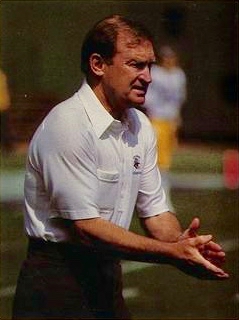
In American football, Air Coryell is the offensive scheme and philosophy developed by former San Diego Chargers and San Diego State Aztecs coach Don Coryell. The offensive philosophy has been also called the "Coryell offense" or the "vertical offense".
With Dan Fouts as quarterback, the San Diego Chargers' offense was among the greatest passing offenses in National Football League history. The Chargers led the league in passing yards an NFL record six consecutive years from 1978 to 1983 and again in 1985. They also led the league in total yards in offense from 1978 to 1983 and in 1985. Coryell, Fouts, Charlie Joiner, and Kellen Winslow are all inducted into the Pro Football Hall of Fame from those Charger teams.
Before Coryell, NFL teams generally used the pro set formation in ball-control, grind-it-out-style offenses that used play-action fakes to set up deep passing attempts when defenses stacked up vs the running game. The pro set features a tight end, two wide receivers, a halfback, and a fullback, often split behind the quarterback. On pass plays, the pro set provided one or even two backs to help protect the quarterback. QBs generally took snaps from under center to allow for more effective use of the play action pass.
In 1978, the contact from defenders on receivers was minimized with the passing of the Mel Blount Rule, which prohibited defenders from making contact with receivers past five yards from the line of scrimmage.
Coryell began his NFL career in 1973 following 12 seasons as the head coach of the San Diego State Aztecs, and soon set the league on its ear with his passing schemes. He won two consecutive division titles (1974–1975) with the St. Louis Cardinals, whose offense emphasized the pass while running the standard pro set. Coryell moved to the Chargers, returning to the same home field he had made a name for himself at the college ranks (San Diego Stadium), and reached the playoffs in four consecutive seasons that included three straight division titles (1979–1981). The Chargers in 1979 were the first AFC Western Division champion to run more passing plays (541) than rushing (481). Coryell's Chargers teams led the league in passing in seven of eight years. The Pro Football Hall of Fame called the Chargers' offenses under Coryell "one of the most explosive and exciting offenses that ever set foot on an NFL field." Coryell was the first coach to win more than 100 games at both the collegiate and professional level. Coryell's offensive innovations changed the entire nature of the league from a run-first league to a pass-first one.
As of 2022, most NFL offenses' passing games are based at least partially on Coryell conventions.
Mike Martz, who ran The Greatest Show on Turf with the St. Louis Rams, said, "Don is the father of the modern passing game. People talk about the West Coast offense, but Don started the 'West Coast' decades ago and kept updating it. You look around the NFL now, and so many teams are running a version of the Coryell offense. Coaches have added their own touches, but it's still Coryell's offense. He has disciples all over the league. He changed the game".
The Coryell offense is based on Sid Gillman's offense, which required the defense to defend the entire field. The passing game was based on timing and rhythm, and coaching the system required a lot of repetition. Coryell expanded on those principles by putting receivers in motion. With the new defensive rules limiting contact to near the line of scrimmage, receivers in motion would be virtually impossible to jam. Coryell not only placed wide receivers in motion, he did so with tight ends and running backs as well. Putting the players in motion also had the advantage of allowing the quarterback to determine pre-snap if the defense would be playing zone or man-to-man defense. It was easier to read the coverage before the snap than afterwards due to the pass rush. It is also harder for a defender to cover if he has to change direction with the receiver instead of squaring up and getting set before a play. Defenses that react to the motion could get confused, leaving a defender in the wrong position.
Hub AI
Air Coryell AI simulator
(@Air Coryell_simulator)
Air Coryell
In American football, Air Coryell is the offensive scheme and philosophy developed by former San Diego Chargers and San Diego State Aztecs coach Don Coryell. The offensive philosophy has been also called the "Coryell offense" or the "vertical offense".
With Dan Fouts as quarterback, the San Diego Chargers' offense was among the greatest passing offenses in National Football League history. The Chargers led the league in passing yards an NFL record six consecutive years from 1978 to 1983 and again in 1985. They also led the league in total yards in offense from 1978 to 1983 and in 1985. Coryell, Fouts, Charlie Joiner, and Kellen Winslow are all inducted into the Pro Football Hall of Fame from those Charger teams.
Before Coryell, NFL teams generally used the pro set formation in ball-control, grind-it-out-style offenses that used play-action fakes to set up deep passing attempts when defenses stacked up vs the running game. The pro set features a tight end, two wide receivers, a halfback, and a fullback, often split behind the quarterback. On pass plays, the pro set provided one or even two backs to help protect the quarterback. QBs generally took snaps from under center to allow for more effective use of the play action pass.
In 1978, the contact from defenders on receivers was minimized with the passing of the Mel Blount Rule, which prohibited defenders from making contact with receivers past five yards from the line of scrimmage.
Coryell began his NFL career in 1973 following 12 seasons as the head coach of the San Diego State Aztecs, and soon set the league on its ear with his passing schemes. He won two consecutive division titles (1974–1975) with the St. Louis Cardinals, whose offense emphasized the pass while running the standard pro set. Coryell moved to the Chargers, returning to the same home field he had made a name for himself at the college ranks (San Diego Stadium), and reached the playoffs in four consecutive seasons that included three straight division titles (1979–1981). The Chargers in 1979 were the first AFC Western Division champion to run more passing plays (541) than rushing (481). Coryell's Chargers teams led the league in passing in seven of eight years. The Pro Football Hall of Fame called the Chargers' offenses under Coryell "one of the most explosive and exciting offenses that ever set foot on an NFL field." Coryell was the first coach to win more than 100 games at both the collegiate and professional level. Coryell's offensive innovations changed the entire nature of the league from a run-first league to a pass-first one.
As of 2022, most NFL offenses' passing games are based at least partially on Coryell conventions.
Mike Martz, who ran The Greatest Show on Turf with the St. Louis Rams, said, "Don is the father of the modern passing game. People talk about the West Coast offense, but Don started the 'West Coast' decades ago and kept updating it. You look around the NFL now, and so many teams are running a version of the Coryell offense. Coaches have added their own touches, but it's still Coryell's offense. He has disciples all over the league. He changed the game".
The Coryell offense is based on Sid Gillman's offense, which required the defense to defend the entire field. The passing game was based on timing and rhythm, and coaching the system required a lot of repetition. Coryell expanded on those principles by putting receivers in motion. With the new defensive rules limiting contact to near the line of scrimmage, receivers in motion would be virtually impossible to jam. Coryell not only placed wide receivers in motion, he did so with tight ends and running backs as well. Putting the players in motion also had the advantage of allowing the quarterback to determine pre-snap if the defense would be playing zone or man-to-man defense. It was easier to read the coverage before the snap than afterwards due to the pass rush. It is also harder for a defender to cover if he has to change direction with the receiver instead of squaring up and getting set before a play. Defenses that react to the motion could get confused, leaving a defender in the wrong position.
Recent media