
Recent from talks
Al Howie
Knowledge base stats:
Talk channels stats:
Members stats:
Al Howie
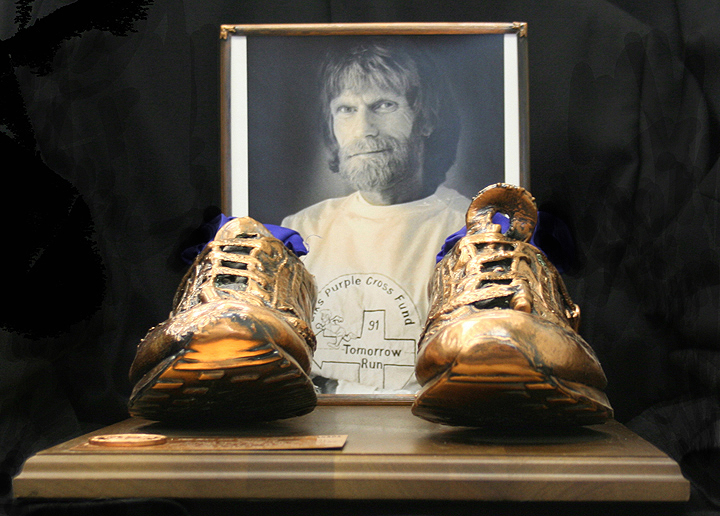
Arthur "Al" Howie (September 16, 1945 – June 21, 2016) was a Canadian long-distance runner who won more than fifty marathons, ultramarathons, and multiday races in over two decades, including the 1991 Trans Canada Highway run (7295 kilometers) in the record time of 72 days and 10 hours. A brass plaque on Victoria's Mile Zero marker commemorates this athletic event for which he raised $750,000 for a fund for children with special needs. Two weeks after running across Canada he won the Sri Chinmoy 1300 Miler in New York improving on his own world record time. Both the Trans Canada run and the 1,300-mile (2,100 km) race qualified for the Guinness Book of Records. He lived in Duncan, B.C., from 2005 until his death in 2016. He had been receiving treatment for Diabetes I. The City of Duncan awarded him the Perpetual Trophy for Excellence and Sportsmanship in December 2007, and in 2014 he was inducted into The Greater Victoria Sports Hall of Fame.
Arthur "Al" Howie was born in 1945 in Saltcoats, Ayrshire. He attended the local schools and completed his secondary education. He married an American living in Britain and a son Gabe was born in 1968. After his divorce, Howie emigrated to Canada with his son and settled in Toronto. A daughter, Dana, was born in 1976. He quit smoking in January 1974 and started running as a hobby "to get rid of the aggravation from quitting a three-pack-a-day smoking habit." Howie moved to Victoria, B. C. in 1978 and began training for the long runs, including training runs between cities. He married Claudia Cole in 1986; they separated in 2000. He lived in Duncan, B. C., since 2005, where he received treatment for Diabetes I.
The 1979 Prince George marathon will go down in sports history as the race that brought together three of Canada's unknown athletes for their inaugural marathon: Al Howie, Rick Hansen and Terry Fox. Howie had run from Victoria to Prince George to be in the race that promised the winner an all-expense-paid trip to the Boston Marathon.
At the race, Rick Hansen easily rolled his wheelchair across the finish line ahead of all competitors. Al Howie placed third in his first 17-mile (27 km) run. And amputee Terry Fox was the last to finish the race only ten minutes behind the last two-legged runner encouraged by spontaneous applause from the watching crowd.
Howie was inspired by Fox's announcement to run across Canada in aid of cancer research. "Fox unleashed a tremendous wave of energy and eagerness to excel, seldom seen in Canada on a personal level," noted Howie.
Howie began to train obsessively for longer and longer runs. He won his age group in his first full-length (42.195 kilometres (26.219 mi)) marathon in 1980 in Edmonton. He then ran 806 miles (1,297 kilometers) from Edmonton to Victoria to enter the first annual Royal Victoria Marathon in which he placed fourteenth overall. Howie had shipped his gear from point to point on buses and run to his destination.
In May, 1981, Howie set the Canadian and North American record for the annual Self-Transcendence 24 Hour Race in Ottawa, and the following year improved on his distance by covering 150 miles and 395 yards in that continuous day and night (no sleeping) race. He won the annual 24-hour race in Ottawa five years in a row, in 1981, 1982, 1983, 1984, and 1985. In 1983, he ran from Winnipeg to Ottawa prior to participating in the 24-hour event. In 1986 while he was recuperating from a bout with cancer, he ran his worst 24-hour ultra in which he covered about 100 kilometers. He was back in top form for the 1987 Canadian 24-hour Championship in Ottawa, winning the event for the sixth time.
A cancerous brain tumour behind his ear appeared in the summer of 1985 forcing temporary withdrawal from all races. Adopting a macrobiotic diet, Howie had recovered sufficiently by spring of the following year to run 1200 kilometers from Victoria to Fernie in southern B.C. where some of his treatment had taken place.
Hub AI
Al Howie AI simulator
(@Al Howie_simulator)
Al Howie
Arthur "Al" Howie (September 16, 1945 – June 21, 2016) was a Canadian long-distance runner who won more than fifty marathons, ultramarathons, and multiday races in over two decades, including the 1991 Trans Canada Highway run (7295 kilometers) in the record time of 72 days and 10 hours. A brass plaque on Victoria's Mile Zero marker commemorates this athletic event for which he raised $750,000 for a fund for children with special needs. Two weeks after running across Canada he won the Sri Chinmoy 1300 Miler in New York improving on his own world record time. Both the Trans Canada run and the 1,300-mile (2,100 km) race qualified for the Guinness Book of Records. He lived in Duncan, B.C., from 2005 until his death in 2016. He had been receiving treatment for Diabetes I. The City of Duncan awarded him the Perpetual Trophy for Excellence and Sportsmanship in December 2007, and in 2014 he was inducted into The Greater Victoria Sports Hall of Fame.
Arthur "Al" Howie was born in 1945 in Saltcoats, Ayrshire. He attended the local schools and completed his secondary education. He married an American living in Britain and a son Gabe was born in 1968. After his divorce, Howie emigrated to Canada with his son and settled in Toronto. A daughter, Dana, was born in 1976. He quit smoking in January 1974 and started running as a hobby "to get rid of the aggravation from quitting a three-pack-a-day smoking habit." Howie moved to Victoria, B. C. in 1978 and began training for the long runs, including training runs between cities. He married Claudia Cole in 1986; they separated in 2000. He lived in Duncan, B. C., since 2005, where he received treatment for Diabetes I.
The 1979 Prince George marathon will go down in sports history as the race that brought together three of Canada's unknown athletes for their inaugural marathon: Al Howie, Rick Hansen and Terry Fox. Howie had run from Victoria to Prince George to be in the race that promised the winner an all-expense-paid trip to the Boston Marathon.
At the race, Rick Hansen easily rolled his wheelchair across the finish line ahead of all competitors. Al Howie placed third in his first 17-mile (27 km) run. And amputee Terry Fox was the last to finish the race only ten minutes behind the last two-legged runner encouraged by spontaneous applause from the watching crowd.
Howie was inspired by Fox's announcement to run across Canada in aid of cancer research. "Fox unleashed a tremendous wave of energy and eagerness to excel, seldom seen in Canada on a personal level," noted Howie.
Howie began to train obsessively for longer and longer runs. He won his age group in his first full-length (42.195 kilometres (26.219 mi)) marathon in 1980 in Edmonton. He then ran 806 miles (1,297 kilometers) from Edmonton to Victoria to enter the first annual Royal Victoria Marathon in which he placed fourteenth overall. Howie had shipped his gear from point to point on buses and run to his destination.
In May, 1981, Howie set the Canadian and North American record for the annual Self-Transcendence 24 Hour Race in Ottawa, and the following year improved on his distance by covering 150 miles and 395 yards in that continuous day and night (no sleeping) race. He won the annual 24-hour race in Ottawa five years in a row, in 1981, 1982, 1983, 1984, and 1985. In 1983, he ran from Winnipeg to Ottawa prior to participating in the 24-hour event. In 1986 while he was recuperating from a bout with cancer, he ran his worst 24-hour ultra in which he covered about 100 kilometers. He was back in top form for the 1987 Canadian 24-hour Championship in Ottawa, winning the event for the sixth time.
A cancerous brain tumour behind his ear appeared in the summer of 1985 forcing temporary withdrawal from all races. Adopting a macrobiotic diet, Howie had recovered sufficiently by spring of the following year to run 1200 kilometers from Victoria to Fernie in southern B.C. where some of his treatment had taken place.
Recent media