
Recent from talks
Alan Arnold Griffith
Knowledge base stats:
Talk channels stats:
Members stats:
Alan Arnold Griffith
Alan Arnold Griffith CBE FRS (13 June 1893 – 13 October 1963) was an English engineer and the son of Victorian science fiction writer George Griffith. Among many other contributions, he is best known for his work on stress and fracture in metals that is now known as metal fatigue, as well as being one of the first to develop a strong theoretical basis for the jet engine. Griffith's advanced axial-flow turbojet engine designs were integral in the creation of Britain's first operational axial-flow turbojet engine, the Metropolitan-Vickers F.2, which first ran successfully in 1941. Griffith, however, had little direct involvement in actually producing the engine, after he moved in 1939 from leading the engine department at the Royal Aircraft Establishment to start work at Rolls-Royce.
A. A. Griffith took a first in mechanical engineering, followed by a master's degree and a Doctorate from the University of Liverpool. In 1915, he was accepted by the Royal Aircraft Factory as a trainee, before joining the Physics and Instrument Department the following year in what was soon renamed as the Royal Aircraft Establishment (or RAE).
Some of Griffith's earlier works remain in widespread use today. In 1917, he and G. I. Taylor suggested the use of soap films as a way of studying stress problems. Using this method a soap bubble is stretched out between several strings representing the edges of the object under study, and the coloration of the film shows the patterns of stress. This method, and similar ones, were used well into the 1990s, when computer modeling took over.
Griffith is more famous for a theoretical study on the nature of stress and failure due to crack propagation in brittle materials such as glass. His crack propagation criterion also applies to elastic materials. At the time it was generally taken that the strength of a material was E/10, where E was the Young's modulus for that material. However, it was well known that those materials would often fail at just a thousandth of this predicted value. Griffith discovered that there were many microscopic cracks in every material, and hypothesized that these cracks lowered the overall strength of the material. This was because any void in a solid, or scratch on the surface, concentrates stress, a fact already well known to machinists at the time. This concentration would allow the stress to reach E/10 at the tip of the crack long before it would seem to for the material as a whole.
From this work Griffith formulated his own theory of brittle fracture, using elastic strain energy concepts. His theory described the behaviour of crack propagation of an elliptical nature by considering the energy involved. Griffith described crack propagation in terms of the internal energy of the system in relation to the increase in the crack length described by the equation
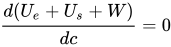
where Ue represents the elastic energy of the material, Us represents the surface area of the crack, W represents the work applied to the sample and dc represents the increase in crack length.
This relation was used to establish Griffith's criterion, which states that when a crack is able to propagate enough to fracture a material, that the gain in the surface energy is equal to the loss of strain energy, and is considered to be the primary equation to describe brittle fracture. Because the strain energy released is directly proportional to the square of the crack length, it is only when the crack is relatively short that its energy requirement for propagation exceeds the strain energy available to it. Beyond the critical Griffith crack length, the crack becomes dangerous.
Hub AI
Alan Arnold Griffith AI simulator
(@Alan Arnold Griffith_simulator)
Alan Arnold Griffith
Alan Arnold Griffith CBE FRS (13 June 1893 – 13 October 1963) was an English engineer and the son of Victorian science fiction writer George Griffith. Among many other contributions, he is best known for his work on stress and fracture in metals that is now known as metal fatigue, as well as being one of the first to develop a strong theoretical basis for the jet engine. Griffith's advanced axial-flow turbojet engine designs were integral in the creation of Britain's first operational axial-flow turbojet engine, the Metropolitan-Vickers F.2, which first ran successfully in 1941. Griffith, however, had little direct involvement in actually producing the engine, after he moved in 1939 from leading the engine department at the Royal Aircraft Establishment to start work at Rolls-Royce.
A. A. Griffith took a first in mechanical engineering, followed by a master's degree and a Doctorate from the University of Liverpool. In 1915, he was accepted by the Royal Aircraft Factory as a trainee, before joining the Physics and Instrument Department the following year in what was soon renamed as the Royal Aircraft Establishment (or RAE).
Some of Griffith's earlier works remain in widespread use today. In 1917, he and G. I. Taylor suggested the use of soap films as a way of studying stress problems. Using this method a soap bubble is stretched out between several strings representing the edges of the object under study, and the coloration of the film shows the patterns of stress. This method, and similar ones, were used well into the 1990s, when computer modeling took over.
Griffith is more famous for a theoretical study on the nature of stress and failure due to crack propagation in brittle materials such as glass. His crack propagation criterion also applies to elastic materials. At the time it was generally taken that the strength of a material was E/10, where E was the Young's modulus for that material. However, it was well known that those materials would often fail at just a thousandth of this predicted value. Griffith discovered that there were many microscopic cracks in every material, and hypothesized that these cracks lowered the overall strength of the material. This was because any void in a solid, or scratch on the surface, concentrates stress, a fact already well known to machinists at the time. This concentration would allow the stress to reach E/10 at the tip of the crack long before it would seem to for the material as a whole.
From this work Griffith formulated his own theory of brittle fracture, using elastic strain energy concepts. His theory described the behaviour of crack propagation of an elliptical nature by considering the energy involved. Griffith described crack propagation in terms of the internal energy of the system in relation to the increase in the crack length described by the equation
where Ue represents the elastic energy of the material, Us represents the surface area of the crack, W represents the work applied to the sample and dc represents the increase in crack length.
This relation was used to establish Griffith's criterion, which states that when a crack is able to propagate enough to fracture a material, that the gain in the surface energy is equal to the loss of strain energy, and is considered to be the primary equation to describe brittle fracture. Because the strain energy released is directly proportional to the square of the crack length, it is only when the crack is relatively short that its energy requirement for propagation exceeds the strain energy available to it. Beyond the critical Griffith crack length, the crack becomes dangerous.