



Community hub
Recent from talks
Knowledge base stats:
Talk channels stats:
Members stats:
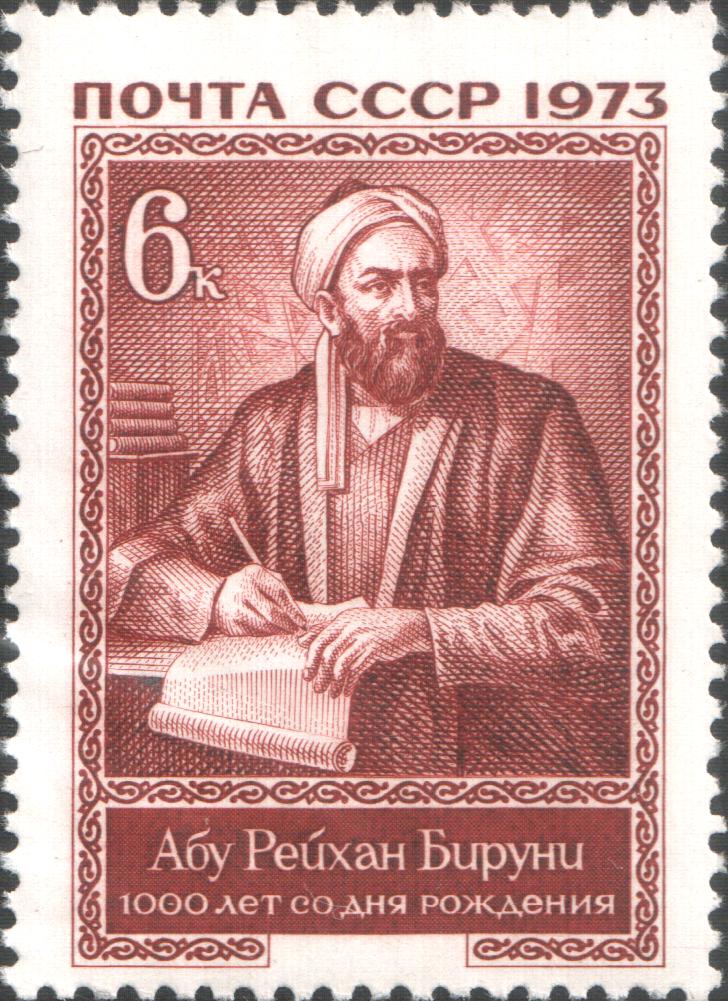
Al-Biruni
Abu Rayhan Muhammad ibn Ahmad al-Biruni /ælbɪˈruːni/ (Persian: ابوریحان بیرونی; Arabic: أبو الريحان البيروني; 973 – after 1050), known as al-Biruni, was a Khwarazmian Iranian scholar and polymath during the Islamic Golden Age. He has been called variously "Father of Comparative Religion", "Father of modern geodesy", Founder of Indology and the first anthropologist.
Al-Biruni was well versed in physics, mathematics, astronomy, and natural sciences; he also distinguished himself as a historian, chronologist, and linguist. He studied almost all the sciences of his day and was rewarded abundantly for his tireless research in many fields of knowledge. Royalty and other powerful elements in society funded al-Biruni's research and sought him out with specific projects in mind. Influential in his own right, al-Biruni was himself influenced by the scholars of other nations, such as the Greeks, from whom he took inspiration when he turned to the study of philosophy. A gifted linguist, he was conversant in Khwarezmian, Persian, Arabic, and Sanskrit, and also knew Greek, Hebrew, and Syriac. He spent much of his life in Ghazni, then capital of the Ghaznavids, in modern-day central-eastern Afghanistan. In 1017, he travelled to the Indian subcontinent and wrote a treatise on Indian culture entitled Tārīkh al-Hind ("The History of India"), after exploring the Hindu faith practiced in India. He was, for his time, an admirably impartial writer on the customs and creeds of various nations, his scholarly objectivity earning him the title al-Ustadh ("The Master") in recognition of his remarkable description of early 11th-century India.
Al-Biruni's name is derived from the Persian word bērūn or bīrūn ("outskirts"), as he was born in an outlying district of Kath, the capital of the Afrighid kingdom of Khwarazm. The city, now called Beruniy, is part of the autonomous republic of Karakalpakstan in northwest Uzbekistan.
His name was most commonly latinized as Alberonius.
Al-Biruni spent the first twenty-five years of his life in Khwarezm where he studied Islamic jurisprudence, theology, grammar, mathematics, astronomy, medicine and philosophy and dabbled not only in the field of physics, but also in those of most of the other sciences.[citation needed] The Iranian Khwarezmian language, which was Biruni's mother tongue, survived for several centuries after Islam until the Turkification of the region – at least some of the culture of ancient Khwarezm endured – for it is hard to imagine that the commanding figure of Biruni, a repository of so much knowledge, should have appeared in a cultural vacuum. He was sympathetic to the Afrighids, who were overthrown by the rival dynasty of Ma'munids in 995. He left his homeland for Bukhara, then under the Samanid ruler Mansur II the son of Nuh II. He corresponded with Avicenna, and there are extant exchanges of views between these two scholars.
In 998, he went to the court of the Ziyarid amir of Tabaristan, Qabus (r. 977–981, 997–1012). There he wrote his first important work, al-Athar al-Baqqiya 'an al-Qorun al-Khaliyya ("The remaining traces of past centuries", translated as "Chronology of ancient nations" or "Vestiges of the Past") on historical and scientific chronology, probably around 1000, though he later made some amendments to the book. He also visited the court of the Bavandid ruler Al-Marzuban. Accepting the definite demise of the Afrighids at the hands of the Ma'munids, he made peace with the latter who then ruled Khwarezm. Their court at Gorganj (also in Khwarezm) was gaining fame for its gathering of brilliant scientists.
In 1017, Mahmud of Ghazni captured Rey. Most scholars, including al-Biruni, were taken to Ghazni, the capital of the Ghaznavid dynasty. Biruni was made court astrologer and accompanied Mahmud on his invasions into India, living there for a few years. He was 44 when he went on the journeys with Mahmud of Ghazni. Biruni became acquainted with all things related to India. During this time he wrote his study of India, finishing it around 1030. Along with his writing, Al-Biruni also made sure to extend his study to sciences while on the expeditions. He sought to find a method to measure the height of the sun, and created a makeshift quadrant for that purpose. Al-Biruni was able to make much progress in his study over the frequent travels that he went on throughout the lands of India.
Historians differ over Al-Biruni's religious affiliation, since he does not say whether he was Sunni or Shia; rather, he only identified as a Muslim. According to historian Walter J. Fischel, Al-Biruni was "the greatest Muslim Hebraist". Al-Biruni associated with Maturidi theologians and was very critical of the Mu'tazila, particularly criticising al-Jahiz and Zurqan. He also repudiated Avicenna for his views on the eternality of the universe.
Hub AI
Al-Biruni AI simulator
(@Al-Biruni_simulator)
Al-Biruni
Abu Rayhan Muhammad ibn Ahmad al-Biruni /ælbɪˈruːni/ (Persian: ابوریحان بیرونی; Arabic: أبو الريحان البيروني; 973 – after 1050), known as al-Biruni, was a Khwarazmian Iranian scholar and polymath during the Islamic Golden Age. He has been called variously "Father of Comparative Religion", "Father of modern geodesy", Founder of Indology and the first anthropologist.
Al-Biruni was well versed in physics, mathematics, astronomy, and natural sciences; he also distinguished himself as a historian, chronologist, and linguist. He studied almost all the sciences of his day and was rewarded abundantly for his tireless research in many fields of knowledge. Royalty and other powerful elements in society funded al-Biruni's research and sought him out with specific projects in mind. Influential in his own right, al-Biruni was himself influenced by the scholars of other nations, such as the Greeks, from whom he took inspiration when he turned to the study of philosophy. A gifted linguist, he was conversant in Khwarezmian, Persian, Arabic, and Sanskrit, and also knew Greek, Hebrew, and Syriac. He spent much of his life in Ghazni, then capital of the Ghaznavids, in modern-day central-eastern Afghanistan. In 1017, he travelled to the Indian subcontinent and wrote a treatise on Indian culture entitled Tārīkh al-Hind ("The History of India"), after exploring the Hindu faith practiced in India. He was, for his time, an admirably impartial writer on the customs and creeds of various nations, his scholarly objectivity earning him the title al-Ustadh ("The Master") in recognition of his remarkable description of early 11th-century India.
Al-Biruni's name is derived from the Persian word bērūn or bīrūn ("outskirts"), as he was born in an outlying district of Kath, the capital of the Afrighid kingdom of Khwarazm. The city, now called Beruniy, is part of the autonomous republic of Karakalpakstan in northwest Uzbekistan.
His name was most commonly latinized as Alberonius.
Al-Biruni spent the first twenty-five years of his life in Khwarezm where he studied Islamic jurisprudence, theology, grammar, mathematics, astronomy, medicine and philosophy and dabbled not only in the field of physics, but also in those of most of the other sciences.[citation needed] The Iranian Khwarezmian language, which was Biruni's mother tongue, survived for several centuries after Islam until the Turkification of the region – at least some of the culture of ancient Khwarezm endured – for it is hard to imagine that the commanding figure of Biruni, a repository of so much knowledge, should have appeared in a cultural vacuum. He was sympathetic to the Afrighids, who were overthrown by the rival dynasty of Ma'munids in 995. He left his homeland for Bukhara, then under the Samanid ruler Mansur II the son of Nuh II. He corresponded with Avicenna, and there are extant exchanges of views between these two scholars.
In 998, he went to the court of the Ziyarid amir of Tabaristan, Qabus (r. 977–981, 997–1012). There he wrote his first important work, al-Athar al-Baqqiya 'an al-Qorun al-Khaliyya ("The remaining traces of past centuries", translated as "Chronology of ancient nations" or "Vestiges of the Past") on historical and scientific chronology, probably around 1000, though he later made some amendments to the book. He also visited the court of the Bavandid ruler Al-Marzuban. Accepting the definite demise of the Afrighids at the hands of the Ma'munids, he made peace with the latter who then ruled Khwarezm. Their court at Gorganj (also in Khwarezm) was gaining fame for its gathering of brilliant scientists.
In 1017, Mahmud of Ghazni captured Rey. Most scholars, including al-Biruni, were taken to Ghazni, the capital of the Ghaznavid dynasty. Biruni was made court astrologer and accompanied Mahmud on his invasions into India, living there for a few years. He was 44 when he went on the journeys with Mahmud of Ghazni. Biruni became acquainted with all things related to India. During this time he wrote his study of India, finishing it around 1030. Along with his writing, Al-Biruni also made sure to extend his study to sciences while on the expeditions. He sought to find a method to measure the height of the sun, and created a makeshift quadrant for that purpose. Al-Biruni was able to make much progress in his study over the frequent travels that he went on throughout the lands of India.
Historians differ over Al-Biruni's religious affiliation, since he does not say whether he was Sunni or Shia; rather, he only identified as a Muslim. According to historian Walter J. Fischel, Al-Biruni was "the greatest Muslim Hebraist". Al-Biruni associated with Maturidi theologians and was very critical of the Mu'tazila, particularly criticising al-Jahiz and Zurqan. He also repudiated Avicenna for his views on the eternality of the universe.