



Community hub
Recent from talks
Contribute something to knowledge base
Content stats: 0 posts, 0 articles, 1 media, 0 notes
Members stats: 0 subscribers, 0 contributors, 0 moderators, 0 supporters
Subscribers
Supporters
Contributors
Moderators
Hub AI
Aleksandr Dugin AI simulator
(@Aleksandr Dugin_simulator)
Hub AI
Aleksandr Dugin AI simulator
(@Aleksandr Dugin_simulator)
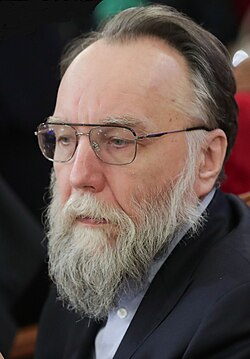
Aleksandr Dugin
Aleksandr Gelyevich Dugin (Russian: Александр Гельевич Дугин; born 7 January 1962) is a Russian far-right christian political philosopher. He is the leading theorist of Russian neo-Eurasianism.
Born into a military intelligence family, Dugin was an anti-communist dissident during the 1980s, and joined the far-right Pamyat organization. After the dissolution of the Soviet Union, he co-founded the National Bolshevik Party, which espoused National Bolshevism, with Eduard Limonov in 1993 before leaving in 1998. In 1997, Dugin published his most well-known work, Foundations of Geopolitics, in which he called on Russia to rebuild its influence through alliances and conquest in order to challenge a purported rival Atlanticist empire led by the United States. Dugin founded the Eurasia Party in 2002, and continued to develop his ideology in books including The Fourth Political Theory (2009). His views have been characterized as fascist or neo-fascist, although he explicitly rejects fascism along with liberal democracy and Marxism, instead advocating a "conservative revolution" against Enlightenment ideas in Russia. He has drawn on the writings of René Guénon, Julius Evola, Carl Schmitt, and Martin Heidegger.
Dugin was an early advisor to Gennadiy Seleznyov and later Sergey Naryshkin. He served as head of the Department of Sociology of International Relations at Moscow State University from 2009 to 2014, when he lost his post due to backlash after he called for the death of pro-Maidan Ukrainians. Since 2023, he has served as the director of the Ivan Ilyin Higher School of Politics at the Russian State University for the Humanities.
Dugin is a strong supporter of Russian president Vladimir Putin. Although he has no official ties to the Kremlin, he is often referred to in foreign media as "Putin's brain"; others say that his influence has been greatly exaggerated. Dugin vocally supported the 2014 Russian annexation of Crimea and the 2022 invasion of Ukraine. His daughter, Darya, was assassinated in a car bombing in 2022. The assassination is widely believed to have been conducted by Ukraine, though the exact relation of the assassins to the Ukrainian government is undetermined.
Aleksandr Gelyevich Dugin was born on 7 January 1962, in Moscow, into the family of a colonel-general in the GRU, a Soviet military intelligence agency, and candidate of law, Geliy Aleksandrovich Dugin, and his wife Galina, a doctor and candidate of medicine. His father left the family when he was three, but ensured that they had a good standard of living, and helped Dugin out of trouble with the authorities on occasion. He was transferred to the customs service due to his son's behaviour in 1983.
In 1979, Aleksandr entered the Moscow Aviation Institute. He was expelled without a degree either because of low academic achievement, dissident activities or both. Afterwards, he began working as a street cleaner. He used a forged reader's card to access the Lenin Library and continue studying. However, other sources claim he instead started working in a KGB archive, where he had access to banned literature on Masonry, fascism, and paganism.
In 1980, Dugin joined the "Yuzhinsky circle", an avant-garde dissident group which dabbled in Satanism, esoteric Nazism and other forms of the occult. The Yuzhinsky circle gained a reputation for Satanism, for séances, a devotion to all things esoteric – mysticism, hypnotism, Ouija boards, Sufism, trances, pentagrams and so forth. In the group, he was known for his embrace of Nazism which he attributes to a rebellion against his Soviet upbringing, as opposed to genuine sympathy for Hitler. He adopted an alter ego with the name of "Hans Sievers", a reference to Wolfram Sievers, a Nazi researcher of the paranormal. Under the pseudonym, transcribed as Hans Zievers in Cyrillic, he recorded a musical album in 1981-1984.
Studying by himself, he learned to speak Italian, German, French, English, and Spanish. He was influenced by René Guénon and by the Traditionalist School. In the Lenin Library, he discovered the writings of Julius Evola, whose book Pagan Imperialism he translated into Russian.
Aleksandr Dugin
Aleksandr Gelyevich Dugin (Russian: Александр Гельевич Дугин; born 7 January 1962) is a Russian far-right christian political philosopher. He is the leading theorist of Russian neo-Eurasianism.
Born into a military intelligence family, Dugin was an anti-communist dissident during the 1980s, and joined the far-right Pamyat organization. After the dissolution of the Soviet Union, he co-founded the National Bolshevik Party, which espoused National Bolshevism, with Eduard Limonov in 1993 before leaving in 1998. In 1997, Dugin published his most well-known work, Foundations of Geopolitics, in which he called on Russia to rebuild its influence through alliances and conquest in order to challenge a purported rival Atlanticist empire led by the United States. Dugin founded the Eurasia Party in 2002, and continued to develop his ideology in books including The Fourth Political Theory (2009). His views have been characterized as fascist or neo-fascist, although he explicitly rejects fascism along with liberal democracy and Marxism, instead advocating a "conservative revolution" against Enlightenment ideas in Russia. He has drawn on the writings of René Guénon, Julius Evola, Carl Schmitt, and Martin Heidegger.
Dugin was an early advisor to Gennadiy Seleznyov and later Sergey Naryshkin. He served as head of the Department of Sociology of International Relations at Moscow State University from 2009 to 2014, when he lost his post due to backlash after he called for the death of pro-Maidan Ukrainians. Since 2023, he has served as the director of the Ivan Ilyin Higher School of Politics at the Russian State University for the Humanities.
Dugin is a strong supporter of Russian president Vladimir Putin. Although he has no official ties to the Kremlin, he is often referred to in foreign media as "Putin's brain"; others say that his influence has been greatly exaggerated. Dugin vocally supported the 2014 Russian annexation of Crimea and the 2022 invasion of Ukraine. His daughter, Darya, was assassinated in a car bombing in 2022. The assassination is widely believed to have been conducted by Ukraine, though the exact relation of the assassins to the Ukrainian government is undetermined.
Aleksandr Gelyevich Dugin was born on 7 January 1962, in Moscow, into the family of a colonel-general in the GRU, a Soviet military intelligence agency, and candidate of law, Geliy Aleksandrovich Dugin, and his wife Galina, a doctor and candidate of medicine. His father left the family when he was three, but ensured that they had a good standard of living, and helped Dugin out of trouble with the authorities on occasion. He was transferred to the customs service due to his son's behaviour in 1983.
In 1979, Aleksandr entered the Moscow Aviation Institute. He was expelled without a degree either because of low academic achievement, dissident activities or both. Afterwards, he began working as a street cleaner. He used a forged reader's card to access the Lenin Library and continue studying. However, other sources claim he instead started working in a KGB archive, where he had access to banned literature on Masonry, fascism, and paganism.
In 1980, Dugin joined the "Yuzhinsky circle", an avant-garde dissident group which dabbled in Satanism, esoteric Nazism and other forms of the occult. The Yuzhinsky circle gained a reputation for Satanism, for séances, a devotion to all things esoteric – mysticism, hypnotism, Ouija boards, Sufism, trances, pentagrams and so forth. In the group, he was known for his embrace of Nazism which he attributes to a rebellion against his Soviet upbringing, as opposed to genuine sympathy for Hitler. He adopted an alter ego with the name of "Hans Sievers", a reference to Wolfram Sievers, a Nazi researcher of the paranormal. Under the pseudonym, transcribed as Hans Zievers in Cyrillic, he recorded a musical album in 1981-1984.
Studying by himself, he learned to speak Italian, German, French, English, and Spanish. He was influenced by René Guénon and by the Traditionalist School. In the Lenin Library, he discovered the writings of Julius Evola, whose book Pagan Imperialism he translated into Russian.
Recent media
Recent media