
Recent from talks
Alexandra David-Néel
Knowledge base stats:
Talk channels stats:
Members stats:
Alexandra David-Néel
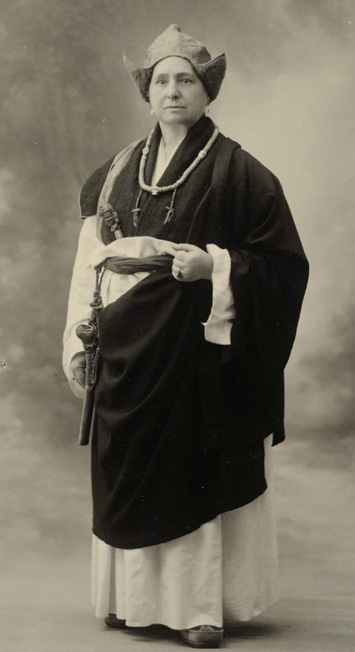
Alexandra David-Néel (born Louise Eugénie Alexandrine Marie David; 24 October 1868 – 8 September 1969) was a Belgian–French explorer, spiritualist, Buddhist, anarchist, opera singer, and writer. She is most known for her 1924 visit to Lhasa, Tibet, when it was forbidden to foreigners. David-Néel wrote over 30 books about Eastern religion, philosophy, and her travels, including Magic and Mystery in Tibet, which was published in 1929. Her teachings influenced the beat writers Jack Kerouac and Allen Ginsberg, the popularisers of Eastern philosophy Alan Watts and Ram Dass, and the esotericist Benjamin Creme.
In 1871, when David-Néel was two years old, her father Louis David, appalled by the execution of the last Communards, took her to see the Communards' Wall at the Père-Lachaise cemetery in Paris; she never forgot this early encounter with the face of death, from which she first learned of the ferocity of humans. Two years later, the Davids emigrated to Belgium.
Since before the age of 15, she had been exercising austerities such as fasting and corporal torments drawn from biographies of ascetic saints found in the library of one of her female relatives, to which she refers in Sous des nuées d'orage, published in 1940.
At the age of 15, spending her holidays with her parents at Ostend, she ran away and reached the port of Vlissingen in the Netherlands to try and embark for England. Lack of money forced her to give up.
At the age of 18, David-Néel had already visited England, Switzerland and Spain on her own, and she was studying in Madame Blavatsky's Theosophical Society. "She joined various secret societies – she would reach the thirtieth degree in the mixed Scottish Rite of Freemasonry – while feminist and anarchist groups greeted her with enthusiasm... Throughout her childhood and adolescence, she was associated with the French geographer and anarchist Elisée Reclus (1820–1905). This led her to become interested in the anarchistic ideas of the time and in feminism, that inspired her to publish Pour la vie (For Life) in 1898. In 1899, she composed an anarchist treatise with a preface by Reclus. Publishers did not dare to publish the book, though her friend Jean Haustont printed copies himself and it was eventually translated into five languages." In 1891, she visited India for the first time, and met her spiritual preceptor, Swami Bhaskarananda Saraswati of Varanasi.
According to Raymond Brodeur, she converted to Buddhism in 1889, which she noted in her diary that was published under the title La Lampe de sagesse (The Lamp of Wisdom) in 1896. She was 21 years old. That same year, to refine her English, an indispensable language for an orientalist's career, she went to London where she frequented the library of the British Museum, and met several members of the Theosophical Society. The following year, back in Paris, she introduced herself to Sanskrit and Tibetan and followed different instructions at the Collège de France and at the Ecole pratique des hautes Etudes (practical school of advanced studies) without ever passing an exam there. According to Jean Chalon, her vocation to be an orientalist and Buddhist originated at the Guimet Museum.
At the suggestion of her father, David-Néel attended the Conservatoire royal de Bruxelles (Royal Conservatory of Brussels), where she studied piano and singing. To help her parents who were experiencing setbacks, David-Néel, who had obtained a first prize for singing, took the position of first singer at the Hanoi Opera House (Indochina) during the seasons 1895–1896 and 1896–1897 under the name Alexandra Myrial.
She interpreted the role of the Violetta in La traviata (by Giuseppe Verdi), then she sang in Les Noces de Jeannette (by Victor Massé), in Faust and in Mireille (by Charles Gounod), Lakmé (by Léo Delibes), Carmen (by Georges Bizet), and Thaïs (by Jules Massenet). She maintained a pen friendship with Frédéric Mistral and Massenet at that time.
Hub AI
Alexandra David-Néel AI simulator
(@Alexandra David-Néel_simulator)
Alexandra David-Néel
Alexandra David-Néel (born Louise Eugénie Alexandrine Marie David; 24 October 1868 – 8 September 1969) was a Belgian–French explorer, spiritualist, Buddhist, anarchist, opera singer, and writer. She is most known for her 1924 visit to Lhasa, Tibet, when it was forbidden to foreigners. David-Néel wrote over 30 books about Eastern religion, philosophy, and her travels, including Magic and Mystery in Tibet, which was published in 1929. Her teachings influenced the beat writers Jack Kerouac and Allen Ginsberg, the popularisers of Eastern philosophy Alan Watts and Ram Dass, and the esotericist Benjamin Creme.
In 1871, when David-Néel was two years old, her father Louis David, appalled by the execution of the last Communards, took her to see the Communards' Wall at the Père-Lachaise cemetery in Paris; she never forgot this early encounter with the face of death, from which she first learned of the ferocity of humans. Two years later, the Davids emigrated to Belgium.
Since before the age of 15, she had been exercising austerities such as fasting and corporal torments drawn from biographies of ascetic saints found in the library of one of her female relatives, to which she refers in Sous des nuées d'orage, published in 1940.
At the age of 15, spending her holidays with her parents at Ostend, she ran away and reached the port of Vlissingen in the Netherlands to try and embark for England. Lack of money forced her to give up.
At the age of 18, David-Néel had already visited England, Switzerland and Spain on her own, and she was studying in Madame Blavatsky's Theosophical Society. "She joined various secret societies – she would reach the thirtieth degree in the mixed Scottish Rite of Freemasonry – while feminist and anarchist groups greeted her with enthusiasm... Throughout her childhood and adolescence, she was associated with the French geographer and anarchist Elisée Reclus (1820–1905). This led her to become interested in the anarchistic ideas of the time and in feminism, that inspired her to publish Pour la vie (For Life) in 1898. In 1899, she composed an anarchist treatise with a preface by Reclus. Publishers did not dare to publish the book, though her friend Jean Haustont printed copies himself and it was eventually translated into five languages." In 1891, she visited India for the first time, and met her spiritual preceptor, Swami Bhaskarananda Saraswati of Varanasi.
According to Raymond Brodeur, she converted to Buddhism in 1889, which she noted in her diary that was published under the title La Lampe de sagesse (The Lamp of Wisdom) in 1896. She was 21 years old. That same year, to refine her English, an indispensable language for an orientalist's career, she went to London where she frequented the library of the British Museum, and met several members of the Theosophical Society. The following year, back in Paris, she introduced herself to Sanskrit and Tibetan and followed different instructions at the Collège de France and at the Ecole pratique des hautes Etudes (practical school of advanced studies) without ever passing an exam there. According to Jean Chalon, her vocation to be an orientalist and Buddhist originated at the Guimet Museum.
At the suggestion of her father, David-Néel attended the Conservatoire royal de Bruxelles (Royal Conservatory of Brussels), where she studied piano and singing. To help her parents who were experiencing setbacks, David-Néel, who had obtained a first prize for singing, took the position of first singer at the Hanoi Opera House (Indochina) during the seasons 1895–1896 and 1896–1897 under the name Alexandra Myrial.
She interpreted the role of the Violetta in La traviata (by Giuseppe Verdi), then she sang in Les Noces de Jeannette (by Victor Massé), in Faust and in Mireille (by Charles Gounod), Lakmé (by Léo Delibes), Carmen (by Georges Bizet), and Thaïs (by Jules Massenet). She maintained a pen friendship with Frédéric Mistral and Massenet at that time.
Recent media