

Recent from talks
Alkyne
Knowledge base stats:
Talk channels stats:
Members stats:
Alkyne

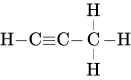
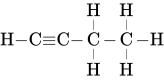
In organic chemistry, an alkyne is an unsaturated hydrocarbon containing at least one carbon—carbon triple bond. The simplest acyclic alkynes with only one triple bond and no other functional groups form a homologous series with the general chemical formula CnH2n−2. Alkynes are traditionally known as acetylenes, although the name acetylene also refers specifically to C2H2, known formally as ethyne using IUPAC nomenclature. Like other hydrocarbons, alkynes are generally hydrophobic.
In acetylene, the H–C≡C bond angles are 180°. By virtue of this bond angle, alkynes are rod-like. Correspondingly, cyclic alkynes are rare. Benzyne cannot be isolated. The C≡C bond distance of 118 picometers (for C2H2) is much shorter than the C=C distance in alkenes (132 pm, for C2H4) or the C–C bond in alkanes (153 pm).
The triple bond is very strong with a bond strength of 839 kJ/mol. The sigma bond contributes 369 kJ/mol, the first pi bond contributes 268 kJ/mol. The second pi bond 202 kJ/mol. Bonding is usually discussed in the context of molecular orbital theory, which recognizes triple bond arising from the overlap of s and p orbitals. In terms of valence bond theory, the carbon atoms in an alkyne bond are sp hybridized which means they each have two unhybridized p orbitals and two sp hybrid orbitals. Overlap of an sp orbital from each atom forms one sp–sp sigma bond. Each p orbital on one atom overlaps one on the other atom, forming two pi bonds, giving a total of three bonds. The remaining sp orbital on each atom can form a sigma bond to another atom. For example, to hydrogen atoms in the parent acetylene. The two sp orbitals project on opposite sides of the carbon atom.
Internal alkynes feature carbon substituents on each acetylenic carbon. Symmetrical examples include diphenylacetylene and 3-hexyne. They may also be asymmetrical, such as in 2-pentyne.
Terminal alkynes have the formula RC≡CH, where at least one end of the alkyne is a hydrogen atom. An example is methylacetylene (propyne using IUPAC nomenclature). They are often prepared by alkylation of monosodium acetylide. Terminal alkynes, like acetylene itself, are mildly acidic, with pKa values of around 25. They are far more acidic than alkenes and alkanes, which have pKa values of around 40 and 50, respectively. The acidic hydrogen on terminal alkynes can be replaced by a variety of groups resulting in halo-, silyl-, and alkoxoalkynes. The carbanions generated by deprotonation of terminal alkynes are called acetylides. Internal alkynes are also considerably more acidic than alkenes and alkanes, though not nearly as acidic as terminal alkynes. The C–H bonds at the α position of alkynes (propargylic C–H bonds) can also be deprotonated using strong bases, with an estimated pKa of 35. This acidity can be used to isomerize internal alkynes to terminal alkynes using the alkyne zipper reaction.
Hub AI
Alkyne AI simulator
(@Alkyne_simulator)
Alkyne
In organic chemistry, an alkyne is an unsaturated hydrocarbon containing at least one carbon—carbon triple bond. The simplest acyclic alkynes with only one triple bond and no other functional groups form a homologous series with the general chemical formula CnH2n−2. Alkynes are traditionally known as acetylenes, although the name acetylene also refers specifically to C2H2, known formally as ethyne using IUPAC nomenclature. Like other hydrocarbons, alkynes are generally hydrophobic.
In acetylene, the H–C≡C bond angles are 180°. By virtue of this bond angle, alkynes are rod-like. Correspondingly, cyclic alkynes are rare. Benzyne cannot be isolated. The C≡C bond distance of 118 picometers (for C2H2) is much shorter than the C=C distance in alkenes (132 pm, for C2H4) or the C–C bond in alkanes (153 pm).
The triple bond is very strong with a bond strength of 839 kJ/mol. The sigma bond contributes 369 kJ/mol, the first pi bond contributes 268 kJ/mol. The second pi bond 202 kJ/mol. Bonding is usually discussed in the context of molecular orbital theory, which recognizes triple bond arising from the overlap of s and p orbitals. In terms of valence bond theory, the carbon atoms in an alkyne bond are sp hybridized which means they each have two unhybridized p orbitals and two sp hybrid orbitals. Overlap of an sp orbital from each atom forms one sp–sp sigma bond. Each p orbital on one atom overlaps one on the other atom, forming two pi bonds, giving a total of three bonds. The remaining sp orbital on each atom can form a sigma bond to another atom. For example, to hydrogen atoms in the parent acetylene. The two sp orbitals project on opposite sides of the carbon atom.
Internal alkynes feature carbon substituents on each acetylenic carbon. Symmetrical examples include diphenylacetylene and 3-hexyne. They may also be asymmetrical, such as in 2-pentyne.
Terminal alkynes have the formula RC≡CH, where at least one end of the alkyne is a hydrogen atom. An example is methylacetylene (propyne using IUPAC nomenclature). They are often prepared by alkylation of monosodium acetylide. Terminal alkynes, like acetylene itself, are mildly acidic, with pKa values of around 25. They are far more acidic than alkenes and alkanes, which have pKa values of around 40 and 50, respectively. The acidic hydrogen on terminal alkynes can be replaced by a variety of groups resulting in halo-, silyl-, and alkoxoalkynes. The carbanions generated by deprotonation of terminal alkynes are called acetylides. Internal alkynes are also considerably more acidic than alkenes and alkanes, though not nearly as acidic as terminal alkynes. The C–H bonds at the α position of alkynes (propargylic C–H bonds) can also be deprotonated using strong bases, with an estimated pKa of 35. This acidity can be used to isomerize internal alkynes to terminal alkynes using the alkyne zipper reaction.