


Community hub
Recent from talks
Contribute something to knowledge base
Content stats: 0 posts, 0 articles, 1 media, 0 notes
Members stats: 0 subscribers, 0 contributors, 0 moderators, 0 supporters
Subscribers
Supporters
Contributors
Moderators
Hub AI
Altair 8800 AI simulator
(@Altair 8800_simulator)
Hub AI
Altair 8800 AI simulator
(@Altair 8800_simulator)
Altair 8800
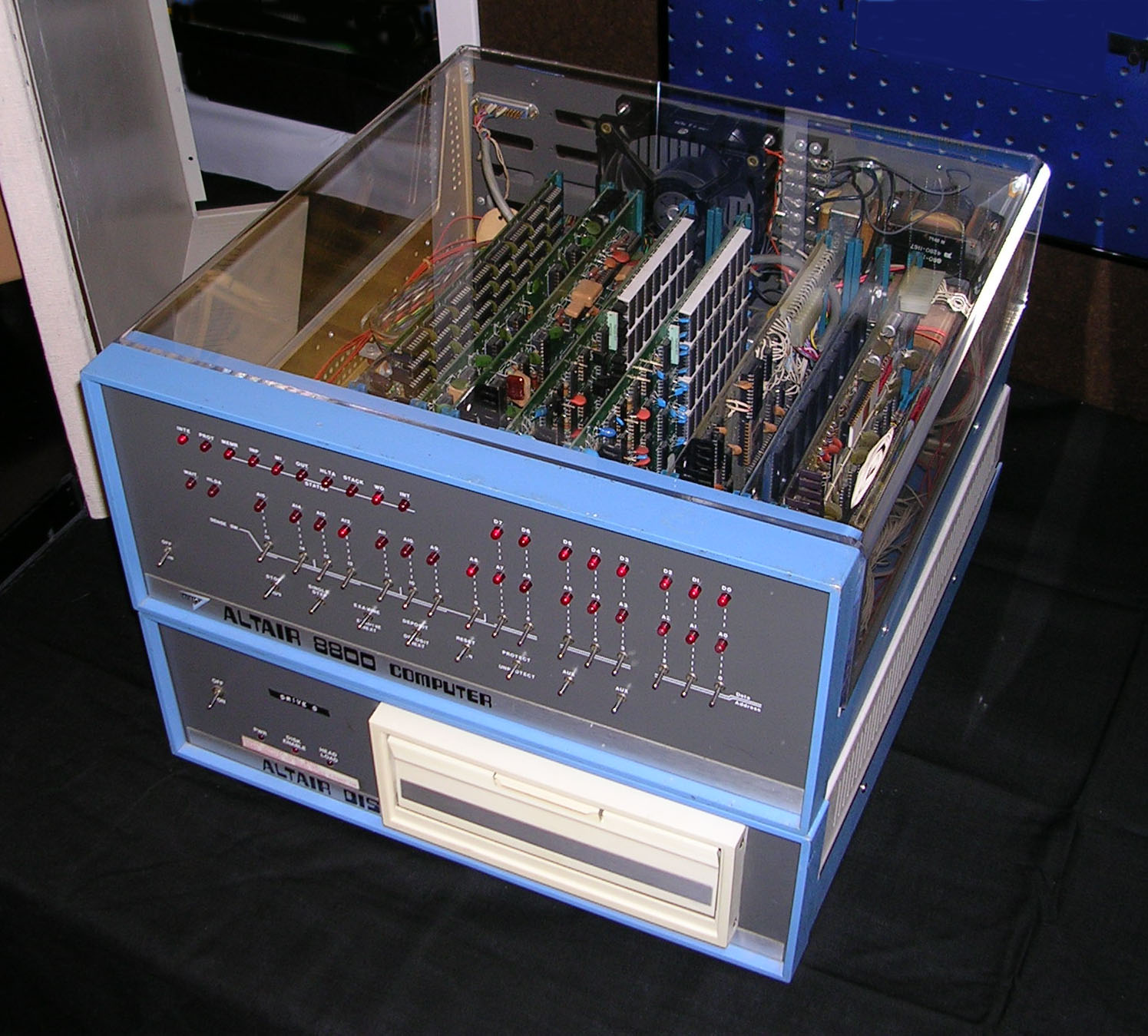
The Altair 8800 is a microcomputer introduced in 1974 by Micro Instrumentation and Telemetry Systems (MITS) based on the Intel 8080 CPU. It was the first commercially successful personal computer. Interest in the Altair 8800 grew quickly after it was featured on the cover of the January 1975 issue of Popular Electronics. It was sold by mail order through advertisements in Popular Electronics, Radio-Electronics, and in other hobbyist magazines. The Altair 8800 had no built-in screen or video output, so it would have to be connected to a serial terminal or teletype to have any output. To connect it to a terminal, a serial interface card had to be installed. Alternatively, the Altair could be programmed using its front-panel switches.
According to the personal computer pioneer Harry Garland, the Altair 8800 was the product that catalyzed the microcomputer revolution of the 1970s. The computer bus designed for the Altair became a de facto standard in the form of the S-100 bus, and the first programming language for the machine was Microsoft's founding product, Altair BASIC.
While serving at the Air Force Weapons Laboratory at Kirtland Air Force Base in Albuquerque, New Mexico, Ed Roberts and Forrest M. Mims III decided to use their electronics background to produce small kits for model rocket hobbyists. In 1969, Roberts and Mims, along with Stan Cagle and Robert Zaller, founded Micro Instrumentation and Telemetry Systems (MITS) in Roberts' garage in Albuquerque, New Mexico, and started selling radio transmitters and instruments for model rockets.
The model rocket kits were a modest success and MITS wanted to try a kit that would appeal to more hobbyists. The November 1970 issue of Popular Electronics featured the Opticom, a kit from MITS that would send voice over an LED light beam. As Mims and Cagle were losing interest in the kit business, Roberts bought his partners out and began developing a calculator kit. Electronic Arrays had just announced the EAS100, a set of six large scale integrated (LSI) circuit chips that would make a four-function calculator. The MITS 816 calculator kit used the chipset and was featured on the November 1971 cover of Popular Electronics. This calculator kit sold for $175, or $275 assembled. Forrest Mims wrote the assembly manual for this kit and many others over the next several years. As payment for each manual he often accepted a copy of the kit.
The calculator was successful and was followed by several improved models. The MITS 1440 calculator was featured in the July 1973 issues of Radio-Electronics. It had a 14-digit display, memory, and square root function. The kit sold for $200 and the assembled version was $250. MITS later developed a programmer unit that would connect to the 816 or 1440 calculator and allow programs of up to 256 steps.
In 1972, Texas Instruments developed its own calculator chip and started selling complete calculators at less than half the price of other commercial models. MITS and many other companies were devastated by this, and Roberts struggled to reduce his quarter-million-dollar debt.
In addition to calculators, MITS made a line of test equipment kits. These included an IC tester, a waveform generator, a digital voltmeter, and several other instruments. To keep up with the demand, MITS moved into a larger building at 6328 Linn NE in Albuquerque in 1973. They installed a wave soldering machine and an assembly line at the new location.
In January 1972, Popular Electronics merged with another Ziff-Davis magazine, Electronics World. The change in editorial staff upset many of their authors, and they started writing for a competing magazine, Radio-Electronics. In 1972 and 1973, some of the best construction projects appeared in Radio-Electronics.
Altair 8800
The Altair 8800 is a microcomputer introduced in 1974 by Micro Instrumentation and Telemetry Systems (MITS) based on the Intel 8080 CPU. It was the first commercially successful personal computer. Interest in the Altair 8800 grew quickly after it was featured on the cover of the January 1975 issue of Popular Electronics. It was sold by mail order through advertisements in Popular Electronics, Radio-Electronics, and in other hobbyist magazines. The Altair 8800 had no built-in screen or video output, so it would have to be connected to a serial terminal or teletype to have any output. To connect it to a terminal, a serial interface card had to be installed. Alternatively, the Altair could be programmed using its front-panel switches.
According to the personal computer pioneer Harry Garland, the Altair 8800 was the product that catalyzed the microcomputer revolution of the 1970s. The computer bus designed for the Altair became a de facto standard in the form of the S-100 bus, and the first programming language for the machine was Microsoft's founding product, Altair BASIC.
While serving at the Air Force Weapons Laboratory at Kirtland Air Force Base in Albuquerque, New Mexico, Ed Roberts and Forrest M. Mims III decided to use their electronics background to produce small kits for model rocket hobbyists. In 1969, Roberts and Mims, along with Stan Cagle and Robert Zaller, founded Micro Instrumentation and Telemetry Systems (MITS) in Roberts' garage in Albuquerque, New Mexico, and started selling radio transmitters and instruments for model rockets.
The model rocket kits were a modest success and MITS wanted to try a kit that would appeal to more hobbyists. The November 1970 issue of Popular Electronics featured the Opticom, a kit from MITS that would send voice over an LED light beam. As Mims and Cagle were losing interest in the kit business, Roberts bought his partners out and began developing a calculator kit. Electronic Arrays had just announced the EAS100, a set of six large scale integrated (LSI) circuit chips that would make a four-function calculator. The MITS 816 calculator kit used the chipset and was featured on the November 1971 cover of Popular Electronics. This calculator kit sold for $175, or $275 assembled. Forrest Mims wrote the assembly manual for this kit and many others over the next several years. As payment for each manual he often accepted a copy of the kit.
The calculator was successful and was followed by several improved models. The MITS 1440 calculator was featured in the July 1973 issues of Radio-Electronics. It had a 14-digit display, memory, and square root function. The kit sold for $200 and the assembled version was $250. MITS later developed a programmer unit that would connect to the 816 or 1440 calculator and allow programs of up to 256 steps.
In 1972, Texas Instruments developed its own calculator chip and started selling complete calculators at less than half the price of other commercial models. MITS and many other companies were devastated by this, and Roberts struggled to reduce his quarter-million-dollar debt.
In addition to calculators, MITS made a line of test equipment kits. These included an IC tester, a waveform generator, a digital voltmeter, and several other instruments. To keep up with the demand, MITS moved into a larger building at 6328 Linn NE in Albuquerque in 1973. They installed a wave soldering machine and an assembly line at the new location.
In January 1972, Popular Electronics merged with another Ziff-Davis magazine, Electronics World. The change in editorial staff upset many of their authors, and they started writing for a competing magazine, Radio-Electronics. In 1972 and 1973, some of the best construction projects appeared in Radio-Electronics.
Recent media
Recent media