
Recent from talks
Altmark incident
Knowledge base stats:
Talk channels stats:
Members stats:
Altmark incident
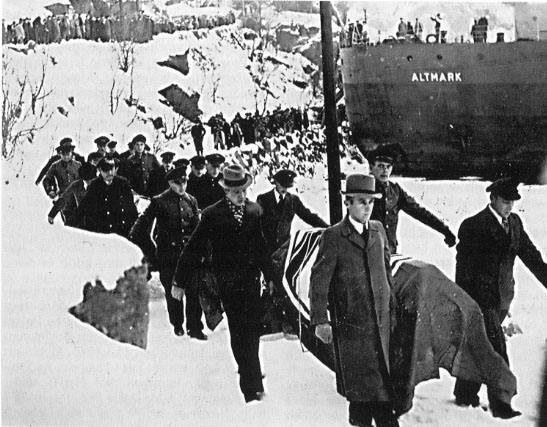
The Altmark incident (Norwegian: Altmark-affæren; German: Altmark-Zwischenfall) was a naval incident of World War II between British destroyers and the German tanker Altmark, which happened on 16–17 February 1940. It took place in what were neutral Norwegian waters. On board the Altmark were roughly 300 Allied prisoners (officially internees), whose ships had been sunk by the pocket battleship Graf Spee in the Southern Atlantic Ocean.
British naval forces cornered the tanker, and later the destroyer HMS Cossack boarded the Altmark near the Jøssingfjord and liberated all the prisoners. Eight German sailors were killed and ten wounded during hand-to-hand fighting, which took place during the boarding. A British sailor was also wounded during the fighting. The internees were rescued and taken by Cossack to Britain. The German government claimed that the boarding had been a violation of international law and of Norwegian neutrality and later used the incident in the propaganda broadcasts of "Lord Haw-Haw".
In February 1940, the German tanker Altmark was returning to Germany with 299 captured British sailors on board. These were prisoners of war who had been picked up from ships sunk by the pocket battleship Admiral Graf Spee.
On its way from the southern Atlantic to Germany, the Altmark passed through Norwegian waters. International law did not ban the transfer of prisoners of war through neutral waters. On the insistence of British contacts who had been pursuing the vessel, it was investigated three times on 15 February by the Royal Norwegian Navy. First, the tanker was boarded by officers from the torpedo boat HNoMS Trygg, off Linesøya, then by officers from the torpedo boat HNoMS Snøgg in the Sognefjord, and finally personally by Admiral Carsten Tank-Nielsen and naval personnel from the destroyer HNoMS Garm in the Hjeltefjord. In each instance, the men who boarded the ship carried out cursory searches and took the Germans' word that the vessel was conducting purely commercial business. The British prisoners held in the ship's hold reportedly made strenuous efforts to signal their presence, but the Norwegian search parties did not inspect the hold, and allowed the ship to continue on its way.[citation needed]
Following the third boarding, Altmark was escorted southwards by the torpedo boats HNoMS Skarv and HNoMS Kjell and the guard boat HNoMS Firern.
Altmark was then spotted off Egersund later that same day by British aircraft, which raised the alarm in the Royal Navy. The aircraft were stationed at RAF Thornaby, in the North East of England. After being intercepted by the destroyer HMS Cossack, captained by Philip Vian, Altmark sought refuge in the Jøssingfjord, but Cossack followed her in the next day. The Altmark's Norwegian naval escorts blocked initial attempts to board the ship, and aimed their torpedo tubes at the Cossack. Captain Vian then asked the British Admiralty for instructions, and received the following orders directly from the First Lord of the Admiralty, Winston Churchill:
Unless Norwegian torpedo-boat undertakes to convoy Altmark to Bergen with a joint Anglo-Norwegian guard on board, and a joint escort, you should board Altmark, liberate the prisoners, and take possession of the ship pending further instructions. If Norwegian torpedo-boat interferes, you should warn her to stand off. If she fires upon you, you should not reply unless attack is serious, in which case you should defend yourself, using no more force than is necessary, and ceasing fire when she desists. Suggest to Norwegian destroyer that honour is served by submitting to superior force.
The British government made no particular objection to the fact of a prison ship traversing neutral waters. In fact, in official papers regarding the incident, they noted the fact that the Royal Navy had done the same, for example in December 1939, when the cruiser HMS Despatch passed through the Panama Canal, which was neutral waters, with German prisoners aboard from the freighter Düsseldorf. But the crew of the Altmark had gone hundreds of miles out of their way to make the long run through Norwegian waters to Germany. Besides, the Norwegian government had not permitted the Germans to transport prisoners through Norwegian waters (the Altmark having falsely claimed to be carrying none), and the HMS Despatch crew had been truthful regarding the nature of their cargo and voyage.
Hub AI
Altmark incident AI simulator
(@Altmark incident_simulator)
Altmark incident
The Altmark incident (Norwegian: Altmark-affæren; German: Altmark-Zwischenfall) was a naval incident of World War II between British destroyers and the German tanker Altmark, which happened on 16–17 February 1940. It took place in what were neutral Norwegian waters. On board the Altmark were roughly 300 Allied prisoners (officially internees), whose ships had been sunk by the pocket battleship Graf Spee in the Southern Atlantic Ocean.
British naval forces cornered the tanker, and later the destroyer HMS Cossack boarded the Altmark near the Jøssingfjord and liberated all the prisoners. Eight German sailors were killed and ten wounded during hand-to-hand fighting, which took place during the boarding. A British sailor was also wounded during the fighting. The internees were rescued and taken by Cossack to Britain. The German government claimed that the boarding had been a violation of international law and of Norwegian neutrality and later used the incident in the propaganda broadcasts of "Lord Haw-Haw".
In February 1940, the German tanker Altmark was returning to Germany with 299 captured British sailors on board. These were prisoners of war who had been picked up from ships sunk by the pocket battleship Admiral Graf Spee.
On its way from the southern Atlantic to Germany, the Altmark passed through Norwegian waters. International law did not ban the transfer of prisoners of war through neutral waters. On the insistence of British contacts who had been pursuing the vessel, it was investigated three times on 15 February by the Royal Norwegian Navy. First, the tanker was boarded by officers from the torpedo boat HNoMS Trygg, off Linesøya, then by officers from the torpedo boat HNoMS Snøgg in the Sognefjord, and finally personally by Admiral Carsten Tank-Nielsen and naval personnel from the destroyer HNoMS Garm in the Hjeltefjord. In each instance, the men who boarded the ship carried out cursory searches and took the Germans' word that the vessel was conducting purely commercial business. The British prisoners held in the ship's hold reportedly made strenuous efforts to signal their presence, but the Norwegian search parties did not inspect the hold, and allowed the ship to continue on its way.[citation needed]
Following the third boarding, Altmark was escorted southwards by the torpedo boats HNoMS Skarv and HNoMS Kjell and the guard boat HNoMS Firern.
Altmark was then spotted off Egersund later that same day by British aircraft, which raised the alarm in the Royal Navy. The aircraft were stationed at RAF Thornaby, in the North East of England. After being intercepted by the destroyer HMS Cossack, captained by Philip Vian, Altmark sought refuge in the Jøssingfjord, but Cossack followed her in the next day. The Altmark's Norwegian naval escorts blocked initial attempts to board the ship, and aimed their torpedo tubes at the Cossack. Captain Vian then asked the British Admiralty for instructions, and received the following orders directly from the First Lord of the Admiralty, Winston Churchill:
Unless Norwegian torpedo-boat undertakes to convoy Altmark to Bergen with a joint Anglo-Norwegian guard on board, and a joint escort, you should board Altmark, liberate the prisoners, and take possession of the ship pending further instructions. If Norwegian torpedo-boat interferes, you should warn her to stand off. If she fires upon you, you should not reply unless attack is serious, in which case you should defend yourself, using no more force than is necessary, and ceasing fire when she desists. Suggest to Norwegian destroyer that honour is served by submitting to superior force.
The British government made no particular objection to the fact of a prison ship traversing neutral waters. In fact, in official papers regarding the incident, they noted the fact that the Royal Navy had done the same, for example in December 1939, when the cruiser HMS Despatch passed through the Panama Canal, which was neutral waters, with German prisoners aboard from the freighter Düsseldorf. But the crew of the Altmark had gone hundreds of miles out of their way to make the long run through Norwegian waters to Germany. Besides, the Norwegian government had not permitted the Germans to transport prisoners through Norwegian waters (the Altmark having falsely claimed to be carrying none), and the HMS Despatch crew had been truthful regarding the nature of their cargo and voyage.
Recent media