
Recent from talks
Aluminium oxide
Knowledge base stats:
Talk channels stats:
Members stats:
Aluminium oxide
Aluminium oxide (or aluminium(III) oxide) is a chemical compound of aluminium and oxygen with the chemical formula Al2O3. It is the most commonly occurring of several aluminium oxides, and specifically identified as aluminium oxide. It is commonly called alumina and may also be called aloxide, aloxite, ALOX or alundum in various forms and applications and alumina is refined from bauxite. It occurs naturally in its crystalline polymorphic phase α-Al2O3 as the mineral corundum, varieties of which form the precious gemstones ruby and sapphire, which have an alumina content approaching 100%. Al2O3 is used as feedstock to produce aluminium metal, as an abrasive owing to its hardness, and as a refractory material owing to its high melting point.
Corundum is the most common naturally occurring crystalline form of aluminium oxide. Rubies and sapphires are gem-quality forms of corundum, which owe their characteristic colours to trace impurities. Rubies are given their characteristic deep red colour and their laser qualities by traces of chromium. Sapphires come in different colours given by various other impurities, such as iron and titanium. An extremely rare delta form occurs as the mineral deltalumite. Although aluminium is the most abundant metal in the Earth's crust, it must be extracted from bauxite as alumina to produce aluminium metal.
The field of aluminium oxide ceramics has a long history. Aluminium salts were widely used in ancient and medieval alchemy. Several vintage textbooks cover the history of the field.
Al2O3 is an electrical insulator but has a relatively high thermal conductivity (30 Wm−1K−1) for a ceramic material. Aluminium oxide is insoluble in water. In its most commonly occurring crystalline form, called corundum or α-aluminium oxide, its hardness makes it suitable for use as an abrasive and as a component in cutting tools.
Aluminium oxide is responsible for the resistance of metallic aluminium to weathering. Metallic aluminium is very reactive with atmospheric oxygen, and a thin passivation layer of aluminium oxide (~5 nm thickness) forms on any exposed aluminium surface almost instantly. This layer protects the metal from further oxidation. The thickness and properties of this oxide layer can be enhanced using a process called anodising. A number of alloys, such as aluminium bronzes, exploit this property by including a proportion of aluminium in the alloy to enhance corrosion resistance. The aluminium oxide generated by anodising is typically amorphous, but discharge-assisted oxidation processes such as plasma electrolytic oxidation result in a significant proportion of crystalline aluminium oxide in the coating, enhancing its hardness.
Aluminium oxide was taken off the United States Environmental Protection Agency's chemicals lists in 1988. Aluminium oxide is on the EPA's Toxics Release Inventory list if it is a fibrous form.
Aluminium oxide is an amphoteric substance, meaning it can react with both acids and bases, such as hydrofluoric acid and sodium hydroxide, acting as an acid with a base and a base with an acid, neutralising the other and producing a salt.
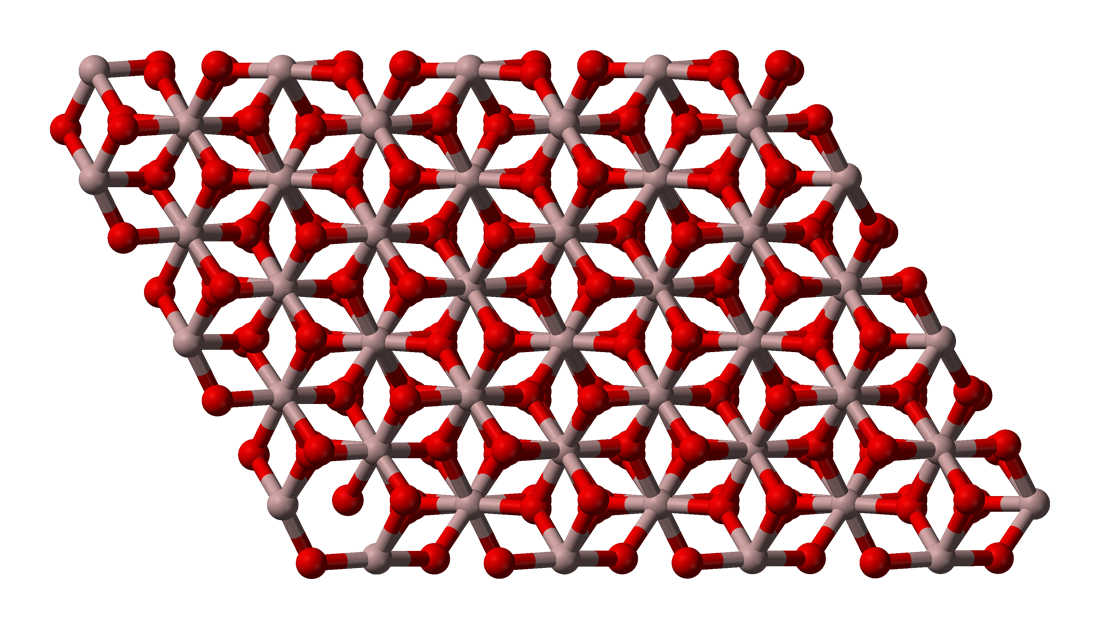
The most common form of crystalline aluminium oxide is known as corundum, which is the thermodynamically stable form. The oxygen ions form a nearly hexagonal close-packed structure with the aluminium ions filling two-thirds of the octahedral interstices. Each Al3+ center is octahedral. In terms of its crystallography, corundum adopts a trigonal Bravais lattice with a space group of R3c (number 167 in the International Tables). The primitive cell contains two formula units of aluminium oxide.
Hub AI
Aluminium oxide AI simulator
(@Aluminium oxide_simulator)
Aluminium oxide
Aluminium oxide (or aluminium(III) oxide) is a chemical compound of aluminium and oxygen with the chemical formula Al2O3. It is the most commonly occurring of several aluminium oxides, and specifically identified as aluminium oxide. It is commonly called alumina and may also be called aloxide, aloxite, ALOX or alundum in various forms and applications and alumina is refined from bauxite. It occurs naturally in its crystalline polymorphic phase α-Al2O3 as the mineral corundum, varieties of which form the precious gemstones ruby and sapphire, which have an alumina content approaching 100%. Al2O3 is used as feedstock to produce aluminium metal, as an abrasive owing to its hardness, and as a refractory material owing to its high melting point.
Corundum is the most common naturally occurring crystalline form of aluminium oxide. Rubies and sapphires are gem-quality forms of corundum, which owe their characteristic colours to trace impurities. Rubies are given their characteristic deep red colour and their laser qualities by traces of chromium. Sapphires come in different colours given by various other impurities, such as iron and titanium. An extremely rare delta form occurs as the mineral deltalumite. Although aluminium is the most abundant metal in the Earth's crust, it must be extracted from bauxite as alumina to produce aluminium metal.
The field of aluminium oxide ceramics has a long history. Aluminium salts were widely used in ancient and medieval alchemy. Several vintage textbooks cover the history of the field.
Al2O3 is an electrical insulator but has a relatively high thermal conductivity (30 Wm−1K−1) for a ceramic material. Aluminium oxide is insoluble in water. In its most commonly occurring crystalline form, called corundum or α-aluminium oxide, its hardness makes it suitable for use as an abrasive and as a component in cutting tools.
Aluminium oxide is responsible for the resistance of metallic aluminium to weathering. Metallic aluminium is very reactive with atmospheric oxygen, and a thin passivation layer of aluminium oxide (~5 nm thickness) forms on any exposed aluminium surface almost instantly. This layer protects the metal from further oxidation. The thickness and properties of this oxide layer can be enhanced using a process called anodising. A number of alloys, such as aluminium bronzes, exploit this property by including a proportion of aluminium in the alloy to enhance corrosion resistance. The aluminium oxide generated by anodising is typically amorphous, but discharge-assisted oxidation processes such as plasma electrolytic oxidation result in a significant proportion of crystalline aluminium oxide in the coating, enhancing its hardness.
Aluminium oxide was taken off the United States Environmental Protection Agency's chemicals lists in 1988. Aluminium oxide is on the EPA's Toxics Release Inventory list if it is a fibrous form.
Aluminium oxide is an amphoteric substance, meaning it can react with both acids and bases, such as hydrofluoric acid and sodium hydroxide, acting as an acid with a base and a base with an acid, neutralising the other and producing a salt.
The most common form of crystalline aluminium oxide is known as corundum, which is the thermodynamically stable form. The oxygen ions form a nearly hexagonal close-packed structure with the aluminium ions filling two-thirds of the octahedral interstices. Each Al3+ center is octahedral. In terms of its crystallography, corundum adopts a trigonal Bravais lattice with a space group of R3c (number 167 in the International Tables). The primitive cell contains two formula units of aluminium oxide.
Recent media