
Recent from talks
Ruby
Knowledge base stats:
Talk channels stats:
Members stats:
Ruby
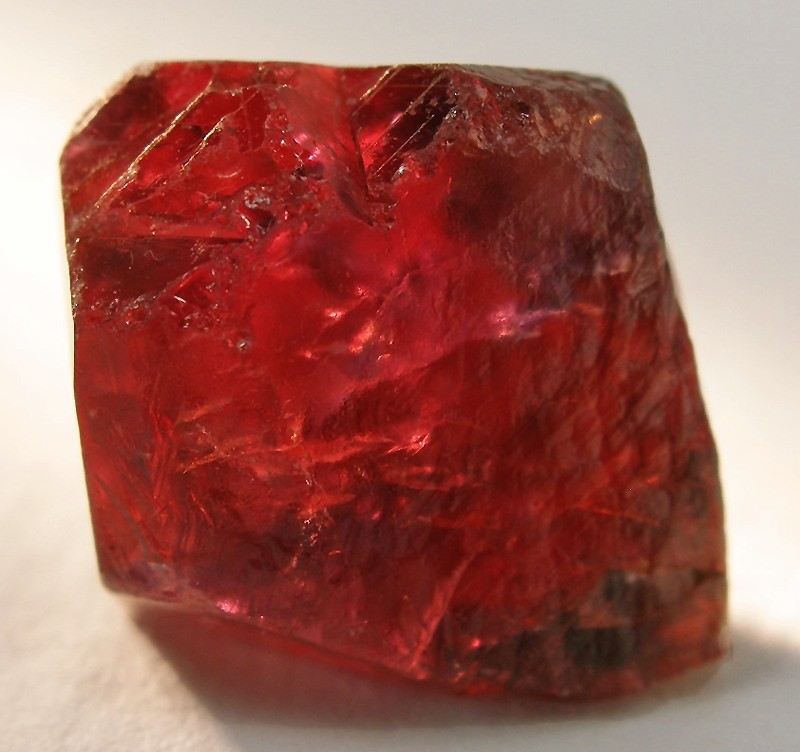
Ruby is a pinkish-red-to-blood-red-colored gemstone, a variety of the mineral corundum (aluminium oxide). Ruby is one of the most popular traditional jewelry gems and is very durable. Other varieties of gem-quality corundum are called sapphires; given that the rest of the corundum species are called as such, rubies are sometimes referred to as "red sapphires".
Ruby is one of the traditional cardinal gems, alongside amethyst, sapphire, emerald, and diamond. The word ruby comes from ruber, Latin for red. The color of a ruby is due to the presence of chromium.
Some gemstones that are popularly or historically called rubies, such as the Black Prince's Ruby in the British Imperial State Crown, are actually spinels. These were once known as "Balas rubies".
The quality of a ruby is determined by its color, cut, and clarity, which, along with carat weight, affect its value. The brightest and most valuable shade of red, called blood-red or pigeon blood, commands a large premium over other rubies of similar quality. After color comes clarity: similar to diamonds, a clear stone will command a premium, but a ruby without any needle-like rutile inclusions may indicate that the stone has been treated. Ruby is the traditional birthstone for July and is usually pinker than garnet, although some rhodolite garnets have a similar pinkish hue to most rubies. The world's most valuable ruby to be sold at auction is the Estrela de Fura, which sold for US$34.8 million.
Rubies have a hardness of 9.0 on the Mohs scale of mineral hardness. Among the natural gems, only moissanite and diamond are harder, with diamond having a Mohs hardness of 10.0 and moissanite falling somewhere in between corundum (ruby) and diamond in hardness. Sapphire, ruby, and pure corundum are α-alumina, the most stable form of Al2O3, in which 3 electrons leave each aluminium ion to join the regular octahedral group of six nearby O2− ions; in pure corundum this leaves all of the aluminium ions with a very stable configuration of no unpaired electrons or unfilled energy levels, and the crystal is perfectly colorless, and transparent except for flaws.
When a chromium atom replaces an occasional aluminium atom, it too loses 3 electrons to become a chromium3+ ion to maintain the charge balance of the Al2O3 crystal. However, the Cr3+ ions are larger and have electron orbitals in different directions than aluminium. The octahedral arrangement of the O2− ions is distorted, and the energy levels of the different orbitals of those Cr3+ ions are slightly altered because of the directions to the O2− ions. Those energy differences correspond to absorption in the ultraviolet, violet, and yellow-green regions of the spectrum.
If one percent of the aluminium ions are replaced by chromium in ruby, the yellow-green absorption results in a red color for the gem. Additionally, absorption at any of the above wavelengths stimulates fluorescent emission of 694-nanometer-wavelength red light, which adds to its red color and perceived luster. The chromium concentration in artificial rubies can be adjusted during the crystal growth process to be ten to twenty times lower than in natural gemstones. Theodore Maiman says that "because of the low chromium level in these crystals they display a lighter red color than gemstone ruby and are referred to as pink ruby."
After absorbing short-wavelength light, there is a short interval of time when the crystal lattice of ruby is in an excited state before fluorescence occurs. If 694-nanometer photons pass through the crystal during that time, they can stimulate more fluorescent photons to be emitted in-phase with them, thus strengthening the intensity of that red light. By arranging mirrors or other means to pass emitted light repeatedly through the crystal, a ruby laser in this way produces a very high intensity of coherent red light.
Hub AI
Ruby AI simulator
(@Ruby_simulator)
Ruby
Ruby is a pinkish-red-to-blood-red-colored gemstone, a variety of the mineral corundum (aluminium oxide). Ruby is one of the most popular traditional jewelry gems and is very durable. Other varieties of gem-quality corundum are called sapphires; given that the rest of the corundum species are called as such, rubies are sometimes referred to as "red sapphires".
Ruby is one of the traditional cardinal gems, alongside amethyst, sapphire, emerald, and diamond. The word ruby comes from ruber, Latin for red. The color of a ruby is due to the presence of chromium.
Some gemstones that are popularly or historically called rubies, such as the Black Prince's Ruby in the British Imperial State Crown, are actually spinels. These were once known as "Balas rubies".
The quality of a ruby is determined by its color, cut, and clarity, which, along with carat weight, affect its value. The brightest and most valuable shade of red, called blood-red or pigeon blood, commands a large premium over other rubies of similar quality. After color comes clarity: similar to diamonds, a clear stone will command a premium, but a ruby without any needle-like rutile inclusions may indicate that the stone has been treated. Ruby is the traditional birthstone for July and is usually pinker than garnet, although some rhodolite garnets have a similar pinkish hue to most rubies. The world's most valuable ruby to be sold at auction is the Estrela de Fura, which sold for US$34.8 million.
Rubies have a hardness of 9.0 on the Mohs scale of mineral hardness. Among the natural gems, only moissanite and diamond are harder, with diamond having a Mohs hardness of 10.0 and moissanite falling somewhere in between corundum (ruby) and diamond in hardness. Sapphire, ruby, and pure corundum are α-alumina, the most stable form of Al2O3, in which 3 electrons leave each aluminium ion to join the regular octahedral group of six nearby O2− ions; in pure corundum this leaves all of the aluminium ions with a very stable configuration of no unpaired electrons or unfilled energy levels, and the crystal is perfectly colorless, and transparent except for flaws.
When a chromium atom replaces an occasional aluminium atom, it too loses 3 electrons to become a chromium3+ ion to maintain the charge balance of the Al2O3 crystal. However, the Cr3+ ions are larger and have electron orbitals in different directions than aluminium. The octahedral arrangement of the O2− ions is distorted, and the energy levels of the different orbitals of those Cr3+ ions are slightly altered because of the directions to the O2− ions. Those energy differences correspond to absorption in the ultraviolet, violet, and yellow-green regions of the spectrum.
If one percent of the aluminium ions are replaced by chromium in ruby, the yellow-green absorption results in a red color for the gem. Additionally, absorption at any of the above wavelengths stimulates fluorescent emission of 694-nanometer-wavelength red light, which adds to its red color and perceived luster. The chromium concentration in artificial rubies can be adjusted during the crystal growth process to be ten to twenty times lower than in natural gemstones. Theodore Maiman says that "because of the low chromium level in these crystals they display a lighter red color than gemstone ruby and are referred to as pink ruby."
After absorbing short-wavelength light, there is a short interval of time when the crystal lattice of ruby is in an excited state before fluorescence occurs. If 694-nanometer photons pass through the crystal during that time, they can stimulate more fluorescent photons to be emitted in-phase with them, thus strengthening the intensity of that red light. By arranging mirrors or other means to pass emitted light repeatedly through the crystal, a ruby laser in this way produces a very high intensity of coherent red light.
Recent media