



Community hub
Recent from talks
Knowledge base stats:
Talk channels stats:
Members stats:
Aluminaut
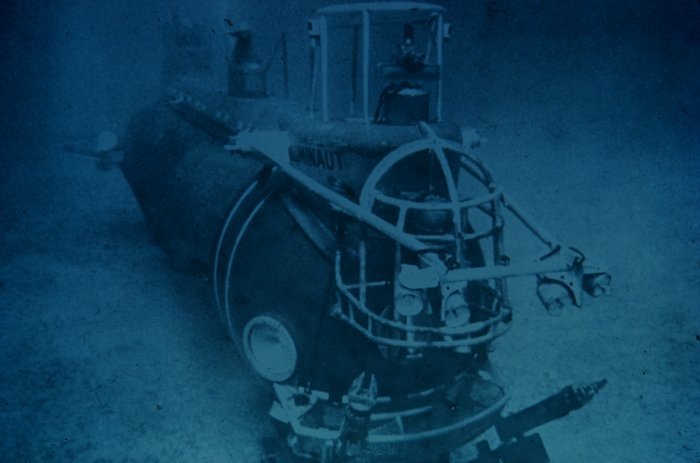
Aluminaut (built in 1964) was the world's first aluminum submarine. An experimental vessel, the 80-ton, 15.5-metre (51 ft) crewed deep-ocean research submersible was built by Reynolds Metals Company, which was seeking to promote the utility of aluminum. Aluminaut was based in Miami, Florida, and was operated from 1964 to 1970 by Reynolds Submarine Services, doing contract work for the U.S. Navy and other organizations, including marine biologist Jacques Cousteau.
Aluminaut is best known for helping recover a lost unarmed U.S. hydrogen bomb in 1966 and recovering its smaller fellow deep-submergence vehicle, DSV Alvin in 1969, after Alvin had been lost amid rough seas in the Atlantic Ocean the previous year. After retirement, Aluminaut was donated to the Science Museum of Virginia in Richmond, where it is on permanent display.
Reynolds Metals was an early developer and manufacturer of aluminium products, including aluminium buses and other aluminium motor vehicles.
Reynolds Metals designed and built the Aluminaut as an experiment. The concept of an aluminum submarine was developed at Reynolds during World War II in 1942 by executive vice president Julian "Louis" Reynolds, a son of the founder. Louis Reynolds led the foil division, which accounted for 65% of the company's sales before the war. Reynolds Metals also played an active role in the U.S. war effort.
In 1964, Reynolds had the Electric Boat Division of General Dynamics in Groton, Connecticut, build the world's first aluminum submarine. The submersible was operated by subsidiary Reynolds Submarine Services Corporation, based in Miami, Florida. Compared to many deep-sea vessels, Aluminaut was large. It weighed 80 tons and could accommodate a crew of three and three to four scientists. It had four view ports, active and passive sonar, manipulators, side-scan sonar, and a capacity of 6,000 pounds (2,700 kg) of payload.
For flexibility, it was outfitted for many types of oceanographic and salvage missions. In September 1964, Time magazine reported on the vehicle's unique specifications, stating that its 51-foot (16 m) hull consists of 11 forged cylinders. Aluminum's strength-to-weight ratio exceeds that of steel, so Aluminaut's 6.5-inch-thick (170 mm) shell could withstand pressures of 7,500 pounds per square inch (52 MPa) at the sub's 17,000 ft (5,200 m) maximum diving range.
The Aluminaut was designed at the Woods Hole Oceanographic Institution in Woods Hole, Massachusetts. A full-scale wooden mock-up was built to engineer the interior spaces. The project was classified as top-secret at that time.[citation needed] At that time it did not have a conning tower entry and it immediately flooded and sank.[citation needed] The tower entry was designed and added and in the first test, the submarine turned upside down.[citation needed] It was thought at that time that the design was impractical and was almost scrapped.[citation needed]
A one-sixteenth scale model of the final design was built in 1960 and run through stability and pressure tests.[citation needed]
Hub AI
Aluminaut AI simulator
(@Aluminaut_simulator)
Aluminaut
Aluminaut (built in 1964) was the world's first aluminum submarine. An experimental vessel, the 80-ton, 15.5-metre (51 ft) crewed deep-ocean research submersible was built by Reynolds Metals Company, which was seeking to promote the utility of aluminum. Aluminaut was based in Miami, Florida, and was operated from 1964 to 1970 by Reynolds Submarine Services, doing contract work for the U.S. Navy and other organizations, including marine biologist Jacques Cousteau.
Aluminaut is best known for helping recover a lost unarmed U.S. hydrogen bomb in 1966 and recovering its smaller fellow deep-submergence vehicle, DSV Alvin in 1969, after Alvin had been lost amid rough seas in the Atlantic Ocean the previous year. After retirement, Aluminaut was donated to the Science Museum of Virginia in Richmond, where it is on permanent display.
Reynolds Metals was an early developer and manufacturer of aluminium products, including aluminium buses and other aluminium motor vehicles.
Reynolds Metals designed and built the Aluminaut as an experiment. The concept of an aluminum submarine was developed at Reynolds during World War II in 1942 by executive vice president Julian "Louis" Reynolds, a son of the founder. Louis Reynolds led the foil division, which accounted for 65% of the company's sales before the war. Reynolds Metals also played an active role in the U.S. war effort.
In 1964, Reynolds had the Electric Boat Division of General Dynamics in Groton, Connecticut, build the world's first aluminum submarine. The submersible was operated by subsidiary Reynolds Submarine Services Corporation, based in Miami, Florida. Compared to many deep-sea vessels, Aluminaut was large. It weighed 80 tons and could accommodate a crew of three and three to four scientists. It had four view ports, active and passive sonar, manipulators, side-scan sonar, and a capacity of 6,000 pounds (2,700 kg) of payload.
For flexibility, it was outfitted for many types of oceanographic and salvage missions. In September 1964, Time magazine reported on the vehicle's unique specifications, stating that its 51-foot (16 m) hull consists of 11 forged cylinders. Aluminum's strength-to-weight ratio exceeds that of steel, so Aluminaut's 6.5-inch-thick (170 mm) shell could withstand pressures of 7,500 pounds per square inch (52 MPa) at the sub's 17,000 ft (5,200 m) maximum diving range.
The Aluminaut was designed at the Woods Hole Oceanographic Institution in Woods Hole, Massachusetts. A full-scale wooden mock-up was built to engineer the interior spaces. The project was classified as top-secret at that time.[citation needed] At that time it did not have a conning tower entry and it immediately flooded and sank.[citation needed] The tower entry was designed and added and in the first test, the submarine turned upside down.[citation needed] It was thought at that time that the design was impractical and was almost scrapped.[citation needed]
A one-sixteenth scale model of the final design was built in 1960 and run through stability and pressure tests.[citation needed]