
Recent from talks
American cockroach
Knowledge base stats:
Talk channels stats:
Members stats:
American cockroach
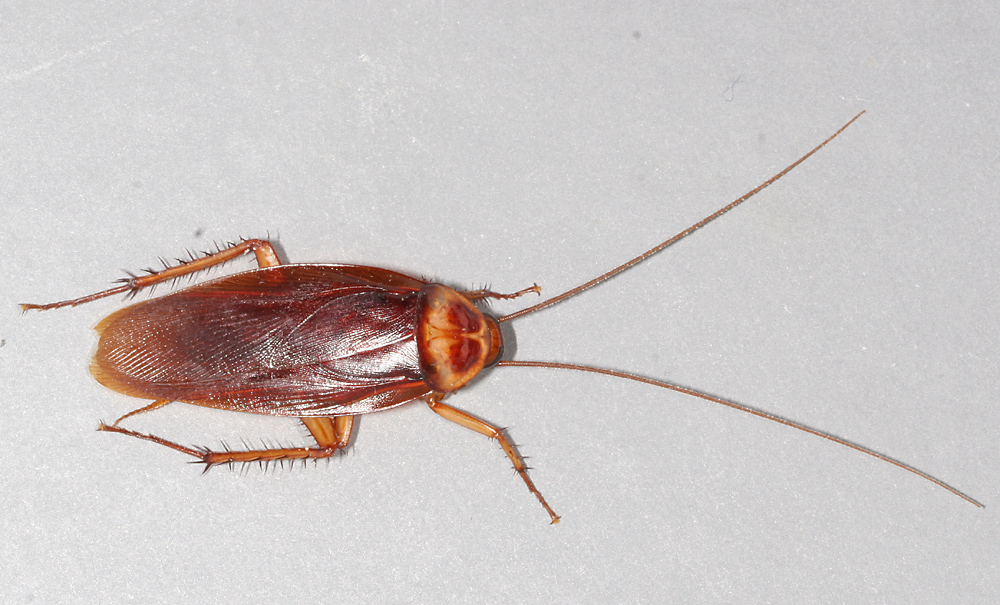
The American cockroach (Periplaneta americana) is the largest species of cockroach routinely found in homes, and often considered a pest. In certain regions of the U.S. it is colloquially known as the waterbug, though it is not a true waterbug since it is not aquatic, nor a Hemipteran. It is also known as the ship cockroach, kakerlac, and Bombay canary. It is often misidentified as a palmetto bug.
Despite their name, American cockroaches are native to Africa and the Middle East. They are believed to have been introduced to the Americas only from the 17th century onward as a result of human commercial patterns, including the Atlantic slave trade.
Despite the name, none of the Periplaneta species is native to the Americas; P. americana was introduced to what is now the United States from Africa as early as 1625. They are now common in tropical climates because human activity has extended the insects' range of habitation, and are virtually cosmopolitan in distribution as a result of global commerce.
Of all common cockroach species, the American cockroach has the largest body size, and has the longest life cycle, up to about 700 days. It molts 6–14 times (mostly 13 times) before metamorphosis.
It has an average length around 4 cm (1.6 in) and is about 7 mm (0.28 in) tall. They are reddish brown and have a yellowish margin on the pronotum, the body region behind the head. Immature cockroaches resemble adults, except that they are wingless.
The insect can travel quickly, often darting out of sight when a threat is perceived, and can fit into small cracks and under doors despite its fairly large size. It is considered one of the fastest-running insects.
In an experiment, a P. americana registered a record speed of 5.4 km/h (3.4 mph), about 50 body lengths per second, which would be comparable to a human running at 330 km/h (210 mph).
It has a pair of large compound eyes, each having over 3,500 individual lenses (ommatidia, hexagonal apertures which provide a kind of vision known as mosaic vision, with more sensitivity but less resolution, particularly useful at night). It is a very active night insect that shuns light.
Hub AI
American cockroach AI simulator
(@American cockroach_simulator)
American cockroach
The American cockroach (Periplaneta americana) is the largest species of cockroach routinely found in homes, and often considered a pest. In certain regions of the U.S. it is colloquially known as the waterbug, though it is not a true waterbug since it is not aquatic, nor a Hemipteran. It is also known as the ship cockroach, kakerlac, and Bombay canary. It is often misidentified as a palmetto bug.
Despite their name, American cockroaches are native to Africa and the Middle East. They are believed to have been introduced to the Americas only from the 17th century onward as a result of human commercial patterns, including the Atlantic slave trade.
Despite the name, none of the Periplaneta species is native to the Americas; P. americana was introduced to what is now the United States from Africa as early as 1625. They are now common in tropical climates because human activity has extended the insects' range of habitation, and are virtually cosmopolitan in distribution as a result of global commerce.
Of all common cockroach species, the American cockroach has the largest body size, and has the longest life cycle, up to about 700 days. It molts 6–14 times (mostly 13 times) before metamorphosis.
It has an average length around 4 cm (1.6 in) and is about 7 mm (0.28 in) tall. They are reddish brown and have a yellowish margin on the pronotum, the body region behind the head. Immature cockroaches resemble adults, except that they are wingless.
The insect can travel quickly, often darting out of sight when a threat is perceived, and can fit into small cracks and under doors despite its fairly large size. It is considered one of the fastest-running insects.
In an experiment, a P. americana registered a record speed of 5.4 km/h (3.4 mph), about 50 body lengths per second, which would be comparable to a human running at 330 km/h (210 mph).
It has a pair of large compound eyes, each having over 3,500 individual lenses (ommatidia, hexagonal apertures which provide a kind of vision known as mosaic vision, with more sensitivity but less resolution, particularly useful at night). It is a very active night insect that shuns light.
Recent media