
Recent from talks
American football rules
Knowledge base stats:
Talk channels stats:
Members stats:
American football rules
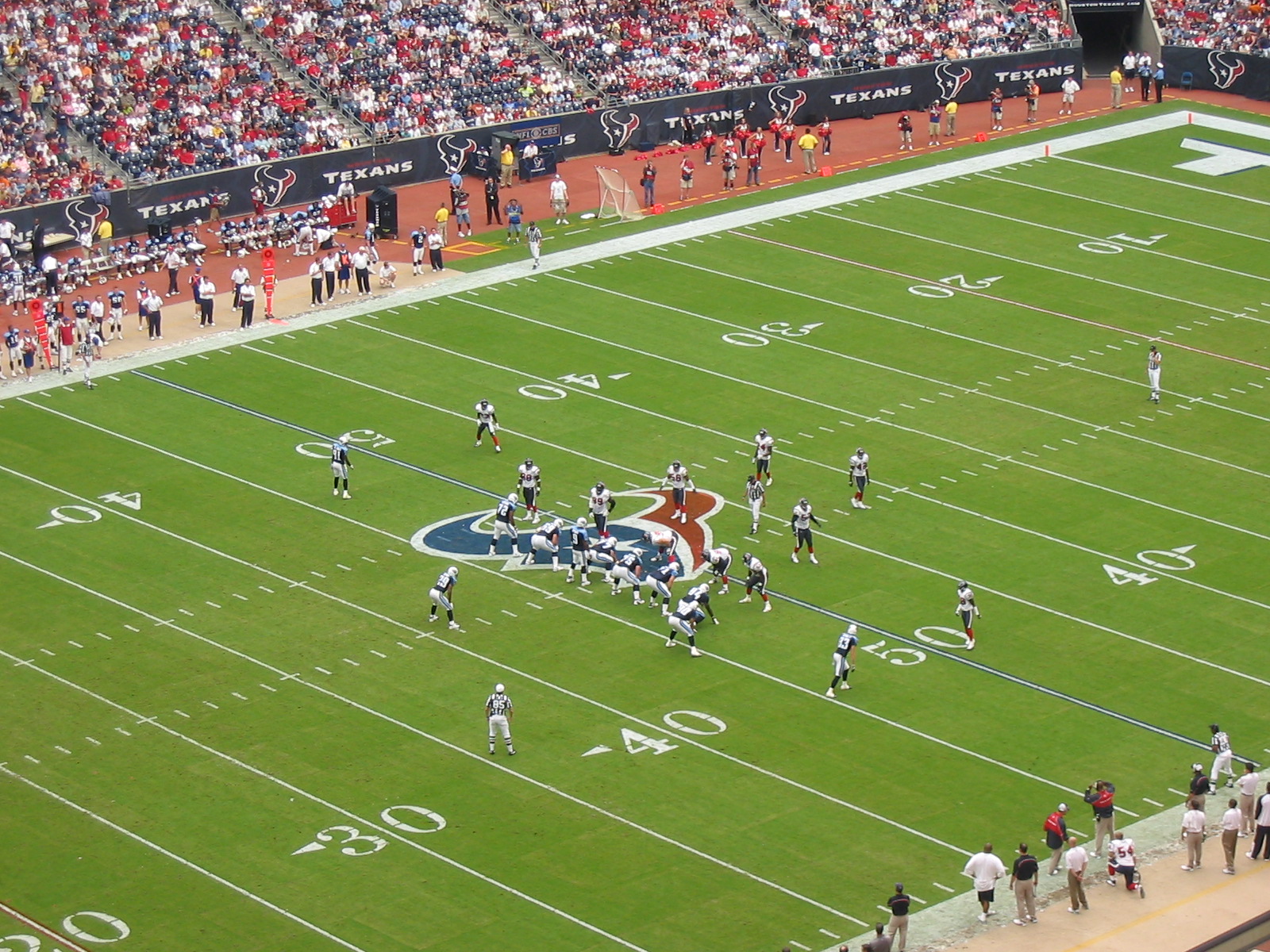
Gameplay in American football consists of a series of downs, individual plays of short duration, outside of which the ball is or is not in play. These can be plays from the line of scrimmage – passes, runs, punts or field goal attempts (from either a place kick or a drop kick) – or free kicks such as kickoffs and fair catch kicks. Substitutions can be made between downs, which allows for a great deal of specialization as coaches choose the players best suited for each particular situation for offense, defense, and also special teams. During a play, each team should have a maximum of 11 players on the field, and each of them has specific tasks assigned for that specific play.
The objective of the game is to score more points than the other team during the allotted time. Teams can score points by advancing the ball to reach the opposite end of the field, which is home to a scoring zone (the end zone) and the goalposts. Teams move the ball down the field by running a series of plays consisting of runs or passes. The team with the ball (the offense) has four plays (downs) to advance at least 10 yards. If the offense succeeds in advancing at least 10 yards, they earn a "first down," and the number of tries allotted is reset. The offense is again given four tries to advance an additional 10 yards, starting from the spot to which they last advanced. If the offense does not advance at least 10 yards during their four downs, the team without the ball (the defense) regains control of the ball (a turnover on downs).
On offense, points are scored by advancing the ball into the opponent's end zone for a touchdown worth six points or by kicking the ball from the playing field through the raised vertical posts (the goalposts) situated on the end line of the end zone for a field goal worth three points. After scoring a touchdown, the offense is given an additional opportunity to attempt to score during an untimed play. Conversion attempts are used to score 1 or 2 points as follows:
While the opposing team has possession, the defense attempts to prevent the offense from advancing the ball and scoring. If an offensive player loses the ball during play (a fumble) or the ball is caught by a defensive player while still in the air (an interception), the defense may attempt to run into the opponent's end zone for a touchdown. The defense may also score two points by tackling the ball carrier in the offense's own end zone (a safety).
Collegiate and professional football games are 1 hour long, divided into four quarters of 15 minutes each. In high school football, 12-minute quarters are usually played. However, the game clock is stopped frequently, and a typical college or professional game can exceed three total hours. The referee controls the clock and stops it after any incomplete pass or play that ends out of bounds, a change of possession of the ball from one team to the other, field goal tries, and kickoffs. In addition, each team is allowed three timeouts each half that may be used at their discretion. The clock normally runs during the action of plays, with a few exceptions known as untimed plays. Some high schools employ a mercy rule in which the clock runs continuously after one team's lead over the other achieves a certain number of points. In these instances, the clock only stops for injuries and timeouts called by a team or a referee.
The clock may also be stopped for an officials' timeout, after which, if the clock was running, it is restarted. For example, if there is a question about whether a team has moved the ball far enough for a first down, the officials may use a measuring device (the chains) to determine the distance. While this measurement is taking place, the officials will signal for a stoppage of the clock. Once the measurement is finished and the ball is placed at the proper location (spotted), the referee will then signal for the clock to restart. Additional situations where officials may take a timeout are to administer a penalty or for an injured player to be removed from the field. Officials also call media timeouts, which allow time for television and radio advertising, often after scoring plays, a change of position, or during extended injury timeouts. If an instant replay challenge is called during the game, the referees signal for a media timeout. The referee signals media timeouts by first using the timeout signal and then extending both arms in a horizontal position.
In addition to the game clock, a separate play clock is used. This counts down the time the offense has to start the next play before it is assessed a delay of game penalty. This clock is typically 25 seconds from when the referee marks the ball ready for play. The NFL and NCAA use a 40-second play clock that starts immediately after the previous play ends, though, for certain delays, such as penalty enforcement, the offense has 25 seconds from when the ball is marked ready. The purpose of the play clock is to ensure that the game progresses consistently, preventing unnecessary delays. Overall, clock management is a significant part of the game; teams leading toward the end of the game will often try to run out the clock via kneeldowns.
Teams change ends of the field at the end of the first quarter and the end of the third quarter, though the situation on the field regarding possession, downs remaining, and distance-to-goal does not change (so a team with possession 5 yards from the opponent's end zone at the end of the first quarter would resume playing 5 yards from the end zone at the other end of the field, which they would then be attacking). Separating the first and second halves is halftime. Both halves and any overtime begin with kick-offs, and the kicking team at the beginning of the game and overtime is decided by a coin toss, while the other team kicks off at the beginning of the second half.
Hub AI
American football rules AI simulator
(@American football rules_simulator)
American football rules
Gameplay in American football consists of a series of downs, individual plays of short duration, outside of which the ball is or is not in play. These can be plays from the line of scrimmage – passes, runs, punts or field goal attempts (from either a place kick or a drop kick) – or free kicks such as kickoffs and fair catch kicks. Substitutions can be made between downs, which allows for a great deal of specialization as coaches choose the players best suited for each particular situation for offense, defense, and also special teams. During a play, each team should have a maximum of 11 players on the field, and each of them has specific tasks assigned for that specific play.
The objective of the game is to score more points than the other team during the allotted time. Teams can score points by advancing the ball to reach the opposite end of the field, which is home to a scoring zone (the end zone) and the goalposts. Teams move the ball down the field by running a series of plays consisting of runs or passes. The team with the ball (the offense) has four plays (downs) to advance at least 10 yards. If the offense succeeds in advancing at least 10 yards, they earn a "first down," and the number of tries allotted is reset. The offense is again given four tries to advance an additional 10 yards, starting from the spot to which they last advanced. If the offense does not advance at least 10 yards during their four downs, the team without the ball (the defense) regains control of the ball (a turnover on downs).
On offense, points are scored by advancing the ball into the opponent's end zone for a touchdown worth six points or by kicking the ball from the playing field through the raised vertical posts (the goalposts) situated on the end line of the end zone for a field goal worth three points. After scoring a touchdown, the offense is given an additional opportunity to attempt to score during an untimed play. Conversion attempts are used to score 1 or 2 points as follows:
While the opposing team has possession, the defense attempts to prevent the offense from advancing the ball and scoring. If an offensive player loses the ball during play (a fumble) or the ball is caught by a defensive player while still in the air (an interception), the defense may attempt to run into the opponent's end zone for a touchdown. The defense may also score two points by tackling the ball carrier in the offense's own end zone (a safety).
Collegiate and professional football games are 1 hour long, divided into four quarters of 15 minutes each. In high school football, 12-minute quarters are usually played. However, the game clock is stopped frequently, and a typical college or professional game can exceed three total hours. The referee controls the clock and stops it after any incomplete pass or play that ends out of bounds, a change of possession of the ball from one team to the other, field goal tries, and kickoffs. In addition, each team is allowed three timeouts each half that may be used at their discretion. The clock normally runs during the action of plays, with a few exceptions known as untimed plays. Some high schools employ a mercy rule in which the clock runs continuously after one team's lead over the other achieves a certain number of points. In these instances, the clock only stops for injuries and timeouts called by a team or a referee.
The clock may also be stopped for an officials' timeout, after which, if the clock was running, it is restarted. For example, if there is a question about whether a team has moved the ball far enough for a first down, the officials may use a measuring device (the chains) to determine the distance. While this measurement is taking place, the officials will signal for a stoppage of the clock. Once the measurement is finished and the ball is placed at the proper location (spotted), the referee will then signal for the clock to restart. Additional situations where officials may take a timeout are to administer a penalty or for an injured player to be removed from the field. Officials also call media timeouts, which allow time for television and radio advertising, often after scoring plays, a change of position, or during extended injury timeouts. If an instant replay challenge is called during the game, the referees signal for a media timeout. The referee signals media timeouts by first using the timeout signal and then extending both arms in a horizontal position.
In addition to the game clock, a separate play clock is used. This counts down the time the offense has to start the next play before it is assessed a delay of game penalty. This clock is typically 25 seconds from when the referee marks the ball ready for play. The NFL and NCAA use a 40-second play clock that starts immediately after the previous play ends, though, for certain delays, such as penalty enforcement, the offense has 25 seconds from when the ball is marked ready. The purpose of the play clock is to ensure that the game progresses consistently, preventing unnecessary delays. Overall, clock management is a significant part of the game; teams leading toward the end of the game will often try to run out the clock via kneeldowns.
Teams change ends of the field at the end of the first quarter and the end of the third quarter, though the situation on the field regarding possession, downs remaining, and distance-to-goal does not change (so a team with possession 5 yards from the opponent's end zone at the end of the first quarter would resume playing 5 yards from the end zone at the other end of the field, which they would then be attacking). Separating the first and second halves is halftime. Both halves and any overtime begin with kick-offs, and the kicking team at the beginning of the game and overtime is decided by a coin toss, while the other team kicks off at the beginning of the second half.
Recent media