



Community hub
Recent from talks
Knowledge base stats:
Talk channels stats:
Members stats:
American kestrel
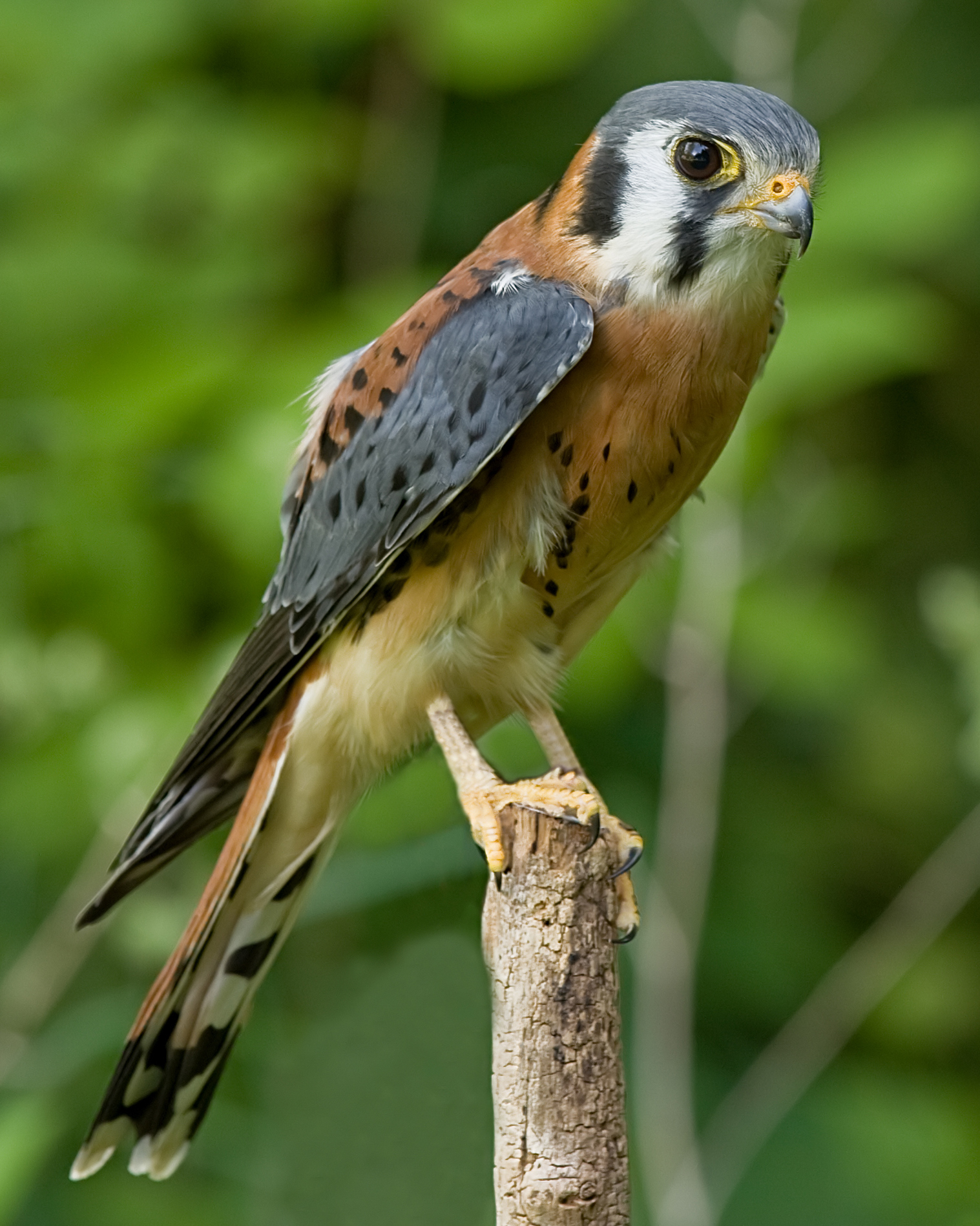
The American kestrel (Falco sparverius) is the smallest and most common falcon in North America. Though it has been called the American sparrowhawk, this common name is a misnomer; the American kestrel is a true falcon, while neither the Eurasian sparrowhawk nor the other species called sparrowhawks are in the Falconidae family, hence only very distantly related to the American kestrel. It has a roughly two-to-one range in size over subspecies and sex, varying in size from about the weight of a blue jay to a mourning dove. It also ranges to South America and is a well-established species that has evolved into 17 subspecies adapted to different environments and habitats throughout the Americas. It exhibits sexual dimorphism in size (females being moderately larger) and plumage, although both sexes have a rufous back with noticeable barring. Its plumage is colorful and attractive, and juveniles are similar in plumage to adults.
The American kestrel usually hunts in energy-conserving fashion by perching and scanning the ground for prey to ambush, though it also hunts from the air. It sometimes hovers in the air with rapid wing beats while homing in on prey. Its diet typically consists of grasshoppers and other insects, lizards, mice, and small birds (e.g. sparrows). This broad diet has contributed to its wide success as a species. It nests in cavities in trees, cliffs, buildings, and other structures. The female lays three to seven eggs, which both sexes help to incubate.
Its breeding range extends from central and western Alaska across northern Canada to Nova Scotia, and south throughout North America, into central Mexico and the Caribbean. It is a local breeder in Central America and is widely distributed throughout South America. Most birds breeding in Canada and the northern United States migrate south in the winter. It is an occasional vagrant to Western Europe.
Based on appearance and behavior it was for many years considered a member of the primarily European and African kestrel clade within the genus Falco, but DNA analysis shows the American kestrel to actually be genetically more closely related to the larger American falcons such as the peregrine, aplomado, and prairie falcons. Though the species has not been renamed as a result of these genetic analyses, it is not actually a kestrel in the phylogenetic sense. Instead, a process of convergent evolution to fit a similar small prey niche in the ecosystem as the true kestrels have left it with similar physical characteristics and hunting methods.
The American kestrel is a common bird used in falconry, especially by beginners. Though not as strong a flyer as many other, larger falcons, proper training and weight control by the falconer allows many American kestrels to become effective hunters of birds in the size range of sparrows and starlings, with occasional success against birds up to approximately twice their own weight.
The American kestrel was formally described in 1758 by the Swedish naturalist Carl Linnaeus in the tenth edition of his Systema Naturae under the current binomial name Falco sparverius. Linnaeus based his account on the "little hawk" that had been described and illustrated by the English naturalist Mark Catesby in his book The Natural History of Carolina, Florida and the Bahama Islands that was published between 1729 and 1732. Linnaeus specified the type locality as America but this was restricted to South Carolina based on Catesby. The genus name is from Late Latin falco meaning "falcon". The specific epithet sparverius is Medieval Latin for a "sparrowhawk".
Until the sixth edition of the AOU Checklist of North American Birds was published by the American Ornithologists' Union in 1983, the most commonly used name for the American kestrel was the sparrow hawk. This was due to a mistaken connection with the Eurasian sparrowhawk in the genus Accipiter. The sixth edition of the AOU Checklist corrected this, officially renaming the bird American kestrel. Several other colloquial names for the kestrel are also in use, including grasshopper hawk, due to its diet, and killy hawk, due to its distinct call.
As noted in the introduction, DNA analysis shows the American kestrel to actually be genetically more closely related to the larger American falcons than to the true kestrels. However, based on its physical similarity to the kestrels and the established nature of the name American kestrel, there has been little impetus to change its name. This could change in the future if continued genetic research more precisely determines the evolutionary history of the American kestrel within the genus Falco. The entire genus is actually a set of species so closely related that most or all can be hybridized by artificial insemination. Significant natural hybridization of species has occurred in the past during the evolution of this closely related set of species, such that precise evolutionary genetic analysis as to which species are more basal to other species or to the genus as a whole is difficult to render.
Hub AI
American kestrel AI simulator
(@American kestrel_simulator)
American kestrel
The American kestrel (Falco sparverius) is the smallest and most common falcon in North America. Though it has been called the American sparrowhawk, this common name is a misnomer; the American kestrel is a true falcon, while neither the Eurasian sparrowhawk nor the other species called sparrowhawks are in the Falconidae family, hence only very distantly related to the American kestrel. It has a roughly two-to-one range in size over subspecies and sex, varying in size from about the weight of a blue jay to a mourning dove. It also ranges to South America and is a well-established species that has evolved into 17 subspecies adapted to different environments and habitats throughout the Americas. It exhibits sexual dimorphism in size (females being moderately larger) and plumage, although both sexes have a rufous back with noticeable barring. Its plumage is colorful and attractive, and juveniles are similar in plumage to adults.
The American kestrel usually hunts in energy-conserving fashion by perching and scanning the ground for prey to ambush, though it also hunts from the air. It sometimes hovers in the air with rapid wing beats while homing in on prey. Its diet typically consists of grasshoppers and other insects, lizards, mice, and small birds (e.g. sparrows). This broad diet has contributed to its wide success as a species. It nests in cavities in trees, cliffs, buildings, and other structures. The female lays three to seven eggs, which both sexes help to incubate.
Its breeding range extends from central and western Alaska across northern Canada to Nova Scotia, and south throughout North America, into central Mexico and the Caribbean. It is a local breeder in Central America and is widely distributed throughout South America. Most birds breeding in Canada and the northern United States migrate south in the winter. It is an occasional vagrant to Western Europe.
Based on appearance and behavior it was for many years considered a member of the primarily European and African kestrel clade within the genus Falco, but DNA analysis shows the American kestrel to actually be genetically more closely related to the larger American falcons such as the peregrine, aplomado, and prairie falcons. Though the species has not been renamed as a result of these genetic analyses, it is not actually a kestrel in the phylogenetic sense. Instead, a process of convergent evolution to fit a similar small prey niche in the ecosystem as the true kestrels have left it with similar physical characteristics and hunting methods.
The American kestrel is a common bird used in falconry, especially by beginners. Though not as strong a flyer as many other, larger falcons, proper training and weight control by the falconer allows many American kestrels to become effective hunters of birds in the size range of sparrows and starlings, with occasional success against birds up to approximately twice their own weight.
The American kestrel was formally described in 1758 by the Swedish naturalist Carl Linnaeus in the tenth edition of his Systema Naturae under the current binomial name Falco sparverius. Linnaeus based his account on the "little hawk" that had been described and illustrated by the English naturalist Mark Catesby in his book The Natural History of Carolina, Florida and the Bahama Islands that was published between 1729 and 1732. Linnaeus specified the type locality as America but this was restricted to South Carolina based on Catesby. The genus name is from Late Latin falco meaning "falcon". The specific epithet sparverius is Medieval Latin for a "sparrowhawk".
Until the sixth edition of the AOU Checklist of North American Birds was published by the American Ornithologists' Union in 1983, the most commonly used name for the American kestrel was the sparrow hawk. This was due to a mistaken connection with the Eurasian sparrowhawk in the genus Accipiter. The sixth edition of the AOU Checklist corrected this, officially renaming the bird American kestrel. Several other colloquial names for the kestrel are also in use, including grasshopper hawk, due to its diet, and killy hawk, due to its distinct call.
As noted in the introduction, DNA analysis shows the American kestrel to actually be genetically more closely related to the larger American falcons than to the true kestrels. However, based on its physical similarity to the kestrels and the established nature of the name American kestrel, there has been little impetus to change its name. This could change in the future if continued genetic research more precisely determines the evolutionary history of the American kestrel within the genus Falco. The entire genus is actually a set of species so closely related that most or all can be hybridized by artificial insemination. Significant natural hybridization of species has occurred in the past during the evolution of this closely related set of species, such that precise evolutionary genetic analysis as to which species are more basal to other species or to the genus as a whole is difficult to render.