Hubbry Logo
Prairie falconPrairie falconMain
Open search
Prairie falcon
Community hub
Prairie falcon
logo
8 pages, 0 posts
0 subscribers
Be the first to start a discussion here.
Prairie falcon
Prairie falcon
from Wikipedia

Prairie falcon
Scientific classification Edit this classification
Kingdom: Animalia
Phylum: Chordata
Class: Aves
Order: Falconiformes
Family: Falconidae
Genus: Falco
Species:
F. mexicanus
Binomial name
Falco mexicanus
Schlegel, 1850
Synonyms

Gennaia mexicana
Hierofalco mexicanus

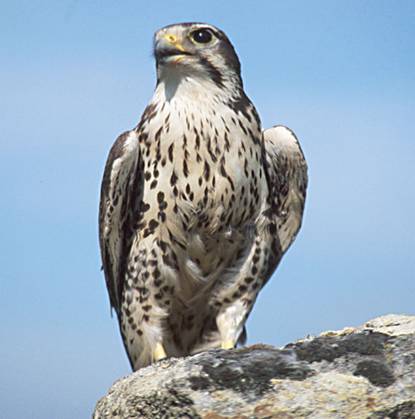
A prairie falcon in Arizona.

The prairie falcon (Falco mexicanus) is a medium-sized falcon found in Western North America. A separate species from the peregrine falcon, with which it shares some visual similarities, the prairie falcon is, essentially, an arid-climate divergence of earlier peregrine falcon lineage. It is thus able to thrive on a more meager, opportunistic diet compared to that of the peregrine,[2] and is generally lighter in weight than a peregrine of similar wingspan. Having evolved in harsher and desert environments, often with low prey density, the prairie falcon has developed into an aggressive and opportunistic hunter of a wide range of both mammalian and avian prey, as well as occasional reptiles.[3] It will regularly take prey from the size of sparrows or finches to birds approximately its own weight, and occasionally much larger.

The prairie falcon is the only larger falcon species native strictly to North America (others are found throughout the Americas and beyond, such as the peregrine falcon with its cosmopolitan distribution). The prairie falcon is resident from Canada (mainly Alberta, British Columbia and Saskatchewan) through the Western United States (west of the Mississippi) and south into Northern Mexico.

Like many raptors and falconiformes, the prairie falcon is popular in falconry; with proper training and care, it is regarded as being equally as skilled as the more well-known peregrine, among others.

Description

[edit]

Appearance

[edit]

Adults

[edit]
soaring

Male prairie falcons are usually 37 to 38 cm in length (~15 inches) and weigh 500 to 635g (1.1 to 1.4 lbs). Females are about 45 cm in length (17.7 inches) and weigh 762 to 970g (1.7 to 2.1 lbs).[4] A large female can be nearly twice the size of a small male, with wingspan reaching to 1.1 meters (3.5 feet), and tends to hunt significantly larger prey.

Plumage is warm gray-brown (sometimes called "sandy") above and pale with more or less dark mottling below. The darkest part of the upper side is the primary wing feathers; the lightest is the rump and tail, particularly the outer tail feathers. The head has a "moustache" mark like a peregrine falcon's but narrower, and a white line over the eye. A conspicuous character is that the axillars ("wingpits") and underwing coverts are black, except along the leading edge of the wing. This creates an effect of "struts" from the body along each wing.

Juveniles

[edit]

There are several ways to distinguish juvenile (first year) Prairie Falcons from adult (second year or older) Prairie Falcons. Each of these methods vary between individuals and several appearance factors may need to be considered as a whole. 1. Vertical dark streaking especially on the upper breast tends to be more prevalent in adults. 2. Exposed portions of shoulder and back feathers tend to be more uniformly colored in juveniles and barred with light and dark horizontal stripes in adults. 3. Skin around eyes, above beak (cere) and on legs and talons tends to be more yellow and sometimes with tinges of orange or green in adults. Skin tends to be gray in juveniles. Factor one can be mistakenly observed because a Prairie Falcon's crop expands and distends upon feeding exposing the white under feathers of the upper breast so that a juvenile Prairie Falcon which just fed can appear from a distance to have a very bright white upper breast like an adult. Also, factor 3 varies so that sometimes a Prairie Falcon's feet begin to turn yellow while juvenile and some individuals have gray skin as adults. It's thought that these fluctuations are caused by diet and resulting hormonal fluctuations between individuals. Of the three factors, factor 2 is probably the most reliable. However, all three factors should be used in conjunction. Interestingly, sometimes one can ascertain whether a Prairie Falcon is exactly in its second year. Some Prairie Falcon individuals molt into adult plumage back and wing feathers that have a more gray tinge than their brown juvenile feathers. First year molts tend to be usually incomplete particularly in the "shoulder" region. If the individual's back and wing feathers have a gray tinge and there are several feathers on the upper wings (shoulder) with a subtle but distinctly different brown tinge, then the bird is a second year bird because it didn't fully molt.

Juvenile Prairie Falcon, Horsetooth Mountain Open Space, Larimer County, Colorado

Call

[edit]

Calls, heard mostly near the nest, are described as repetitive kree kree kree…, kik kik kik…, and the like, similar to the peregrine's call but higher-pitched.[5]

Similar birds

[edit]

Experts can separate a distant prairie falcon from a peregrine falcon (generally the only similar species in its range) by its shape and flight style. The prairie falcon has a longer tail in proportion to its size; a more tubular, less stocky body; and the wing joint is farther from the body. Its wingbeats are described as strong and shallow like the peregrine's and having the same quick cadence, but stiffer and more mechanical.[6]

Systematics and evolution

[edit]

Outward resemblance

[edit]

The prairie falcon outwardly resembles the peregrine as well as the Old World "hierofalcons", especially the saker falcon.

Previous categorisation

[edit]

It was previously often considered the only New World member of the hierofalcon subgenus, but in recent decades this assumption has been disproven by genetic analysis. DNA studies beginning in the 1980s have shown the prairie falcon to be closer to the peregrine than to the hierofalcons.[7][8]

Current classification and convergent evolution

[edit]

It now is considered an early aridland offshoot of the peregrine falcon lineage, much as the hierofalcons represent a later[9] separate divergence that similarly adapted to arid habitat. Thus, the similarities between the prairie falcon and the hierofalcons are a good example of convergent evolution, with the prairie falcon and similar looking and behaving Old World forms such as the saker and lanner falcons not being the closest of related species, but instead ecological equivalents.[10] However, "closely related" is a relative term here, since most or all the members of the genus falco are closely enough related that they can produce hybrid offspring via artificial insemination. But, only the most closely related of these species will produce fertile or partially fertile offspring.

Relationship to Peregrine falcon

[edit]

The karyological data of Schmutz and Oliphant[11] provided early scientific evidence of the unexpectedly close relationship between the peregrine and prairie falcons. Wink and Sauer-Gürth[12] later estimated using molecular systematics that the prairie falcon diverged about 3 to 5 million years ago from an archaic peregrine ancestor, assuming a molecular clock calibration of 2% sequence divergence per 1 million years. The prairie falcon then evolved from its peregrine stock forebears in a process of parapatric speciation based on partially separated environments where different selective pressures lead to separate genetic drift and eventually to separate species. This process has led to the prairie falcon having enhanced survivability in the sparse arid environment that dominates the interior of the American west. This enhanced competitiveness in this environment is based on superior energy efficiency (being no larger than the prey base and competition with other raptors requires), and versatility in the utilization of a wider range of prey. Moderately lower weight than the muscular peregrine for similar wingspan not only allows lower food and energy requirements by the simple expedient of less muscle to support, but also allows a lighter wing loading (weight per square unit of wing area) that allows more distance to be covered per calorie consumed when hunting over prey sparse terrain.[13] The lighter wing loading also allows greater maneuverability, which is valuable in the pursuit of agile lightly wing loaded prey and rapidly dodging ground prey. When the prairie falcon locates needed prey, it is relentless in its pursuit. Quoting from the book The Prairie Falcon, "Because they evolved in the harsh western environment, prairie falcons have the stamina to out-fly the strongest quarry. They have the spirit to crash through dense cover when attacking prey, something peregrines seldom attempt."[14] In the longer distance lower prey density American west, the prairie falcon also has evolved eyes that are proportionally larger relative to head size than the already large eyes of other falcons.[15] The specialization of the prairie falcon to this particular environment is also reflected by the fact that there are no subspecies of the prairie falcon evolved to fit other environments, and that it seldom strays far outside the native range to which it is most suited and within which it has competitive advantages over the peregrine falcon.

Though they are separate species after several million years of mostly separate evolution, prairie falcons are known to still occasionally interbreed with peregrines in the wild.[16] The male offspring of these crossings may be fertile, and provide an avenue for at least some gene flow to possibly still occur between the species. Such gene flow in the past may have contributed to the continuing genetic closeness of the two species today.[7]

Ecology, behavior, and reproduction

[edit]

Habitat and distribution

[edit]

The natural habitat of the prairie falcon is open country, especially arid, in summer including alpine tundra to shortgrass prairie and high desert. In winter it is more widespread, ranging to low deserts and occasionally to towns. It breeds from southern Saskatchewan, Alberta and south-central British Columbia south through the western United States–roughly between the eastern edge of the Mountain Time Zone and the Cascade Mountains, as well as the Central Valley of California–to the Mexican states of Baja California, Durango, and northern San Luis Potosí. It is much less migratory than the other North American falcons, but in winter it does withdraw somewhat from the northernmost and highest-elevation parts of its breeding range and spreads west to the deserts and Pacific coast of California, east to about the 100th meridian, and south to Baja California Sur, Jalisco, and Hidalgo.

Diet

[edit]

The prairie falcon eats mostly small mammals (especially in summer) and small to medium-sized birds caught in flight, though as an opportunistic predator it will occasionally take larger birds. Though accounts of the prairie falcon taking prey as large as geese are verifiable (a prey that may be over 5 times heavier than a large female prairie falcon), it usually takes prey smaller than itself that it may safely subdue and which can be carried to the nest or to a safe perch to consume. The majority of prey is 150g or less, a weight that even the smaller tiercel (male) can carry long distances back to the nest.[17] Most prey is thus 30% or less of the weight of the tiercel, which is a common prey size fraction across numerous species of falcons where the males do the majority of the hunting during the nesting season. However, over shorter distances wildlife biologists have documented prairie falcons carrying up to about 60–70% of their body weight.[18] Common mammalian prey for prairie falcons includes squirrels, ground squirrels, prairie dogs, chipmunks, gophers, and rabbits of various species. Reptiles are also sometimes taken. Bird prey commonly includes sparrows, starlings, grackles, doves, quail, meadow larks, pigeons, coots, teal, and mallards—virtually any bird of up to approximately the falcon's own size and occasionally significantly larger. However, the need to feed their young focuses them on prey they can carry during nesting season, and the reproductive success of the prairie falcon depends upon such smaller prey being available.[17]

Flying methods

[edit]

In keeping with the needs of a predator living in a prey-sparse desert environment, the prairie falcon has developed a wide range of hunting and flight styles.[19] Like the merlin, it often hunts by flying fast and low, at a height of only a few meters or so, hoping to find surprised prey as it comes over the terrain or around bushes. Its cruising speed is estimated at 72 km/h (45 mph) and it accelerates in the chase. A variation on this method is for the falcon to stoop down from altitude and then level out near the ground, initially traveling at more than 100 mph at altitudes of a meter or two, sometimes gliding for more than a kilometer this way.[20] If the rapidly approaching falcon flushes bird prey, the falcon has the speed advantage and may rapidly close with the prey. Another variation on these low attacks is using terrain as cover to approach beneath a flock of birds, then using its speed to perform a rapid climbing surprise attack into the flock.[21] It also pursues prey sighted from a perch in the manner of the short-winged accipiter hawks, again often flying low and using its speed to close with the prey in a tail-chase. Prairie falcons may even deliberately emulate the flight style of other birds in order to deceive potential prey and allow a surprise attack by the falcon.[22] The dramatic high speed diving stoop from high altitude in the manner of the peregrine falcon, allowing overtaking the swiftest of birds or delivering a knock-out blow to large prey, is also a very natural part of the hunting repertoire of the prairie falcon.[23] At impact the prey is hit with a closed foot or feet, or swiped with an open foot armed with talons. High-speed films have shown that this second method is the more common, with the toes closed into a "fist" immediately after striking. The claw on the hind toe, or hallux, is particularly effective and deadly in raking the prey.[24] When the closed foot strike is used it is typically directed against the head or wing of the prey, and if it does not outright kill, the prey is often rendered unconscious or unable to fly. These strikes are often accompanied by an explosion of feathers and an audible impact that may be heard from the ground hundreds of feet away. They have been known to be so forceful they can literally separate the head from the body of the prey.[25]

Territory

[edit]

Territories of mated pairs in nesting season range from under 200 to over 400 square kilometers. Smaller territories where prey does not have to be carried as far enhances reproductive success.[26]

Nesting

[edit]

Nest

[edit]

This species nests on cliff ledges, so breeding adults are local during the breeding season.

Eggs

[edit]

The clutch averages four eggs, which are subelliptical and pinkish with brown, reddish-brown, and purplish dots. As part of their adaptation to hotter and lower humidity desert climates, the eggs of the prairie falcon are less porous and retain water better than those of their peregrine falcon cousins,[27] leading to a higher hatching rate under these conditions.

Incubation

[edit]

The incubation period is 31 days, beginning with the 2nd to last or last egg laid. Incubation becomes more intense after later eggs are laid, somewhat evening out hatching times.

Splitting of work

[edit]

As is typical for falcons, the female does most of the incubating and brooding, and the male brings most of the food, with the female also hunting after the young are 12 to 14 days old.

Chicks

[edit]

The young fledge (first fly) from 36 to 41 days after hatching. They continue to be supported by their parents while learning to fly and hunt, with the parents gradually winding down the amount of food they provide as the youngsters' hunting skills improve. At approximately 65 days of age they are ready to be self-sufficient, and disperse from their natal area.[28]

Competition

[edit]

In its range the prairie falcon must compete for food and space with other often larger raptors including the peregrine falcon, red tailed hawk, Harris's hawk, ferruginous hawk, great horned owl, and golden eagle. The large, powerful, and surprisingly agile golden eagle is the apex avian predator in this range, and is generally willing and able to attack and kill any of these other raptors. Under the right circumstances all these species are capable of sometimes displacing and occasionally killing the prairie falcon. However, the prairie falcon will aggressively defend its territory against any of them, with male and female often mounting a coordinated attack, and often turns the tables on these larger raptors. Wildlife biologists report numerous observations of prairie falcons successfully driving away and sometimes killing raptors larger than themselves.[29] When a prairie falcon kills a larger raptor, it usually does so in a diving stoop with striking methods similar to what it uses against prey much larger than itself. It may use a foot with talons clinched like a fist to make a high energy strike against the head or wing of its opponent, or use an extended talon in a rapier like thrust to create a fatal wound. However, it is not a given that prairie falcons will always be in conflict with nearby raptors. In years when food is plentiful, prairie falcons have been known to nest within a few hundred meters of great horned owls, peregrine falcons, red-tailed hawks, and golden eagles, with both sets of parents successfully rearing their young.[30]

Population size

[edit]

As of 2006, the population of prairie falcons was estimated to be stable or increasing at over 5,000 pairs,[31] with perhaps 200 pairs breeding at the Snake River Birds of Prey National Conservation Area in Idaho.[32] By contrast, in the years before DDT contamination extirpated the eastern U.S. peregrine falcon population in the 1950s and 1960s, the number of eastern peregrines in the United States had already dropped to about 350 pairs.[33] It is thought the prairie falcon mostly avoided the population loss suffered by the peregrine from DDT induced egg shell thinning due to its more remote environment partly insulating it from pesticide contamination.[34] The loss of peregrine population allowed the expansion of prairie falcon range to cliff nesting sites in areas formerly occupied by peregrines moderately outside historic prairie falcon territory. The successful reintroduction of peregrines to eastern and central United States brought peregrine and prairie falcons back into competition in these areas. The reintroduction program led by the Peregrine Fund bred and released more than 4,000 peregrine falcons from 1974 to 1997. The program necessarily made use of available captive bred peregrine stock with a strong genetic influence from larger bodied peregrine subspecies. The created strain of mixed subspecies peregrine tends to be heavier and stronger than the prairie falcon, and where they conflict over nesting sites they often displace prairie falcons.[35] However, these reintroduced peregrines are little threat to prairie falcon populations within their natural range, as the prairie falcon with its greater heat tolerance, lower daily food requirement, and wider prey base has the survival advantage in the harsh high desert environment in which it has evolved to prosper.

Use in falconry

[edit]

This species is often used in falconry. It is the most popular falcon captured from the wild for falconry purposes in the United States, due to its abundance and relative ease to acquire. It is valued for its aggressiveness, agility, and determination to bring down game. Although some falconers considered the prairie falcon hard to train and unpredictable, others note that with proper training taking into account its impatient nature it may be as effective as the peregrine falcon. In his book The Hunting Falcon, biologist and falconer Bruce Haak states "In the field, the prairie falcon leaves no doubt that it can hold its own against the peregrine as a stylish and dedicated hunting companion."[36]

The smaller and more agile males are particularly effective in the taking of small game birds such as dove, quail, and smaller ducks, while the larger and more powerful females reliably take larger game up through the size of large ducks and even pheasants.[37] Some prairie falcons will strike still larger game such as geese and greater sage-grouse, but their willingness to do so runs the risk of injury to the falcon.[38][39] The sage-grouse in particular is difficult game, with the males weighing as much as 8 lbs, and being so hard-muscled that inexperienced falcons can easily be injured in striking them in a high-speed stoop. It takes a skilled falcon that knows how to forcefully but carefully and accurately strike them in the head or wing to bring them down cleanly. For this difficult prey experienced falconers usually prefer larger peregrine females, gyrfalcons, or gyr-peregrine hybrids,[40] though some female prairie falcons do master the art of bringing down larger game.[38]

Proper training for prairie falcons includes providing abundant food when raising them (to avoid them developing the habit of screaming for food), and extensive "manning" (close contact and handling) when training them.[41] Unlike the peregrine, they do not respond well to training with the swung lure, as missing the lure brings out their impatience. Teaching prairie falcons to climb and "wait on" to stoop on game is best accomplished by a reward system of flushing game or serving live birds such as pigeons for the falcon to chase when the falcon has assumed the proper position several hundred feet or more above the falconer. The prairie falcon's eagerness to hunt and chase requires that it be patiently taught that when it assumes the proper waiting on position the falconer can be trusted to reliably flush game.[42] As the falcon comes to understand this, it learns to hunt as an effective team with the falconer.

The availability of commercially bred falcons has in recent years reduced the need to capture falcons from the wild for use in falconry.[43] The prairie falcon along with the peregrine and gyrfalcon is now often available via captive breeding. The prairie falcon is also sometimes hybridized with the peregrine falcon or gyrfalcon to create a falcon combining the aggressiveness and heat tolerance of the prairie falcon with the easier trainability and slightly greater strength of the larger peregrine subspecies, or the greater horizontal speed and significantly larger size and strength of the gyrfalcon.

Conservation and status

[edit]

Due to this species' large range and apparently increasing population, it has been classified by the IUCN as least concern.[1] However, it has experienced some local declines in Texas, California, British Columbia and Alberta as grasslands are developed for agriculture, suburbs, highways, and other automobile uses. Such a decline could result in an inability for birds to find mates or suitable habitats.[44]

Mortality and causes

[edit]

A major contributor to mortality has been the Great horned owl (Bubo virginianus) but to a lesser extent, it has been observed that infestations of Haematosiphon inodorus and in some cases Oeciacus vicarius may be a cause of fledgling morbidity.[45]

[edit]

Footnotes

[edit]

References

[edit]
[edit]
Revisions and contributorsEdit on WikipediaRead on Wikipedia
from Grokipedia
The Prairie falcon (Falco mexicanus) is a medium-sized native to western , measuring 14.6–18.5 inches (37–47 cm) in length with a wingspan of 35.4–44.5 inches (90–113 cm), featuring pale brown upperparts, creamy underparts, distinctive black malar stripes, and dark triangular patches under the wings visible in flight. This inhabits open, arid environments including grasslands, shrubby deserts, prairies, and high-elevation treeless areas, often nesting on steep cliffs, bluffs, or rock outcrops. Found across a broad range from southern through the western United States to northern Mexico, the prairie falcon is largely resident in its core breeding areas but may migrate short distances or wander in winter to more varied open habitats like farmlands and urban edges. It is a skilled hunter, primarily preying on small mammals such as ground squirrels and pocket gophers, as well as like horned larks and songbirds, occasionally taking reptiles, , or larger quarry like jackrabbits through low, gliding flights or steep aerial pursuits. Breeding occurs from February to July, with monogamous pairs performing acrobatic displays and aggressively defending cliffside nests—simple scrapes or reused sites—where females lay 2–6 eggs that incubate for 29–34 days, and young fledge after about 5–6 weeks. Populations of the prairie falcon, estimated at around 110,000 mature individuals (as of 2025), remain stable overall with an increasing trend and are classified as of least concern globally, though local declines have occurred in areas affected by agricultural development, pesticides like , and . This species' adaptability to diverse open landscapes underscores its ecological role as a top predator in arid ecosystems, with individuals capable of living up to 17 years in the wild.

Description

Physical characteristics

The prairie falcon (Falco mexicanus) is a medium-sized raptor with average measurements of 37–47 cm in length, a of 90–113 cm, and a body weight ranging from 420–1,100 g. Males are noticeably smaller than females, with the latter typically 20–30% larger in linear dimensions such as length, a form of reverse that allows for division of prey sizes during breeding, where males target smaller items and females larger ones. Adult prairie falcons exhibit plumage adapted for camouflage in open, arid landscapes, featuring a grayish-brown back and upperwings, pale underparts with fine brown streaking on the breast and belly, and distinctive dark axillaries forming a patch under the wing from the armpit to the wrist. A thin, dark brown mustache-like malar stripe contrasts with the pale face, while the tail is paler than the back and shows faint barring. Juveniles differ markedly, with more heavily streaked underparts that are buffy overall, fading to white on the belly, a slightly darker brown back, and a tail with bolder barring than in adults. Physical adaptations include strong, curved talons suited for grasping medium-sized mammals and birds, and a robust build with relatively broad wings that facilitate efficient soaring over vast open habitats. Adults undergo an annual complete molt beginning post-breeding in late spring or early summer (typically May–August), replacing feathers sequentially to maintain flight capability. Juveniles complete a preformative molt in their first year, acquiring adult-like plumage by the following breeding season.

Vocalizations

The Prairie falcon's vocal repertoire is relatively limited compared to songbirds but serves essential functions in territory defense, courtship, and . The primary vocalization is the alarm or territorial cacking call, a loud, shrill, repetitive "kik-kik-kik" or "kack-kack-kack" that is raspy and high-pitched, often delivered in flight or from a perch near the nest site to deter intruders. This call varies in intensity, tone, and duration based on the perceived threat level, escalating to a more aggressive, chattering "klee-klee-klee" during heightened defense. During , pairs produce a distinct eechup call, described as a sharp "chup," "kuduchip," or "kek-kek-kek," often accompanying aerial displays, ledge bowing, and mutual soaring to strengthen pair bonds and coordinate nesting activities. Both males and females contribute to these vocalizations, with males typically emitting shriller versions while offering food to lure the female. This call facilitates communication between mates, sometimes involving duetting with sequenced chips or squeaks. Nestlings and fledglings employ a food-begging call, a whining "ee-ick" or high-pitched squeak, to solicit prey from parents, particularly during the brooding period when adults respond by delivering to the nest ledge. These calls are context-specific, helping to coordinate feeding and maintain cohesion amid the falcon's open, arid habitats. Overall, vocalizations play a key role in warning of predators or rivals and synchronizing breeding efforts, though they are less complex than in vocal-learning .

Similar species

The Prairie falcon (Falco mexicanus) is often confused with other North American falcons due to shared traits like pointed wings and swift flight, particularly in flight or at a distance. Common misidentifications occur with the (Falco peregrinus), which shares a similar size and body proportions but inhabits more urban, coastal, or cliffside environments compared to the prairie falcon's preference for open grasslands and arid plains. In overlapping regions such as the , where both species may over open terrain, observers must rely on subtle and behavioral cues to differentiate them. Compared to the , the prairie falcon exhibits a browner overall with paler underparts that are lightly streaked rather than heavily barred, and it lacks the peregrine's distinctive dark and malar stripe. In flight, the prairie falcon displays prominent dark axillary patches (visible as "armpits" under the wings) and a pale underwing with a dark trailing edge, contrasting with the peregrine's uniformly dark underwing and more pointed wingtips. The prairie falcon's wings are broader and less sharply pointed, contributing to a flatter soaring posture, whereas the peregrine employs faster, more direct flight with frequent stoops. These differences are especially useful in shared habitats like river valleys or plateaus, where misidentification is common during migration or winter. The (Falco columbarius), a smaller and stockier , poses confusion in open areas during migration, though it prefers wooded edges and coastal habitats over the prairie falcon's expansive prairies. Merlins are noticeably smaller (about two-thirds the length) with darker, more uniformly streaked underparts and a shorter, broader that appears square-tipped in flight, unlike the prairie falcon's longer, more rounded . The prairie falcon's thin "mustache" marking is more pronounced, and its underwing axillaries are darker and more visible, while the merlin shows quicker, erratic wingbeats rather than the prairie falcon's steady, powerful strokes. Overlaps in edges can lead to errors, but size and flight style provide reliable separation. Gyrfalcons (Falco rusticolus) are larger and bulkier, leading to occasional confusion in northern winter ranges where prairie falcons may venture into tundra-like edges overlapping with gyrfalcon irruptions. The gyrfalcon's plumage is paler and less patterned, often gray or white with minimal streaking, contrasting the prairie falcon's warmer brown tones and distinct axillary spots. In flight, the gyrfalcon's broader wings and slower, more powerful beats differ from the prairie falcon's agile, flat-winged soaring over open ground. Habitat divergence—gyrfalcons in coasts versus prairie falcons in semi-arid interiors—reduces encounters, but in shared northern plains, the size disparity (gyrfalcon up to 25% larger) is a key identifier. Field identification tips emphasize observing underwing patterns and posture: the prairie falcon's dark axillaries and pale central underwing stand out during soaring on level wings, unlike the pointed-winged, diving posture of peregrines or the compact, fluttering flight of merlins. In open versus urban settings, these traits, combined with the prairie falcon's head-bobbing when perched, aid quick differentiation from ecological look-alikes.

Taxonomy and systematics

Etymology and naming

The scientific name of the prairie falcon, Falco mexicanus, was established by Dutch ornithologist Hermann Schlegel in 1850 in his work Abhandlungen aus dem Gebiete der Zoologie und vergleichenden Anatomie. The genus Falco derives from the term for a , which itself stems from , meaning "sickle" or "curved blade," alluding to the bird's notched wings or hooked and talons characteristic of raptors. The specific epithet mexicanus refers to , with the original type locality given as "Mexico," though later restricted to , U.S.A., due to historical confusion over the specimen's origin, likely collected prior to 1848. The common English name "prairie falcon" reflects the bird's association with open grassland and ecosystems across western , distinguishing it from more forested falcon species. Historically, the prairie falcon was known under synonyms such as Falco polyargus, an obsolete binomial used by 19th-century naturalists like Elliott Coues to describe its pale and multiple white spots (polyargus meaning "many white spots"), but this was later consolidated under F. mexicanus. Among , particularly tribes in the American Southwest and Plains such as the , the prairie falcon holds cultural significance, often depicted in kachina figures as a swift hunter or runner symbolizing speed and prowess in the Soyohim ceremony.

Classification history

The Prairie falcon was first scientifically described as a distinct species, Falco mexicanus, by Dutch ornithologist Hermann Schlegel in 1850, based on specimens collected in . Subsequent taxonomic works affirmed this status, with the type locality restricted to , U.S.A., in James L. Peters' Check-list of Birds of the World (volume 1, 1931). The American Ornithologists' Union (AOU), in its initial Check-list of North American Birds (1886), recognized F. mexicanus as a full , a classification maintained without alteration through all subsequent editions and supplements up to the present day under the . Contemporary consensus places the Prairie falcon as a monotypic in the genus Falco (family , order ), reflecting its stable taxonomic position since description.

Evolutionary relationships

The Prairie falcon (Falco mexicanus) is a member of the genus Falco in the family Falconidae, a diverse group of diurnal birds of prey adapted primarily to open habitats worldwide. Phylogenetic analyses using multiple nuclear and mitochondrial loci place F. mexicanus as basal or sister to the Peregrine falcon-Hierofalco clade (encompassing species like the Saker (F. cherrug) and Gyr falcon (F. rusticolus)), distinct from other New World lineages. Earlier mtDNA-based studies had ambiguously linked the Prairie falcon to the Peregrine falcon (F. peregrinus), but comprehensive genomic data support its position outside the derived Hierofalco subgenus. Morphological and ecological parallels between the Prairie falcon and the —such as streamlined body forms, powerful flight capabilities, and stooping hunting techniques suited to pursuing prey in vast, open landscapes—exemplify . These adaptations arose independently in the two lineages, driven by the proliferation of arid grasslands and steppes during the , which favored aerial predators over forest-dwelling raptors. Unlike the more cosmopolitan Peregrine, the Prairie falcon's traits reflect specialization to North American prairies, underscoring how habitat expansion catalyzed parallel evolutionary trajectories across falcon clades. The fossil record of traces back to the Eocene, but modern Falco lineages emerged in the , with North American falconid fossils known from formations. For the Prairie falcon specifically, the earliest direct evidence comes from Pleistocene deposits, such as the McPherson Formation in (, ~0.13–0.01 million years ago), preserving bones attributable to F. mexicanus. estimates suggest the divergence of the Prairie falcon's lineage from other Falco species occurred around 3–5 million years ago, aligning with global and the spread of open habitats that facilitated rapid within the genus. Genomic surveys of the Prairie falcon reveal moderate genetic diversity, with observed heterozygosity averaging 0.34 across sampled populations in western , comparable to other species but without signs of recent demographic contraction. Analyses of over 567,000 single-nucleotide polymorphisms (SNPs) indicate a panmictic structure, supported by high via long-distance dispersal, though subtle signals of historical isolation appear at select loci like A2ML1. While no acute bottlenecks are evident, the species' overall genetic stability suggests resilience to past environmental pressures, such as Pleistocene climate shifts, maintaining effective population sizes sufficient for long-term viability.

Distribution and habitat

Geographic range

The prairie falcon (Falco mexicanus) has a breeding range spanning western , extending from southern southward through the western to northern , and reaching eastward to the . In , breeding populations are concentrated in south-central , southern , and southern , where they favor open landscapes with suitable nesting cliffs. Within the , the species nests widely from Washington and in the north, through states such as , , , , , , and , down to , , , and the western portions of and . In , breeding occurs in northern regions including , Chihuahua, , , and northern . As a partial migrant, the prairie exhibits varied winter distributions depending on local conditions. Northern breeding populations, particularly those in and the northern U.S., migrate southward to wintering grounds in the southern and central , often shifting to lower elevations or areas with abundant prey. Southern populations, including those in the southwestern U.S. and , tend to be resident year-round, with some individuals remaining near breeding sites. During winter, the species may appear farther east, occasionally reaching the , central , and even the valley, though it remains primarily associated with western open habitats. Historically, the prairie falcon's distribution expanded in the mid-20th century, particularly following the drastic decline of the (Falco peregrinus) in the 1950s and 1960s due to pesticide contamination, allowing prairie falcons to occupy former cliff-nesting territories. Post-1950s agricultural expansion across the and western grasslands created additional open habitats and boosted prey populations, such as ground squirrels and songbirds in farmlands, further supporting range and population growth in some regions. However, recent decades have seen contractions in localized areas, including declines in , , and , attributed to , intensive agriculture, and . The prairie falcon is endemic to North America, with its entire global distribution confined to this continent and no records of introduced populations elsewhere.

Habitat preferences

The Prairie falcon (Falco mexicanus) primarily inhabits open, arid, and semi-arid landscapes across western , favoring environments such as shrub-steppe deserts, grasslands, and mixed shrub-grasslands that provide expansive views for hunting and nesting. These habitats are characterized by low vegetation cover, which allows the bird to exploit ground-dwelling prey while avoiding dense forests or heavily wooded areas that limit visibility and maneuverability. Nesting sites are a critical component of habitat selection, with the species requiring steep cliffs, bluffs, or rocky outcrops for breeding, often in proximity to prey-rich microhabitats like rodent colonies or open plains teeming with small mammals. The falcon's elevation range spans from to approximately 3,350 meters (10,990 feet), enabling adaptation to diverse topographic features from coastal lowlands to high-altitude . In human-modified landscapes, Prairie falcons demonstrate tolerance for agricultural fields, rangelands, and areas affected by livestock grazing or energy development, provided that undisturbed cliff nesting sites and adjacent open areas remain available. However, they avoid intensive urbanization or conversion of native grasslands to cropland, which disrupts essential structure.

Behavior and ecology

Diet and foraging

The Prairie falcon's diet primarily consists of small to medium-sized mammals, which comprise 70-80% of its prey by biomass, including ground squirrels (such as Urocitellus spp. and Spermophilus spp.) and mice (e.g., deer mice, Peromyscus maniculatus). Birds make up 20-30% of the diet, with common items including doves (e.g., mourning doves, Zenaida macroura), larks (e.g., horned larks, Eremophila alpestris), and other passerines like western meadowlarks (Sturnella neglecta). Reptiles and insects occur occasionally, particularly in warmer regions or among juveniles. Seasonal variations influence prey selection, with a greater reliance on birds during winter when mammalian prey like s hibernate or become less available. In contrast, summer and breeding seasons emphasize mammals, aligning with peaks in activity. Juveniles tend to consume smaller prey items, such as and young , reflecting their developing hunting skills and parental provisioning. Foraging efficiency is moderate, with hunting success rates typically ranging from 20-30%, influenced by prey density and environmental conditions. In arid areas, Prairie falcons cache excess food in cliffs or crevices to buffer against prey shortages, a behavior observed more frequently during breeding. Dietary studies, often based on pellet analysis, reveal regional variations tied to local prey abundance; for instance, pellets from desert populations show higher reptile proportions (up to 20-33%), while grassland sites emphasize mammals like thirteen-lined ground squirrels (Spermophilus tridecemlineatus) at 91% frequency. In southwestern Wyoming, mammals dominated at 98% of the identified diet.

Flight and hunting techniques

The Prairie falcon (Falco mexicanus) employs a versatile array of flight styles adapted to its open and habitats, emphasizing and maneuverability over extreme velocity. During patrols, it frequently soars on or glides efficiently at moderate speeds, allowing it to cover vast expanses while scanning for prey below. This energy-efficient gliding conserves stamina for prolonged searches across patchy terrain, where prey like ground squirrels or small birds may be dispersed over kilometers. In contrast to the high-altitude, vertical stoops of the (Falco peregrinus), which exceed 320 km/h (200 mph), the prairie falcon's flights prioritize sustained low-level coverage rather than rapid descents. Hunting techniques vary with prey type and season, showcasing the species' adaptability. For terrestrial mammals such as ground squirrels, the prairie falcon often pursues at ground level in swift, low-altitude flights—typically 5-10 meters above the surface—flushing and capturing prey through direct chases or short, shallow stoops. Mid-air intercepts are common for avian prey like horned larks or meadowlarks, where the falcon uses rapid wingbeats and agile turns to close distances in active pursuits, striking with talons to disable targets before consuming them in flight or on the ground. Stoops emphasize precision and endurance in open landscapes rather than the blistering acceleration seen in other . In winter, perch-hunting becomes more prevalent, particularly in northern populations, where individuals station themselves on elevated rocks or fence posts to spot prey before launching short, explosive flights. This method reduces energy expenditure compared to constant aerial searches, aligning with seasonal shifts toward scarcer resources. Overall, these strategies enable success rates of 20-30% in targeted hunts, such as on feral pigeons, highlighting the prairie falcon's proficiency in diverse predation tactics suited to arid environments.

Territorial behavior

Prairie falcons maintain breeding territories that typically range from 50 to 300 km² per pair, though these can expand significantly in regions with scarce prey resources to ensure adequate opportunities. In more productive habitats, territories are more compact, reflecting the birds' to local prey for efficient defense and resource access. Defense of these territories involves a combination of aerial pursuits and vocalizations, with both sexes engaging intruders but males often taking primary responsibility for patrolling boundaries through regular flights along the perimeter. These displays escalate from warning calls—such as the sharp kek-kek-kek—to stoops and chases that drive off threats, effectively protecting nesting cliffs and foraging grounds without physical contact in most cases. Pairs are monogamous, forming strong bonds that reinforce , particularly among resident populations that hold territories year-round rather than relinquishing them during non-breeding seasons. Intraspecific conflicts arise when same-species intruders encroach, prompting aggressive responses like dives and vocal harassment, though such encounters rarely result in fatalities due to the birds' agile evasion tactics.

Migration patterns

The Prairie falcon (Falco mexicanus) is classified as a partial migrant, with populations in northern regions exhibiting varying degrees of movement southward during the non-breeding season. Approximately 30–50% of individuals from northern breeding areas, such as those in and the , migrate to wintering grounds extending into central , while others remain resident or engage in shorter dispersals. Post-breeding dispersal typically begins in and continues through , as falcons seek areas with abundant prey following the retreat of primary summer food sources like ground squirrels. Return migrations to breeding territories occur from to May, aligning with the onset of the breeding season and the re-emergence of prey in northern habitats. Migration routes generally follow overland paths through the and , facilitating access to open grasslands rich in winter prey such as horned larks and meadowlarks. In mountainous regions, some populations undertake altitudinal migrations, shifting to lower elevations during winter to exploit milder conditions and available resources without long-distance travel. Satellite telemetry studies conducted by the U.S. Geological Survey in the 2010s, building on earlier radio-tracking efforts, have revealed that migrating Prairie falcons cover average distances of 500–1,000 km, with individuals from breeding sites often relocating to the northern or southern intermontane valleys. These data highlight the species' adaptive movement strategies, influenced by prey availability and environmental conditions.

Reproduction

Breeding biology

The breeding season of the Prairie falcon (Falco mexicanus) typically spans from late February or March to July across its range, with peak activity occurring in April in northern populations. This timing is closely tied to the availability of prey, particularly ground squirrels and other small mammals that become more abundant in spring, providing essential resources for reproduction. and pair formation often begin upon arrival at breeding territories, which pairs defend aggressively during this period. Mating rituals involve elaborate aerial displays, including soaring flights, vocalizations, and acrobatic maneuvers such as cutting sharp parabolas in the sky while calling to attract or impress the female. Pairs may also engage in talon-locking during these displays, a where the birds grasp each other's talons mid-air before separating. Pair bonds typically form in the first or second year of life, though most individuals do not attempt breeding until age two, with some breeding as early as one year. Prairie falcons are predominantly monogamous during the breeding season, forming stable pairs that last for the duration of reproduction, though rare instances of extra-pair copulations have been observed. Breeding success varies by region and environmental conditions but generally results in 50-70% of young reaching fledging age annually, with higher rates in areas of abundant prey.

Nesting and eggs

Prairie falcons typically select nest sites on cliff ledges or in natural crevices and potholes along steep bluffs, often positioned in the upper half of the cliff face to minimize predation risks and provide shelter from the elements. These sites are usually recessed and protected by an overhang of rock, with pairs reusing the same general cliff area year after year. While the birds do not construct elaborate nests, they create a shallow scrape in the substrate, which may be lined with minimal debris such as cow dung, gravel, or plant material; occasionally, they repurpose abandoned stick nests built by or . Though cliff sites predominate, prairie falcons rarely nest in trees, caves, quarries, or man-made structures like buildings and powerline towers when natural options are scarce. The clutch consists of 2–6 eggs, with an average of 3–5 depending on regional conditions and food availability; laying typically occurs from late March to early May in most of the breeding range. Eggs are oval-shaped, measuring approximately 47–56 mm in length and 36–43 mm in width, and feature a creamy white to pinkish or russet ground color blotched or spotted with reddish-brown, , or purplish markings that provide against rocky substrates. These eggs are adapted for arid environments, with thicker shells to reduce water loss during incubation. Prairie falcons exhibit strong site fidelity, with breeding pairs returning to the same nesting cliffs or ledges in 80–94% of cases across studied populations in and , facilitating efficient territory defense and mate retention. This high reuse rate contributes to long-term occupancy of traditional eyries, sometimes spanning decades in stable habitats.

Incubation and parental roles

The for Prairie falcon (Falco mexicanus) eggs typically lasts 29–39 days, with the female performing the majority of the incubation duties by covering the eggs nearly continuously to maintain optimal and , including all nocturnal incubation and a mean of 62% of daylight hours. The male incubates a mean of 33% of daylight hours but plays a crucial role by hunting and delivering food to the female at the nest site throughout this period. Incubation generally begins with the laying of the penultimate egg in the clutch, which results in asynchronous hatching spaced 1–3 days apart and establishes a size hierarchy among siblings, where first-hatched chicks grow larger and receive priority access to food. Following , the female assumes primary responsibility for brooding , and warming them almost continuously during the first 10–14 days to shield them from , predators, and overheating. During this early phase, the male remains the principal provider, delivering the bulk of prey items—primarily small mammals and birds—to the nest, which the female then tears apart and feeds to the young. Prey delivery rates average 2–3 items per day during incubation but increase to 5–10 items daily per nest in the initial brooding stage, supporting the rapid growth of the brood. As the chicks develop feathers and thermoregulate better, around 10–14 days post-hatching, the female begins to share hunting duties, allowing both parents to alternate in provisioning the nest and reducing the male's exclusive burden. This division of labor ensures efficient energy allocation, with the larger female focusing initially on nest attendance while the smaller, more agile male excels in aerial pursuits of prey.

Chick development

Prairie falcon chicks, or nestlings, remain in the nest for a period of 29–47 days before fledging. During this nestling phase, they exhibit rapid growth, with weight increasing significantly; by around 30 days of age, males reach approximately 551 g and females 791 g, representing about 80–90% of body depending on . This growth is fueled by frequent prey deliveries from parents, primarily small mammals and birds, enabling the chicks to develop the musculature and feathers necessary for flight. Fledging typically occurs between 36 and 41 days after hatching, with initial flights often clumsy and short as the young birds test their wings near the nest site. Over the following 2–4 weeks, fledglings gradually improve their aerial proficiency, practicing maneuvers while staying within the natal territory. Siblings may compete aggressively for food dropped by parents during this transition, as brood sizes of 3–5 young vie for limited provisions. Parental provisioning continues post-fledging for about 30–35 days, with adults delivering prey to help the young learn hunting skills before independence around 2 months after . Typically, around 80–90% of hatched chicks survive to fledge in studied populations, though only 20–30% survive their first year due to predation, , and other factors during the dependence period.

Conservation and human interactions

The global population of the Prairie falcon (Falco mexicanus) is estimated at approximately 110,000 mature individuals, equivalent to roughly 20,000–30,000 breeding pairs across its range in western North America and , and has remained stable to slightly increasing since the 1980s. Regional variations exist, with declines noted in agricultural and desert regions of , where historical surveys documented a 15% reduction in breeding pairs between 1972 and 1976, attributed to alterations, and more recent studies confirm ongoing losses in areas. In contrast, populations have increased in certain habitats; for example, a 2025 study in Idaho's Morley Nelson Birds of Prey National Conservation Area reported 257 nesting pairs in 2021, up from peaks of 206–217 pairs in the 1970s–2000s, indicating stable to growing occupancy in protected public lands. Population monitoring relies on standardized methods to track breeding activity and distribution. The North American Breeding Bird Survey (BBS) provides long-term trend data through roadside counts during the breeding season, though it yields imprecise estimates for low-density raptors like the Prairie falcon due to their cliff-nesting habits. Targeted nest surveys in priority areas, such as Bureau of Land Management (BLM)-administered rangelands and national conservation areas, involve repeated visits to historical territories from late winter through summer to assess occupancy, productivity, and fledging success. The International Union for Conservation of Nature (IUCN) classifies the Prairie falcon as Least Concern globally, reflecting its wide distribution and lack of immediate extinction risk. However, it is watch-listed in several U.S. states, including Washington, where it appears on the watch list and state at-risk roster due to regional vulnerabilities.

Threats and mortality factors

The Prairie falcon faces significant threats from habitat degradation, primarily driven by conversion of native grasslands and shrubsteppe to agricultural lands, which reduces foraging areas and prey availability. In regions like the western United States, agricultural expansion has altered up to substantial portions of the species' range, leading to local population declines where native habitats are replaced by croplands and irrigated fields. This habitat loss disrupts the falcons' reliance on open landscapes for hunting ground squirrels and other small mammals, exacerbating vulnerability in breeding areas. Pesticide exposure poses a lesser risk to Prairie falcons compared to other raptors like the Peregrine falcon, owing to their primarily mammalian diet and more sedentary habits, which limit accumulation of organochlorine contaminants. Historical use of DDT and similar chemicals caused eggshell thinning and reduced productivity in areas with high avian prey consumption, but overall impacts were milder than in migratory species feeding on contaminated birds. Modern pesticides, including rodenticides, continue to threaten falcons indirectly through poisoned prey, though monitoring shows lower residue levels in Prairie falcon tissues. Key mortality factors include collisions with human infrastructure, such as wind turbines and power lines, which pose direct risks during hunting flights over open terrain. Predation by Great Horned Owls targets both adults and nestlings, particularly in shared cliff habitats, while starvation becomes prevalent during droughts that crash populations. Energy development and illegal shooting further contribute to adult losses, with noted as a minor but persistent hazard. Climate change amplifies these pressures, with studies from the 2020s linking warming temperatures and prolonged droughts to declines in key prey like ground squirrels, reducing breeding success in arid regions. Increased storm frequency and severity also damage cliff nests and disrupt , contributing to higher nest failure rates during events. These factors have been associated with observed declines in vulnerable areas. Annual adult mortality averages around 25%, with juveniles experiencing rates up to 75% in the first year due to inexperience and environmental stressors. Average wild lifespan is approximately 4-5 years, though some individuals reach 15-17 years or more under favorable conditions.

Conservation measures

The falcon (Falco mexicanus) is protected under the U.S. Migratory Act (MBTA) of 1918, which prohibits the take, possession, or sale of the species without authorization, as it is listed among the migratory birds covered by the international treaties implemented through this legislation. The species is not listed under the Convention on International Trade in Endangered Species of Wild Fauna and Flora (), reflecting its overall stable global status, though is monitored through general regulations where applicable. Conservation efforts for the Prairie falcon emphasize habitat protection and threat mitigation on public lands. Nest site management in areas like the Morley Nelson Snake River National Conservation Area (NCA) in involves restricting human disturbances near cliffs and monitoring breeding sites to minimize impacts from and development. Efforts to address secondary include restrictions on second-generation rodenticides (SGARs) in key raptor habitats, as promoted by the U.S. Environmental Protection Agency (EPA), which has implemented mitigation measures to reduce exposure risks to through prey contamination. In 2025, ongoing monitoring programs in the NCA, including annual breeding surveys and full-area counts every five years, track population trends and nesting success to inform adaptive management. Research initiatives led by the U.S. Geological Survey (USGS) focus on the species' responses to environmental changes, including studies in the NCA that evaluate nesting abundance and success in relation to habitat alterations and prey availability. Investigations into examine how ecosystems support Prairie falcon and breeding under shifting conditions, such as altered patterns affecting populations. Habitat restoration efforts incorporate grazing controls on public lands to maintain native , preventing that could degrade cliff-adjacent areas while promoting for prey species like ground squirrels. These measures have contributed to successes, including recovery from the relatively minor impacts of and other organochlorine pesticides in the mid-20th century, where Prairie falcons exhibited lower eggshell thinning compared to more sensitive species like the , allowing populations to rebound after the 1972 U.S. ban on . Stable and even increasing populations have been documented in protected areas, such as the NCA, where nesting pairs rose from 217 in to 257 in 2021, demonstrating the effectiveness of targeted conservation in countering broader grassland bird declines.

Use in falconry

The Prairie falcon (Falco mexicanus) is prized in falconry for its hardiness, agility, and adaptability to hunting both avian and mammalian prey, making it suitable for targeting small to medium-sized game such as , doves, rabbits, and ground squirrels. Its aggressive stooping technique and precise footing enable effective pursuit in open terrains typical of the , where falconers often deploy it for free-flight hunting of ground quarry after initial conditioning. These traits, combined with the bird's resilience to variable and prey , position it as a versatile choice for falconers seeking a robust raptor that performs well on diverse quarry without the delicacy of some imported species. Passage juveniles—first-year birds captured after fledging—are generally preferred over adults or eyases (nestlings) due to their more balanced , prior experience, and quicker to , resulting in "cool, calm, and efficient" hunters that require less intensive early handling. Adults can be more challenging owing to established behaviors, while eyases demand significant commitment to overcome issues like imprinting or seasonal excitability, though some falconers select them for their innate enthusiasm. begins with on a in human environments to build tolerance, followed by to foster focus—often using controlled feeding to maintain flying weights around 16 ounces for tiercels. Standard falconry equipment includes to calm the bird during transport and handling, jessing for secure , and creance line work for initial flights; progression involves lure with baited like skinned pigeon or breasts to condition responses to birds, transitioning to free-flight waiting-on techniques where the pitches to heights up to 600 feet for opportunistic strikes on flushed ground prey. is commonly employed to track birds during free flights and prevent losses. In the United States, Prairie falcon use in is regulated under federal and state permits issued by the U.S. Fish and Wildlife Service and agencies, allowing capture primarily in 19 western and midwestern states where populations are stable. Falconers must hold appropriate licenses (apprentice, general, or ) and adhere to take limits, such as quotas on nestlings or passage birds, to ensure ; annual harvest estimates at 0.2% of the breeding have shown no adverse impacts on or rates. Experts recommend keeping take below 1% of the to maintain long-term viability, given the species' high reproductive rates and low natural mortality, positioning as a minor, regulated activity that supports conservation through falconer involvement in monitoring.

References

Add your contribution
Related Hubs
User Avatar
No comments yet.