


Community hub
Recent from talks
Contribute something to knowledge base
Content stats: 0 posts, 0 articles, 1 media, 0 notes
Members stats: 0 subscribers, 0 contributors, 0 moderators, 0 supporters
Subscribers
Supporters
Contributors
Moderators
Hub AI
Amintore Fanfani AI simulator
(@Amintore Fanfani_simulator)
Hub AI
Amintore Fanfani AI simulator
(@Amintore Fanfani_simulator)
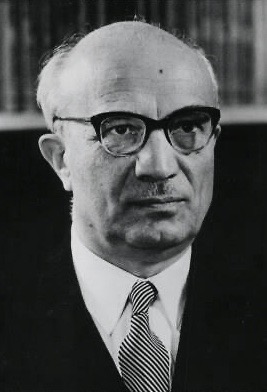
Amintore Fanfani
Amintore Fanfani (Italian pronunciation: [aˈmintore faɱˈfaːni]; 6 February 1908 – 20 November 1999) was an Italian politician and statesman, who served as 32nd prime minister of Italy for five separate terms. He was one of the best-known Italian politicians after the Second World War and a historical figure of the left-wing faction of Christian Democracy. He is also considered one of the founders of the modern Italian centre-left.
Beginning as a protégé of Alcide De Gasperi, Fanfani achieved cabinet rank at a young age and occupied all the major offices of state over the course of a forty-year political career. In foreign policy, he was one of the most vocal supporters of European integration and established closer relations with the Arab world. In domestic policy, he was known for his cooperation with the Italian Socialist Party, which brought to an alliance that radically changed the country, by such measures as the nationalization of Enel, the extension of compulsory education, and the introduction of a more progressive tax system.
Fanfani served in numerous ministerial positions, including Minister of the Interior, Minister of Foreign Affairs, Minister of Labour, Minister of Agriculture and Minister of Budget and Economic Planning. He served also as President of the Italian Senate for three terms between 1968 and 1987. He was appointed senator for life in 1972. Six years later, after the resignation of Giovanni Leone, he provisionally assumed the functions of President of the Republic as chairman of the upper house of the Italian Parliament, until the election of Sandro Pertini. Despite his long political experience and personal prestige, Fanfani never succeeded in being elected head of state.
Fanfani and the long-time liberal leader Giovanni Giolitti still hold the record as the only statesmen to have served as prime minister of Italy in five non-consecutive periods of office. He was sometimes nicknamed Cavallo di Razza ("Purebred Horse"), thanks to his innate political ability; however, his detractors simply called him "Pony" due to his small size.
Fanfani was born in Pieve Santo Stefano, in the province of Arezzo, Tuscany, in a middle-class family. His father, Giuseppe Fanfani (1878–1943), was a carpenter's son who succeeded in studying and graduating in law, starting the profession of lawyer and notary; while his mother Annita Leo (1884–1968) was a housewife. Fanfani, who was the first of nine children, grew up in an observant Catholic family. Fanfani was named after Amintore Galli, who composed the socialist anthem the Workers' Hymn; Fanfani's siblings were similarly named with eclectic or unusual names.
In 1920, at only 12 years old, Fanfani joined Catholic Action (AC), of which he became a local leader after a few years. After attending the scientific lyceum of Arezzo, he graduated in political and economic sciences in 1930 at the Catholic University in Milan, with the thesis Economic Repercussions and Effects of the English Schism. He was the author of a number of important works on economic history dealing with religion and the development of capitalism in the Renaissance and Reformation in Europe. His thesis was published in Italian and then in English as Catholicism, Capitalism and Protestantism in 1935.
Under the regime of Benito Mussolini, he joined the National Fascist Party (PNF) supporting the corporatist ideas of the regime promoting collaboration between the classes, which he defended in many articles. "Some day", he once wrote, "the European continent will be organized into a vast supranational area guided by Italy and Germany. Those areas will take authoritarian governments and synchronize their constitutions with Fascist principles."
He also wrote for the official magazine of racism in Fascist Italy, The Defence of the Race (Italian: La difesa della razza). In 1938, he was among the 330 that signed the antisemitic Manifesto of Race (Italian: Manifesto della razza) – culminating in laws that stripped the Italian Jews of any position in the government, university or professions which many previously had. Fanfani also became a professor at the School of Fascist Mysticism in Milan.
Amintore Fanfani
Amintore Fanfani (Italian pronunciation: [aˈmintore faɱˈfaːni]; 6 February 1908 – 20 November 1999) was an Italian politician and statesman, who served as 32nd prime minister of Italy for five separate terms. He was one of the best-known Italian politicians after the Second World War and a historical figure of the left-wing faction of Christian Democracy. He is also considered one of the founders of the modern Italian centre-left.
Beginning as a protégé of Alcide De Gasperi, Fanfani achieved cabinet rank at a young age and occupied all the major offices of state over the course of a forty-year political career. In foreign policy, he was one of the most vocal supporters of European integration and established closer relations with the Arab world. In domestic policy, he was known for his cooperation with the Italian Socialist Party, which brought to an alliance that radically changed the country, by such measures as the nationalization of Enel, the extension of compulsory education, and the introduction of a more progressive tax system.
Fanfani served in numerous ministerial positions, including Minister of the Interior, Minister of Foreign Affairs, Minister of Labour, Minister of Agriculture and Minister of Budget and Economic Planning. He served also as President of the Italian Senate for three terms between 1968 and 1987. He was appointed senator for life in 1972. Six years later, after the resignation of Giovanni Leone, he provisionally assumed the functions of President of the Republic as chairman of the upper house of the Italian Parliament, until the election of Sandro Pertini. Despite his long political experience and personal prestige, Fanfani never succeeded in being elected head of state.
Fanfani and the long-time liberal leader Giovanni Giolitti still hold the record as the only statesmen to have served as prime minister of Italy in five non-consecutive periods of office. He was sometimes nicknamed Cavallo di Razza ("Purebred Horse"), thanks to his innate political ability; however, his detractors simply called him "Pony" due to his small size.
Fanfani was born in Pieve Santo Stefano, in the province of Arezzo, Tuscany, in a middle-class family. His father, Giuseppe Fanfani (1878–1943), was a carpenter's son who succeeded in studying and graduating in law, starting the profession of lawyer and notary; while his mother Annita Leo (1884–1968) was a housewife. Fanfani, who was the first of nine children, grew up in an observant Catholic family. Fanfani was named after Amintore Galli, who composed the socialist anthem the Workers' Hymn; Fanfani's siblings were similarly named with eclectic or unusual names.
In 1920, at only 12 years old, Fanfani joined Catholic Action (AC), of which he became a local leader after a few years. After attending the scientific lyceum of Arezzo, he graduated in political and economic sciences in 1930 at the Catholic University in Milan, with the thesis Economic Repercussions and Effects of the English Schism. He was the author of a number of important works on economic history dealing with religion and the development of capitalism in the Renaissance and Reformation in Europe. His thesis was published in Italian and then in English as Catholicism, Capitalism and Protestantism in 1935.
Under the regime of Benito Mussolini, he joined the National Fascist Party (PNF) supporting the corporatist ideas of the regime promoting collaboration between the classes, which he defended in many articles. "Some day", he once wrote, "the European continent will be organized into a vast supranational area guided by Italy and Germany. Those areas will take authoritarian governments and synchronize their constitutions with Fascist principles."
He also wrote for the official magazine of racism in Fascist Italy, The Defence of the Race (Italian: La difesa della razza). In 1938, he was among the 330 that signed the antisemitic Manifesto of Race (Italian: Manifesto della razza) – culminating in laws that stripped the Italian Jews of any position in the government, university or professions which many previously had. Fanfani also became a professor at the School of Fascist Mysticism in Milan.
Recent media
Recent media