
Recent from talks
Ammonium carbonate
Knowledge base stats:
Talk channels stats:
Members stats:
Ammonium carbonate
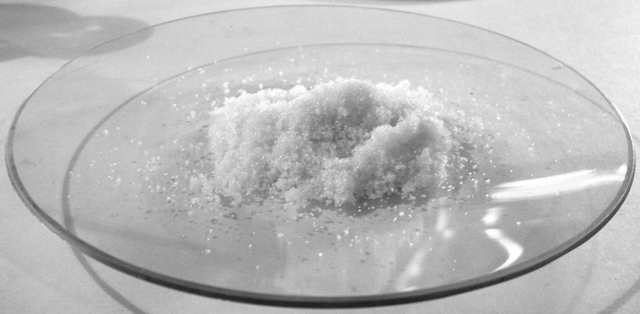
Ammonium carbonate is a chemical compound with the chemical formula [NH4]2CO3. It is an ammonium salt of carbonic acid. It is composed of ammonium cations [NH4]+ and carbonate anions CO2−3. Since ammonium carbonate readily degrades to gaseous ammonia and carbon dioxide upon heating, it is used as a leavening agent and also as smelling salt. It is also known as baker's ammonia and is a predecessor to the more modern leavening agents baking soda and baking powder. It is a component of what was formerly known as sal volatile and salt of hartshorn, and produces a pungent smell when baked. It comes in the form of a white powder or block, with a molar mass of 96.09 g/mol and a density of 1.50 g/cm3. It is a strong electrolyte.
Ammonium carbonate is produced by combining carbon dioxide and aqueous ammonia. About 80,000 tons/year were produced as of 1997.
An orthorhombic ammonium carbonate monohydrate is known ([NH4]2CO3·H2O). It crystallizes in an ammonia solution exposed in a carbon dioxide-rich atmosphere.
Ammonium carbonate slowly decomposes at standard temperature and pressure through two pathways. Thus any initially pure sample of ammonium carbonate will soon become a mixture including various byproducts.
Ammonium carbonate can spontaneously decompose into ammonium bicarbonate and ammonia:
Which further decomposes to carbon dioxide, water and another molecule of ammonia:
Ammonium carbonate may be used as a leavening agent in traditional recipes, particularly those from northern Europe and Scandinavia (e.g. Amerikaner, Speculoos, Tunnbröd or Lebkuchen). It was the precursor to today's more commonly used baking powder.
Originally made from ground deer horn and called hartshorn, today it is called baker's ammonia. It is prepared by the sublimation of a mixture of ammonium sulfate and calcium carbonate and occurs as a white powder or a hard, white or translucent mass. It acts as a heat activated leavening agent and breaks down into carbon dioxide (leavening), ammonia (which needs to dissipate) and water. It is sometimes combined with sodium bicarbonate to mimic as a[clarify] double acting baking powder and to help mask any ammonia smell not baked out.
Hub AI
Ammonium carbonate AI simulator
(@Ammonium carbonate_simulator)
Ammonium carbonate
Ammonium carbonate is a chemical compound with the chemical formula [NH4]2CO3. It is an ammonium salt of carbonic acid. It is composed of ammonium cations [NH4]+ and carbonate anions CO2−3. Since ammonium carbonate readily degrades to gaseous ammonia and carbon dioxide upon heating, it is used as a leavening agent and also as smelling salt. It is also known as baker's ammonia and is a predecessor to the more modern leavening agents baking soda and baking powder. It is a component of what was formerly known as sal volatile and salt of hartshorn, and produces a pungent smell when baked. It comes in the form of a white powder or block, with a molar mass of 96.09 g/mol and a density of 1.50 g/cm3. It is a strong electrolyte.
Ammonium carbonate is produced by combining carbon dioxide and aqueous ammonia. About 80,000 tons/year were produced as of 1997.
An orthorhombic ammonium carbonate monohydrate is known ([NH4]2CO3·H2O). It crystallizes in an ammonia solution exposed in a carbon dioxide-rich atmosphere.
Ammonium carbonate slowly decomposes at standard temperature and pressure through two pathways. Thus any initially pure sample of ammonium carbonate will soon become a mixture including various byproducts.
Ammonium carbonate can spontaneously decompose into ammonium bicarbonate and ammonia:
Which further decomposes to carbon dioxide, water and another molecule of ammonia:
Ammonium carbonate may be used as a leavening agent in traditional recipes, particularly those from northern Europe and Scandinavia (e.g. Amerikaner, Speculoos, Tunnbröd or Lebkuchen). It was the precursor to today's more commonly used baking powder.
Originally made from ground deer horn and called hartshorn, today it is called baker's ammonia. It is prepared by the sublimation of a mixture of ammonium sulfate and calcium carbonate and occurs as a white powder or a hard, white or translucent mass. It acts as a heat activated leavening agent and breaks down into carbon dioxide (leavening), ammonia (which needs to dissipate) and water. It is sometimes combined with sodium bicarbonate to mimic as a[clarify] double acting baking powder and to help mask any ammonia smell not baked out.
Recent media