Hubbry Logo
Amphibious Marine Brigade (Turkish Armed Forces)Amphibious Marine Brigade (Turkish Armed Forces)Main
Open search
Amphibious Marine Brigade (Turkish Armed Forces)
Community hub
Amphibious Marine Brigade (Turkish Armed Forces)
logo
8 pages, 0 posts
0 subscribers
Be the first to start a discussion here.
Amphibious Marine Brigade (Turkish Armed Forces)
from Wikipedia
Amphibious Marine Infantry Brigade
Amfibi Deniz Piyade Tugayı
Founded1966[1]
Country Turkey
AllegianceTurkish Armed Forces
BranchTurkish Naval Forces
TypeMarines
RoleAir assault
Airlift
Amphibious warfare
Anti-tank warfare
Armoured warfare
Artillery observer
Bomb disposal
CBRN defense
Close-quarters combat
Counterinsurgency
Counter-battery fire
Demining
Desert warfare
Direct action
Disaster response
Emergency management
Fire support
Force protection
Forward air control
HUMINT
Indirect fire
Intelligence assessment
ISTAR
Maneuver warfare
Medical evacuation
Military engineering
Military intelligence
Military logistics
Mountain warfare
Naval boarding
Patrolling
Raiding
Reconnaissance
SIGINT
Special reconnaissance
Support special operations
Tactical communications
Tracking
Urban warfare
SizeBrigade
BrigadeFoça, İzmir
NicknameTurkish Crocodiles
Mottos"Always Ready!"
"Once a marine, always a marine"
ColorsGreen
MarchAlay marşı
MascotCrocodile
Engagements
Insignia
AbbreviationAMFİBİ

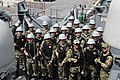
The Amphibious Marine Brigade (Turkish: Amfibi Deniz Piyade Tugayı), also known as Amphibious Commando (Turkish: Amfibi Komando), is the marine corps special operations capable unit of the Turkish Naval Forces based in Foça near İzmir, three amphibious battalions, an MBT battalion, an artillery battalion, a support battalion and other company-sized units.[3][4]

History

[edit]

The modern history of Turkish Marine Brigade, under the command of the Turkish Amphibious Group, began in 1966 with the formation of Amphibious Marine Infantry Brigade Command's first Amphibious Landing Forces, constituting the 1st Marine Infantry Battalion, was formed with Vice Admiral Kemal Kayacan's encouragement on 15 September 1966 at the Garrison of Golcük. The Forces Headquarters was established in Mersin in April 1971. The 2nd Amphibious Marine Infantry Battalion was founded in 1973, and the headquarters of the Amphibious Marine Infantry Regiment was constituted on 18 April 1974, completed prior to the Invasion of Cyprus.[2]

The Amphibious Marine Infantry Regiment operated on July 20, 1974, during intervention to Cyprus by sea, secured the beachhead and contributed to significant success. Amphibious Marine Infantry Regiment also participated in the Second Peace Operation, with the success of given tasks fulfilled. Due to the success in Cyprus Peace Operation, on November 15, 1983, Chief of the General Staff awarded the Gold "Outstanding courage and Self-sacrifice" medal.[1]

After the invasion of Cyprus in 1974, the 3rd Naval Infantry Battalion, the Amphibious Support Battalion, was formed in 1979 in Izmir. This completed the organization of the unit at the regimental level. In 1980, the 3rd Amphibious Marine Infantry Battalion temporarily deployed to Mersin to complete martial law executive tasks. In the period 1985–1992 many domestic and overseas drills were conducted, the Aegean Sea and the Mediterranean deterrence tasks were performed successfully. The Amphibious Marine İnfantry Regiment also participated operations in Syria and Libya under the leadership of Admiral Gürsel Çaypınar. [1]

[edit]

See also

[edit]

References

[edit]
Revisions and contributorsEdit on WikipediaRead on Wikipedia
from Grokipedia
The Amphibious Marine Brigade (Turkish: Amfibi Deniz Piyade Tugayı) is the principal marine infantry formation of the Turkish Naval Forces, designed for amphibious assaults, special operations, and expeditionary missions across land, sea, and coastal domains. Headquartered in Foça near İzmir, the brigade underwent modernization starting in 1966 with the creation of dedicated amphibious marine infantry battalions under the Turkish Amphibious Group. It consists of multiple specialized battalions, including infantry, tank, and support units, with ongoing expansion to include a third marine infantry brigade as part of enhanced naval force structure. The unit has executed critical tasks in major operations, such as securing beachheads during the 1974 Cyprus intervention and participating in counter-terrorism efforts in Euphrates Shield and Peace Spring operations in Syria. Known for rigorous training that enables operations in harsh environments, the brigade maintains capabilities for commando raids, humanitarian assistance, and non-combatant evacuations, supported by advanced amphibious vehicles like the FNSS MAV.

History

Origins and Establishment (1960s)

The Amphibious Marine Infantry of the Turkish Naval Forces was formally established in 1966, marking the creation of dedicated amphibious assault units within the branch. This began with the activation of the 1st Amphibious Marine Infantry Battalion on September 15, 1966, under the command structure of the emerging Amphibious Group. The formation addressed Turkey's strategic requirements for expeditionary forces capable of seaborne operations, particularly in the Aegean and Mediterranean theaters, where NATO alliance commitments necessitated rapid-response capabilities for potential conflicts involving island chains and littoral zones. Initially based in Foça, İzmir Province, the battalion represented an evolution from pre-existing naval coastal defense elements, integrating infantry trained for ship-to-shore maneuvers with naval support. Personnel underwent foundational training in amphibious landings, leveraging limited indigenous landing craft developed in the mid-1960s, such as early LCU types constructed domestically to supplement allied-supplied vessels. This establishment aligned with broader post-World War II military reorganizations in Turkey, which emphasized integrated joint operations following NATO accession in 1952 and amid escalating regional frictions, including disputes over maritime boundaries with Greece. The unit's initial strength focused on battalion-level organization, prioritizing mobility and seizure of beachheads over large-scale mechanized forces.

Development Through the 1970s and Expansion

In April 1971, the headquarters of the Amphibious Forces Command was relocated from Foça to Mersin to improve logistical positioning for operations in the eastern Mediterranean. This shift facilitated faster deployment capabilities amid rising tensions in Cyprus. The formation of the 2nd Amphibious Marine Infantry Battalion in 1973 expanded the unit's structure, completing the Amphibious Marine Infantry Regiment by July 1974 with approximately 750 marines across two battalions. This buildup emphasized amphibious assault proficiency, drawing on U.S. Marine Corps doctrinal influences for joint sea-air-land operations. During the Cyprus intervention on 20 July 1974, the regiment executed the initial amphibious landing at Pentemili Beach, west of , commencing at 0831 hours using landing craft such as LCM-8s and LCVPs. Facing logistical constraints including limited beach capacity for only three LCTs, outdated radios causing communication failures, and numerical inferiority against Cypriot National Guard forces numbering around 12,000 regulars plus 10,000 reservists, the marines secured the beachhead by 0950 hours. Naval gunfire and air support suppressed enemy artillery, enabling perimeter consolidation despite counterattacks with T-34/85 tanks and mechanical issues in Turkish M47 tanks. By 22 July, linkage with airborne forces was achieved after overcoming high terrain obstacles and expanding control eastward. The operation's success in rapidly seizing and holding the beachhead, with around 13,500 troops landed in the first 24 hours, validated the regiment's , directly informing post-intervention expansions. In , the 3rd Naval Infantry Battalion and Amphibious Support Battalion were established, formalizing brigade-level organization and enhancing power projection through integrated infantry, armor, and logistics elements. This growth incorporated empirical lessons on amphibious coordination, underscoring the causal effectiveness of specialized marine forces in contested littoral environments.

Post-Cold War Modernization and Reforms

Following the dissolution of the in 1991, Turkey's defense posture shifted from conventional -oriented threats to asymmetric challenges, including ethnic insurgencies and regional instability. The Amphibious Marine Brigade, as part of the , adapted by emphasizing rapid deployment and counter-insurgency capabilities, supporting operations against the PKK in southeastern Turkey during the 1990s. This realignment reflected broader Turkish military efforts to enhance combat readiness amid post-Cold War geopolitical changes, prioritizing flexible forces over static defense. In the 2000s, reforms integrated the brigade more closely with special operations units, fostering interoperability for expeditionary roles beyond traditional amphibious assaults. These changes aligned with Turkey's evolving naval strategy, transitioning from coastal defense to assertive in the Mediterranean and The brigade's training regimens incorporated joint exercises to address hybrid threats, maintaining elite status amid institutional restructuring. The 2016 coup attempt prompted sweeping purges across the Turkish Armed Forces, including the Navy, with approximately 30% of admirals and generals dismissed to excise alleged Gülenist infiltrators. For the Amphibious Marine Brigade, this resulted in the removal of disloyal personnel, bolstering command loyalty and operational cohesion under civilian oversight. Subsequent reforms emphasized ideological alignment and merit-based promotions, mitigating risks of internal subversion while preserving combat effectiveness. By the late 2010s, the brigade's modernization supported Turkey's Mavi Vatan (Blue Homeland) doctrine, which advocates expansive maritime claims and blue-water ambitions to secure national interests. This doctrinal shift positioned amphibious marines as key enablers for sovereignty enforcement in contested waters, integrating with national strategies for deterrence and rapid response.

Organization and Structure

Command Hierarchy and Headquarters

The Amphibious Marine Brigade falls under the operational authority of the Turkish Naval Forces Command, ensuring alignment with broader maritime strategy and defense priorities. Its primary headquarters, the Amphibious Marine Brigade Command, is situated in Foça, İzmir Province, a strategic coastal location that supports rapid deployment along Turkey's Aegean and Mediterranean flanks. This basing facilitates logistical efficiency and proximity to amphibious training grounds, enabling swift response to regional threats or contingencies. Within the naval hierarchy, the brigade reports directly to the Amphibious Task Group Command, also headquartered in Foça, which coordinates expeditionary operations and integrates marine infantry with naval assets for seamless joint maneuvers. This structure promotes operational responsiveness by embedding the brigade within the Amphibious Group's framework, allowing for synchronized planning between ground assault forces and supporting sea-based logistics during amphibious assaults or defensive postures. The command chain emphasizes decentralized execution under centralized naval oversight, minimizing delays in mobilization for missions such as coastal defense or power projection. The brigade maintains a personnel strength of approximately 4,500 to 5,000 marines, configured in a brigade-level formation optimized for high-intensity, rapid-reaction tasks. This scale supports sustained operations without diluting naval command's focus on fleet integration, while the Foça headquarters houses key staff elements for intelligence, planning, and sustainment to uphold readiness across Turkey's vulnerable maritime borders.

Component Units and Personnel Composition

The Amphibious Marine Brigade comprises three core marine infantry battalions—the 1st, 2nd, and 3rd—tasked with executing amphibious assaults, littoral maneuvers, and rapid seizure of beachheads. The 1st and 2nd Battalions, established in the early 1970s, provide the foundational infantry structure, while the 3rd Battalion is in the process of formation as of 2024 to expand operational capacity. Complementing these are specialized support elements, including logistics battalions for sustainment in expeditionary environments and integrated special forces detachments focused on reconnaissance, direct action raids, and intelligence gathering in contested coastal zones. The brigade's personnel total approximately 4,500 members, drawn from volunteers who undergo stringent selection emphasizing physical endurance, combat proficiency, and adaptability to maritime-terrestrial transitions. Post-2016 coup attempt reforms introduced mandatory ideological screening alongside physical assessments, prioritizing candidates vetted for loyalty to the chain of command and national directives to mitigate internal security risks and enhance unit cohesion under stress. This process, informed by widespread purges of over 80% of senior officers implicated in or suspected of disloyalty, has reshaped recruitment to favor ideological alignment with state priorities, as evidenced by revised promotion protocols and expanded background checks. Special forces detachments within the brigade recruit from this pool, requiring additional qualifications in unconventional warfare tactics to support raiding and scouting roles.

Equipment and Capabilities

Amphibious Vehicles and Landing Craft

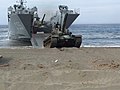
The Amphibious Marine Brigade relies on a fleet of tank landing ships (LSTs) and tanks (LCTs) for heavy-lift capabilities during amphibious operations, enabling the transport of armored vehicles, troops, and supplies directly onto defended shorelines. The Bayraktar-class LSTs, comprising TCG Bayraktar (L-402) commissioned in 2017 and TCG Sancaktar (L-403) in 2021, each displace approximately 7,250 tons fully loaded and achieve speeds up to 18 knots, facilitating the beaching of mechanized units over extended distances. These vessels support forcible entry by delivering up to 17 main battle tanks or equivalent loads via bow doors and ramps, with stern ramps for vehicle recovery. Complementing the LSTs, the brigade employs multiple classes of LCTs, including the 140-class and 151-class, totaling around 19 units, for tactical shore-to-shore movements of heavier equipment. These craft, with displacements near 1,300 tons, enable rapid deployment of armored assets from larger ships to establish initial beachheads against resistance. Recent enhancements include the New Type LCT project, with the lead vessel Ç-159 launched in February 2025 by Anadolu Shipyard, featuring improved maneuverability and a displacement of 1,155 tons for sustained operations at 20 knots. Integration with the TCG Anadolu landing helicopter dock (LHD), commissioned in April 2023, extends these surface assets' reach through vertical envelopment, allowing helicopters to insert troops over the horizon while LCTs and LCMs (landing craft mechanized) from the ship's well deck deliver vehicles directly to assault zones. For mechanized beachhead establishment, the brigade fields amphibious assault vehicles such as the ACV-15, a tracked armored personnel carrier developed by FNSS, capable of high-mobility operations in varied terrain including water crossings at speeds up to 7 knots. These vehicles, numbering in the dozens within marine units, provide protected mobility for infantry to secure landing sites under fire. Advancements include ongoing upgrades to ACV-15 variants for enhanced desert and amphibious performance, contracted in 2023. Newly acquired Marine Assault Vehicles (MAV), also known as ZAHA, began deliveries in March 2023, featuring self-righting capability after capsizing—the first such vehicle in Turkish service—and improved over-the-horizon projection when launched from LHDs or LSTs. These assets collectively enable the brigade to conduct contested landings by combining surface heavy lift with rapid, protected vehicular advance from the surf zone inland.

Weapons Systems and Logistics Support

The Amphibious Marine Brigade's infantry elements are primarily equipped with the G3 battle rifle as a standard individual weapon, supplemented by machine guns such as the MG3 for capabilities in amphibious assault scenarios. Mortar systems, including 81 mm models like the domestically produced variants, provide indirect fire support for platoon-level operations, while anti-tank missiles such as the OMTAS medium-range guided weapon enable engagement of armored threats during beachhead establishment or littoral maneuvers. Artillery support derives from towed howitzers, including 105 mm and 155 mm calibers, which deliver sustained fire to neutralize coastal defenses ahead of marine advances. Logistics sustainment relies on naval prepositioning via dedicated amphibious and auxiliary vessels, such as logistic support ships capable of transporting ammunition, fuel, and supplies to forward positions. These assets facilitate brigade-level self-sufficiency for initial independent operations, typically spanning 72 hours, by enabling rapid resupply in austere littoral environments without reliance on contested shore infrastructure. Adaptations for urban and mountainous terrain incorporate man-portable mortars and anti-tank systems, refined through empirical data from regional deployments emphasizing mobility and reduced logistical footprints over extended fire support chains.

Operations and Deployments

Cyprus Intervention (1974)

On July 20, 1974, elements of the Turkish Amphibious Marine Brigade executed the initial amphibious assault of Operation Attila at Pentemili beach near Kyrenia, landing approximately 1,000 marines from LSTs and supported by naval gunfire and air cover against outnumbered Greek Cypriot National Guard positions. The marines rapidly secured a beachhead spanning several kilometers, repelling counterattacks and establishing defensive positions that facilitated the arrival of follow-on army units, including armored elements, over the subsequent days. This operation captured an initial 3% of Cyprus's territory by the time of the first ceasefire on July 22, with Turkish forces reporting minimal marine casualties in the landing phase—around 20 killed and 100 wounded—while inflicting heavier losses on Cypriot defenders estimated at over 200. Turkish accounts credit the brigade's swift advance with halting imminent threats to Turkish Cypriot enclaves, including documented attacks and killings by Greek Cypriot militias following the July 15 coup d'état led by Nikos Sampson, which aimed to unite Cyprus with Greece and had already resulted in the deaths of several dozen Turkish Cypriots in the preceding days. The intervention, per Ankara, prevented broader massacres akin to those in 1963–1964 intercommunal violence, where over 500 Turkish Cypriots were killed, by creating a protective corridor linking isolated communities to the secured north. These claims draw from eyewitness reports and post-operation assessments, though independent verification remains contested due to restricted access to archives. The operation sparked immediate international controversy, with the UN Security Council adopting Resolution 353 on July 20 demanding an immediate end to hostilities, withdrawal of foreign military personnel, and cessation of foreign interference, viewing the landings as a violation of Cypriot sovereignty despite the preceding coup. Turkey justified the action under Article IV of the 1960 Treaty of Guarantee, which authorized guarantor powers (Turkey, Greece, UK) to intervene unilaterally if necessary to restore the bi-communal constitution undermined by the Athens-backed coup, though critics argue the response exceeded proportionate restoration by establishing permanent territorial control. Declassified analyses highlight that while the treaty permitted limited action, the amphibious scale and outcomes deviated into de facto partition, prompting ongoing legal disputes without resolution in bodies like the European Court of Human Rights.

Counter-Terrorism and Regional Operations (1990s–Present)

Since the 1990s, the Amphibious Marine Brigade has supported Turkey's counter-terrorism efforts against the Kurdistan Workers' Party (PKK) in southeastern regions, deploying specialized units for ground operations in challenging terrain. In December 1993, one marine infantry battalion was dispatched to Şırnak province to engage in anti-terrorist activities, contributing to the ' adaptation to low-intensity conflict through lighter, more mobile formations. These deployments leveraged the brigade's amphibious training for rapid insertions via coastal or riverine approaches, enabling surprise maneuvers against PKK hideouts in areas like the Black Sea coast and southeastern waterways, where traditional army units faced logistical constraints. The brigade extended its role to regional maritime security operations, participating in multinational counter-piracy and interdiction missions in the Gulf of Aden and off Somalia's coast. As part of (2009–2016) and , Turkish naval assets including marine boarding teams conducted visit, board, search, and seizure actions, detaining pirates and escorting over 1,000 merchant vessels annually in high-risk corridors; for instance, in 2009, frigate TCG Gediz neutralized a pirate skiff targeting commercial shipping, with marine specialists securing detainees. These efforts disrupted piracy networks, reducing successful attacks from 217 in 2009 to 4 by 2013 in the monitored areas, though sustained patrols were required due to persistent threats from groups like al-Shabaab affiliates. In support of hybrid regional engagements, brigade elements deployed to Libya amid the 2019–2020 civil war, aiding the UN-recognized Government of National Accord against the Libyan National Army through advisory and operational roles that integrated with Turkish drone strikes and naval logistics, helping reverse frontline losses near Tripoli by mid-2020. This intervention, involving up to 3,800 Turkish-backed forces overall, shifted momentum via targeted operations that neutralized over 100 opposing vehicle-mounted units, though it drew criticism for escalating proxy dynamics without UN mandate expansion. The brigade's versatility thus extended beyond amphibious assault to address asymmetric threats, including PKK-linked activities in border zones and maritime terrorism vectors.

Training and Doctrine

Domestic Training Programs and Facilities

The Amphibious Marine Brigade conducts its primary domestic training at the Foça Naval Base near İzmir, which functions as the central hub for developing operational proficiency in amphibious warfare. Established as the brigade's headquarters following its relocation from Gölcük in 1977, the base features facilities tailored for rigorous preparation in high-risk maritime environments, including land-based simulations and sea access for practical drills. Training programs emphasize endurance and specialized skills, with personnel undergoing daily routines such as full-gear morning runs, commando-level exercises, and practical sessions in vessel boarding, fast-roping, and survival under adverse sea conditions. These annual cycles integrate land and maritime components to build resilience for prolonged operations, incorporating shooting, sports, and mission-specific theoretical instruction. As of January 2025, recent evaluations included sniper courses and comprehensive amphibious maneuvers to maintain peak physical and tactical capabilities. The brigade's doctrine has shifted from reliance on NATO standards toward nationally oriented frameworks, prioritizing scenarios centered on Aegean Sea defense amid ongoing territorial disputes. This evolution aligns with broader Turkish naval strategy, incorporating assertive postures to safeguard maritime claims, while retaining core amphibious tactics adapted to regional threats like island-hopping contingencies. Readiness is assessed through internal after-action reviews of domestic exercises, ensuring alignment with national security imperatives over multilateral formats.

Joint Exercises and International Cooperation

The Amphibious Marine Brigade participates in multinational exercises to bolster interoperability with allies and partner nations, focusing on amphibious assault coordination and rapid deployment scenarios. In August 2025, Turkish marines joined the for the inaugural bilateral amphibious exercise in , conducted from July 27 to August 2, which included amphibious landings, combat firing techniques, convoy escorts, and urban operations drills to validate joint operational readiness. Within NATO structures, elements of the brigade integrated into the Turkish Amphibious Task Force, which assumed command of the Allied Reaction Force (ARF) Amphibious Task Force (CATF) and Commander Landing Force (CLF) roles on July 1, 2025, marking Turkey's first such leadership in ARF maritime components. This command facilitated exercises like Dynamic Mariner 25, emphasizing allied amphibious interoperability across the Mediterranean and Atlantic. Large-scale national exercises such as Denizkurdu-II/2025, involving over 120 ships from May 6 to 17, and Mavi Vatan-2025 with 77 surface vessels in January, tested brigade integration in complex amphibious operations, including live-fire landings that enhance capabilities transferable to international coalitions. These drills have demonstrably improved command-and-control synchronization and live-fire proficiency among participating forces, as evidenced by coordinated multinational maneuvers in prior iterations like EFES, where interoperability planning reduced execution timelines.

Strategic Role and Assessments

Integration in Turkish Naval Strategy

The Amphibious Marine Brigade constitutes a pivotal element in Turkey's Mavi Vatan (Blue Homeland) doctrine, which asserts expansive maritime jurisdiction across the Aegean, Eastern Mediterranean, and Black Seas to safeguard national interests against perceived encirclement. This integration emphasizes amphibious power projection as a means to deny adversaries control over chokepoints and littoral zones, enabling rapid seizure or reinforcement of islands and coastal areas that could otherwise constrain Turkish naval maneuverability. The brigade's capabilities align with first-principles of maritime strategy by prioritizing offensive denial over static defense, allowing Turkey to project force asymmetrically in archipelagic environments where numerical fleet superiority alone proves insufficient. In synergy with the Turkish Navy's surface combatants and submarines, the brigade forms a layered operational framework for integrated defense, where amphibious units provide ground-holding presence to support fleet actions in contested waters. This coordination has been empirically validated through multi-domain exercises, such as the Mavi Vatan-2025 drill on January 12, 2025, which incorporated land, air, and naval elements to simulate holistic maritime operations including amphibious insertions. Submarine-launched threats and surface fleet fire support extend the brigade's reach, creating causal dependencies where amphibious forces amplify naval deterrence by occupying denied areas post-strike, as outlined in the Turkish Navy's 2022–2025 activity report detailing specialized amphibious and coastal defense protocols. The brigade's strategic embedding further contributes to deterrence amid Eastern Mediterranean hydrocarbon disputes, where control over exclusive economic zones hinges on credible forcible response options. By enabling swift littoral maneuvers, it counters attempts to isolate Turkey's maritime domain through alliances excluding Ankara, reinforcing a posture of resolved commitment to defend delineated claims without reliance on prolonged attrition. This doctrinal fusion underscores Turkey's transition to a maritime-oriented defense posture, prioritizing amphibious enablers for sustained presence in resource-contested theaters.

Effectiveness and Criticisms

![Amphibious Marines perform fast-rope exercises from a U.S. Navy MH-60S Sea Hawk helicopter during exercise Phoenix Express in 2009][float-right] The Amphibious Marine Brigade proved its effectiveness in the 1974 Cyprus intervention, executing amphibious landings on July 20-23 despite incomplete air and naval superiority, utilizing surprise to overcome Greek defensive advantages and secure beachheads that enabled subsequent advances. Turkish naval assessments highlight the operation's success in demonstrating adaptability under operational constraints, with forces rapidly consolidating gains against numerically comparable opponents. Participation in multinational exercises, such as Phoenix Express and EFES 2016, has further validated capabilities in amphibious assaults and interdiction, with integrated operations alongside NATO allies underscoring tactical proficiency in controlled environments. Following the 2016 coup attempt purges, which dismissed over 1,500 staff officers across the , the brigade maintained operational readiness, with internal evaluations emphasizing enhanced loyalty and cohesion in subsequent training and deployments. Turkish military sources attribute this to rigorous post-purge vetting, fostering unit discipline evident in sustained exercise performance. Critics, including Western defense analysts, point to logistical vulnerabilities in peer or near-peer conflicts, where reliance on contested landing craft exposes forces to precision strikes absent assured air superiority, as simulated in NATO scenarios. Equipment modernization has occasionally lagged NATO peers in areas like advanced amphibious vehicles, though recent indigenous programs mitigate gaps; for instance, French assessments acknowledge overall naval contributions but note interoperability challenges in high-intensity multi-front operations. These concerns are tempered by operational data from Cyprus and exercises, where adaptability compensated for material limitations, countering claims of inherent overstretch with evidence of effective force employment.

Recent Developments (2020s)

In August 2024, the Turkish Naval Forces established a third Marine Infantry Brigade to enhance amphibious capabilities amid heightened regional tensions in the Eastern Mediterranean and Black Sea. This expansion builds on the existing two brigades, increasing personnel and operational capacity for rapid deployment and power projection. From July 2025 to June 2026, Turkey assumed leadership of NATO's Amphibious Task Force for the first time, following successful readiness inspections of its Amphibious Task Group. This role, transferred from , underscores the brigade's integration into alliance structures, focusing on multinational amphibious operations and crisis response. The brigade has deepened integration with the TCG Anadolu, Turkey's amphibious assault ship reconfigured as a drone carrier, enabling drone-supported marine operations. During the Sea Wolf-I 2025 exercise, Bayraktar TB3 drones launched from the Anadolu conducted strikes, demonstrating combined arms tactics with marine assault elements across multiple seas. The exercise, involving over 90 ships, submarines, and aircraft, tested urban assault and maritime interdiction drills, affirming the brigade's readiness for hybrid threats.

References

Add your contribution
Related Hubs
User Avatar
No comments yet.