Hubbry Logo
Fire supportFire supportMain
Open search
Fire support
Community hub
Fire support
logo
8 pages, 0 posts
0 subscribers
Be the first to start a discussion here.
Contribute something
Fire support
Fire support
from Wikipedia
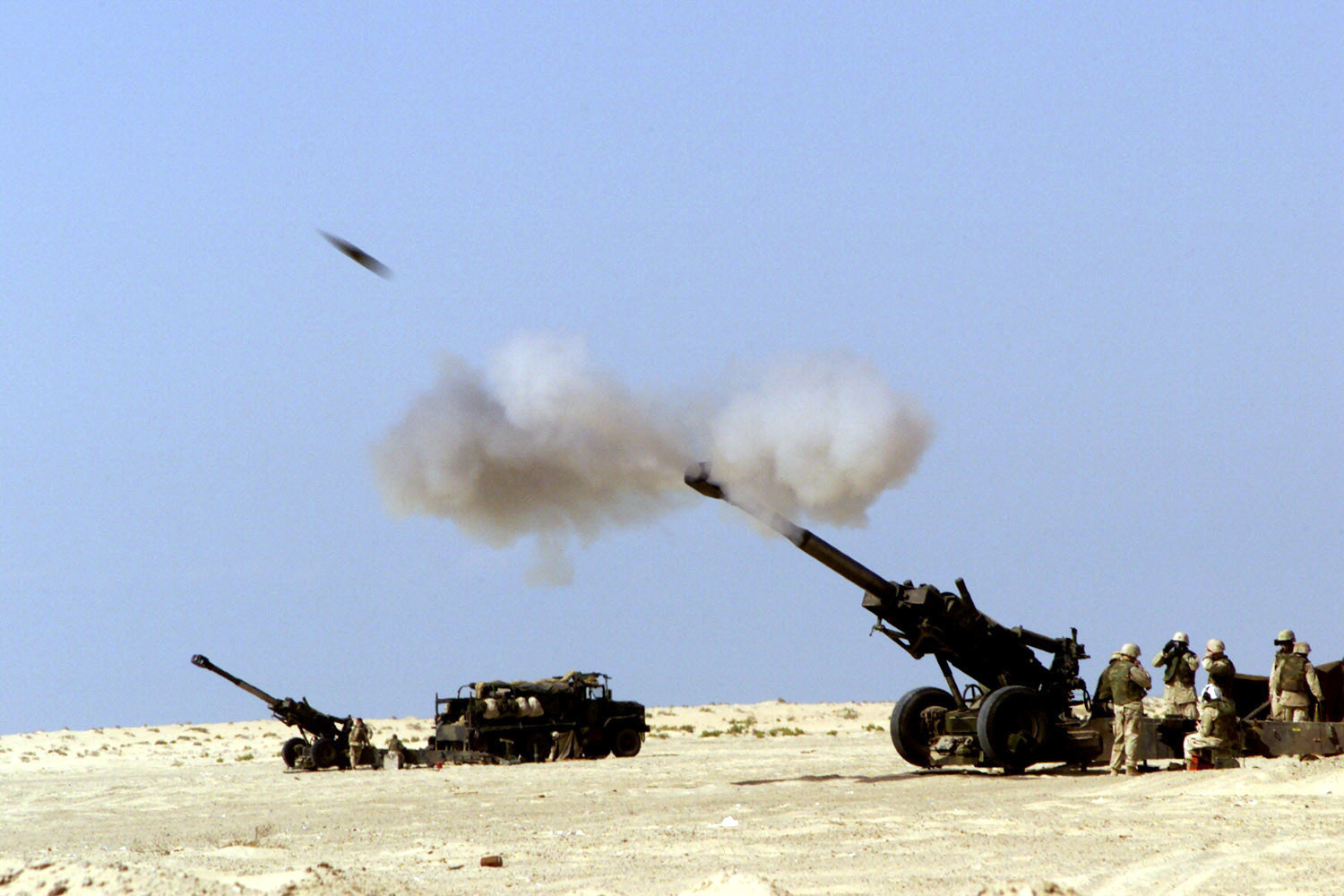
An M198 howitzer firing a 155 mm caliber shell to provide artillery fire support

Fire support is a military tactics term used to describe weapons fire used to support friendly forces by engaging, suppressing, or destroying enemy forces, facilities, or materiel in combat. It is often provided through indirect fire, though the term may also be used for some forms of supporting direct fire.

The United States Department of Defense defines fire support as "fires that directly support land, maritime, amphibious, and special operations forces to engage enemy forces, combat formations, and facilities in pursuit of tactical and operational objectives."[1]

Overview

[edit]
U.S. Marines watching the aftermath of an airstrike during Operation Prairie II of the Vietnam War

Fire support generally consists of fire from heavy or crew-served weaponry with high firepower, including strikes and barrages from artillery, mortars, rocket artillery, and missiles; naval gunfire support from naval artillery; airstrikes, strafes, and close air support from military aircraft; and drone strikes from unmanned combat aerial vehicles; among various other forms. Fire support is typically ordered and directed by an observer (e.g. artillery observer, forward air controller, etc.) on the front line, and provided by a weapon crew or operator in the rear, usually from a fortification, vehicle, or facility (such as a fire support base).

Fire support is used to support and supplement military units that may lack the capabilities or firepower offered by fire support. For example, an infantry unit needing heavy explosives to bombard an enemy emplacement, or a large smoke screen to cover their advance, and lacking the ability to do so themselves (e.g. insufficient effectiveness using grenades), may call for fire support from a capable nearby mortar unit.

Fire support can reduce friendly casualties whilst devastating enemy capabilities and morale. Effective use of fire support—as seen during the 2018 Battle of Khasham of the Syrian Civil War, where an outnumbered force used various forms of fire support to their advantage, avoiding serious casualties—may help swing a battle in one's favor.

History

[edit]

Varying forms of fire support have existed since the advent of early cannons and rockets, which were used to bombard enemy positions and fortifications to support infantry. Warships have long provided fire support using their cannons. The use of fire support in its current form developed during World War I and World War II, when combined arms and advances in technology and tactics made fire support increasingly effective.

Definition

[edit]

Fire support is defined as "assistance to infantry and armored units by artillery fire, naval gunfire, and airplane strafing and bombing."[2]

Early cannons (1300-1599)

[edit]

Early versions of artillery included the Roman ballista, essentially a large, mounted version of a crossbow that fired a single arrow. The first documented use of bombards, (large mortars) in Europe as we know them today was at the siege of Algeciras in 1343. By the 1470s, casting and metal work dramatically improved, giving way to the modern cannon. In the early 15th century, cast iron balls were invented for cannons. These balls, combined with gunpowder, were commonly used during sieges. By around 1550, the French had begun categorizing their guns by caliber, leading to a more organized formation of artillery.

Renaissance and revolutionary cannons (1600-1790)

[edit]

Circa 1650, the French garrison gun was invented. The garrison gun was usually mounted and tied down to reduce recoil, and could be mounted in very small spaces. By the mid-18th century artillery pieces were making an appearance in North America, most notably during the French and Indian War. Artillery was later used by the Americans in their war for independence. The Continental Army used cannons captured at Fort Ticonderoga to win the Battle of Yorktown, the last major battle of the American Revolution.

Fire support during World War I and World War II (1914-1945)

[edit]

During the first World War, fire support was mostly used preemptively before an infantry attack. Artillery was often used to destroy enemy forces and positions, as well as obstacles in and near trenches. During this time, we also see the introduction of chemical fire support, using chemical compounds inside of shells in addition to conventional armaments. During the second World War, there was a joint usage of fire support by field artillery, naval fire support and air support. Field artillery was mainly in the western and eastern theaters, while naval fire support was used during the pacific theater, however a large number of ships were used to give fire support on D-Day. During World War II there was a large use of aerial fire support that included major improvements in technology in all theaters and campaigns of the second world war.

Fire support in Vietnam (1955–1974)

[edit]

During the Vietnam War, fire support was used to flush out Viet Cong positions. Most notably, napalm was used to destroy forests and jungles, resulting in less cover for the enemy.

Fire support in recent warfare (since 1975)

[edit]

During Operation Desert Storm the United States used fire support, particularly onboard naval craft to bombard positions. During this operation, we also see the introduction of drones into combat, as a way to provide fire support from the air without a manned aircraft. During Operation Desert storm, Artillery was used to achieve a decisive victory by coalition forces. More recently Artillery has been used in the Russo-Ukrainian war to bombard troops and key positions. When the war first broke out, the United States sent artillery aid including shells, cannons and Patriot missile defense systems to aid Ukraine. As of 2023, Fire support by tanks and artillery have been used by the Israeli Defense Force to bombard key positions in the war against Hamas.

[edit]

See also

[edit]

References

[edit]
Revisions and contributorsEdit on WikipediaRead on Wikipedia
from Grokipedia
Fire support is the coordinated and integrated employment of indirect fires from land, air, and naval platforms, including , mortars, rockets, missiles, and armed aircraft, to deliver lethal and nonlethal effects that support ground maneuver forces in achieving operational objectives across the spectrum of conflict. In military operations, fire support plays a pivotal role in enhancing the effectiveness of maneuver units by destroying, neutralizing, or suppressing enemy forces, protecting friendly troops, and shaping the to enable decisive actions. It integrates with the commander's to provide close support for forces in contact, deep fires against enemy reserves, and counterfire to neutralize hostile , thereby contributing to the control of territory, populations, and key areas. Fire support has evolved from traditional barrages to modern precision-guided munitions and , multi-domain operations. The fire support system encompasses three primary elements: target acquisition through , , and assets like radars and unmanned aerial systems; via fire support coordinators and joint targeting boards to ensure synchronization; and delivery systems such as cannon , naval gunfire, , and electronic warfare for both lethal and nonlethal effects. Types of fire support include indirect surface-to-surface fires from and mortars, air-to-surface strikes via fixed- and rotary-wing aircraft, naval surface fire support, and suppressive or obscuring effects like smoke screens. These capabilities are employed across offensive, defensive, and stability operations to maximize combat power while minimizing risks to civilians and friendly forces. Effective fire support relies on principles of early and continuous , unity of effort among and multinational forces, flexibility in response to dynamic threats, and rigorous coordination measures to prevent . Key coordination tools include fire support coordination measures such as the fire support coordination line (FSCL) and coordinated fire line (CFL), which delineate areas for unrestricted fires, alongside control measures like high-density control zones to integrate air and ground operations seamlessly. Through these mechanisms, fire support ensures timely, precise, and sustainable effects that align with broader campaign objectives.

Definition and Principles

Definition

Fire support is defined as the rapid and continuous integration of surface-to-surface indirect fires, target acquisition, armed aircraft, and other lethal and nonlethal attack or delivery systems that converge on targets across all domains in support of the supported commander's concept of operations. In joint operations, it encompasses fires that directly support land, maritime, amphibious, and special operations forces by engaging enemy forces, combat formations, and facilities to achieve tactical and operational objectives. This includes weapons such as artillery, mortars, rockets, aviation assets, and naval guns, employed to engage, suppress, fix, or destroy enemy targets while aiding friendly maneuver forces. Unlike , which involves line-of-sight aiming and engagement by weapons like rifles or guns integrated into the maneuver element, fire support emphasizes methods that deliver effects without a direct observer line to the target, requiring precise coordination to integrate with ground operations. This distinction ensures that fire support assets, often positioned rearward, provide suppressive or destructive effects to enable freedom of maneuver for forward units without exposing the firing platforms to immediate counterfire. The terminology of fire support was formalized in U.S. Army publications in the post-World War II period through field manuals that standardized its integration into tactics. This evolution reflects a shift toward systematic planning and execution, as detailed in doctrines like FM 3-09, which builds on prior manuals to address modern multi-domain operations. Fire support must operate within legal and ethical boundaries, including that align with , such as the , which require parties to distinguish between combatants and civilians and to take feasible precautions to minimize from indirect fires in populated areas. These obligations, reinforced by Additional Protocol I to the (Article 51(5)(b)), prohibit attacks expected to cause excessive incidental civilian harm relative to the concrete military advantage anticipated.

Principles of Employment

The principles of fire support employment provide a doctrinal framework for integrating fires into military operations to achieve decisive effects while minimizing risks to friendly forces. U.S. Army doctrine in FM 3-09 outlines 10 key principles: Plan and coordinate fire support early and continuously; ensure the continuous availability of target information; use all available lethal and nonlethal fires; employ the fire support asset from the lowest echelon capable of delivering effective fires; furnish the type of support requested; use the most effective delivery system to deliver the required effect; provide adequate support; ensure rapid coordination of fire support; provide flexibility in response; and support the force in contact. To prevent friendly fire and ensure safe integration of joint fires, fire support coordination measures (FSCMs) such as the fire support coordination line (FSCL) and no-fire areas (NFAs) are employed. The FSCL is a line beyond which fires can be delivered without additional coordination with affected forces, facilitating a permissive environment for rapid engagement while protecting forward troops; it is established by the maneuver commander and adjusted based on operational tempo. NFAs designate zones where fires are prohibited to safeguard friendly units, civilians, or critical infrastructure, except in cases of self-defense or with explicit approval from the establishing commander. These measures are dynamically managed through liaison and communication to balance offensive momentum with force protection. The targeting process follows a structured cycle to identify, engage, and evaluate effectively, typically using the Decide, Detect, Deliver, and Assess (D3A) . In the Decide phase, commanders identify high-payoff (HPTs) based on the mission and develop prioritized target lists integrated with preparation of the . Detection involves locating and tracking using sensors, , or acquisition assets to validate their status. Delivery assigns appropriate assets—such as or air support—to engage at the optimal time, synchronizing effects through preplanned or immediate requests. Assessment evaluates battle damage and effects via reports from observers or sensors, recommending re-engagement if necessary to measure success against objectives. Integration with maneuver ensures fire support shapes the battlefield to enable ground forces' freedom of action, dividing fires into close support for immediate tactical needs and deep fires for disrupting enemy reserves. Close support directly aids advancing units by suppressing threats during assaults or breaches, coordinated through forward observers to align with the scheme of maneuver. Deep fires target enemy command nodes or logistics farther to the rear, creating windows of opportunity for maneuver by degrading the enemy's ability to reinforce or counterattack. This synchronization occurs continuously during planning and execution, using FSCMs to deconflict fires with troop movements and phase lines. Effectiveness is measured through criteria focused on achieving specific outcomes, such as suppression, which temporarily degrades enemy performance below mission-capable levels. Adjustment techniques distinguish between observed fires, which use forward observers or sensors for real-time corrections to enhance accuracy, and unobserved fires, relying on precomputed or predicted impacts for rapid but less precise delivery in high-tempo scenarios. These metrics guide reallocation of assets and inform commanders on whether fires have met suppression thresholds, such as neutralizing key enemy capabilities without excessive expenditure.

Types of Fire Support

Ground-Based Systems

Ground-based systems form the backbone of support in military operations, providing responsive, high-volume fires to suppress, neutralize, or destroy enemy targets while supporting maneuver forces. These systems primarily encompass and mortars, which deliver projectiles via high-angle trajectories to engage defilade positions beyond direct line-of-sight. Unlike air or naval assets, ground-based platforms emphasize integration with ground maneuver elements through established coordination measures, such as the fire support coordination line (FSCL), to synchronize effects across the battlefield. Artillery systems are categorized into towed, self-propelled, and multiple-launch variants, each optimized for different operational needs in terms of mobility and . Towed howitzers, such as the M777 155mm lightweight system, offer high portability for rapid deployment in expeditionary environments, weighing under 10,000 pounds and compatible with air transport via C-130 aircraft. Self-propelled howitzers, like the M109A6 Paladin 155mm, provide armored protection and on-the-move firing capability, typically organized in batteries of eight guns for heavy combat teams. Multiple-launch rocket systems (MLRS), including the wheeled , enable saturation fires with precision-guided rockets, launching up to six munitions per pod from a truck-mounted platform for quick setup in forward areas. Mortars serve as organic, close-range fire support assets at the and levels, prioritizing responsiveness over long-range projection. Light 60mm mortars, such as the M224, are man-portable systems weighing 18 to 45 pounds, ideal for units in airborne or roles due to their simplicity and ability to be carried by a single . Medium 81mm mortars, like the M252, balance portability and power at around 93 pounds, breaking down into loads for a three-man team and providing greater explosive yield for platoon-level suppression. Heavy 120mm mortars, including the M120, deliver the most potent effects at 320 pounds, often vehicle-mounted for support and capable of outranging lighter variants to engage targets in defilade with high-angle . Ammunition for ground-based systems varies to achieve diverse effects, from destructive to obscuring or illuminating. High-explosive (HE) rounds form the core for fragmentation and blast effects against personnel and light fortifications, compatible across howitzers and mortars. munitions generate screening or marking effects to obscure enemy observation or signal friendly positions, while illumination rounds deploy flares for nighttime over areas up to several kilometers. Precision-guided munitions, such as the GPS-guided 155mm shell, enhance accuracy to a radial miss distance of less than 2 meters, enabling reduced by replacing up to 10 conventional rounds per target. Mobility and deployment tactics prioritize survivability against enemy counterfire, particularly through counter-battery operations that neutralize hostile via radar-directed strikes. maneuvers involve firing a salvo or mission, then rapidly relocating to a new position—often within minutes—to evade detection and retaliation, resetting the enemy's targeting cycle and maintaining operational tempo. This tactic is especially critical for self-propelled and MLRS platforms, which can displace under armor or via wheeled to minimize exposure. Range and accuracy are determined by system design, propellant, and guidance, with fire direction centers (FDCs) serving as the computational hub for missions. Modern howitzers typically achieve effective ranges of 30-40 km, such as the M777 extending to 40 km with munitions, allowing support for brigade-level operations. FDCs, located proximate to firing units, process observer data to compute ballistic solutions—including , , and settings—using automated systems for rapid, precise targeting that adjusts for environmental factors like wind and terrain.

Air-Delivered Support

Air-delivered support encompasses aerial operations that provide timely and precise firepower to ground forces, primarily through (CAS) and related assets. CAS involves air action by fixed-wing and rotary-wing against hostile targets in close proximity to friendly forces, requiring detailed integration of each mission with the of those forces. This form of support enables dynamic effects, such as suppressing enemy positions or destroying armored threats, while minimizing risk to allied troops. Fixed-wing aircraft, such as the A-10 Thunderbolt II, excel in low-altitude strikes with heavy ordnance loads, while rotary-wing platforms like the AH-64 Apache provide agile, helicopter-based attacks in complex terrain. These assets deliver precision-guided munitions (PGMs), including laser-guided bombs like the for line-of-sight targeting and GPS-guided Joint Direct Attack Munitions (JDAMs) such as the GBU-31 for all-weather operations. Rotary-wing systems often employ air-to-ground missiles like the , which offer standoff range and high accuracy against vehicles or personnel. Effective targeting and control rely on joint terminal attack controllers (JTACs), who operate from forward positions to coordinate strikes using standardized procedures, such as the 9-line briefing format that details target location, friendly positions, and restrictions. Control types range from Type 1 (visual acquisition by both controller and ) to Type 3 (pre-briefed attacks without real-time visuals), ensuring deconfliction through measures like fire support coordination measures (FSCMs). may involve designation or pointers to direct PGMs precisely. Air-delivered support offers advantages including rapid response—often within minutes when are on station—and extended reach beyond ground-based systems, enhancing maneuverability in fluid engagements. All-weather PGMs and pods enable operations in adverse conditions, while loiter capabilities allow sustained and multiple strikes. However, limitations include vulnerability to enemy air defenses, such as man-portable systems, and challenges in urban or low-visibility environments where target identification risks or . Detailed coordination can introduce delays compared to simpler fire support options. Unmanned aerial systems (UAS), such as the MQ-9 Reaper, extend these capabilities with persistent fire support, combining intelligence, surveillance, and reconnaissance (ISR) for up to 27 hours on station while armed with Hellfire missiles and GBU-12 bombs. These platforms enable munitions delivery and remote piloting, reducing risk to personnel in contested areas and supporting prolonged operations. Naval gunfire support (NGFS) provides from surface ships to suppress, neutralize, or destroy enemy targets in littoral environments, historically employing large-caliber guns such as the 16-inch batteries on Iowa-class battleships during and the , which delivered high-volume, long-range bombardment to support amphibious assaults. In modern operations, NGFS relies on 5-inch/127mm guns mounted on destroyers and cruisers, such as the Mk 45 system, which offers precision-guided munitions for improved accuracy against time-sensitive targets within 13-20 nautical miles of the shore. These systems integrate with joint fire control measures to deliver responsive support, as demonstrated in Desert Storm where NGFS from cruisers and destroyers neutralized Iraqi coastal defenses ahead of Marine landings. Cruise missiles, particularly the , extend naval fire support to standoff ranges exceeding 1,000 miles, enabling deep strikes against fixed infrastructure or command nodes without exposing ships to coastal threats. Launched from submarines or surface combatants, TLAM variants like the Block V provide both land-attack and anti-ship capabilities, with inertial navigation and GPS guidance ensuring sub-meter accuracy for precision fires in support of ground operations. This capability has been pivotal in operations such as the 1991 , where over 300 Tomahawks crippled Iraqi air defenses, creating fires corridors for follow-on forces. Emerging non-kinetic systems augment traditional naval fires through electronic warfare (EW), cyber operations, and . EW jamming disrupts enemy communications and radar, functioning as a form of fires to deny adversaries access and suppress air defenses without physical destruction, as outlined in U.S. where electronic attack integrates with kinetic effects for multi-domain dominance. Cyber fires involve offensive operations to degrade command-and-control networks, potentially halting enemy movements or in real-time, with U.S. Cyber Command emphasizing their role in synchronizing effects across phases of conflict to shape the . , including GPS satellites and constellations, enable precise targeting for naval strikes by providing persistent and positioning data, as seen in that links orbital systems to accurate weapons delivery for expeditionary forces. In amphibious operations, naval fire support integrates with Marine Air-Ground Task Force (MAGTF) elements through coordinated planning, where offshore platforms deliver pre-landing bombardments and sustained fires to protect assault waves, using liaison teams to deconflict with ground maneuvers. This synchronization, as in historical examples like , relies on shared fire support coordination measures to allocate assets across surface, air, and subsurface domains. Despite these capabilities, naval fire support faces limitations including weather dependency, which can degrade visibility and accuracy for gunfire during storms or , restricting operations to clear conditions unlike all-weather alternatives. Range constraints limit effective NGFS to littoral zones, with modern 5-inch guns unable to match the deep-strike reach of missiles or , while coordination challenges arise from integrating multi-service fires, necessitating robust networks to avoid in dynamic environments. Additionally, the vulnerability of ships to anti-ship missiles near shorelines demands standoff employment, reducing responsiveness for close support.

Historical Development

Early Development (1300-1799)

The adoption of gunpowder in Europe during the early 14th century, originating from Chinese inventions of the 10th to 13th centuries, marked the beginning of fire support in warfare, initially through rudimentary cannons used to breach fortifications in sieges. By the 1320s, the first documented European cannons appeared, with illustrations in Walter de Milemete's 1326 treatise depicting vase-shaped weapons, and references to powder formulations for the French king. These early bombards, often constructed from wooden staves hooped with iron, were employed at the Battle of Crécy in 1346 during the Hundred Years' War, where English forces reportedly used small guns to support infantry against French assaults, though their impact was more psychological than decisive due to unreliable powder and slow reloading. Similarly, at the subsequent Siege of Calais (1346–1347), such weapons aided in weakening defenses, establishing gunpowder artillery as an emerging tool for indirect support to ground troops. Medieval cannons, including the pot-de-fer—a bulbous, vase-like single-barrel device introduced around the late —and ribauldequins, multi-barreled firearms mounted on carts from the , began providing limited support by firing stone or iron projectiles to disrupt enemy formations or cover advances. These weapons were primarily deployed in sieges, such as the 1453 , where large bombards breached walls to facilitate assaults, but their role in open battles remained marginal. Key limitations included poor mobility, as heavy iron or early pieces required teams of oxen or sledges for transport, rendering them unsuitable for rapid battlefield repositioning, and low accuracy due to inconsistent quality and rough barrel interiors that caused erratic trajectories. Production costs for both cannons and saltpeter-based powder further restricted their widespread use, confining them mostly to royal or wealthy commanders. Advancements during the , particularly in bronze casting techniques borrowed from bell-founders, enabled the production of lighter, more reliable by the late 15th century, shifting some applications toward battlefield support. In the (1494–1559), French forces under Charles VIII introduced mobile bronze cannons, including falconets—small, lightweight pieces firing 1- to 2-pound shots—that could be horse-drawn and repositioned quickly to support maneuvers, as seen in the rapid of Italian cities in 1494. These innovations, with smoother bores and trunnions for easier , improved range to about 1,000 yards and allowed for quicker firing rates compared to medieval bombards, though accuracy still depended on manual aiming. In the late 18th century, the , developed by Jean-Baptiste Vaquette de Gribeauval in during the 1760s, represented a pinnacle of pre-industrial mobility reforms, standardizing lighter 4-, 8-, and 12-pounder guns along with 6-inch howitzers that reduced weight by up to 40% through shorter 18-caliber barrels and . Following tests in starting in 1764 and official adoption in 1765, the system emphasized field, siege, and garrison categories, with mobile batteries using 4- to 6-horse teams for rapid deployment. This was demonstrated at the Siege of Yorktown in 1781, where French forces under Rochambeau employed Gribeauval-pattern 4-pounders and heavier pieces in coordinated batteries to bombard British positions, supporting American infantry advances and contributing to Cornwallis's surrender. Tactically, evolved from static roles, where bombards were fixed to batter walls, to integrated support by the , facilitated by the French invention of the limber around 1550—a two-wheeled attachment that allowed horse-drawn cannons to be maneuvered like caissons for quicker unlimbering and firing. Influenced by earlier Hussite wagon forts and the Hundred Years' War's rudimentary field use, this shift enabled pieces like falconets to provide covering fire for squares against cavalry, as in the 1525 , though full massed batteries emerged later under in the 1620s. By the 1760s, Gribeauval's reforms further promoted for dynamic support, using at 300–400 yards to break enemy lines, laying groundwork for fire support as an extension of firepower.

19th Century to World War I (1800-1918)

During the , transitioned from dispersed support to concentrated "grand battery" tactics, where massed guns were grouped for overwhelming firepower against key enemy positions. This approach, pioneered by Napoleon Bonaparte, emphasized mobility and coordination with and , transforming into a decisive battlefield element rather than mere auxiliary support. At the in 1805, French forces employed grand batteries featuring 12-pounder guns to shatter Austrian and Russian lines, achieving a pivotal victory through precise, en masse bombardment. In the (1861-1865), innovations marked a shift toward greater accuracy and range, driven by rifled barrels that superseded smoothbores. The , a muzzle-loading rifled cannon developed by Captain Robert Parrott, exemplified this progress, with its 3-inch model offering an effective range of up to 3 miles (6,000 yards) through spin-stabilized projectiles. These advancements enabled longer-distance engagements, such as at Gettysburg, where rifled outranged and outgunned opposing forces, influencing tactical doctrines for operations. Late 19th-century developments further industrialized , with breech-loading mechanisms revolutionizing loading speed and safety compared to muzzle-loaders. German industrialist introduced steel breech-loading field guns in the 1870s, such as the C/73 model, which used horizontal sliding blocks for rapid reloading and employed shrapnel shells—hollow projectiles filled with bullets and timed fuses, invented by British Lieutenant in 1784 but widely adopted for anti-personnel effects. By the 1890s, quick-firing mechanisms, incorporating hydraulic systems, allowed sustained rates of fire up to 15-20 rounds per minute, as seen in the French 75 mm Mle 1897 gun, enhancing 's role in linear . World War I's stalemate accelerated 's evolution into a primary offensive tool, with doctrines emphasizing massive preparatory bombardments to breach fortified lines. The in 1916 introduced creeping barrages, where fire advanced incrementally ahead of advancing to suppress defenders, though often with tragic coordination failures leading to friendly . Chemical agents added a new dimension, as gas shells—first deployed by at in 1915—delivered , , and for area denial and psychological impact, by 1918 accounting for approximately one-fifth of all shells fired by Allied forces. targeted enemy guns, aided by precursors to modern detection like sound ranging, which used microphones to triangulate positions based on acoustic signatures, neutralizing up to 40% of German batteries in key sectors. Doctrinal shifts from direct to , initiated in the late amid increasing weapon ranges, became entrenched in , requiring observation beyond line-of-sight. Forward observers, often embedded with infantry units, directed fire via telephone or signal lamps, adjusting barrages in real-time to compensate for inaccuracies and , a practice formalized after lessons from the Russo-Japanese War (1904-1905) and refined through British and French manuals by 1917. This integration elevated fire support from static enfilade to dynamic maneuver enabler, though communication limitations often resulted in over 70% of shells falling short or long in early offensives.

World War II (1939-1945)

World War II marked a pivotal era in fire support, integrating it deeply into mechanized warfare through operations across multiple domains, evolving from World War I's static barrages to mobile, synchronized fires that emphasized speed and disruption. This shift enabled rapid advances and large-scale encirclements, with fire support assets like , , and naval guns providing decisive suppression and destruction to support ground maneuvers on a global scale. The conflict's vast theaters—from Europe's rolling plains to the Pacific's islands—tested these systems, highlighting both innovations in coordination and persistent logistical hurdles. German tactics exemplified early mechanized fire support integration during the 1939 , where emphasized rapid penetration and encirclement using armored divisions, motorized , and air assets to achieve daily advances of 10-15 kilometers. , including 105mm howitzers from divisional regiments like the 78th, delivered intense, short bombardments to paralyze Polish communications and fortifications, synchronized with for surprise effects. Complementing these were Stuka (Ju-87) dive-bombers, which acted as "air mobile ," providing precision by targeting positions, assemblies, and road columns up to 1 kilometer ahead of advancing troops, creating panic and neutralizing defenses to maintain offensive momentum. Allied forces developed responsive fire support systems to counter Axis mobility, with the adopting the 105mm M2A1 as the backbone of divisional by 1940, replacing lighter 75mm guns to match German firepower in triangular divisions featuring three battalions of 36 guns each for direct support. In the , Katyusha multiple rocket launchers enabled massed fires during the (1942-1943), with truck-mounted BM-13 systems firing 16 130mm rockets in volleys from the Volga's east bank, delivering area saturation against German positions and serving as a psychological through their screeching trajectory to bolster the Sixty-Second Army's urban defense. Naval gunfire provided overwhelming support in the Pacific, as seen at in February 1945, where battleships like the USS Nevada, , and delivered the war's heaviest pre-assault barrages, closing to 2,500-3,000 yards to destroy blockhouses and caves with 14-inch shells, enabling Marine landings despite intact Japanese fortifications. Air support evolved with (CAS) missions during the invasion (D-Day, June 6, 1944), where IX Tactical Air Command's P-47 Thunderbolts flew armored column cover from forward strips, using 500-pound bombs and .50-caliber machine guns to destroy over 1,000 German vehicles and 45 tanks within 300-500 yards of friendly forces. Challenges included extended supply lines strained by Allied bombing of French rails, forcing reliance on truck convoys like the , and adverse weather that curtailed bombardments, such as at where only 13 hours of effective fire occurred over three days due to storms.

Post-World War II Conflicts (1946-1990)

In the (1950-1953), forces, led by the , achieved artillery dominance through superior firepower, including the deployment of 8-inch howitzers by units such as the U.S. Army's 17th Battalion, which provided long-range support against North Korean and Chinese positions. This superiority countered Chinese human-wave assaults, where massed infantry charges aimed to overwhelm UN lines despite heavy casualties from concentrated barrages and air support. The conflict highlighted fire support's role in limited wars under the shadow of potential nuclear escalation, as UN artillery fire rates and mobility often exceeded those of Communist forces by factors of 10 to 1 in key battles. The (1955-1975) shifted emphasis toward air-delivered fire support in counterinsurgency operations, with involving B-52 Stratofortress strikes that delivered massive to interdict North Vietnamese supply lines and support ground troops, flying over 5,000 sorties in 1966 alone. , a sustained air campaign from 1965 to 1968, targeted North Vietnamese infrastructure with tactical aircraft, though it faced restrictions to avoid broader escalation amid tensions. Indirect support included Operation Ranch Hand's defoliation efforts, which sprayed over 18 million gallons of herbicides like from 1962 to 1971 to clear vegetation around fire support bases and deny enemy cover, enhancing and troop visibility in terrain. These methods reflected doctrinal adaptations to , prioritizing air mobility over traditional ground due to the protracted nature of the conflict. During the of 1973, Egyptian and Syrian forces employed artillery in ambushes and preparatory barrages to support initial advances, with Egyptian guns providing covering fire for infantry crossings of the and Syrian batteries outnumbering Israeli ones 115 to 11 on the . responded with effective , delaying initial Arab barrages—such as a 53-minute Egyptian preparation that faced no immediate Israeli response until 40 minutes in—and integrating unmanned aerial vehicles for reconnaissance to spot and neutralize enemy artillery positions. This use of early drones, including in operations against Syrian batteries, marked a technological evolution in fire support coordination under the nuclear deterrence of superpower patrons. In the of 1982, British naval gunfire support revived as a key element in amphibious operations, with ships like HMS Glamorgan providing bombardment for ground advances, such as the Mount Kent operation, using 4.5-inch guns to suppress Argentine positions from offshore. Argentine forces countered with air-launched missiles, sinking HMS Sheffield on May 4 after it served as a and damaging HMS Glamorgan post-bombardment on June 12, demonstrating the vulnerability of naval fire support platforms in contested waters. The campaign underscored the integration of sea-based artillery in , limited by distance and logistics in a post-colonial proxy conflict. Doctrinal developments in the 1980s, particularly the U.S. Army's doctrine adopted in , emphasized integrating deep strikes with conventional fire support to disrupt enemy follow-on forces, synchronizing artillery, aviation, and long-range missiles for operational depth against threats. This framework extended principles to scenarios, focusing on initiative through rear-area interdiction while avoiding nuclear thresholds.

Contemporary Conflicts (1991-Present)

In the of 1991, coalition forces revolutionized fire support through the integration of GPS-guided artillery and stealth bombers, enabling precise targeting that overwhelmed Iraqi defenses during Operation Desert Storm. This approach facilitated the campaign's notably brief 100-hour ground phase, where synchronized aerial and ground fires disrupted enemy and command centers with minimal allied losses. The wars in and from 2001 to 2021 marked a shift toward persistent, remotely delivered fire support, exemplified by MQ-1 Predator drones launching Hellfire missiles for targeted strikes against insurgent leaders and high-value targets. In urban combat, such as the Second Battle of Fallujah in 2004, from A-10 Thunderbolt II aircraft and AC-130 gunships provided suppressive fires that supported Marine advances through booby-trapped buildings and intense close-quarters fighting. Counter-IED operations increasingly relied on precision fires, including drone-launched munitions and , to preemptively neutralize roadside threats and protect convoys. In the since 2011, Russian Su-25 Frogfoot aircraft delivered , flying over 1,600 sorties to strike rebel positions and reinforce Syrian regime forces in contested urban areas like . The ongoing War from 2022 to 2025 has highlighted Western precision fire support, with U.S.-supplied HIMARS rocket systems conducting strikes that destroyed Russian ammunition depots and bridges, significantly slowing advances. By late 2024, the provision of ATACMS missiles extended Ukrainian deep-strike capabilities to over 300 kilometers, targeting airfields and command nodes inside Russia. Technological shifts in fire support emphasize information-age integration, with AI-driven targeting systems accelerating the decide-detect-deliver process to enable real-time adjustments in contested environments. Hypersonic missiles, traveling at speeds above Mach 5, provide rapid, non-interceptable strike options against time-sensitive targets, enhancing suppression of enemy air defenses. Loitering munitions, such as the series, offer extended and on-demand precision engagement, bridging the gap between and in fluid operations. Challenges in contemporary conflicts include navigating urban environments, where high civilian densities demand heightened discrimination in fires to avoid unintended harm. in impose strict limitations, requiring positive identification of threats amid blurred lines between combatants and noncombatants, which can delay or restrict fire support delivery. Cyber integration supports fire denial by disrupting adversary targeting networks and command links, but demands synchronized kinetic and non-kinetic effects to counter electronic warfare countermeasures effectively.

References

Add your contribution
Related Hubs
Contribute something
User Avatar
No comments yet.