
Recent from talks
Amphipolis
Knowledge base stats:
Talk channels stats:
Members stats:
Amphipolis
Amphipolis (Greek: Αμφίπολη, romanized: Amfipoli; Ancient Greek: Ἀμφίπολις, romanized: Amphipolis) was an important ancient Greek polis (city), and later a Roman city, whose large remains can still be seen. It gave its name to the modern municipality of Amphipoli, in the Serres regional unit of Northern Greece.
Amphipolis was originally a colony of ancient Athenians and was the site of the battle between the Spartans and Athenians in 422 BC. It was later the place where Alexander the Great prepared for campaigns leading to his invasion of Asia in 335 BC. Alexander's three finest admirals, Nearchus, Androsthenes and Laomedon, resided in Amphipolis. After Alexander's death, his wife Roxana and their son Alexander IV were imprisoned and murdered there in 311 BC.
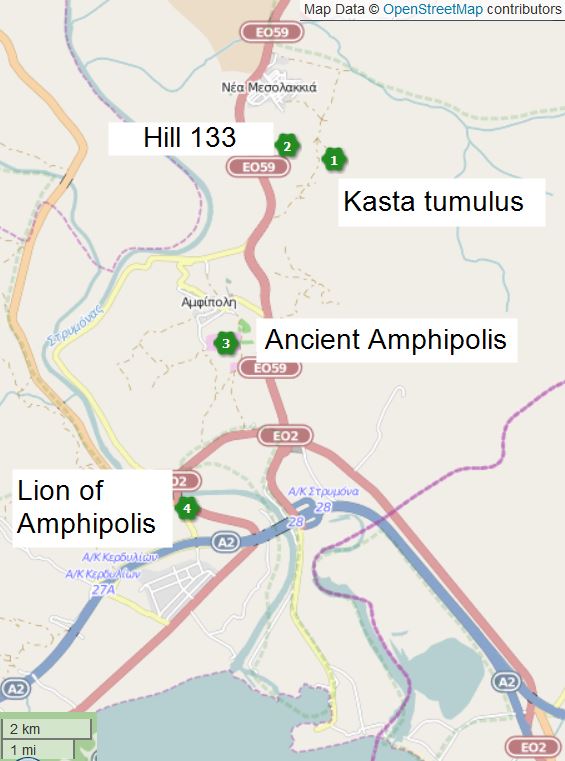
Excavations in and around the city have revealed important buildings, ancient walls and tombs. The finds are displayed at the archaeological museum of Amphipolis. At the nearby vast Kasta burial mound, an ancient Macedonian tomb has recently been revealed. The Lion of Amphipolis monument nearby is a popular destination for visitors.
It was located within the region of Edonis.
Throughout the 5th century BC, Athens sought to consolidate its control over Thrace, which was strategically important because of its raw materials (the gold and silver of the Pangaion hills and the dense forests that provided timber for naval construction), and the sea routes vital for Athens' supply of grain from Scythia. A first unsuccessful attempt at colonisation was in 497 BC by the Milesian Tyrant Histiaeus.[citation needed] After the defeat of the Persians at the Battle of Marathon in 490 BC, the Athenian general Kimon managed to occupy Eion a few kilometres south on the coast in 476 BC, and turned it into a military base and commercial port. The Athenians founded a first colony at Ennea-Hodoi (‘Nine Ways’) in 465 BC, but the first ten thousand colonists were massacred by the Thracians. A second attempt took place in 437 BC on the same site under general Hagnon which was successful. The city and its first impressive and elaborately built walls of 7.5 km length date from this time. The new Athenian colony quickly became of considerable size and wealth.
The new settlement took the name of Amphipolis (literally, "around the city"), a name which is the subject of much debate about its etymology. Thucydides claims the name comes from the fact that the Strymon River flows "around the city" on two sides; however a note in the Suda (also given in the lexicon of Photius) offers a different explanation apparently given by Marsyas, son of Periander: that a large proportion of the population lived "around the city". However, a more probable explanation is the one given by Julius Pollux: that the name indicates the vicinity of an isthmus.
Amphipolis quickly became the main power base of the Athenians in Thrace and, consequently, a target of choice for their Spartan adversaries. In 424 BC during the Peloponnesian War the Spartan general Brasidas captured Amphipolis.
Two years later in 422 BC, a new Athenian force under the general Cleon failed once more during the Battle of Amphipolis at which both Kleon and Brasidas lost their lives. Brasidas survived long enough to hear of the defeat of the Athenians and was buried at Amphipolis with impressive pomp. From then on he was regarded as the founder of the city and honoured with yearly games and sacrifices.
Hub AI
Amphipolis AI simulator
(@Amphipolis_simulator)
Amphipolis
Amphipolis (Greek: Αμφίπολη, romanized: Amfipoli; Ancient Greek: Ἀμφίπολις, romanized: Amphipolis) was an important ancient Greek polis (city), and later a Roman city, whose large remains can still be seen. It gave its name to the modern municipality of Amphipoli, in the Serres regional unit of Northern Greece.
Amphipolis was originally a colony of ancient Athenians and was the site of the battle between the Spartans and Athenians in 422 BC. It was later the place where Alexander the Great prepared for campaigns leading to his invasion of Asia in 335 BC. Alexander's three finest admirals, Nearchus, Androsthenes and Laomedon, resided in Amphipolis. After Alexander's death, his wife Roxana and their son Alexander IV were imprisoned and murdered there in 311 BC.
Excavations in and around the city have revealed important buildings, ancient walls and tombs. The finds are displayed at the archaeological museum of Amphipolis. At the nearby vast Kasta burial mound, an ancient Macedonian tomb has recently been revealed. The Lion of Amphipolis monument nearby is a popular destination for visitors.
It was located within the region of Edonis.
Throughout the 5th century BC, Athens sought to consolidate its control over Thrace, which was strategically important because of its raw materials (the gold and silver of the Pangaion hills and the dense forests that provided timber for naval construction), and the sea routes vital for Athens' supply of grain from Scythia. A first unsuccessful attempt at colonisation was in 497 BC by the Milesian Tyrant Histiaeus.[citation needed] After the defeat of the Persians at the Battle of Marathon in 490 BC, the Athenian general Kimon managed to occupy Eion a few kilometres south on the coast in 476 BC, and turned it into a military base and commercial port. The Athenians founded a first colony at Ennea-Hodoi (‘Nine Ways’) in 465 BC, but the first ten thousand colonists were massacred by the Thracians. A second attempt took place in 437 BC on the same site under general Hagnon which was successful. The city and its first impressive and elaborately built walls of 7.5 km length date from this time. The new Athenian colony quickly became of considerable size and wealth.
The new settlement took the name of Amphipolis (literally, "around the city"), a name which is the subject of much debate about its etymology. Thucydides claims the name comes from the fact that the Strymon River flows "around the city" on two sides; however a note in the Suda (also given in the lexicon of Photius) offers a different explanation apparently given by Marsyas, son of Periander: that a large proportion of the population lived "around the city". However, a more probable explanation is the one given by Julius Pollux: that the name indicates the vicinity of an isthmus.
Amphipolis quickly became the main power base of the Athenians in Thrace and, consequently, a target of choice for their Spartan adversaries. In 424 BC during the Peloponnesian War the Spartan general Brasidas captured Amphipolis.
Two years later in 422 BC, a new Athenian force under the general Cleon failed once more during the Battle of Amphipolis at which both Kleon and Brasidas lost their lives. Brasidas survived long enough to hear of the defeat of the Athenians and was buried at Amphipolis with impressive pomp. From then on he was regarded as the founder of the city and honoured with yearly games and sacrifices.
Recent media