Hubbry Logo
SpartaSpartaMain
Open search
Sparta
Community hub
Sparta
logo
8 pages, 0 posts
0 subscribers
Be the first to start a discussion here.
Sparta
Sparta
from Wikipedia

Key Information

Sparta[1] was a prominent city-state in Laconia in ancient Greece. In antiquity, the state was known as Lacedaemon (Λακεδαίμων, Lakedaímōn), while "Sparta" referred to its capital, a group of villages in the valley of the Evrotas River in Laconia, in southeastern Peloponnese.[2] Around 650 BC, it rose to become one of the major military powers in Greece, a status it retained until 371 BC.

Sparta was recognized as the leading force of the unified Greek military during the Greco-Persian Wars, in rivalry with the rising naval power of Athens.[3] Sparta was the principal enemy of Athens during the Peloponnesian War (431–404 BC),[4] from which it emerged victorious after the Battle of Aegospotami. Thebes' victory over Sparta at the Battle of Leuctra in 371 BC ended Spartan hegemony and freed Messenia from Spartan rule; the loss of the slave labor this region provided sent the city into terminal decline as a military power, though it retained its independence until its forcible integration into the Achaean League in 192 BC. The city recovered some autonomy after the Roman conquest of Greece in 146 BC and became a tourist destination during the Roman era, restoring some measure of prosperity. However, Sparta was sacked in 396 AD by the Visigothic king Alaric, and underwent a long period of decline into the medieval period, when much of its population relocated to Mystras. Modern Sparta is a provincial town and the seat of the Laconia regional administration.

Sparta was unique in ancient Greece for its social system and constitution, which were supposedly introduced by the semi-mythical lawgiver Lycurgus. Spartan society was exceptionally militarized, focusing the entire attention of the Spartiate class on military training and physical development to the point of legally barring them from productive economic activity. The inhabitants of Sparta were rigidly stratified into Spartiates (citizens with full rights), mothakes and perioikoi (free non-citizens), and helots (state-owned enslaved non-Spartan locals), with helots making up the vast majority of the population; social mobility was nearly nonexistent. Spartiate men underwent the harsh agoge training regimen, and Spartan phalanx units were widely considered to be among the best in battle, though this was as much a matter of propaganda as battlefield prowess[5]. Free Spartiate women enjoyed somewhat greater legal rights than elsewhere in classical antiquity, though helots suffered exceptionally harsh treatment at the hands of the Spartiates (particularly the Crypteia), causing repeated revolts. Sparta was a subject of fascination in its own day, as well as in later Western culture following the revival of classical learning. The admiration of Sparta is known as Laconophilia.

Names

[edit]

The ancient Greeks used one of three words to refer to the Spartan city-state and its location. First, "Sparta" refers primarily to the main cluster of settlements in the valley of the Eurotas River.[6] The second word, "Lacedaemon" (Λακεδαίμων),[7] was often used as an adjective and is the name referenced in the works of Homer and the historians Herodotus and Thucydides. The third term, "Laconice" (Λακωνική), referred to the immediate area around the town of Sparta, the plateau east of the Taygetos mountains,[8] and sometimes to all the regions under direct Spartan control, including Messenia.

Eurotas River

The earliest attested term referring to Lacedaemon is the Mycenaean Greek 𐀨𐀐𐀅𐀖𐀛𐀍, ra-ke-da-mi-ni-jo, "Lakedaimonian", written in Linear B syllabic script,[9][n 1] the equivalent of the later Greek Λακεδαιμόνιος, Lakedaimonios (Latin: Lacedaemonius).[15][16]

Herodotus seems to use "Lacedaemon" for the Mycenaean Greek citadel at Therapne, in contrast to the lower town of Sparta. This term could be used synonymously with Sparta, but typically it denoted the region in which the city was located.[17] In Homer it is typically combined with epithets of the countryside: wide, lovely, shining and most often hollow and broken (full of ravines),[18] suggesting the Eurotas Valley. "Sparta" on the other hand is described as "the country of lovely women", an epithet for people.

The residents of Sparta were often called Lacedaemonians. This epithet utilized the plural of the adjective Lacedaemonius (Greek: Λακεδαιμόνιοι; Latin: Lacedaemonii, but also Lacedaemones). The ancients sometimes used a back-formation, referring to the land of Lacedaemon as Lacedaemonian country. As most words for "country" were feminine, the adjective was in the feminine: Lacedaemonia (Λακεδαιμονία, Lakedaimonia). Eventually, the adjective came to be used alone.

Hollow Lacedaemon. Site of the Menelaion, the ancient shrine to Helen and Menelaus constructed in the Bronze Age city that stood on the hill of Therapne on the left bank of the Eurotas River overlooking the future site of Dorian Sparta. Across the valley the successive ridges of Mount Taygetus are in evidence.

"Lacedaemonia" was not in general use during the classical period and before. It does occur in Greek as an equivalent of Laconia and Messenia during the Roman and early Byzantine periods, mostly in ethnographers and lexica of place names. For example, Hesychius of Alexandria's Lexicon (5th century AD) defines Agiadae as a "place in Lacedaemonia" named after Agis.[19] The actual transition may be captured by Isidore of Seville's Etymologiae (7th century AD), an etymological dictionary. Isidore relied heavily on Orosius' Historiarum Adversum Paganos (5th century AD) and Eusebius of Caesarea's Chronicon (early 5th century AD), as did Orosius. The latter defines Sparta to be Lacedaemonia Civitas,[20] but Isidore defines Lacedaemonia as founded by Lacedaemon, son of Semele, which is consistent with Eusebius' explanation.[21] There is a rare use, perhaps the earliest of "Lacedaemonia", in Diodorus Siculus' The Library of History,[22] but probably with Χώρα (chōra, "country") suppressed.

Lakedaimona was until 2006 the name of a province in the modern Greek prefecture of Laconia.

Geography

[edit]
Antique map of classical city of Sparta (based on ancient sources and not archaeology).

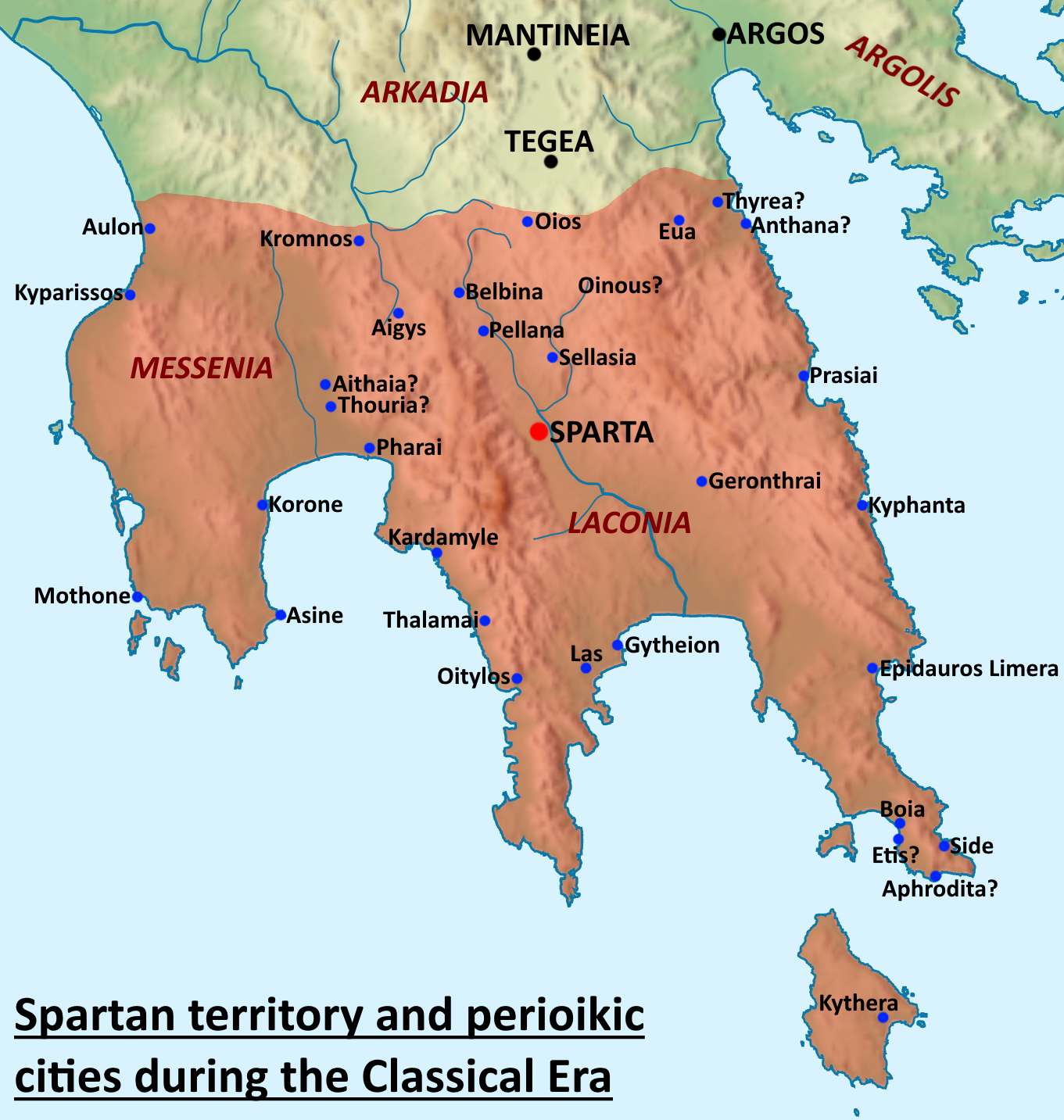
Sparta is located in the region of Laconia, in the south-eastern Peloponnese. Ancient Sparta was built on the banks of the Eurotas, the largest river of Laconia, which provided it with a source of fresh water. The Eurotas valley was a natural fortress, bounded to the west by Mt. Taygetus (2,407 m) and to the east by Mt. Parnon (1,935 m). To the north, Laconia is separated from Arcadia by hilly uplands reaching 1000 m in altitude. These natural defenses worked to Sparta's advantage and protected it from sacking and invasion. Though landlocked, Sparta had a vassal harbor, Gytheio, on the Laconian Gulf.

Mythology

[edit]

Lacedaemon (Greek: Λακεδαίμων) was a mythical king of Laconia.[23] The son of Zeus by the nymph Taygete, he married Sparta, the daughter of Eurotas, by whom he became the father of Amyclas, Eurydice, and Asine. As king, he named his country after himself and the city after his wife.[23] He was believed to have built the sanctuary of the Charites, which stood between Sparta and Amyclae, and to have given to those divinities the names of Cleta and Phaenna. A shrine was erected to him in the neighborhood of Therapne.

Tyrtaeus, an archaic era Spartan writer, is the earliest source to connect the origin myth of the Spartans to the lineage of the hero Heracles; later authors, such as Diodorus Siculus, Herodotus, and Apollodorus, also made mention of Spartans understanding themselves to be descendants of Heracles.[24][25][26][27]

Archaeology of the classical period

[edit]
The theater of ancient Sparta with Mt. Taygetus in the background.

Thucydides wrote:

Suppose the city of Sparta to be deserted, and nothing left but the temples and the ground-plan, distant ages would be very unwilling to believe that the power of the Lacedaemonians was at all equal to their fame. Their city is not built continuously, and has no splendid temples or other edifices; it rather resembles a group of villages, like the ancient towns of Hellas, and would therefore make a poor show.[28][29]

Until the early 20th century, the chief ancient buildings at Sparta were the theatre, of which, however, little showed above ground except portions of the retaining walls; the so-called Tomb of Leonidas, a quadrangular building, perhaps a temple, constructed of immense blocks of stone and containing two chambers; the foundation of an ancient bridge over the Eurotas; the ruins of a circular structure; some remains of late Roman fortifications; several brick buildings and mosaic pavements.[28]

The remaining archaeological wealth consisted of inscriptions, sculptures, and other objects collected in the local museum, founded by Stamatakis in 1872 and enlarged in 1907. Partial excavation of the round building was undertaken in 1892 and 1893 by the American School at Athens. The structure has been since found to be a semicircular retaining wall of Hellenic origin that was partly restored during the Roman period.[28]

Ruins of the Temple of Artemis Orthia

In 1904, the British School at Athens began a thorough exploration of Laconia, and in the following year excavations were made at Thalamae, Geronthrae, and Angelona near Monemvasia. In 1906, excavations began in Sparta itself.[28]

A "small circus" (as described by Leake) proved to be a theatre-like building constructed soon after 200 AD around the altar and in front of the Temple of Artemis Orthia. It is believed that musical and gymnastic contests took place here, as well as the famous flogging ordeal administered to Spartan boys (diamastigosis). The temple, which can be dated to the 2nd century BC, rests on the foundation of an older temple of the 6th century, and close beside it were found the remains of a yet earlier temple, dating from the 9th or even the 10th century. The votive offerings in clay, amber, bronze, ivory and lead dating from the 9th to the 4th centuries BC, which were found in great profusion within the precinct range, supply invaluable information about early Spartan art.[28]

Remaining section of wall that surrounded ancient Sparta

In 1907, the location of the sanctuary of Athena "of the Brazen House" (Χαλκίοικος, Chalkioikos) was determined to be on the acropolis immediately above the theatre. Though the actual temple is almost completely destroyed, the site has produced the longest extant archaic inscription in Laconia, numerous bronze nails and plates, and a considerable number of votive offerings. The city wall, built in successive stages from the 4th to the 2nd century, was traced for a great part of its circuit, which measured 48 stades or nearly 10 km (6 miles) (Polyb. 1X. 21). The late Roman wall enclosing the acropolis, part of which probably dates from the years following the Gothic raid of 262 AD, was also investigated. Besides the actual buildings discovered, a number of points were situated and mapped in a general study of Spartan topography, based upon the description of Pausanias.[28]

In terms of domestic archaeology, little is known about Spartan houses and villages before the Archaic period, but the best evidence comes from excavations at Nichoria in Messenia where postholes have been found. These villages were open and consisted of small and simple houses built with stone foundations and clay walls.[30]

Menelaion

[edit]
The Menelaion

The Menelaion is a shrine associated with Menelaus, located east of Sparta, by the river Eurotas, on the hill Profitis Ilias (Coordinates: 37°03′57″N 22°27′13″E / 37.0659°N 22.4536°E / 37.0659; 22.4536). Built around the early 8th century BC, the Spartans believed it had been the former residence of Menelaus. In 1970, the British School in Athens started excavations around the Menelaion in an attempt to locate Mycenaean remains in the area. Among other findings, they uncovered the remains of two Mycenaean mansions and found the first offerings dedicated to Helen and Menelaus. These mansions were destroyed by earthquake and fire.[31][better source needed]

Excavations made from the early 1990s to the present suggest that the area around the Menelaion in the southern part of the Eurotas valley seems to have been the center of Mycenaean Laconia.[32] The Mycenaean settlement was roughly triangular in shape, with its apex pointed towards the north. Its area was approximately equal to that of the "newer" Sparta, but denudation has wreaked havoc with its buildings and nothing is left of its original structures save for ruined foundations and broken potsherds.[28]

History

[edit]

Prehistory, "dark age" and archaic period

[edit]

The prehistory of Sparta is difficult to reconstruct because the literary evidence was written far later than the events it describes and is distorted by oral tradition.[33] The earliest certain evidence of human settlement in the region of Sparta consists of pottery dating from the Middle Neolithic period, found in the vicinity of Kouphovouno some two kilometres (1.2 miles) south-southwest of Sparta.[34]

This civilization seems to have fallen into decline by the late Bronze Age, when, according to Herodotus, Macedonian tribes from the north (called Dorians by those they conquered) marched into the Peloponnese and, subjugating the local tribes, settled there.[33] The Dorians seem to have set about expanding the frontiers of Spartan territory almost before they had established their own state.[35] They fought against the Argive Dorians to the east and southeast, and also the Arcadian Achaeans to the northwest. The evidence suggests that Sparta, relatively inaccessible because of the topography of the Taygetan plain, was secure from early on: it was never fortified.[35]

Lycurgus

Nothing distinctive in the archaeology of the Eurotas River Valley identifies the Dorians or the Dorian Spartan state. The prehistory of the Neolithic, the Bronze Age and the Dark Age (the Early Iron Age) at this moment must be treated apart from the stream of Dorian Spartan history.[citation needed]

The legendary period of Spartan history is believed to fall into the Dark Age. It treats the mythic heroes such as the Heraclids and the Perseids, offering a view of the occupation of the Peloponnesus that contains both fantastic and possibly historical elements. The subsequent proto-historic period, combining both legend and historical fragments, offers the first credible history.

Between the 8th and 7th centuries BC the Spartans experienced a period of lawlessness and civil strife, later attested by both Herodotus and Thucydides.[36] As a result, they carried out a series of political and social reforms of their own society which they later attributed to a semi-mythical lawgiver, Lycurgus.[37] Several writers throughout antiquity, including Herodotus, Xenophon, and Plutarch have attempted to explain Spartan exceptionalism as a result of the so-called Lycurgan Reforms.[38][39][40][41]

Classical Sparta

[edit]

In the Second Messenian War, Sparta established itself as a local power in the Peloponnesus and the rest of Greece. During the following centuries, Sparta's reputation as a land-fighting force was unequalled.[42] At its peak around 500 BC, Sparta had some 20,000–35,000 citizens, plus numerous helots and perioikoi. The likely total of 40,000–50,000 made Sparta one of the larger Greek city-states;[43][44] however, according to Thucydides, the population of Athens in 431 BC was 360,000–610,000, making it much larger.[n 2]

In 480 BC, a small force led by King Leonidas (about 300 full Spartiates, 700 Thespians, and 400 Thebans, although these numbers were lessened by earlier casualties[46]) made a legendary last stand at the Battle of Thermopylae against the massive Persian army, led by Xerxes.[47] The Spartans received advance warning of the Persian invasion from their deposed king Demaratus, which prompted them to consult the Delphic oracle. According to Herodotus, the Pythia proclaimed that either one of the kings of Sparta had to die or Sparta would be destroyed.[48] This prophecy was fulfilled after king Leonidas died in the battle. The superior weaponry, strategy, and bronze armour of the Greek hoplites and their phalanx fighting formation again proved their worth one year later when Sparta assembled its full strength and led a Greek alliance against the Persians at the Battle of Plataea in 479 BC.

Ancient Sparta.

The decisive Greek victory at Plataea put an end to the Greco-Persian War along with Persian ambitions to expand into Europe. Even though this war was won by a pan-Greek army, credit was given to Sparta, who besides providing the leading forces at Thermopylae and Plataea, had been the de facto leader of the entire Greek expedition.[49]

In 464 BC, a violent earthquake occurred along the Sparta faultline destroying much of what was Sparta and many other city-states in ancient Greece. This earthquake is marked by scholars as one of the key events that led to the First Peloponnesian War.

In later Classical times, Sparta along with Athens, Thebes, and Persia were the main powers fighting for supremacy in the northeastern Mediterranean. In the course of the Peloponnesian War, Sparta, a traditional land power, acquired a navy which managed to overpower the previously dominant flotilla of Athens, ending the Athenian Empire. At the peak of its power in the early 4th century BC, Sparta had subdued many of the main Greek states and even invaded the Persian provinces in Anatolia (modern day Turkey), a period known as the Spartan hegemony.

During the Corinthian War, Sparta faced a coalition of the leading Greek states: Thebes, Athens, Corinth, and Argos. The alliance was initially backed by Persia, which feared further Spartan expansion into Asia.[50] Sparta achieved a series of land victories, but many of her ships were destroyed at the Battle of Cnidus by a Greek-Phoenician mercenary fleet that Persia had provided to Athens. The event severely damaged Sparta's naval power but did not end its aspirations of invading further into Persia, until Conon the Athenian ravaged the Spartan coastline and provoked the old Spartan fear of a helot revolt.[51]

After a few more years of fighting, in 387 BC the Peace of Antalcidas was established, according to which all Greek cities of Ionia would return to Persian control, and Persia's Asian border would be free of the Spartan threat.[51] The effects of the war were to reaffirm Persia's ability to interfere successfully in Greek politics and to affirm Sparta's weakened hegemonic position in the Greek political system.[52] Sparta suffered a severe military defeat to Epaminondas of Thebes at the Battle of Leuctra.[53]

As Spartan citizenship was inherited by blood, Sparta increasingly faced a helot population that vastly outnumbered its citizens.[54] The alarming decline of Spartan citizens was commented on by Aristotle.

Hellenistic and Roman Sparta

[edit]
Medieval depiction of Sparta from the Nuremberg Chronicle (1493)

Sparta never fully recovered from its losses at Leuctra in 371 BC and the subsequent helot revolts. In 338, Philip II invaded and devastated much of Laconia, turning the Spartans out, though he did not seize Sparta itself.[55] Even during its decline, Sparta never forgot its claim to be the "defender of Hellenism" and its Laconic wit. An anecdote has it that when Philip II sent a message to Sparta saying "If I invade Laconia, I shall turn you out.",[56] the Spartans responded with the single, terse reply: αἴκα, "if".[57][58][59] When Philip created the League of Corinth on the pretext of unifying Greece against Persia, the Spartans chose not to join, since they had no interest in joining a pan-Greek expedition unless it were under Spartan leadership. Thus, upon defeating the Persians at the Battle of the Granicus, Alexander the Great sent to Athens 300 suits of Persian armour with the following inscription: "Alexander, son of Philip, and all the Greeks except the Spartans, give these offerings taken from the foreigners who live in Asia".

The Spartan king Agis III sent a force to Crete in 333 BC to secure the island for the Persian interest.[60][61] Agis next took action against Macedon by laying siege to Megalopolis in 331 BC, while Alexander campaigned against the Persians in Asia as leader of the Hellenic league. However, a large Macedonian army under general Antipater marched to its relief and defeated the Spartan-led force in a pitched battle.[62] More than 5,300 of the Spartans and their allies were killed in battle, and 3,500 of Antipater's troops.[63] Agis, now wounded and unable to stand, ordered his men to leave him behind to face the advancing Macedonian army so that he could buy them time to retreat. On his knees, the Spartan king slew several enemy soldiers before being finally killed by a javelin.[64] Alexander was merciful, and he only forced the Spartans to join the League of Corinth, which they had previously refused.[65]

After the Diadochi Wars, Sparta continued to be one of the Peloponesian powers until its eventual loss of independence in 192 BC. In 272 BC Pyrrhus of Epirus failed to besiege Sparta. Cleomenes III tried to make Sparta the dominant power of the Peloponnese against the Achaean League with initial successes but he was finally defeated in 222 BC at the battle of Selassia from a Macedonian-Achaean alliance under Antigonus Doson. During the First Macedonian War, Sparta was an ally of the Roman Republic. Spartan political independence was put to an end when it was eventually forced into the Achaean League by Philopoemen, after its defeat in the decisive Laconian War by a coalition of other Greek city-states and Rome, and the resultant overthrow of its final king Nabis, in 192 BC. Sparta played no active part in the Achaean War in 146 BC when the Achaean League was defeated by the Roman general Lucius Mummius. Subsequently, Sparta became a free city under Roman rule, some of the institutions of Lycurgus were restored,[66] and the city became a tourist attraction for the Roman elite who came to observe exotic Spartan customs.[n 3]

In 214 AD, Roman emperor Caracalla, in his preparation for his campaign against Parthia, recruited a 500-man Spartan cohort (lokhos). Herodian described this unit as a phalanx, implying it fought like the old Spartans as hoplites, or even as a Macedonian phalanx. Despite this, a gravestone of a fallen legionary named Marcus Aurelius Alexys shows him lightly armed, with a pilos-like cap and a wooden club. The unit was presumably discharged in 217 after Caracalla was assassinated.[71]

An exchange of letters in the deutero-canonical First Book of Maccabees expresses a Jewish claim to kinship with the Spartans:

Areus king of the Lacedemonians to Onias the high priest, greeting: It is found in writing, that the Lacedemonians and Jews are brethren, and that they are of the stock of Abraham: Now therefore, since this is come to our knowledge, ye shall do well to write unto us of your prosperity. We do write back again to you, that your cattle and goods are ours, and ours are yours.

— Authorized King James Version 1 Maccabees 12.20

The letters are reproduced in a variant form by Josephus.[72] Jewish historian Uriel Rappaport notes that the relationship between the Jews and the Spartans expressed in this correspondence has "intrigued many scholars, and various explanations have been suggested for the problems raised ... including the historicity of the Jewish leader and high priest Jonathan's letter to the Spartans, the authenticity of the letter of Arius to Onias, cited in Jonathan's letter, and the supposed 'brotherhood' of the Jews and the Spartans." Rappaport is clear that "the authenticity of [the reply] letter of Arius is based on even less firm foundations than the letter of Jonathan".[73]

Spartans long spurned the idea of building a defensive wall around their city, believing they made the city's men soft in terms of their warrior abilities. A wall was finally erected after 184 BCE, after the peak of the city-state's power had come and gone.[74]

Post-classical and modern Sparta

[edit]

In 396 AD, Sparta was sacked by Visigoths under Alaric I.[75][76] According to Byzantine sources, some parts of the Laconian region remained pagan until well into the 10th century. The Tsakonian language still spoken in Tsakonia is the only surviving descendant of the ancient Doric language.[77] In the Middle Ages, the political and cultural center of Laconia shifted to the nearby settlement of Mystras, and Sparta fell further in even local importance. Modern Sparta was re-founded in 1834, by a decree of King Otto of Greece. Today it is a provincial town and the capital of the Laconia administrative region.

Structure of Classical Spartan society

[edit]

Constitution

[edit]
Structure of the Spartan Constitution

Sparta was an oligarchy. The state was ruled by two hereditary kings of the Agiad and Eurypontid families,[78] both supposedly descendants of Heracles and equal in authority, so that one could not act against the power and political enactments of his colleague.[28]

The duties of the kings were primarily religious, judicial, and military. As chief priests of the state, they maintained communication with the Delphian sanctuary, whose pronouncements exercised great authority in Spartan politics. In the time of Herodotus c. 450 BC, their judicial functions had been restricted to cases dealing with heiresses (epikleroi), adoptions and the public roads (the meaning of the last term is unclear in Herodotus' text and has been interpreted in a number of ways). Aristotle describes the kingship at Sparta as "a kind of unlimited and perpetual generalship" (Pol. iii. 1285a), while Isocrates refers to the Spartans as "subject to an oligarchy at home, to a kingship on campaign" (iii. 24).[28]

Civil and criminal cases were decided by a group of officials known as the ephors, as well as a council of elders known as the Gerousia. The Gerousia consisted of 28 elders over the age of 60, elected for life and usually part of the royal households, and the two kings.[79] High state decisions were discussed by this council, who could then propose policies to the damos, the collective body of Spartan citizenry, who would select one of the alternatives by vote.[80][81]

Royal prerogatives were curtailed over time. From the period of the Persian wars, the king lost the right to declare war and was accompanied in the field by two ephors. He was supplanted by the ephors also in the control of foreign policy. Over time, the kings became mere figureheads except in their capacity as generals. Political power was transferred to the ephors and Gerousia.[28]

An assembly of citizens called the Ekklesia was responsible for electing men to the Gerousia for life.

Citizenship

[edit]

The Spartan education process known as the agoge was essential for full citizenship. However, usually the only boys eligible for the agoge were Spartiates, those who could trace their ancestry to the original inhabitants of the city.

There were two exceptions. Trophimoi or "foster sons" were foreign students invited to study. The Athenian general Xenophon, for example, sent his two sons to Sparta as trophimoi. Also, the son of a helot could be enrolled as a syntrophos[82] if a Spartiate formally adopted him and paid his way; if he did exceptionally well in training, he might be sponsored to become a Spartiate.[83] Spartans who could not afford to pay the expenses of the agoge could lose their citizenship.

These laws meant that Sparta could not readily replace citizens lost in battle or otherwise, which eventually proved near fatal as citizens became greatly outnumbered by non-citizens, and even more dangerously by helots.

Non citizens

[edit]

The other classes were the perioikoi, free inhabitants who were non-citizens, and the helots,[84] state-owned serfs. Descendants of non-Spartan citizens were forbidden the agoge.

Helots

[edit]

The Spartans were a minority of the Lakonian population. The largest class of inhabitants were the helots (in Classical Greek Εἵλωτες / Heílôtes).[85][86]

The helots were originally free Greeks from the areas of Messenia and Lakonia whom the Spartans had defeated in battle and subsequently enslaved.[87] In contrast to populations conquered by other Greek cities (e.g. the Athenian treatment of Melos), the male population was not exterminated and the women and children turned into chattel slaves. Instead, the helots were given a subordinate position in society more comparable to serfs in medieval Europe than chattel slaves in the rest of Greece.[citation needed] The Spartan helots were not only agricultural workers, but were also household servants, both male and female would be assigned domestic duties, such as wool-working.[88] However, the helots were not the private property of individual Spartan citizens, regardless of their household duties, and were instead owned by the state through the kleros system.[89]

Helots did not have voting or political rights. The Spartan poet Tyrtaios refers to Helots being allowed to marry and retaining 50% of the fruits of their labor.[90] They also seem to have been allowed to practice religious rites and, according to Thucydides, own a limited amount of personal property.[91] Initially, helots couldn't be freed but during the middle Hellenistic period, some 6,000 helots accumulated enough wealth to buy their freedom, for example, in 227 BC.

In other Greek city-states, free citizens were part-time soldiers who, when not at war, carried on other trades. Since Spartan men were full-time soldiers, they were not available to carry out manual labour.[92] The helots were used as unskilled serfs, tilling Spartan land. Helot women were often used as wet nurses. Helots also travelled with the Spartan army as non-combatant serfs. At the last stand of the Battle of Thermopylae, the Greek dead included not just the legendary three hundred Spartan soldiers but also several hundred Thespian and Theban troops and a number of helots.[93]

There was at least one helot revolt (c. 465–460 BC) that led to prolonged conflict. By the tenth year of this war the Spartans and Messenians had reached an agreement in which Messenian rebels were allowed to leave the Peloponnese.[94] They were given safe passage under the terms that they would be re-enslaved if they tried to return. This agreement ended the most serious incursion into Spartan territory since their expansion in the seventh and eighth centuries BC.[95] Thucydides remarked that "Spartan policy is always mainly governed by the necessity of taking precautions against the helots."[96][97] On the other hand, the Spartans trusted their helots enough in 479 BC to take a force of 35,000 with them to Plataea, something they could not have risked if they feared the helots would attack them or run away. Slave revolts occurred elsewhere in the Greek world, and in 413 BC 20,000 Athenian slaves ran away to join the Spartan forces occupying Attica.[98] What made Sparta's relations with her slave population unique was that the helots, precisely because they enjoyed privileges such as family and property, retained their identity as a conquered people (the Messenians) and also had effective kinship groups that could be used to organize rebellion.[citation needed]

As the Spartiate population declined and the helot population continued to grow, the imbalance of power caused increasing tension. According to Myron of Priene[99] of the middle 3rd century BC:

They assign to the Helots every shameful task leading to disgrace. For they ordained that each one of them must wear a dogskin cap (κυνῆ / kunễ) and wrap himself in skins (διφθέρα / diphthéra) and receive a stipulated number of beatings every year regardless of any wrongdoing, so that they would never forget they were slaves. Moreover, if any exceeded the vigour proper to a slave's condition, they made death the penalty; and they allotted a punishment to those controlling them if they failed to rebuke those who were growing fat.[100]

Plutarch also states that Spartans treated the helots "harshly and cruelly": they compelled them to drink pure wine (which was considered dangerous – wine usually being cut with water) "...and to lead them in that condition into their public halls, that the children might see what a sight a drunken man is; they made them to dance low dances, and sing ridiculous songs..." during syssitia (obligatory banquets).[101]

Each year when the Ephors took office, they ritually declared war on the helots, allowing Spartans to kill them without risk of ritual pollution.[102] This fight seems to have been carried out by kryptai (sing. κρύπτης kryptēs), graduates of the agoge who took part in the mysterious institution known as the Krypteia.[103] Thucydides states:

The helots were invited by a proclamation to pick out those of their number who claimed to have most distinguished themselves against the enemy, in order that they might receive their freedom; the object being to test them, as it was thought that the first to claim their freedom would be the most high spirited and the most apt to rebel. As many as two thousand were selected accordingly, who crowned themselves and went round the temples, rejoicing in their new freedom. The Spartans, however, soon afterwards did away with them, and no one ever knew how each of them perished.[104]

Perioikoi

[edit]

The Perioikoi came from similar origins as the helots but occupied a significantly different position in Spartan society. Although they did not enjoy full citizen-rights, they were free and not subjected to the same restrictions as the helots. The exact nature of their subjection to the Spartans is not clear, but they seem to have served partly as a kind of military reserve, partly as skilled craftsmen and partly as agents of foreign trade.[105] Perioikoic hoplites served increasingly with the Spartan army, explicitly at the Battle of Plataea, and although they may also have fulfilled functions such as the manufacture and repair of armour and weapons,[106] they were increasingly integrated into the combat units of the Spartan army as the Spartiate population declined.[107]

Economy

[edit]
Name vase of the Spartan artist known as the Rider Painter (Laconian black-figured kylix, c. 550–530 BC)

Full citizen Spartiates were barred by law from trade or manufacture, which consequently rested in the hands of the Perioikoi.[28] This lucrative monopoly, in a fertile territory with a good harbors, ensured the loyalty of the perioikoi.[108] Despite the prohibition on menial labor or trade, there is evidence of Spartan sculptors,[109] and Spartans were certainly poets, magistrates, ambassadors, and governors as well as soldiers.

Allegedly, Spartans were prohibited from possessing gold and silver coins, and according to legend Spartan currency consisted of iron bars to discourage hoarding.[110] Though the conspicuous display of wealth appears to have been discouraged, this did not preclude the production of very fine decorated bronze, ivory and wooden works of art as well as exquisite jewellery, attested in archaeology.[111]

Allegedly as part of the Lycurgan Reforms in the mid-8th century BC, a massive land reform had divided property into 9,000 equal portions. Each citizen received one estate, a kleros, which was expected to provide his living.[112] The land was worked by helots who retained half the yield. From the other half, the Spartiate was expected to pay his mess (syssitia) fees, and the agoge fees for his children. However, nothing is known of matters of wealth such as how land was bought, sold, and inherited, or whether daughters received dowries.[113] However, from early on there were marked differences of wealth within the state, and these became more serious after the law of Epitadeus some time after the Peloponnesian War, which removed the legal prohibition on the gift or bequest of land.[28][114] By the mid-5th century, land had become concentrated in the hands of a tiny elite, and the notion that all Spartan citizens were equals had become an empty pretence. By Aristotle's day (384–322 BC) citizenship had been reduced from 9,000 to less than 1,000, then further decreased to 700 at the accession of Agis IV in 244 BC. Attempts were made to remedy this by imposing legal penalties upon bachelors,[28] but this could not reverse the trend.

Life in Classical Sparta

[edit]
Jean-Pierre Saint-Ours, The Selection of Children in Sparta, 1785. A Neoclassical imaging of what Plutarch describes.

Birth and death

[edit]

Sparta was above all a militarist state, and emphasis on military fitness began virtually at birth. According to Plutarch, after birth, a mother would bathe her child in wine to see whether the child was strong. If the child survived it was brought before the Gerousia by the child's father. The Gerousia then decided whether it was to be reared or not.[28] It is commonly stated that if they considered it "puny and deformed", the baby was thrown into a chasm on Mount Taygetos known euphemistically as the Apothetae (Gr., ἀποθέται, "Deposits").[115][116] This would, in effect, be a primitive form of eugenics.[115] Plutarch is the sole historical source for the Spartan practice of systemic infanticide motivated by eugenics.[117] Sparta is often viewed as being unique in this regard, however, anthropologist Laila Williamson notes: "Infanticide has been practiced on every continent and by people on every level of cultural complexity, from hunter gatherers to high civilizations. Rather than being an exception, then, it has been the rule."[118] There is controversy about the matter in Sparta, since excavations in the chasm only uncovered adult remains, likely belonging to criminals[119] and Greek sources contemporary to Sparta do not mention systemic infanticide motivated solely by eugenics.[120]

Spartan burial customs changed over time. The Archaic Spartan poet Tyrtaeus spoke of the Spartan war-dead as follows:

Never do his [the war-dead's] name and good fame perish,
But even though he is beneath the earth he is immortal,
Young and old alike mourn him,
All the city is distressed by the painful loss,
and his tomb and children are pointed out among the people,
and his children's children and his line after them.[121]

When Spartans died, marked headstones would only be granted to soldiers who died in combat during a victorious campaign or women who died either in service of a divine office or in childbirth.[122] These headstones likely acted as memorials, rather than as grave markers. Evidence of Spartan burials is provided by the Tomb of the Lacedaimonians in Athens.[citation needed] Excavations at the cemetery of classical Sparta, uncovered ritually pierced kantharoid-like ceramic vessels, the ritual slaughter of horses, and specific burial enclosures alongside individual 'plots'. Some of the graves were reused over time.[123][124]

In the Hellenistic Period, grander, two-storey monumental tombs are found at Sparta. Ten of these have been found for this period.[124]

Education

[edit]
Bronze appliqué of Spartan manufacture, possibly depicting Orestes, 550–525 BC (Getty Villa)

When male Spartans began military training at age seven, they would enter the agoge system. The agoge was designed to encourage discipline and physical toughness and to emphasize the importance of the Spartan state. Boys lived in communal messes and, according to Xenophon, whose sons attended the agoge, the boys were fed "just the right amount for them never to become sluggish through being too full, while also giving them a taste of what it is not to have enough."[125] In addition, they were trained to survive in times of privation, even if it meant stealing.[126] Besides physical and weapons training, boys studied reading, writing, music and dancing. Special punishments were imposed if boys failed to answer questions sufficiently "laconically" (i.e. briefly and wittily).[127]

Spartan boys were expected to take an older male mentor, usually an unmarried young man. According to some sources, the older man was expected to function as a kind of substitute father and role model to his junior partner; however, others believe it was reasonably certain that they had sexual relations (the exact nature of Spartan pederasty is not entirely clear). Xenophon, an admirer of the Spartan educational system whose sons attended the agoge, explicitly denies the sexual nature of the relationship.[128][125]

Some Spartan youth apparently became members of an irregular unit known as the Krypteia. The immediate objective of this unit was to seek out and kill vulnerable helot Laconians as part of the larger program of terrorising and intimidating the helot population.[129]

Less information is available about the education of Spartan girls, but they seem to have gone through a fairly extensive formal educational cycle, broadly similar to that of the boys but with less emphasis on military training. Spartan girls received an education known as mousikē. This included music, dancing, singing and poetry. Choral dancing was taught so Spartan girls could participate in ritual activities, including the cults of Helen and Artemis.[130] In this respect, classical Sparta was unique in ancient Greece. In no other city-state did women receive any kind of formal education.[131]

Military life

[edit]
The so-called Leonidas sculpture (5th century BC), Archaeological Museum of Sparta, Greece

At age 20, the Spartan citizen began his membership in one of the syssitia (dining messes or clubs), composed of about fifteen members each, of which every citizen was required to be a member.[28] Here each group learned how to bond and rely on one another. The Spartans were not eligible for election for public office until the age of 30. Only native Spartans were considered full citizens and were obliged to undergo the training as prescribed by law, as well as participate in and contribute financially to one of the syssitia.[132]

Sparta is thought to be the first city to practice athletic nudity, and some scholars claim that it was also the first to formalize pederasty.[133] According to these sources, the Spartans believed that the love of an older, accomplished aristocrat for an adolescent was essential to his formation as a free citizen. The agoge, the education of the ruling class, was, they claim, founded on pederastic relationships required of each citizen,[134] with the lover responsible for the boy's training.

However, other scholars question this interpretation. Xenophon explicitly denies it,[125] but not Plutarch.[135]

Spartan men remained in the active reserve until age 60. Men were encouraged to marry at age 20 but could not live with their families until they left their active military service at age 30. They called themselves "homoioi" (equals), pointing to their common lifestyle and the discipline of the phalanx, which demanded that no soldier be superior to his comrades.[136] Insofar as hoplite warfare could be perfected, the Spartans did so.[137]

Thucydides reports that when a Spartan man went to war, his wife (or another woman of some significance) would customarily present him with his aspis (shield) and say: "With this, or upon this" (Ἢ τὰν ἢ ἐπὶ τᾶς, Èi tàn èi èpì tàs), meaning that true Spartans could only return to Sparta either victorious (with their shield in hand) or dead (carried upon it).[138] This is almost certainly propaganda. Spartans buried their battle dead on or near the battle field; corpses were not brought back on their shield.[139] Nevertheless, it is fair to say that it was less of a disgrace for a soldier to lose his helmet, breastplate or greaves than his shield, since the former were designed to protect one man, whereas the shield also protected the man on his left. Thus, the shield was symbolic of the individual soldier's subordination to his unit, his integral part in its success, and his solemn responsibility to his comrades in arms – messmates and friends, often close blood relations.

According to Aristotle, the Spartan military culture was actually short-sighted and ineffective. He observed:

It is the standards of civilized men not of beasts that must be kept in mind, for it is good men not beasts who are capable of real courage. Those like the Spartans who concentrate on the one and ignore the other in their education turn men into machines and in devoting themselves to one single aspect of city's life, end up making them inferior even in that.[140]

One of the most persistent myths about Sparta that has no basis in fact is the notion that Spartan mothers were without feelings toward their off-spring and helped enforce a militaristic lifestyle on their sons and husbands.[141][142] The myth can be traced back to Plutarch, who includes no less than 17 "sayings" of "Spartan women", all of which paraphrase or elaborate on the theme that Spartan mothers rejected their own offspring if they showed any kind of cowardice. In some of these sayings, mothers revile their sons in insulting language merely for surviving a battle. These sayings purporting to be from Spartan women were far more likely to be of Athenian origin and designed to portray Spartan women as unnatural and so undeserving of pity.[139]

Agriculture, food, and diet

[edit]

Sparta's agriculture consisted mainly of barley, wine, cheese, grain, and figs. These items were grown locally on each Spartan citizen's kleros and were tended to by helots. Spartan citizens were required to donate a certain amount of what they yielded from their kleros to their syssitia, or mess. These donations to the syssitia were a requirement for every Spartan citizen. All the donated food was then redistributed to feed the Spartan population of that syssitia.[143] The helots who tended to the lands were fed using a portion of what they harvested.[144]

Marriage

[edit]

Plutarch reports the peculiar customs associated with the Spartan wedding night:

The custom was to capture women for marriage... The so-called 'bridesmaid' took charge of the captured girl. She first shaved her head to the scalp, then dressed her in a man's cloak and sandals, and laid her down alone on a mattress in the dark. The bridegroom – who was not drunk and thus not impotent, but was sober as always – first had dinner in the messes, then would slip in, undo her belt, lift her and carry her to the bed.[145]

The husband continued to visit his wife in secret for some time after the marriage. These customs, unique to the Spartans, have been interpreted in various ways. One of them decidedly supports the need to disguise the bride as a man in order to help the bridegroom consummate the marriage, so unaccustomed were men to women's looks at the time of their first intercourse. The "abduction" may have served to ward off the evil eye, and the cutting of the wife's hair was perhaps part of a rite of passage that signaled her entrance into a new life.[146]

Role of women

[edit]

Political, social, and economic equality

[edit]

Spartan women, of the citizenry class, enjoyed a status, power, and respect that was unknown in the rest of the classical world. The higher status of females in Spartan society started at birth; unlike Athens, Spartan girls were fed the same food as their brothers.[147] Nor were they confined to their father's house and prevented from exercising or getting fresh air as in Athens, but exercised and even competed in sports.[147] Most important, rather than being married off at the age of 12 or 13, Spartan law forbade the marriage of a girl until she was in her late teens or early 20s. The reasons for delaying marriage were to ensure the birth of healthy children, but the effect was to spare Spartan women the hazards and lasting health damage associated with pregnancy among adolescents. Spartan women, better fed from childhood and fit from exercise, stood a far better chance of reaching old age than their sisters in other Greek cities, where the median age for death was 34.6 years or roughly 10 years below that of men.[148]

Unlike Athenian women who wore heavy, concealing clothes and were rarely seen outside the house, Spartan women wore dresses (peplos) slit up the side to allow freer movement and moved freely about the city, either walking or driving chariots. Girls as well as boys exercised, possibly in the nude, and young women as well as young men may have participated in the Gymnopaedia ("Festival of Nude Youths").[149][150]

Another practice that was mentioned by many visitors to Sparta was the practice of "wife-sharing". In accordance with the Spartan belief that breeding should be between the most physically fit parents, many older men allowed younger, more fit men, to impregnate their wives. Other unmarried or childless men might even request another man's wife to bear his children if she had previously been a strong child bearer.[151] For this reason many considered Spartan women polygamous or polyandrous.[152] This practice was encouraged in order that women bear as many strong-bodied children as they could. The Spartan population was hard to maintain due to the constant absence and loss of the men in battle and the intense physical inspection of newborns.[153]

Spartan women were also literate and numerate, a rarity in the ancient world. Furthermore, as a result of their education and the fact that they moved freely in society engaging with their fellow (male) citizens, they were notorious for speaking their minds even in public.[154] Plato, in the middle of the fourth century, described women's curriculum in Sparta as consisting of gymnastics and mousike (music and arts). Plato praised Spartan women's ability when it came to philosophical discussion.[155]

Most importantly, Spartan women had economic power because they controlled their own properties, and those of their husbands. It is estimated that in later Classical Sparta, when the male population was in serious decline, women were the sole owners of at least 35% of all land and property in Sparta.[156] The laws regarding a divorce were the same for both men and women. Unlike women in Athens, if a Spartan woman became the heiress of her father because she had no living brothers to inherit (an epikleros), the woman was not required to divorce her current spouse in order to marry her nearest paternal relative.[156]

Historic women

[edit]

Many women played a significant role in the history of Sparta.[157] Queen Gorgo, heiress to the throne and the wife of Leonidas I, was an influential and well-documented figure. Herodotus records that as a small girl she advised her father Cleomenes to resist a bribe. She was later said to be responsible for decoding a warning that the Persian forces were about to invade Greece; after Spartan generals could not decode a wooden tablet covered in wax, she ordered them to clear the wax, revealing the warning.[158] Plutarch's Moralia contains a collection of "Sayings of Spartan Women", including a laconic quip attributed to Gorgo: when asked by a woman from Attica why Spartan women were the only women in the world who could rule men, she replied "Because we are the only women who are mothers of men".[159] In 396, Cynisca, sister of the Eurypontid king Agesilaos II, became the first woman in Greece to win an Olympic chariot race. She won again in 392, and dedicated two monuments to commemorate her victory, these being an inscription in Sparta and a set of bronze equestrian statues at the Olympic temple of Zeus.[160][161]

Laconophilia

[edit]
See caption
Leonidas at Thermopylae, 1814 painting by Jacques-Louis David

Laconophilia is love or admiration of Sparta and its culture or constitution. Sparta was subject of considerable admiration in its day, even in rival Athens. In ancient times "Many of the noblest and best of the Athenians always considered the Spartan state nearly as an ideal theory realised in practice."[162] Many Greek philosophers, especially Platonists, would often describe Sparta as an ideal state, strong, brave, and free from the corruptions of commerce and money. The French classicist François Ollier in his 1933 book Le mirage spartiate (The Spartan Mirage) warned that a major scholarly problem is that all surviving accounts of Sparta were by non-Spartans who often excessively idealized their subject.[163] The term "Spartan Mirage" has come to refer to "idealized distortions and inventions regarding the character of Spartan society in the works of non-Spartan writers," beginning in Greek and Roman antiquity and continuing through the medieval and modern eras.[164] These accounts of Sparta are typically associated with the social or political concerns of the writer.[164] No accounts survive by the Spartans themselves, if such were ever written.

Young Spartans Exercising by Edgar Degas (1834–1917)

With the revival of classical learning in Renaissance Europe, Laconophilia re-appeared, for example in the writings of Machiavelli. The Elizabethan English constitutionalist John Aylmer compared the mixed government of Tudor England to the Spartan republic, stating that "Lacedemonia [was] the noblest and best city governed that ever was". He commended it as a model for England. The philosopher Jean-Jacques Rousseau contrasted Sparta favourably with Athens in his Discourse on the Arts and Sciences, arguing that its austere constitution was preferable to the more sophisticated Athenian life. Sparta was also used as a model of austere purity by Revolutionary and Napoleonic France.[165]

A German racist strain of Laconophilia was initiated by Karl Otfried Müller, who linked Spartan ideals to the supposed racial superiority of the Dorians, the ethnic sub-group of the Greeks to which the Spartans belonged. In the 20th century, this developed into Fascist admiration of Spartan ideals. Adolf Hitler praised the Spartans, recommending in 1928 that Germany should imitate them by limiting "the number allowed to live". He added that "The Spartans were once capable of such a wise measure... The subjugation of 350,000 Helots by 6,000 Spartans was only possible because of the racial superiority of the Spartans." The Spartans had created "the first racialist state".[166] Following the invasion of the USSR, Hitler viewed citizens of the USSR as like the helots under the Spartans: "They [the Spartans] came as conquerors, and they took everything", and so should the Germans. A Nazi officer specified that "the Germans would have to assume the position of the Spartiates, while... the Russians were the Helots."[166]

Certain early Zionists, and particularly the founders of Kibbutz movement in Israel, were influenced by Spartan ideals, particularly in education. Tabenkin, a founding father of the Kibbutz movement and the Palmach strikeforce, prescribed that education for warfare "should begin from the nursery", that children should from kindergarten be taken to "spend nights in the mountains and valleys".[167][168]

In modern times, the adjective "Spartan" means simple, frugal, avoiding luxury and comfort.[169] The term "laconic phrase" describes the very terse and direct speech characteristic of the Spartans.

Sparta also features prominently in modern popular culture, most famously the Battle of Thermopylae (see Battle of Thermopylae in popular culture).

Notable ancient Spartans

[edit]

See also

[edit]

Notes

[edit]

References

[edit]

Sources

[edit]
  • Davies, Norman (1997) [1996]. Europe: A History. Random House. ISBN 0712666338.
  • Adcock, F. E. (1957), The Greek and Macedonian Art of War, Berkeley: University of California Press, ISBN 0-520-00005-6 {{citation}}: ISBN / Date incompatibility (help)
  • Autenrieth, Georg (1891). A Homeric Dictionary for Schools and Colleges. New York: Harper and Brothers.
  • Blundell, Sue (1999). Women in Ancient Greece. London: British Museum Press. ISBN 978-0-7141-2219-9.
  • Cartledge, Paul (2002), Sparta and Lakonia: A Regional History 1300 to 362 BC (2nd ed.), Oxford: Routledge, ISBN 0-415-26276-3
  • Cartledge, Paul (2001), Spartan Reflections, London: Duckworth, ISBN 0-7156-2966-2
  • Cartledge, Paul; Spawforth, Antony (2001), Hellenistic and Roman Sparta (2nd ed.), Oxford: Routledge, ISBN 0-415-26277-1
  • Ehrenberg, Victor (2002) [1973], From Solon to Socrates: Greek History and Civilisation between the 6th and 5th centuries BC (2nd ed.), London: Routledge, ISBN 978-0-415-04024-2
  • Forrest, W. G. (1968), A History of Sparta, 950–192 B.C., New York: W. W. Norton & Co.
  • Green, Peter (1998), The Greco-Persian Wars (2nd ed.), Berkeley: University of California Press, ISBN 0-520-20313-5
  • Liddell, Henry George; Scott, Robert (1940). Jones, Henry Stuart (ed.). A Greek-English Lexicon. Oxford: Clarendon Press.
  • Pomeroy, Sarah B. (2002), Spartan Women, Oxford: Oxford University Press, ISBN 978-0-19-513067-6
  • Powell, Anton (2001), Athens and Sparta: Constructing Greek Political and Social History from 478 BC (2nd ed.), London: Routledge, ISBN 0-415-26280-1
  • Pausanias (1918). Description of Greece. with an English Translation by W.H.S. Jones, Litt.D., and H.A. Ormerod, M.A., in 4 Volumes. ISBN 9780674992078. {{cite book}}: ISBN / Date incompatibility (help)
  • Plutarch (1874), Plutarch's Morals, Translated from the Greek by several hands. Corrected and revised by. William W. Goodwin, PH. D., Boston, Cambridge{{citation}}: CS1 maint: location missing publisher (link)
  • Plutarch (1891), Bernardakis, Gregorius N. (ed.), Moralia, Plutarch (in Greek), Leipzig: Teubner
  • Plutarch (2005), Richard J.A. Talbert (ed.), On Sparta (2nd ed.), London: Penguin Books, ISBN 0-14-044943-4
  • Plutarch (2004), Frank Cole Babbitt (ed.), Moralia Volume III, Loeb Classical Library, Cambridge: Harvard University Press, ISBN 0-674-99270-9
  • West, M. L. (1999), Greek Lyric Poetry, Oxford: Oxford University Press, ISBN 978-0-19-954039-6

Further reading

[edit]
[edit]
Revisions and contributorsEdit on WikipediaRead on Wikipedia
from Grokipedia
Sparta (Σπάρτη), anciently known as Lacedaemon (Λακεδαίμων), was a Dorian Greek city-state situated in the river valley of Laconia, in the southeastern of . It rose to dominance in the Archaic period around the seventh century BC as the leading power in the , exerting influence through a combination of military prowess and a distinctive socio-political order designed to sustain a small citizen-warrior elite amid a large servile population. This system prioritized the maintenance of equality among Spartiates—the full male citizens—via communal living in (mess halls), land allotments worked by , and rigorous education through the , which instilled discipline and martial skills from childhood. The Spartan polity featured a mixed constitution with dual kings from the Agiad and Eurypontid lines, a council of elders called the gerousia, and annually elected ephors who held significant executive and oversight powers, elements often ascribed to legendary reforms by Lycurgus though lacking firm historical verification. Economically insular, Sparta shunned coined money in favor of iron bars to deter trade and luxury, fostering an austere ethos that contrasted sharply with more commercial peers like Athens. Militarily, Sparta's hoplite phalanx and emphasis on perseverance enabled key triumphs, including the stand at Thermopylae against the Persians in 480 BC and ultimate victory over Athens in the Peloponnesian War (431–404 BC), establishing temporary hegemony via the Peloponnesian League. However, Sparta's rigid structure proved brittle; the citizen body dwindled due to warfare , low from prolonged and life, and failure to adapt to demographic pressures, culminating in catastrophic defeat at Leuctra in 371 BC and subsequent loss of Messenian , which eroded the economic base. Archaeological evidence underscores a modest urban core without monumental or walls—symbolizing reliance on citizen —while revealing a society dependent on perioikoi for crafts and trade, and marked by periodic suppression of through declarations of and secret purges. Modern historiography, drawing on sources like and tempered by epigraphic and excavation data, cautions against romanticized views of Spartan , attributing its stability to pragmatic coercion rather than innate superiority.

Geography and Setting

Location and Terrain

Ancient Sparta was situated in the southeastern peninsula, within the region of Laconia, , at approximately 37°04′N 22°26′E. The city occupied the western bank of the River, at the northern end of a fertile roughly 5 km wide and extending southward for several kilometers. This positioning placed Sparta in an elongated valley, spanning about 82 km between the mountain ranges, which provided natural barriers and agricultural resources. The terrain featured the valley as a central lowland corridor, flanked by the rugged mountain range to the west, rising to peaks over 2,400 meters, and the Parnon range to the east. These mountains created a defensive , limiting access routes and contributing to Sparta's isolation and security, while the surrounding slopes offered timber, pastures for , and limited beyond the valley floor. The plain itself supported groves, vineyards, and grain cultivation, sustained by the river's seasonal flooding. Sparta lay at an elevation of about 200 meters above , with the broader Laconia region exhibiting varied from coastal plains to inland highlands. The Mediterranean climate included mild, wet winters and hot, dry summers, with an average annual temperature of 17.4°C and around 817 mm, facilitating but requiring in drier periods. This geographical setup influenced settlement patterns, emphasizing the valley's defensibility and resource concentration.

Environmental Influences on Society

Sparta occupied the River valley in Laconia, a region hemmed in by the Mountains to the west and the Parnon range to the east, creating natural fortifications that deterred external threats and limited interaction with neighboring Greek states. These imposing barriers, with rising to over 2,400 meters, fostered a sense of that reinforced internal cohesion and a defensive mindset, channeling societal energies toward military preparedness rather than expansive commerce or colonization. The valley's and alluvial soils along the supported intensive agriculture, yielding staples like , , olives, grapes, and figs sufficient for the citizen body's needs, though the constrained —spanning roughly 100 square kilometers of cultivable land—demanded efficient and labor systems. This environmental bounty, irrigated by the , enabled self-reliance but also underscored the perils of overdependence on a fixed agrarian base, prompting early conquests such as the subjugation of around the 8th-7th centuries BC to secure additional territory and laborers. , bound to the land, performed all farming, liberating Spartiates from toil and permitting lifelong dedication to warfare and civic discipline. Scarce navigable outlets and mountainous confines curtailed naval ambitions or overseas trade, contrasting with maritime powers like and embedding a land-based, infantry-centric in Spartan identity. Periodic floods from the and seismic activity in the tectonically active further emphasized resilience and communal resource management, traits aligned with the rigors of the training system that conditioned youth for austerity. Overall, Laconia's austere drove a hyper-militarized society, where intertwined with institutional choices to prioritize efficacy over demographic expansion or .

Names and Terminology

Etymology and Historical Designations

The name Sparta derives from the Σπάρτα (Spártā), the form used by its inhabitants, as opposed to the Σπάρτη (Spártē). Its linguistic origin is uncertain but may trace to Greek sparte, denoting a cord made from spartos, a type of broom plant (Spartium junceum), ultimately from the sper- meaning "to strew, sow, or scatter," possibly alluding to sown fields or scattered settlements in the River valley. Alternative folk etymologies link it to σπάρτον (spárton), "rope or cable," referencing cords purportedly used to mark the city's foundational boundaries, though this lacks direct archaeological corroboration. In antiquity, Sparta specifically denoted the urban core—a cluster of five villages (Limnai, Kynsouria, Pitane, Mesogeia, and Amyklai) rather than a single fortified polis—in the fertile valley of southeastern . The broader polity encompassing this city and its surrounding territories, including perioikic towns and helot-controlled lands, was designated Lacedaemon (Λακεδαίμων, Lakedaímōn), a term derived from the Lacedaemon, son of and , who was said to have unified the region. This distinction is evident in classical texts, where foreign Greeks often referred to the state as Lacedaemon while its elite citizens self-identified as Lacedaemonioi (Lacedaemonians), reserving Spartiates for full-blooded homoioi () residing in the urban core. The encompassing geographic region was known as Laconia, from which the adjective Laconian derives, reflecting Dorian Greek settlement patterns post-Mycenaean collapse around 1100 BCE. By the Classical period (c. 500–300 BCE), Lacedaemon predominated in diplomatic and historiographic contexts, such as ' accounts of the (431–404 BCE), where alliances were forged with "the Lacedaemonians" rather than "Spartans." The term Sparta gained traction externally for , emphasizing the city's military and political dominance, while Spartan as a emerged later in Hellenistic and Roman usage to evoke the austere , as in Latin Spartanus. Post-Classical sources, including Byzantine chronicles, retained Lacedaemon for the province until the medieval era, when Latinized forms like Lacedemonia persisted in European maps until the 19th-century Greek independence. This nomenclature reflects Sparta's unique synoikism—a loose of villages without typical urban walls—contrasting with more centralized poleis like .

Modern Usage

The modern city of Sparti serves as the capital of the Laconia regional unit in Greece's , with a population of approximately 18,000 residents whose economy relies on , , and local services. Originally re-established in the near the site of ancient Sparta, it features archaeological sites integrated into contemporary urban life, though it lacks the monumental scale of ancient ruins due to historical depopulation and relocation of inhabitants to nearby during the Byzantine era. In contemporary English, "Spartan" denotes a lifestyle or environment characterized by austerity, simplicity, and minimal comforts, evoking the ancient city's reputed frugality and discipline as described by classical sources like . Similarly, "laconic" refers to terse, concise speech, derived from Laconia—the region encompassing Sparta—stemming from anecdotes of Spartan brevity, such as King Philip II's demand met with the reply "If." These terms persist in military, architectural, and self-improvement contexts to signify rigorous , though they romanticize Sparta's systemic inequalities, including helot subjugation, which underpinned its stability. Sparta influences modern through depictions emphasizing martial valor, as in the 2006 film , which portrays the as a clash of hyper-masculine ideals against decadence, grossing over $450 million worldwide but criticized for historical inaccuracies that amplify propaganda-like heroism over factual defeats and internal divisions. Video game franchises like Halo adopt "Spartan" for elite super-soldiers, reinforcing a mythic of unbreakable warriors that ignores Sparta's reliance on perioikoi and for economic and military support, leading scholars to argue such portrayals foster ahistorical admiration detached from evidence of Sparta's post-371 BC decline. This —admiration for perceived Spartan virtues—appears in literature and fitness regimens promoting "Spartan" training, yet empirical analysis reveals ancient Sparta's success derived more from geographic isolation and oligarchic coercion than innate superiority.

Mythological Foundations

Legendary Origins and Heroes

According to tradition, the region of Laconia was first ruled by , a mythical king and son of Myles, who gave his name to the principal river of the Eurotas Valley. had no male heirs, and upon his death, the throne passed to his son-in-law Lacedaemon, son of and the nymph , who married 's daughter Sparta. Lacedaemon renamed the land Lacedaemonia after himself and the city Sparta after his wife, establishing the foundational eponymous figures in Spartan lore. Spartan mythology further traced the origins of its dual kingship to descendants of , the legendary hero and son of , whose offspring, the Heraclidae, were said to have invaded and settled the during the Dorian migration around the 12th–11th century BC, displacing earlier Mycenaean rulers. The Agiad royal line claimed direct descent from through Hyllus and , while the Eurypontid line stemmed from Procles, a descendant via Melas. This Heraclean ancestry served to legitimize , portraying the Spartans as rightful inheritors of heroic Dorian stock, though archaeological evidence indicates cultural continuity rather than wholesale conquest. Prominent Spartan heroes included , king of Sparta and brother of , who ruled alongside his wife Helen, the daughter of (or ) and Leda, renowned in myth as the most beautiful woman whose abduction by sparked the circa 1200 BC. Upon returning from , and Helen were deified as hero-gods in Sparta, with the sanctuary dedicated to their cult near the city, featuring artifacts attesting to early worship. The Dioscuri, (Polydeuces), twin brothers of Helen and patrons of horsemanship and rescue, were also central figures, born to Leda and venerated as protectors of Sparta's cavalry and youth. himself was honored as an ancestral patron, with myths linking him to local feats like slaying the and aiding in Dorian returns, reinforcing the warrior ethos in Spartan identity. ![The Menelaion, sanctuary dedicated to Menelaus and Helen]center

Relation to Historical Development

Spartan kings of both the Agiad and Eurypontid lines claimed descent from Heracles through the Heraclids, specifically the twins Eurysthenes and Procles, providing ideological justification for the unique dual monarchy that balanced power and prevented the rise of sole rulers, a system operative from at least the 8th century BCE onward. This mythological genealogy linked Sparta's ruling elite to Dorian migrations around 1100–1000 BCE, framing historical conquests over Laconia's indigenous populations as a rightful return of Heraclid heirs, thereby legitimizing territorial expansion and the subjugation of helots by circa 700 BCE. The legend of Lycurgus, a semi-mythical figure dated variably to the 9th–7th centuries BCE, intertwined with the Great Rhetra—an oracle from Apollo at Delphi outlining the assembly, council of elders, and institutional checks—served to sacralize the constitutional framework that emerged during the Archaic period, rendering reforms immutable and fostering the oligarchic equality among Spartiates that underpinned military cohesion. By attributing land redistribution, communal messes, and the agoge training system to divine mandate, the myth reinforced the societal structures that enabled Sparta's rise as a Peloponnesian hegemon by the mid-6th century BCE, evident in the formation of the Peloponnesian League around 550 BCE. Heroic cults honoring figures like the Dioscuri and Helen, tied to local substrates, evolved from the 8th century BCE to integrate mythological narratives with historical identity, promoting a supranational Spartan that justified interventions in Greek affairs, such as the repulsion of the Persian invasion in 480–479 BCE, where evocations of Heraclean valor mobilized citizen-soldiers. These myths, while not direct historical records, causally influenced institutional rigidity and cultural insularity, contributing to Sparta's dominance until the defeat at Leuctra in 371 BCE by preserving a amid evolving Greek poleis.

Archaeology

Major Sites and Artifacts

The , located on the eastern bank of the River, stands as one of the most extensively excavated religious sites in Sparta. British School at Athens (BSA) excavations from 1906 to 1910 uncovered multiple phases of construction dating from the BCE onward, including temples, altars, and structures associated with Spartan youth training rituals known as the . Key artifacts include thousands of terracotta used in cult practices, Archaic carved ivories depicting mythological scenes, and lead votive figures of warriors, women, musicians, and animals, providing evidence of the sanctuary's role in religious and educational ceremonies. The , situated approximately 5 kilometers east of central Sparta on a hill known as Profitis Ilias, comprises a palatial complex and later sanctuary dedicated to and Helen. BSA excavations between 1973 and 1976 revealed Mycenaean structures from the 15th to 13th centuries BCE, including mansion-like buildings with masonry, alongside Geometric and Archaic votive offerings. Artifacts recovered encompass , bronze tools, weapons such as spearheads, and terracotta figurines, indicating continuity from palatial Mycenaean culture into Spartan hero cult worship. Sparta's , overlooking the ancient city center, features remnants of the Hellenistic theater and earlier Spartan structures, excavated by the BSA starting in 1910. The site includes stoas, a , and defensive walls, with the theater's cavea and preserving evidence of public performances and assemblies from the 3rd century BCE, built over Classical predecessors. Inscriptions and architectural fragments from the area attest to civic and religious functions, though Spartan austerity limited monumental remains compared to other Greek poleis. Other notable finds include skeletal remains in the Kaiadas chasm near Sparta, potentially linked to the disposal of unfit infants or war captives, with over 100 individuals dated to the Archaic and Classical periods based on associated . These sites collectively yield sparse but telling evidence of Sparta's material culture, characterized by functional simplicity rather than ornate decoration, aligning with historical accounts of societal priorities.

Classical Period Evidence

Archaeological evidence from Sparta's Classical period (c. 480–323 BC) remains limited, characterized by modest religious structures, votive deposits, and sparse domestic traces, which corroborate literary descriptions of the city's austere prioritizing military rigor over architectural grandeur. Major excavations, led by the British School at Athens from 1906 to 1926, focused on sanctuaries and the , yielding artifacts that indicate continuity of practices but few innovations in building or craftsmanship. The , located along the River, provides the most substantial Classical-period remains, including rebuilt altars and platforms from the overlying earlier Archaic layers. Votive offerings unearthed there encompass pottery sherds, terracotta figurines, and bronze implements deposited over time, reflecting ongoing rituals such as athletic and educational dedications integral to Spartan youth training. These finds, spanning from the into the Classical era, include evidence of structural modifications to accommodate larger gatherings, though no grand temple dominates the site until Hellenistic times. On the , fragmentary foundations of the Temple of Chalkioikos, dedicated to Sparta's patron , reveal a simple rectangular edifice of blocks, likely constructed or refurbished in the . No intact bronze sheathing or extensive sculptures survive, despite Pausanias' accounts of war trophies adorning its interior; the modest scale aligns with Sparta's avoidance of lavish until defeats prompted later fortifications. Laconian from this period appears in contexts as plain wares and imports rather than elaborate painted vessels, signaling a decline in local fineware production after the Archaic era's peak, with output focused on utilitarian needs over export or decoration. Inscriptions, primarily dedicatory in Laconian Doric, are scarce—numbering fewer than in neighboring regions—and mostly confined to sanctuaries, with examples like victory stelai underscoring ties between , , and civic identity; this epigraphic restraint mirrors Spartan oral traditions and wood-based record-keeping. Domestic archaeology yields little beyond simple rubble foundations and hearths in perioikic settlements, while urban Spartan burials are nearly absent due to battlefield cremations for hoplites and prohibitions on ostentatious graves; isolated , such as iron weapons or minimal , occasionally surface but lack the elaboration seen elsewhere in . The overall paucity of Classical artifacts within Sparta proper—contrasting with abundant periokic or battlefield finds—suggests a centralized, non-materialistic society, where resources funneled toward the and army rather than enduring monuments.

Recent Excavations and Interpretations

In 2000, the British School at Athens undertook the Acropolis Basilica Project, focusing on the early Christian basilica atop the Spartan acropolis, originally excavated in the 1920s; this work clarified architectural phases from Late Antiquity through Byzantine periods, including mosaic floors and structural modifications indicative of prolonged religious use. Excavations at the ancient in 2008, jointly by the British School at and the Ephorate of , revealed Hellenistic foundations beneath Roman and Byzantine layers, with findings including stone seating arrangements and potential stage mechanisms that align with broader Peloponnesian theatre designs; these results, published in , enhance understanding of Sparta's post-classical cultural continuity and urban adaptation. Surveys in the Eurotas plain since 2009 uncovered a Mycenaean palace at Agios Vasileios near Xigali, approximately 20 kilometers of Sparta, announced in 2015; the site, occupied circa 1680–1600 BC before destruction by fire around 1450 BC, spanned 10 rooms with frescoed walls, storage facilities, and tablets—the earliest administrative script in Laconia—demonstrating palatial administration, literacy, and trade links in Bronze Age Laconia predating Dorian settlement. These discoveries challenge longstanding interpretations derived primarily from literary sources portraying Sparta as architecturally austere and culturally insular; from the palace indicates a sophisticated prehistoric society in the region, while and findings underscore multilayered urban development, suggesting greater material investment and external influences than classical accounts imply, prompting revisions toward viewing Sparta within broader Mediterranean trajectories rather than exceptional isolation.

Historical Timeline

Prehistoric and Dark Age Origins

Human occupation in the valley, the core of Laconian territory, dates to the period, with evidence from sites such as the Kouveleiki Caves indicating late Neolithic activities around 5000–4000 BC, including household tools and subsistence patterns adapted to marginal terrains. Early (Early Helladic) settlements proliferated in the valley and adjacent Helos plain circa 3000–2000 BC, featuring and topographic adaptations that suggest small-scale agrarian communities rather than urban centers. The Middle and Late (Mycenaean period, ca. 1700–1100 BC) marked a peak in regional complexity, with the at Therapne—approximately 5 km northeast of later Sparta—serving as a prominent administrative and cult center. Excavations reveal a palace-like structure from Late Helladic IIIA1 (ca. 1400 BC), including halls, storage facilities, and Linear B-influenced artifacts, though lacking the scale of mainland palaces like those at or . Associated settlements at Vapheio and Amyklai indicate a network of fortified sites controlling the fertile valley, facilitating trade via the River to coastal ports. This era's end coincided with the broader Aegean collapse around 1200–1100 BC, evidenced by abandonment layers at the and reduced material culture, pointing to economic disruption and possible depopulation without clear signs of external destruction. The subsequent Dark Age (ca. 1100–800 BC) in Laconia features scant archaeological record, characterized by village-like clusters rather than centralized authority, with continuity in basic pottery forms but a shift toward simpler, hand-made wares. Ancient traditions, preserved in Herodotus and later historians, attribute Spartan ethnogenesis to Dorian migrants from northern Greece, mythologized as the "Return of the Heracleidae" establishing dual kingship around the 11th–10th centuries BC. However, archaeological data reveal no widespread invasion strata—such as mass burials or weapon hoards—in Laconia, favoring interpretations of gradual dialectal shifts (to Doric Greek) and population movements amid post-Mycenaean fragmentation over violent conquest. By the late Dark Age (9th–8th centuries BC), proto-Spartan communities consolidated in the Eurotas plain, laying groundwork for Archaic expansions through subsistence farming and nascent social hierarchies, as inferred from emerging Geometric burials and sanctuaries. This period's opacity underscores reliance on interdisciplinary evidence, where linguistic and genetic proxies suggest endogenous development with minor northern influences rather than wholesale replacement.

Archaic Reforms and Expansion

During the Archaic period (c. 800–480 BC), Sparta implemented social and institutional reforms that emphasized military readiness and citizen equality, enabling aggressive territorial expansion. Attributed to the legendary Lycurgus, these reforms included equal land allotments (kleroi) to avert oligarchic factionalism, mandatory communal dining (syssitia) financed by fixed contributions from each household, and state-supervised education (agoge) instilling endurance and obedience from age seven. Such measures freed Spartiates from private pursuits, creating a professional warrior class reliant on public land worked by dependents. The , an oracle from , codified political divisions into five phylai (tribes) and 30 obai (subdivisions), while balancing power among dual kings, a council of elders (), and (apella), with mechanisms for vetoing unjust declarations. Though its exact date remains debated—possibly mid-7th century BC—the Rhetra stabilized governance amid Dorian consolidation post-Dark Age migrations. This framework, prioritizing martial cohesion over individual ambition, underpinned Sparta's ability to project power beyond its Valley core. Expansion commenced with of Laconia by c. 750 BC, subjugating pre-Dorian populations and incorporating Dorian settlements as perioikoi—autonomous townships providing artisans, traders, and light-armed levies without political rights at Sparta. Perioikoi, numbering dozens of poleis like Gytheion and Sellasia, formed a , contributing naval expertise and economic output while swearing loyalty oaths. The pivotal conquests were the Messenian Wars, securing agricultural wealth to sustain the Spartiate phalanx. The (c. 743–724 BC) ended in Spartan dominance, reducing many Messenians to proto-helotage on redistributed estates, though resistance persisted. The Second Messenian War (c. 685–668 BC), prosecuted under King Theopompus with improved tactics, crushed the revolt led by Aristomenes, annexing outright and enslaving its inhabitants as —chattel laborers comprising perhaps 70% of the population, ritually declared war upon annually to justify coercion. This doubled Spartan territory to c. 8,500 km², with Messenian plains yielding surplus grain for , but entrenched a servile prone to uprisings, necessitating constant vigilance. By c. 600 BC, Sparta's realm stabilized, allying with to form the Peloponnesian core against external threats.

Classical Era Dominance and Wars

Sparta's prominence in the Classical era emerged prominently during the Persian Wars of 490–479 BC, where it assumed leadership of the Greek coalition against the . In 480 BC, commanded a small Spartan contingent of approximately 300 hoplites alongside allied forces at the Battle of Thermopopylae, delaying the Persian advance under and preserving Greek naval opportunities at Salamis. The following year, Spartan regent Pausanias led the allied Greek army to victory at the in 479 BC, decisively defeating the Persian forces and their Ionian Greek allies, which compelled the Persian withdrawal from mainland . These engagements underscored Sparta's and strategic coordination, as it directed the pan-Hellenic efforts despite initial reluctance to commit fully due to religious obligations. By the mid-fifth century BC, Sparta had solidified its dominance through the , a network of alliances formed in the sixth century BC to counter threats like Argos and ensure mutual defense among Peloponnesian states. This league enabled Sparta to project power beyond Laconia, intervening in conflicts such as the (c. 460–445 BC) against and its allies, which ended in a stalemate formalized by the . Tensions escalated into the Great Peloponnesian War (431–404 BC), chronicled by , where Sparta exploited Athenian overextension, particularly the disastrous (415–413 BC), and secured Persian funding to build a navy under . Spartan forces, leveraging their superiority on land, ultimately besieged and captured in 404 BC, dismantling its walls and imposing an oligarchic regime known as the . Post-victory hegemony from 404 to 371 BC saw Sparta enforce pro-Spartan governments across , including in , Thebes, and Minor, while campaigning against Persian satraps to "liberate" Ionian Greeks as stipulated by the King's Peace of 387 BC. However, this overreach provoked resentment, culminating in the Corinthian War (395–387 BC), where a coalition of , Thebes, , and Argos, backed by Persia, challenged Spartan supremacy; Sparta prevailed with Persian mediation but at the cost of alienating allies. Internal strains, including a declining citizen population and reliance on perioikoi and helot troops, weakened Sparta's position. The era's dominance shattered at the on July 6, 371 BC, where Theban general employed an innovative oblique-order tactic, concentrating 50-deep ranks on the left flank against Sparta's elite unit, killing King and over 1,000 Spartans—including 400 of the 700 Spartiates present—while inflicting minimal Theban losses. This defeat, attributed to Spartan tactical rigidity and numerical inferiority (approximately 10,000 vs. Thebes' 6,000–7,000), ended Sparta's , liberated in subsequent Theban invasions, and reduced Spartan forces to under 1,000 full citizens by the late fourth century BC, marking the decline of its classical military preeminence.

Hellenistic and Roman Transformations

Following the decisive defeat at the in 371 BC, Sparta lost control over and its helot workforce, leading to economic strain and a shrunken citizen estimated at fewer than 1,000 adult males by the mid-third century BC. This precipitated internal crises, prompting reformist efforts to expand the homoioi class through land redistribution and debt remission, echoing Lycurgan ideals but adapting to demographic collapse. King Agis IV of the Eurypontid line, reigning from circa 245 to 241 BC, initiated radical changes by proposing the cancellation of all debts, division of land into approximately 700 equal lots for citizens, and inclusion of select perioikoi and freed into the citizen body to bolster military numbers. Supported initially by and his Agiad co-king Eudamidas II, Agis revived the agoge training system but faced opposition from wealthy ephors and oligarchs, who orchestrated his arrest and execution, stalling the program. Agis's successor, of the (r. 235–222 BC), advanced similar policies after eliminating rivals, redistributing land into 4,000 lots among Spartiates, neodamodeis, and motivated lower classes, while enforcing communal messes and rigorous training to restore martial discipline. These measures enabled conquests including Argos, , and parts of Arcadia, briefly reestablishing Peloponnesian influence, but ended in defeat at the in 222 BC against a Macedonian-Achaean coalition led by , forcing Cleomenes's exile to Ptolemaic where he died by suicide in 220 BC. Partial reversals followed, though some egalitarian elements persisted amid ongoing instability. The mid-third century saw tyrannical rule under Machanidas and then Nabis (r. 207–192 BC), who continued redistribution by confiscating elite estates for supporters and freed , while developing a of up to 40 ships with Egyptian aid to project power. Nabis's regime, marked by harsh suppression of oligarchic exiles, provoked Roman intervention; besieged Sparta's port Gythium in 195 BC, compelling territorial concessions, though Nabis retained internal control until his assassination by Aetolian mercenaries in 192 BC. Subsequent factional strife led Sparta into the , from which it broke in 188 BC via Roman treaty, regaining some Laconia but remaining vulnerable. Roman conquest of in 146 BC, following the and sack of , granted Sparta civitas libera status, exempting it from tribute and allowing nominal under oversight. This era transformed Sparta into a cultural relic, with imperial patronage funding a theater, gymnasium, and , while elites staged ceremonial agoge rituals and mock battles for Roman tourists drawn to its legendary austerity. Dual kingship and ephorate endured symbolically, but military relevance waned, population stagnated around 2,000–3,000, and society integrated Roman customs, diluting classical rigor into performative heritage.

Medieval to Modern Continuity

After the Roman conquest of in 146 BC, Sparta's political independence and distinctive militaristic institutions ceased, though the site retained settlement and administrative significance as part of the of . In 396 AD, the city was sacked by under Alaric, leading to partial depopulation, but Byzantine authorities repopulated the area and renamed it Lacedaemon, using the ancient Homeric term for the region. During and the early Byzantine period, Sparta contracted from its Roman-era expansion, with only a limited fortified area maintained amid broader regional instability, including Slavic incursions into Laconia that disrupted continuity but did not fully depopulate the valley. In the medieval era, Sparta's role diminished further as nearby emerged as the administrative and cultural center of the under Byzantine rule after 1204, following the Fourth Crusade's fragmentation of the empire. The site itself persisted as a small settlement and ecclesiastical see, but lacked the prominence of its classical past, with fortifications reflecting defensive needs against invasions rather than urban revival. Ottoman conquest of the in 1460 incorporated Sparta into the empire as a minor village known locally as Paleosparti, under continuous but subdued habitation amid agricultural communities; it experienced no major revolts specific to the site during the Greek War of Independence, unlike Maniot descendants claiming Spartan heritage who resisted Ottoman control. Greek independence in marked a shift, with the modern city of Sparti founded in 1834 by , who decreed expansion from the existing village into a planned town adjacent to ancient ruins to symbolically revive the historical name and foster regional development in Laconia. This neoclassical settlement, designed with philhellenic inspiration, served as the prefectural capital, emphasizing continuity through geography and rather than institutional or demographic links to antiquity; until the , the area had remained a modest rural cluster without urban pretensions. Today, Sparti functions as an administrative hub with a of approximately 16,000, preserving archaeological sites like the ancient theater while integrating modern infrastructure, though scholarly assessments note limited direct settlement continuity due to abandonments and refoundings over centuries, distinguishing it from more persistent urban centers like .

Government and Institutions

Lycurgus Constitution and Reforms

Lycurgus, a semi-legendary figure in Spartan tradition, is credited with establishing the constitution and key reforms that defined the city's unique oligarchic and militaristic society, though historical evidence for his existence and singular role remains scant and primarily derived from later ancient authors. According to Plutarch's account, drawing on earlier sources like Aristotle, Lycurgus traveled to Crete and other regions to study laws before consulting the Delphic oracle, which issued the Great Rhetra as the foundational decree. This rhetra, preserved in prose form by Plutarch, instructed the establishment of a gerousia (council of elders) comprising 30 members including the two kings, and empowered the Spartan assembly (apella) to declare war, peace, and major decisions, while prohibiting rhetorical debate in the assembly to maintain unity. The Great Rhetra's authenticity is supported by its citation in Aristotle's fragments and Plutarch, with linguistic analysis indicating an archaic origin likely from the 7th century BCE, predating later Spartan adjustments like the veto power granted to kings and gerousia over assembly decisions as noted by Herodotus. These political reforms created a mixed constitution balancing monarchical, aristocratic, and democratic elements, which ancient commentators like Plutarch praised for preventing tyranny and factionalism through institutional checks. Economically, Lycurgus is said to have redistributed arable land into approximately 39,000 equal kleroi (allotments) to eliminate wealth disparities and inheritance disputes, dividing it between Spartiates and perioikoi, while introducing iron obols as currency to deter luxury trade and foreign influence, as these were cumbersome and valueless outside Sparta. Archaeological finds of such iron bars corroborate the use of this monetary system, though not directly tied to Lycurgus. Social reforms attributed to Lycurgus emphasized communal discipline and austerity, mandating syssitia (common messes) where adult male citizens contributed fixed shares of produce monthly and dined together to foster equality and oversight, with exclusion for non-contributors leading to loss of citizenship rights. He reportedly banned gold and silver coinage, luxury goods, and elaborate arts, prohibiting most foreign artisans and teachers to insulate Spartan culture from corrupting influences, while promoting physical training and laconic speech. These measures, idealized in Plutarch's biography written centuries later, aimed at prioritizing collective martial virtue over individual wealth, though modern analysis suggests the reforms evolved gradually from the 8th to 6th centuries BCE rather than stemming from a single legislator, with Crete's institutions influencing early developments as per Herodotus. Despite evidential gaps, the enduring attribution to Lycurgus reflects Sparta's self-conception of divinely ordained stability, enabling its dominance until the 4th century BCE.

Dual Kingship and Ephorate

Sparta's dual kingship consisted of two hereditary monarchs, one from the and one from the Eurypontid dynasty, a system unique among Greek city-states that likely originated from the semi-mythical division following the , with the houses tracing descent from the twins and Procles, sons of . This served to diffuse executive authority, preventing any single ruler from consolidating power, as mutually checked each other while sharing responsibilities in military command, where one might lead campaigns abroad while the other remained to govern domestically. The kings held lifelong tenure, with succession passing patrilineally within their respective houses, and fulfilled religious duties as priests of deities such as Lakedaimon (Agiad) and Zeus Ouranos (Eurypontid), alongside judicial roles in cases involving heiresses or adoptions. The ephorate comprised five annually elected magistrates, chosen by in the (ekklesia) from all full citizens, with eligibility open to Spartiates but on re-election to ensure rotation and prevent entrenchment. Ephors wielded extensive executive, judicial, and supervisory powers, including oversight of foreign ambassadors, control over declarations of or , management of state finances, and enforcement of laws against through annual declarations of enmity. They presided over civil and criminal trials, convened the and assembly, and by the had assumed primary responsibility for maintaining constitutional order, often acting as the city's chief diplomats and administrators during peacetime. The ephors functioned as a critical to , annually swearing mutual oaths to uphold the laws, with two ephors typically accompanying royal campaigns to monitor conduct and prevent overreach. They possessed the authority to prosecute or depose a for misconduct, such as financial impropriety or failure in command, as evidenced in cases where ephors impeached rulers for exceeding their military or religious prerogatives, thereby embedding checks within the to sustain oligarchic stability amid Sparta's emphasis on collective discipline over individual . This interplay reflected Sparta's mixed constitution, where the ephorate's short terms and popular election balanced the kings' hereditary prestige, fostering resilience against internal factionalism as seen in the system's endurance from the Archaic period through the .

Assembly and Gerousia

The Gerousia, Sparta's council of elders, comprised 28 male Spartiates elected for life from those over age 60, plus the two kings, for a total of 30 members. Election by acclamation occurred during assembly meetings, with candidates presented sequentially; the individual eliciting the strongest collective shout from the assembled citizens was deemed victorious, a process described by Plutarch as ensuring selection based on perceived merit and popular acclaim rather than intrigue. This body, attributed to the reforms of Lycurgus via the Great Rhetra—an oracle purportedly consulted around the 8th or 7th century BCE—served as the primary deliberative and judicial authority, reflecting a prioritization of experienced counsel over youthful impulse in Spartan governance. The Gerousia's functions included probouleusis, or preparatory legislation, where it drafted motions on war, peace, alliances, and laws for assembly ratification; it also adjudicated capital offenses, imposing penalties like death or by majority vote without . emphasized its role in guiding state policy, while critiqued the system in his for potential deadlock if rejected elder proposals without alternatives, underscoring the causal tension between oligarchic initiation and limited popular oversight. In practice, this structure maintained stability by vesting initiative with elders whose lifelong tenure and age insulated decisions from short-term , though ancient accounts like 's idealize it as fostering through restraint. The , or Apella, consisted of all male Spartiates (full citizens) aged and above, excluding hypomeiones or those stripped of rights, and met approximately monthly on full-moon nights between the rivers Babyca and Knakion, often near the . Its powers were restrictive: it could not initiate or debate motions but voted yes or no—via shouting gauged by elders—on proposals from the , kings, or ephors, thereby ratifying war declarations, treaties, elder elections, and select magistracies. The granted the assembly "power to the people" in final decisions, yet a later clarified that neither it nor the elders could override the Rhetra's core framework, limiting its to prevent dissolution into mob rule. This interplay rendered Sparta's regime mixed but oligarchy-dominant, with the assembly's acclamatory voting—lacking secrecy or nuance—ensuring broad consent without empowering demagoguery, as portrayed it as a check on executive overreach. highlighted inherent flaws, such as the risk of irrational rejections disrupting governance, evidenced by rare but notable overrides like the assembly's 403 BCE refusal of a Gerousia-backed with . Empirical outcomes, including Sparta's endurance through the 5th century BCE Peloponnesian Wars, suggest the system's causal realism: elder preparation filtered proposals for feasibility, while assembly ratification aligned policy with citizen buy-in, though population decline among Spartiates by the 4th century eroded its representativeness.

Social Hierarchy

Spartiates: Citizenship and Obligations

The Spartiates, known as the homoioi or "equals," constituted the narrow class of full citizens in ancient Sparta, comprising adult males of Dorian descent who met stringent criteria for membership in the demos. Citizenship was hereditary, requiring both parents to be Spartiates, and demanded successful completion of the agoge training regimen from age seven to twenty, which instilled martial discipline and communal loyalty. Additionally, Spartiates were allotted kleroi—fixed land holdings cultivated by helots—that generated sufficient produce to fund mandatory contributions to the syssitia, the communal messes where adult males dined together daily or bi-daily, fostering equality and oversight of peers. Failure to maintain these allotments or contributions due to impoverishment resulted in demotion to hypomeiones or other inferior statuses, excluding the individual from political rights and military equality. Spartiates bore lifelong obligations centered on military readiness, as they were legally barred from commerce, crafts, or agriculture, devoting themselves exclusively to warfare and governance. Every Spartiate male served in the army from age twenty until sixty, training rigorously in the formation and participating in annual campaigns or krypteia operations against to maintain dominance. Politically, they voted in the apella assembly on war, peace, and laws, while eligibility for the elder council required election after sixty, emphasizing wisdom from experience. Religious duties included oversight of cults like Orthia and participation in festivals reinforcing communal bonds. was expected by thirty, with public shaming for bachelors via ritual mockery to ensure population continuity, though low birth rates persisted amid high casualties. These demands contributed to a severe demographic decline, with the population peaking at approximately 8,000 adult males around 480 BC before contracting sharply due to losses, such as 400 killed at Leuctra in 371 BC, and socioeconomic factors like unequal land inheritance concentrating wealth among elites, impoverishing others into loss. By the late fourth century BC, numbers had fallen below 1,000, exacerbated by phenomena like tresantes—cowards stripped of for flight—and failure to redistribute land amid helot productivity strains. This oliganthropy undermined Sparta's , as the fixed pool resisted expansion despite existential threats.

Perioikoi: Free Non-Citizens

The perioikoi were the free inhabitants of the territories controlled by Sparta, primarily in Laconia and , who lacked full citizenship rights but enjoyed personal freedom and property ownership. They formed a distinct below the Spartiates, residing in autonomous communities scattered across the landscape, including coastal settlements like Gytheion and inland towns such as Sellasia and Amyclae. These poleis maintained in domestic matters, administering local laws and institutions independently, while deferring to Spartan oversight on , taxation, and levies. This arrangement fostered loyalty, as evidenced by the rarity of perioikic revolts against Sparta over centuries, with the perioikoi trading political exclusion from the Spartan assembly for economic privileges unavailable to citizens. Economically, the perioikoi sustained the Spartan system by engaging in activities prohibited or disdained by Spartiates, such as , , , and artisanal production. They controlled commerce, including maritime activities from ports like Gytheion, and produced goods like iron weapons, , and textiles, which supported both local needs and export. Unlike Spartiates, who derived income from helot-tilled kleroi, perioikoi owned private land and pursued profit-oriented enterprises, forming the backbone of Lacedaemon's non-agricultural . This division enabled Sparta's austere citizenry to prioritize military training, with perioikoi providing essential material support without direct interference in citizen life. In military affairs, perioikoi contributed significantly as , often organized into separate units within the Lacedaemonian army, serving as hoplites alongside Spartiates. At the in 479 BC, records that Sparta deployed 5,000 perioikoi hoplites in addition to 5,000 Spartiates and 35,000 , highlighting their numerical parity with citizens in major campaigns. They participated in key victories, including the Peloponnesian Wars, where their contingents bolstered Spartan forces, though they lacked the elite status of the Spartan rear ranks. Population estimates suggest perioikoi numbered in the tens of thousands during the classical peak, potentially rivaling or exceeding Spartiates, which underscores their integral role in sustaining Sparta's hegemony despite political subordination. This integration reflected a pragmatic alliance, where perioikoi gained protection from external threats in exchange for service, maintaining stability until disruptions like the defeat at Leuctra in 371 BC prompted shifts in allegiance.

Helots: Status and Rebellions

The constituted the unfree laboring class of ancient Sparta, primarily consisting of populations subjugated during the conquest of Laconia and , with the latter group descending from the defeated Messenians after the (c. 735–715 BC) and (c. 685–668 BC). Bound to specific land allotments (kleroi) owned collectively by the Spartan state and assigned to individual Spartiates, helots cultivated the soil and delivered a fixed portion of their produce—typically half—to their assigned masters, retaining the surplus for subsistence and limited personal use. Unlike chattel slaves in , helots were not individually owned and could possess movable such as or , though their status remained hereditary and inalienable, with families working the same plots across generations. Demographic estimates indicate a significant disparity, with ancient accounts reporting ratios as high as seven per during the campaign at in 479 BC, implying tens of thousands of helots supporting a shrinking citizen body that numbered around 8,000 adult males at its classical peak but declined to fewer than 3,500 by 418 BC. This imbalance necessitated stringent controls, including ritual humiliations such as mandatory distinctive attire (e.g., dogskin caps and leather garments) to mark their subservience and prevent impersonation of free persons. Spartans annually declared formal on the helots, enabling the killing of any deemed threatening without incurring bloodguilt under , a practice rooted in the perpetual enmity viewed as essential to maintaining dominance over a resentful subject population. To enforce subjugation, Sparta employed the krypteia, a rite involving select young Spartiates who, under cover of night, patrolled rural areas to assassinate suspected of disloyalty or physical prowess, thereby instilling widespread terror and culling potential leaders. Ancient sources like describe this as a deliberate policy of intimidation, though modern archaeological and comparative analyses suggest helot conditions may have resembled more than unrelenting brutality, with evidence of relative stability in agricultural output and occasional integration into Spartan as light-armed troops or rowers. Helots also contributed to Sparta's economy beyond farming, performing domestic tasks and accompanying armies, which exposed them to opportunities for through valor, as seen in the granting of freedom to 2,000 helots after the in 406 BC. Helot rebellions posed an existential threat due to numerical superiority, with the most significant erupting in 464 BC following a devastating that razed Sparta and killed a substantial portion of its citizens, prompting Messenian to seize the stronghold of Ithome and rally under leaders like Aristomenes in a bid for . The uprising, termed the Third Messenian War or Great Helot Revolt, endured nearly a decade; Sparta, initially weakened, sought aid from but later dismissed their forces amid suspicions of democratic sympathies, ultimately resolving the conflict by allowing defeated rebels to depart as free methoikoi under Athenian protection rather than risking prolonged enslavement. attributes the revolt's scale to accumulated grievances and the disaster's chaos, noting involvement of some perioikoi alongside . Smaller disturbances persisted, including the in c. 400 BC, where a disenfranchised plotted with and neodamodeis (freed helots) to overthrow the regime, foiled by ephoral vigilance and underscoring ongoing internal tensions. During the Theban invasion of 369 BC, exploited helot discontent by proclaiming liberation, leading to mass defections and the founding of as a free city, which permanently eroded Spartan control over and contributed to the decline of helotage. These events highlight how helot unrest, fueled by systemic oppression and demographic pressures, constrained Sparta's external ambitions and reinforced its militarized domestic focus.

Military System

Agoge Training and Discipline

The agoge constituted the mandatory training regimen for male Spartan citizens (Spartiates), commencing at age seven and extending to approximately age thirty, with the primary objective of cultivating warriors proficient in endurance, obedience, and combat. This system, attributed in ancient accounts to the legendary lawgiver Lycurgus, separated boys from their families to instill collective loyalty over familial ties, housing them in austere barracks with minimal provisions—a single cloak for all seasons and scant rations deliberately insufficient for sustenance. Primary descriptions derive from late sources like Plutarch's Life of Lycurgus (c. 100 CE), written centuries after Sparta's classical peak (c. 500–371 BCE), potentially incorporating idealizations or distortions absent from earlier contemporaries like Xenophon, whose Constitution of the Lacedaemonians emphasizes discipline but omits granular details of the agoge. Training progressed through age-graded stages: paides (ages 7–17), focusing on foundational hardiness via barefoot marches, exposure to cold and hunger, and group exercises to build resilience and solidarity; paidiskoi (ages 17–19), shifting to advanced military drills including weapons handling and formation tactics; and hebontes (ages 20–29), integrating leadership roles and surveillance duties. Boys supplemented meager meals by pilfering from helot farms or perioikoi settlements, a practice valorized as essential for in scarcity or campaign, though detection incurred flogging not for theft but incompetence in evasion, as recounted by to underscore cunning over morality. Physical regimen prioritized functional strength through wrestling, running, and mock engagements rather than isolated , complemented by rudimentary for memorizing laws and choral dances for rhythmic coordination in battle lines. Failure in endurance tests or contests could result in demotion or exclusion from , enforcing Darwinian selection amid Sparta's demographic pressures from low birth rates and high warfare attrition. A pivotal late phase for select elite youths around age twenty involved the krypteia, a clandestine operation where participants, armed covertly, patrolled rural areas at night to eliminate prominent or defiant helots, ostensibly to preempt revolts and perpetuate terror among the enslaved majority outnumbered roughly 7:1 over Spartiates. Plutarch frames this as state-sanctioned murder to maintain dominance, aligning with Aristotle's observation of systemic helot antagonism requiring annual declarations of war for legal killings; however, modern analyses debate its scale—ranging from ritualistic rite-of-passage hunts to systematic policing—given sparse archaeological corroboration and potential exaggeration in Hellenistic-era narratives to glorify Sparta's austerity. Upon completion around age thirty, survivors integrated as full mess-group members (syssitia), eligible for marriage and voting, though lifelong military obligations persisted, with non-participants relegated to inferior hypomeiones status. The agoge's efficacy in forging cohesive heavy infantry is evidenced by Sparta's sustained hegemony in the Peloponnesian League until 371 BCE, yet its rigidity contributed to cultural insularity and failure to adapt to evolving warfare like Theban oblique tactics at Leuctra.

Army Structure and Phalanx Tactics

The Spartan army was primarily composed of Spartiates, the full male citizens trained from youth in the agoge system, forming the elite heavy infantry core estimated at around 5,000 men at its classical peak before the Battle of Leuctra in 371 BC. These were supplemented by perioikoi hoplites, free non-citizens from Laconia and Messenia numbering roughly equal to Spartiates in major campaigns, such as the 5,000 perioikoi at Plataea in 479 BC, organized in separate contingents to maintain Spartiate prestige and cohesion. Helots, the serf population, served as light-armed skirmishers, attendants, and laborers, with up to 35,000 accompanying the Plataea force primarily for support roles like carrying supplies and javelins, though some were armed with lighter weapons for flanking harassment. Military organization was hierarchical, with the smallest tactical subunit, the enomotia, consisting of 32–36 men drawn from common mess groups (syssitia) of about 15 citizens, allowing for flexible squad-level maneuvers under an enomotarch. Four to five enomotiai formed a pentekostys of roughly 128–200 men, commanded by a pentekonter, while two to four pentekostyes comprised a lochos (regiment) of 200–500 Spartiates led by a lochagos, often recruited territorially from Sparta's obai (villages). The army's divisions were morae, typically six for Spartiates each holding 500–1,000 men by Xenophon's era, under a mora commander reporting to the kings or polemarchs, enabling coordinated deployment of about 3,000–6,000 total hoplites in field armies. This structure emphasized homogeneity and drill, with units training to interchange seamlessly, contrasting with less rigid allied formations. Phalanx tactics centered on the hoplite phalanx, a dense rectangular formation of armored infantry advancing in close order to deliver a crushing frontal push. Spartiate hoplites equipped with an 8-foot dory spear for overarm thrusts, a large round aspis shield interlocking on the left, bronze cuirass or linothorax, greaves, and Corinthian helmet prioritized protection and reach, enabling a files-and-ranks array typically 8 men deep and 50–100 files wide for optimal stability against charges. Discipline was paramount: troops advanced silently to a flute's rhythm, maintaining alignment through rigorous agoge-instilled obedience, avoiding the disorder common in citizen militias. In battle, the exploited the rightward "shift" inherent to right-facing hoplites—each man angling slightly behind the shield of the man to his right—prompting Spartans to deepen their right flank (up to 12–16 ranks) and angle obliquely to envelop foes, as at where superior cohesion routed Persian levies. involved shield-to-shield shoving (othismos) to disrupt enemy spears, followed by thrusting and short-sword stabs in the resultant gaps, with reserves rotating forward to sustain pressure without breaking formation. Helot skirmishers screened advances or disrupted enemy lights, but the phalanx's rigidity limited flanking maneuvers, relying instead on perioikoi wings for extension and the core's refusal to yield, which preserved tactical dominance in set-piece clashes until outnumbered or outmaneuvered.

Key Victories and Strategic Role

Sparta's military prowess was demonstrated in several pivotal land battles that solidified its reputation as the preeminent force in . In 479 BC, Spartan forces under King Pausanias commanded the Greek allied army at the , where approximately 5,000 hoplites and supporting perioikoi defeated a Persian army led by Mardonius, estimated at 100,000-300,000 strong, resulting in heavy Persian casualties and the effective expulsion of Persian land forces from mainland Greece. This victory, achieved through disciplined formations that withstood and assaults, marked the culmination of in the Second Persian Invasion. Earlier, in 418 BC, Sparta under King Agis II secured a decisive win at the Battle of Mantinea against an Argive-led coalition including and Mantinea, with Spartan forces numbering around 4,000 hoplites routing the enemy through superior cohesion and tactical maneuvering, thereby reasserting dominance over Arcadia and weakening democratic alliances. Naval engagements highlighted Sparta's adaptability, particularly in the (431-404 BC). The in 405 BC saw Spartan admiral surprise and destroy the Athenian fleet of 170 triremes, capturing or sinking nearly all vessels while suffering minimal losses, which crippled ' naval power and forced its surrender the following year. This triumph relied on intelligence from defectors and rapid strikes rather than traditional line battles, underscoring Sparta's shift from land-centric warfare by leveraging Persian funding for shipbuilding and perioikoi rowers. These victories preserved but were often Pyrrhic, as they strained the citizen-soldier class due to high casualties among the limited Spartiates. Strategically, Sparta served as the linchpin of the , an alliance formed around 550 BC comprising Peloponnesian states like , , and , which provided auxiliary troops and resources in exchange for Spartan protection against external threats and internal revolts. As the league's hegemon, Sparta enforced a balance of power in , deterring aggression through annual invasions and selective interventions, such as quelling Messenian helot revolts in the that expanded its territory. Its focus on defensive depth—fortified borders, rapid mobilization of 8,000-10,000 hoplites, and reliance on allies for non-infantry roles—countered naval powers like , enabling Sparta to project influence without expansive colonization. However, this role emphasized continental control over overseas empire, limiting adaptability to prolonged sieges or amphibious operations. Post-Persian Wars, Sparta's victories at and subsequent Mycale (479 BC naval support) positioned it as guardian against eastern incursions, fostering a conservative order that prioritized stasis (stability) over democratic expansionism.

Operational Limitations and Defeats

The Spartan military's core strength resided in a small cadre of full citizen Spartiates, whose limited numbers—exacerbated by chronic oliganthropia (manpower shortage) from the fifth century BC onward due to warfare, natural disasters like the , and restrictive policies—imposed severe operational constraints on sustained campaigning and recovery from losses. By the early fourth century BC, effective Spartiates numbered fewer than 2,000, rendering the army reliant on perioikoi and allied levies for bulk, while required constant oversight to prevent revolt, limiting expeditionary flexibility. Tactically, the Spartan excelled in disciplined frontal engagements on open plains but proved rigid and vulnerable to , , or uneven terrain, where maintaining close-order cohesion faltered without adaptive maneuvers. This inflexibility stemmed from an overemphasis on traditional drill over scouting, reserves, or integration, hindering responses to innovative foes. These limitations manifested decisively at the on July 6, 371 BC, where Theban commander exploited Spartan expectations of standard alignment by massing 50 files deep on his left against the Spartan right (their strongest wing, traditionally placed opposite the enemy weak side), overwhelming and killing King while inflicting ~400 Spartiates casualties—over half their deployed elite—from a total force of ~10,000 versus Thebes' ~6,000. The disproportionate losses, irreplaceable amid demographic decline, shattered the aura of invincibility and enabled Theban liberation of Messenian , eroding Sparta's economic base. Subsequent defeats underscored ongoing vulnerabilities: a naval rout at Cnidus in 394 BC exposed inadequate seamanship against Persian-Athenian fleets, costing 170 triremes and curtailing maritime ambitions. By 338 BC at , Spartan rigidity yielded to Macedonian phalangites and under Philip II, reducing Sparta to a unable to counter evolving warfare. Sparta's failure to reform tactics or expand perpetuated these defeats, prioritizing ideological purity over pragmatic adaptation.

Daily Life and Customs

Birth, Infancy, and Eugenics Practices

Ancient accounts describe a rigorous evaluation of Spartan newborns to ensure only physically robust infants were raised, reflecting the society's prioritization of military fitness. According to Plutarch's Life of Lycurgus (written circa 100 CE), fathers carried newborns to the Lesche, where tribal elders and inspectors examined them; if deemed "well-built and sturdy," the child was returned for rearing and assigned a share of communal land, but if "ill-born and deformed," it was exposed at the Apothetae, a chasm at the foot of Mount Taÿgetus, on the rationale that such lives benefited neither the individual nor the state. This procedure, presented as instituted by the lawgiver Lycurgus in the 8th or 7th century BCE, served an eugenic function by culling perceived weaknesses to sustain a warrior elite. Plutarch's narrative, drawing from earlier Hellenistic traditions, remains the primary source for this practice, though contemporary Spartan records are absent, and authors like Xenophon and Aristotle, who wrote on Sparta in the 4th century BCE, do not detail infant inspections explicitly. Some rituals preceded formal review: infants were reportedly bathed in wine to test constitution and harden the skin, a step believed to reveal inherent vigor. Approved infants were raised at home by mothers until age seven, when boys entered the agoge training, emphasizing communal rearing over paternal discretion to foster state loyalty. Scholarly assessment of these eugenics practices varies, with some viewing 's account as credible given Sparta's demographic pressures and helot threats necessitating a strong class, aligning with first-principles incentives for population . However, recent archaeological analyses challenge systematic selective exposure; studies of burials in Laconia and reveal no disproportionate discard of deformed remains, attributing high neonatal mortality (up to 30-50% in antiquity) to natural causes rather than policy-driven , and questioning 's late, potentially idealized portrayal influenced by Platonic . No verified mass exposure sites at Taÿgetus yield skeletons selectively from the "weak," undermining claims of routine cliffsides hurling, though isolated exposure for severe defects may have occurred as in other Greek poleis. This debate underscores source credibility issues, as Roman-era writers like romanticized Sparta's austerity amid its decline, potentially exaggerating for moral edification.

Education Beyond Agoge

Spartan girls underwent a state-supervised education emphasizing physical fitness from approximately age seven, distinct from the agoge reserved for males, with the primary aim of producing robust offspring capable of enduring military demands. This training included running, wrestling, discus throwing, javelin hurling, and other athletic exercises conducted in public settings, often unclothed or in minimal attire to promote endurance and health. Xenophon attributes this regimen to Lycurgus's reforms, arguing it ensured mothers bore strong children rather than weaklings, as sedentary lifestyles in other Greek states produced frail progeny. In addition to athletics, girls received instruction in music, dance, singing, and poetry recitation, skills intended to cultivate grace and cultural knowledge while reinforcing communal values. reports that these elements drew from festivals like the Hyakinthia, where choruses of maidens performed, blending physical prowess with artistic expression to honor gods and sustain Spartan traditions. Unlike Athenian females, who were largely confined to domestic arts, Spartan girls' occurred openly, fostering social interaction and preparing them for roles in eugenic selection of mates. Evidence for formal education among perioikoi or helots remains sparse, with no indications of state-mandated programs comparable to those for Spartiates. Perioikoi, dwelling in autonomous communities, likely acquired practical skills in crafts, , and local militias through familial or communal , without Spartiate oversight. Helots, as state-owned serfs bound to agricultural labor, received no documented or physical training, their roles limited to toil supporting citizen leisure and warfare. Occasional exceptions allowed exceptional helot or perioikoi sons to enter the as mothakes if adopted by a , but this did not extend to systematic for their broader classes. For adult Spartiates post-agoge, learning shifted to informal settings within , where elders imparted oral traditions, legal precedents, and martial strategy through debate and recitation, emphasizing laconic wisdom over written texts. rates among all Spartans were low, prioritizing physical and moral discipline; later critiqued this system for neglecting intellectual pursuits, contributing to Sparta's cultural insularity.

Marriage, Family, and Reproduction

Spartan marriages were typically arranged by families to maintain social and economic cohesion among the citizen class, with unions occurring between individuals of equivalent status. Girls married upon reaching physical maturity, generally between ages 18 and 20, while men wed after completing their training, around age 30. This age disparity stemmed from the state's emphasis on male readiness and female reproductive prime, as described by and . The wedding ritual involved the groom "abducting" the bride in a mock capture, symbolizing prowess and the transition to adulthood, after which the bride had her head shaved, donned a man's , and lay in wait on a for secret nocturnal visits from her husband. These clandestine encounters, initially conducted away from the bride's home, persisted even after to preserve the husband's discipline and barracks camaraderie, per Xenophon's account in the . Formal feasts followed, but the emphasis remained on procreation rather than festivity. Family units centered on the nuclear managed by the , as husbands often resided in (communal messes) until later life or continued doing so post-marriage to uphold . Women retained significant in affairs, including oversight, reflecting Sparta's pragmatic allocation of roles to support citizen numbers amid high male mortality in warfare. was permissible, particularly if childless, to enable with a more fertile partner, prioritizing lineage continuity over personal bonds. Reproductive practices incentivized large families to bolster the citizen population, with mothers of three sons exempt from taxes and those of five gaining lifelong state maintenance, as Plutarch reports in Life of Lycurgus. Custom permitted wife-sharing among kin or peers deemed genetically superior, allowing multiple men to sire children with one woman to optimize offspring quality, a policy Xenophon attributes to Lycurgus to eliminate jealousy and enhance eugenic outcomes. Aristotle critiqued this as contributing to population decline by complicating paternity and inheritance, though ancient sources like Polybius affirm its role in sustaining Spartan demographics. Children belonged to the state, with paternity claims secondary to communal benefit.

Diet, Housing, and Material Culture

Spartan males over the age of thirty participated in syssitia, communal dining groups of approximately fifteen members each, where meals emphasized equality and austerity to prevent luxury and foster discipline. Each member contributed fixed monthly portions to the common table, including a bushel of barley meal, eight gallons of wine, five pounds of cheese, two and a half pounds of figs, and a small amount for seasonings or relishes, ensuring a standardized, nutrient-dense but unvaried diet primarily of grains, dairy, and fruits. Pork blood soup, known as melas zomos or black broth, formed a staple, seasoned minimally with vinegar and salt, and was so valued that elderly men reportedly reserved portions for themselves over meat. This regimen, lacking elaborate preparation or fire-dependent cooking, aimed to build physical resilience and minimize health issues, with Plutarch noting that Spartans required little medical intervention due to their temperate habits. Housing in Sparta reflected the same ethos of functionality over ostentation, with Lycurgus' reforms restricting construction to basic tools: roofs shaped only by the axe and doors by the saw, prohibiting ornate or complex designs. Dwellings were modest, typically single-story structures of mud brick or stone with thatched or tiled roofs, lacking interior walls or fortifications, as the unwalled city itself symbolized confidence in military prowess rather than reliance on barriers. Furniture was rudimentary—mats for sleeping instead of raised beds—and homes avoided decorative elements, aligning with the broader rejection of foreign luxuries to maintain social equality among citizens. Material culture prioritized utility and deterrence of wealth accumulation, with clothing limited to a single woolen cloak per person annually, issued to boys from age twelve and eschewing undergarments or variety to accustom citizens to hardship. Currency consisted of heavy iron bars, deliberately cumbersome and of low intrinsic value after quenching in vinegar, which discouraged hoarding, trade, or importation of extravagances by rendering accumulation impractical. Non-essential crafts, such as fine artistry or elaborate metalwork, were suppressed, with skilled labor redirected toward military needs; possessions remained sparse, emphasizing communal sharing in messes over private accumulation. Xenophon corroborates this austerity in daily life, observing that Spartan practices extended simplicity to child-rearing and apparel, contrasting with other Greeks' indulgences.

Economy and Labor

Agrarian Base and Land Distribution

Sparta's economy was fundamentally agrarian, relying on the cultivation of fertile lands in the River valley of Lakonia and the expansive plains of , the latter acquired through the Spartan conquest during the around 743–725 BCE. This territorial expansion provided the agricultural surplus necessary to sustain the citizen class, who were prohibited from engaging in manual labor or to focus on military training and service. The system's design emphasized self-sufficiency, with crop production primarily for subsistence, communal messes (), and minimal market exchange. Land distribution centered on the kleros, a fixed allotment granted to each Spartiate household, typically assigned at or near birth to ensure lifelong support without personal cultivation. Tradition, as reported by Plutarch, attributes to the lawgiver Lycurgus a division of Spartan territory into approximately 9,000 equal kleroi for the citizen body, aiming to foster equality among the homoioi ("similars") and prevent wealth disparities that could undermine civic cohesion. These allotments, estimated at an average of 18–20 hectares per household, were fragmented across regions and worked by assigned helots under a sharecropping arrangement, where laborers delivered a substantial portion—often half—of the yield in kind to cover the Spartiate's syssitia dues and family needs. The state retained nominal ownership of both kleroi and helots, rendering the land inalienable to preserve the equalitarian ideal and avert economic dependency. Despite the theoretical uniformity, indicates deviations from strict equality over time, with land concentration among families contributing to the decline in numbers through oligantrophy— due to inability to meet mess contributions. critiqued this systemic flaw, observing that Sparta's failure to enforce redistribution allowed inheritance practices, particularly favoring heiresses, to skew holdings disproportionately toward women and wealthy lineages, eroding the agrarian base's intended balance. Helot-managed estates thus formed the causal backbone of Spartan , enabling military specialization but fostering tensions that periodically erupted in revolts, as the laborers' exploitation underpinned the citizens' leisure.

Helot Contributions and Exploitation

The , primarily descendants of the conquered Messenians and Laconians, formed the backbone of Sparta's agrarian economy by cultivating the kleroi, state-allotted land parcels assigned to each citizen upon reaching adulthood. These allotments, distributed to sustain the citizen-body's (communal messes), were worked exclusively by helots, who produced staple crops such as barley, wheat, olives, and figs, enabling Spartiates to devote themselves fully to military training without engaging in manual labor. Helots retained any surplus after fulfilling their obligations, which incentivized basic productivity, though yields were constrained by the system's emphasis on subsistence over or surplus maximization. Exploitation was inherent in the helotage system, characterized by a sharecropping-like typically amounting to half the annual , collected as a fixed (apophora) to fund the 's mess contributions and minimal material needs. This coerced labor model, distinct from chattel but no less oppressive, relied on systemic terror to maintain control, including the krypteia—a rite where young Spartiates stalked and assassinated potentially rebellious —and an annual declaration of war by the ephors, legally sanctioning the killing of without repercussion. The population vastly outnumbered Spartiates, with estimates from indicating a ratio of approximately seven per Spartiate during the campaign at in 479 BC (around 35,000 supporting 5,000 Spartiates), a disparity that heightened Spartiate vigilance against uprisings. Helot contributions extended sporadically to military support, as evidenced by their deployment as light-armed troops or attendants at battles like , where they numbered in the thousands alongside Spartan hoplites, though their primary role remained agricultural rather than combat-oriented. Exploitation fueled chronic unrest, culminating in major revolts such as the Messenian uprising following the devastating of 464 BC, which exposed the fragility of Spartan dominance and required prolonged suppression with allied aid from before betrayal. This system, while efficient for sustaining a warrior elite, stifled economic diversification and contributed to Sparta's long-term demographic and territorial vulnerabilities, as helot flight or inefficiency eroded the kleroi's productivity over time.

Limited Trade and Self-Sufficiency

Spartan economic policy emphasized autarkeia (self-sufficiency), prioritizing internal production to insulate citizen-soldiers from the perceived corrupting influences of commerce and luxury goods, which could undermine military discipline and equality. This approach, rooted in the legendary reforms of Lycurgus, directed spartiates to focus exclusively on warfare and governance, delegating agrarian labor to helots and crafts to perioikoi in dependent territories. The fertile Eurotas valley and surrounding Laconia provided staples such as barley, olives, and wine, enabling basic sustenance without reliance on imports during the classical period (c. 500–371 BC). Helots, state-owned serfs numbering perhaps 7:1 relative to citizens by the 5th century BC, cultivated fixed land allotments (kleroi) allocated to each spartiate household, yielding fixed contributions in kind to support the mess system (syssitia) and minimal personal needs. Perioikoi, free inhabitants of coastal and upland towns like Gytheion, managed mining (e.g., iron from Taygetus), pottery production, and shipbuilding, supplying Sparta internally while handling any external exchanges to avoid citizen entanglement. This division ensured self-reliance in essentials, with estimates suggesting Laconia's arable land—approximately 2,000–3,000 square kilometers—sufficed for the citizen body's modest population of 5,000–8,000 adult males. Trade was deliberately curtailed among spartiates, who were legally barred from mercantile pursuits; observed that this isolation preserved simplicity but later faltered as accumulated Persian post-404 BC fueled inequality and luxury imports. Tradition held that Sparta employed iron oboloi—cumbersome spits weighing up to 1.5 kg each, quenched in to render them brittle and low-value—as , discouraging , , and foreign by making transactions unwieldy compared to silver drachmae elsewhere. attributes this to Lycurgus's ban on and silver c. 800 BC, though and contemporary evidence suggest reserves existed by the 5th century, and archaeological finds yield no widespread iron , indicating the system may have been localized or exaggerated in later accounts to idealize Spartan . Archaeological traces reveal sporadic external contacts, such as Laconian black-glaze pottery exported to and (c. 6th–4th centuries BC) and rare imports like a Lakonian in a Celtic grave at , , hinting at indirect trade via perioikoi intermediaries rather than state policy. praised this restraint for fostering virtue, yet by the , deviations—evident in ephebic inscriptions and luxury artifacts—contributed to oligantropia () as wealth disparities eroded the equal landholding prerequisite for . Overall, self-sufficiency sustained Sparta's until systemic rigidities, including helot unrest and post-war wealth influx, exposed its vulnerabilities.

Role of Women

Spartan women enjoyed broader legal rights to ownership than their counterparts in most other Greek city-states, primarily due to the system tied to the kleros, the equal land allotments distributed among Spartiates under Lycurgus's reforms. Unlike in , where female was limited and typically passed through male lines with women acting as conduits for male heirs, Spartan law allowed daughters to inherit the kleros if a father died without sons, designating them as epikleroi (heiresses) who retained control over the estate. This mechanism ensured the continuity of Spartan citizen families amid high male mortality from warfare, enabling women to manage and derive income from land worked by . By the mid-fourth century BC, observed that Spartan women collectively owned approximately two-fifths of the land, attributing this accumulation to laws permitting unrestricted gifts and bequests of to females while prohibiting sales of inherited kleroi. He critiqued the system in his for fostering disparities and luxury among women, arguing that the lawgiver's failure to curb female alienation undermined social stability, as dowries and inheritances concentrated holdings in fewer hands. This economic allowed elite Spartan women to engage in transactions, such as leasing land or investing in like horses, though evidence for widespread business activity remains indirect and inferred from later Hellenistic records. Legal constraints persisted, however; women could not alienate core kleroi through sale, a safeguard against commodification echoed in Aristotle's note that buying or selling possessed was deemed dishonorable. Upon , a woman's typically remained separate from her husband's, managed independently to support household needs during his prolonged absences, reflecting a pragmatic to Sparta's militarized rather than egalitarian ideals. Primary accounts, including Aristotle's, derive from non-Spartan observers and may exaggerate influence to critique Spartan deviations from broader Greek norms, yet epigraphic and legal fragments corroborate women's de facto control over estates.

Physical Training and Social Freedoms

Spartan girls received systematic physical training from childhood, paralleling the regimen of boys but excluding instruction in arms-bearing. Xenophon attributes this practice to Lycurgus, who mandated exercises for females to ensure that offspring from strong parents would possess robust constitutions. Plutarch details specific activities, including running, wrestling, discus-throwing, and javelin-throwing, conducted under a tough regime to develop bodily strength suitable for motherhood. This training occurred in public settings, often with participants clad only in short tunics or nude, designed to acclimate them to environmental rigors and foster endurance. notes that such exposure contrasted sharply with norms in other Greek poleis, where female seclusion prevailed, and served to eliminate jealousy while promoting communal fitness. Archaeological evidence for these practices remains scant, relying primarily on literary accounts from non-Spartan observers like , an admirer of Spartan institutions, and , whose biographical work draws on earlier traditions potentially idealized. The emphasis on athletics granted Spartan women unusual social liberties, including beyond the and participation in mixed-gender choruses and festivals involving and exercise. These activities reinforced a culture of public boldness, as evidenced by recorded aphorisms where women openly exhorted men to valor or shamed cowardice. , critiquing from an Athenian perspective, decried this as licentiousness, arguing it undermined Spartan stability by exempting women from legal restraints imposed elsewhere, though his assessment reflects democratic biases against oligarchic rather than empirical refutation. By the BCE, women controlled nearly two-fifths of Spartan land, a consequence of male absences and laws intertwined with their elevated physical and social roles.

Contributions to Eugenics and Warfare

Spartan women's physical regimen, including running, wrestling, and throwing, was designed to enhance their capacity to bear and deliver strong offspring, aligning with the state's emphasis on producing fit warriors. This training, unique among Greek poleis, reflected a eugenic rationale where maternal fitness directly contributed to generational quality, as articulated in ancient accounts prioritizing robust progeny for societal survival. The practice of selective infant exposure, reported by Plutarch in his Life of Lycurgus, involved elders inspecting newborns for viability; deformed or weak infants were exposed on Mount Taygetus to cull unfit members, ensuring only healthy children entered the agoge. While the decision rested with male elders, women's roles in reproduction—delayed marriages until physical maturity and selective mating pressures—supported this system by fostering conditions for superior births, though archaeological evidence for widespread exposure remains sparse, suggesting the custom may have been less systematic than described. Plutarch notes women employed preparatory measures during pregnancy to yield "better-shaped and prettier children," underscoring their active participation in eugenic outcomes. In warfare, Spartan women bolstered the military ethos by publicly shaming retreating soldiers and extolling victorious ones, with sayings like "return with your shield or upon it" attributed to mothers urging unyielding resolve. As landowners controlling up to 40% of arable territory by the BCE, they managed estates and helot labor during extended campaigns, enabling Sparta's professional to sustain prolonged engagements without . This economic stewardship and motivational influence amplified Sparta's martial prowess, though women did not engage in direct combat.

Comparisons to Other Greek Societies

Spartan women possessed greater legal than their counterparts in most other Greek poleis, particularly , where females remained under perpetual male guardianship () and could not independently own or control property. In Sparta, women inherited land when male heirs were absent, leading to female ownership of approximately 40 percent of by the fourth century BCE, facilitated by equal for daughters and substantial that remained under female control. Athenian , by contrast, restricted women from inheriting beyond a dowry, which passed to male kin upon widowhood, confining them to domestic dependency without economic agency. Socially, Spartan women enjoyed freedoms that scandalized other , moving publicly without , participating in mixed-gender festivals, and managing during male absences at , in stark contrast to Athenian in the gynaikonitis (women's ) and prohibition from public discourse or unescorted outings. Physical training for Spartan girls, including running, wrestling, and from childhood, aimed to produce robust offspring and was conducted openly, often nude, differing sharply from the minimal, household-bound activities of Athenian women, who received no formal athletic and were valued primarily for and childbearing without emphasis on fitness. Marriage practices further highlighted divergences: Spartan girls wed later, around 18–20 years, after physical maturation to enhance reproductive , while Athenian girls married at 14–15 to older men, prioritizing alliances over eugenic fitness. Spartan women also received in , music, and dance to cultivate virtuous mothers, exceeding the rudimentary domestic training in . critiqued these Spartan freedoms as contributing to societal decay through female luxury and inheritance concentration, reflecting broader Greek unease with Laconian deviations from patriarchal norms.

Cultural and Intellectual Life

Oral Traditions and Secrecy

Spartan governance and customs relied heavily on oral transmission, with the Great Rhetra serving as the unwritten constitutional foundation attributed to the semi-legendary lawgiver Lycurgus in the 8th century BCE. This rhetra, interpreted as an oracular pronouncement from Delphi, outlined the assembly's role, elder council, and dual kingship but was prohibited from being recorded in writing to safeguard its sanctity and prevent unauthorized modifications. Oral recitation by magistrates and memorization during the agoge education system ensured its preservation across generations, reflecting a deliberate cultural preference for verbal fidelity over textual fixity. This emphasis on orality intertwined with a broader of , insulating internal practices from external scrutiny and potential . Spartans maintained opacity around , social hierarchies, and punitive mechanisms like the krypteia, a secretive rite for ephebes involving the nocturnal elimination of to perpetuate subjugation and deterrence. The absence of indigenous written records—despite evidence of basic for practical purposes—stemmed from post-6th century BCE and a strategic aversion to disseminating that could aid adversaries, as noted in analyses of Spartan communication tools like the skytale . Oral traditions extended to poetry, paeans, and communal recitations during festivals such as the Hyakinthia, fostering collective identity without prolific authorship. Accounts from external observers like Herodotus and Xenophon, lacking direct Spartan corroboration, highlight this reticence, underscoring how secrecy amplified the "Spartan mirage" in Greek perceptions while enabling adaptive, unscrutinized enforcement of norms. Such practices prioritized causal stability in a helot-dependent society, where divulging details risked unrest, though they later hampered historical transparency amid demographic decline.

Arts, Religion, and Festivals

Spartan arts prioritized functional and communal expressions over individualistic or decorative pursuits, with poetry, music, and dance integrated into military training and social cohesion. In the archaic period (c. 700–500 BC), Sparta produced notable poets such as Alcman, who composed choral lyrics celebrating beauty and harmony, and Tyrtaeus, whose elegies urged martial valor during the Second Messenian War (c. 685–668 BC). Music featured prominently in the agoge, the rigorous education system, where boys learned to play the aulos (double-reed instrument) and perform in choruses to foster discipline and endurance. Dance routines mimicked hoplite maneuvers, emphasizing rhythm and collective precision rather than aesthetic flourish. Visual arts, including bronze work and terracotta votives, were modest and tied to religious contexts, reflecting Sparta's aversion to ostentation amid its oligarchic ethos. Religion in Sparta adhered to Greek polytheism but emphasized deities linked to , war, and civic order, with Apollo as the primary patron god, invoked for prophecy and protection. Orthia, a localized and huntress goddess syncretized with the panhellenic , held a central sanctuary on the River's bank, where rituals from the onward involved blood offerings to ensure agricultural bounty and youth vitality. Other key cults included Athena Chalkioikos, honored in a bronze-tiled temple for defensive warfare, and the Dioscuri (), twin heroes deified as cavalry protectors. Spartan piety manifested through oracles, such as consultations at , and state-controlled sacrifices by kings and elders, prioritizing communal rites over personal mysticism. Archaeological evidence from the Orthia site reveals wooden idols and altars predating monumental construction in the , underscoring continuity from Mycenaean influences. Festivals reinforced religious devotion and social discipline, often blending athletic displays, music, and . The Hyakinthia, held annually at Apollo's Amyklai over three days in spring (c. May), mourned the death of Hyacinthus—Apollo's beloved—through somber sacrifices on the first day, followed by joyous choruses, dances, and equestrian events, prohibiting dirges to symbolize renewal. The , a summer (), featured naked ephebes and adults performing martial dances to flute music, honoring Apollo and fostering generational bonds without full nudity implying eroticism but rather idealized physicality. The Karneia, a nine-day rite in late summer (), dedicated to Apollo Karneios, involved processions, communal feasts, and a ritual where a (karneios) was selected to avert misfortune, historically delaying military campaigns—like the Spartan absence at Marathon in 490 BC. At the Orthia , the diamastigosis (flogging rite) tested adolescent boys' as they vied to steal cheeses from the altar, enduring whips until blood flowed, evolving from in earlier eras to a controlled trial by the classical period. These events, exclusive to citizens, underscored Sparta's fusion of , physical rigor, and state unity.

Literacy and Philosophical Output

Literacy in ancient Sparta, contrary to some ancient Athenian accounts that depicted Spartans as illiterate to emphasize cultural contrasts, is evidenced by epigraphic remains such as inscriptions on votive offerings, treaties, and public records dating from the Archaic to Hellenistic periods. Archaeological finds, including over 100 inscriptions from Spartan territory, demonstrate functional literacy among citizens for administrative and religious purposes, with examples like the bronze stele recording the Great Rhetra around 700 BC. Modern scholarship attributes claims of Spartan illiteracy in sources like Isocrates (c. 436–338 BC), who asserted they avoided letters to prioritize martial training, to ideological bias stemming from Athenian rivalry rather than empirical reality. Spartan , the agoge, incorporated basic as part of its compulsory public system for males from age seven, equipping office-holders and citizens with skills for reading laws, oracles, and military dispatches, though writing was likely utilitarian rather than literary. Female was notably higher than in other Greek poleis, with evidence from personal inscriptions and Xenophon's accounts of women managing estates, suggesting rates approaching those of males due to property practices. This supported Sparta's oligarchic governance, as seen in recorded ephoral decisions and treaties, but avoided extensive record-keeping to prevent bureaucratic entrenchment, aligning with their emphasis on oral transmission and . Philosophical output from Sparta was negligible in formal treatises or schools, reflecting a cultural preference for embodied wisdom over speculative discourse, with no surviving Spartan-authored philosophical texts comparable to Athenian works. Figures like Chilon (fl. ), one of Sages, contributed maxims such as "," but these were aphoristic and integrated into political reform rather than systematic inquiry. Spartan "" manifested in laconic sayings (apophthegmata) preserved by (c. 46–119 AD), emphasizing , brevity, and action—e.g., King Leonidas' response at (480 BC): "Come and take them"—which prioritized causal efficacy in conduct over abstract reasoning. This practical ethos influenced later thinkers; Cynics and Stoics drew on Spartan exemplars for , viewing their discipline as a model of resilience without theoretical elaboration. The absence of prolific output stemmed from institutional secrecy and , where excessive writing was distrusted as potentially subversive, favoring oral traditions that reinforced communal values over individual authorship. Empirical data from paucity of papyri or libraries underscores Sparta's divergence from literate cultures like , where philosophical schools produced voluminous works, highlighting how Spartan priorities in demographics and warfare causally suppressed speculative pursuits.

Decline and Fall

Internal Weaknesses and Demographics

Sparta's demographic structure was rigidly stratified, consisting of a small elite class of full citizens known as , free non-citizens called perioikoi, and a large servile of bound to the land. At its peak around 480 BC, the population numbered approximately 8,000 adult males, comprising a tiny fraction—estimated at 1/10 to 1/32—of the total Laconian . vastly outnumbered them, with reporting a ratio of seven helots per at the , implying about 35,000 helots accompanying 5,000 Spartiates; broader estimates place the helot at 75,000 to 118,000 during this period. This imbalance fostered chronic insecurity, as the reliance on helot agricultural labor for sustenance left the citizenry vulnerable to uprisings, exemplified by the major helot revolt following the 464 BC earthquake, which nearly overwhelmed Spartan forces despite perioikoi assistance. The Spartiate population underwent severe decline from the early fifth to the mid-fourth century BC, dropping from roughly 8,000 adult males to fewer than 1,000, a process termed oliganthropia that critically undermined Sparta's military and political power. Aristotle attributed this not to inherent biological infertility but to socio-economic factors, including the concentration of landholdings among a shrinking number of wealthy families, which excluded many from maintaining the mandatory contributions to communal messes (syssitia) required for citizenship retention. Consequently, impoverished Spartiates became hypomeiones (inferiors), forfeiting full status and swelling the non-citizen underclass; by the late fifth century, this had halved the citizen rolls, with further losses from war casualties and restrictive inheritance practices that favored primogeniture over broader distribution. These demographics exacerbated internal weaknesses, as the dwindling Spartiate numbers limited Sparta's capacity to field hoplite armies, contributing to defeats like Leuctra in 371 BC, where only 700 fought against a larger Theban force. The system's rigidity stifled economic innovation and demographic recovery, with policies such as delayed male marriage (until age 30) and selective reducing birth rates, while the pervasive fear of rebellion—manifest in institutions like the krypteia—diverted resources from expansion to internal suppression. Unlike more flexible poleis, Sparta's failure to integrate perioikoi or manumit en masse prevented adaptation, rendering the state demographically brittle and prone to oligarchic factionalism, as evidenced by repeated kingship disputes and legislative experiments like the seisachtheia land reforms that proved ineffective.

External Pressures and Conquests

Sparta's post-Peloponnesian War hegemony provoked widespread resistance among Greek city-states, culminating in the Boeotian War of 378–371 BC, during which Thebes expelled Spartan garrisons and asserted independence. This conflict escalated to the on July 6, 371 BC, where Theban general innovated with an oblique phalanx formation, concentrating 50-deep ranks against Sparta's elite right wing under King . The Spartans suffered heavy losses, including the death of Cleombrotus and approximately 400 citizen-hoplites out of 700 present—a demographic blow equivalent to one-third of their adult male citizenry—while inflicting fewer casualties on the Thebans. The Leuctra defeat enabled Thebes to dismantle Spartan dominance through direct invasions of the . In winter 370/369 BC, led 70,000 troops, including Arcadian and Argive allies, into Laconia—the first major foreign incursion since the Persian Wars—devastating Spartan lands, freeing , and prompting Messenian revolt. The Thebans founded as a fortified independent state in 369 BC, stripping Sparta of its fertile Messenian territories and the workforce that had produced surplus food supporting the full-time Spartiates. Sparta mustered defenses but avoided , preserving its core but losing peripheral control and economic viability. Subsequent Theban expeditions, such as the 367 BC campaign, continued to erode Spartan alliances by bolstering the against Sparta. Theban hegemony faltered after ' death at the Battle of Mantinea in 362 BC, yet the territorial and manpower losses proved irreversible, leaving Sparta vulnerable to emerging powers. Macedon's ascent under Philip II intensified external pressures. Following Philip's victory at in 338 BC over an Athenian-Theban coalition, Sparta declined integration into the Macedonian-led , prompting Philip's famously unanswered ultimatum. Direct confrontation was averted, but Macedonian dominance curtailed Spartan resurgence. In 331 BC, amid Alexander's Persian campaigns, Spartan king launched a revolt with 30,000 mercenaries and allies, capturing and challenging Peloponnesian garrisons. Macedonian regent countered with superior forces, defeating the Spartans at and slaying Agis, compelling Sparta's acquiescence to Macedonian overlordship and further integration into Hellenistic frameworks. These conquests and subjugations by Thebes and Macedon, rather than outright , progressively marginalized Sparta's military and political autonomy.

Post-Spartan Survival and Tourism

Following the Roman conquest of Greece in 146 BC, Sparta retained limited autonomy and experienced economic prosperity during the early Roman Empire, transitioning from a military power to a site of cultural tourism. Roman visitors, drawn to its legendary history of austerity and warfare, prompted local performances of ancient rituals, mock battles, and festivals mimicking classical Spartan practices, effectively turning the city into a spectacle akin to a theme park. Infrastructure developments, including viewing stands at sites like the Sanctuary of Artemis Orthia, supported this tourism, with imperial patronage from figures such as Hadrian enhancing its appeal. Sparta suffered destruction by under in 396 CE, leading to temporary abandonment, though Byzantine authorities later repopulated the area under the name Lacedaemon. It flourished as a regional center in the before Frankish conquest in the 13th century shifted prominence to nearby , which became the seat of Byzantine power in the . Under Ottoman rule from the , the ancient site largely declined into obscurity, with settlement patterns shifting away from the core ruins. The modern city of Sparti was established in 1834 by King near the ancient location to revive the historical legacy, incorporating planned urban design and proximity to archaeological remains. Systematic excavations began in the late 19th and early 20th centuries, uncovering key structures like the , theater, and sanctuaries. Contemporary in Sparti centers on these archaeological sites, including the free-access with its ancient theater, the —site of ritual floggings in antiquity—and the , a shrine. The displays artifacts such as statues and inscriptions from Laconia, while the purported of Leonidas attracts visitors despite scholarly doubts about its authenticity. Annual visitor numbers remain modest compared to major Greek sites, appealing primarily to those interested in classical history, with guided tours highlighting the contrast between Sparta's fabled past and its sparse physical remnants.

Legacy and Reception

Ancient Admiration and Rivalry

In , Sparta elicited widespread admiration for its military discipline, constitutional stability, and austere ethos, particularly among intellectuals who contrasted it favorably with the perceived excesses of democratic . , an Athenian exile who resided in Sparta, extolled its institutions in his , attributing the city's preeminence—despite its small population—to Lycurgus's reforms, including rigorous physical training from youth, communal messes (), and laws promoting equality among citizens and contempt for luxury. He argued that these practices fostered unparalleled obedience and martial prowess, enabling Sparta to dominate with fewer than 8,000 full citizens around 400 BC. similarly drew inspiration from Sparta's ordered society for his ideal state in The Republic and Laws, praising its communal property allotments (kleroi), suppression of private wealth accumulation, and emphasis on virtue over commerce, which he saw as antidotes to democratic instability and moral decay in . This phenomenon, termed , even influenced some Athenians during the late , who adopted Spartan austerity in dress and governance amid disillusionment with imperial overreach. Herodotus reinforced this esteem by highlighting Spartan valor in the Persian Wars, notably King Leonidas I's stand at in 480 BC, where 300 Spartans delayed Xerxes's invasion, embodying the Greek ideal of sacrificial bravery against numerical odds. He portrayed Sparta as a bulwark of Hellenic freedom, with its dual kingship and ephorate preserving ancient customs amid Persian threats, though his Halicarnassian origins may have tempered overt Athenian bias. Other Greeks valued Sparta's adherence to traditional religion, unchanging laws, and diplomatic restraint, viewing it as a model of self-sufficiency and that contrasted with innovative but volatile poleis. Yet this admiration coexisted with intense rivalry, most prominently with , culminating in the (431–404 BC), a conflict attributed to Sparta's fear of Athens's rising naval empire and commercial dominance, which threatened the Peloponnesian balance of power. Sparta led the in land-based invasions of , while Athens relied on its for sea supremacy, escalating ideological tensions between oligarchic stability and democratic expansionism. , writing from an Athenian vantage but emphasizing structural causes over moral failings, depicted Sparta as conservative and hesitant—delaying war until Corinthian pressure in 433 BC—yet ultimately victorious through Persian subsidies and Athenian missteps like the Sicilian Expedition (415–413 BC). Aristotle later critiqued Sparta's system in Politics, arguing its hyper-militaristic focus neglected commerce, arts, and women's education, leading to demographic decline via property concentration among few heirs by the 4th century BC; he deemed it deviant from mixed constitutions, prioritizing war over balanced virtue. Rivalries extended to Thebes, whose victory at Leuctra in 371 BC shattered Spartan hegemony, exposing internal vulnerabilities like helot dependence, but ancient sources like Thucydides reveal Sparta's alliances often stemmed from pragmatic hegemony rather than universal enmity. These dynamics underscore Sparta's polarizing role: a beacon of discipline to admirers, yet a conservative foil provoking conflict with expansive powers.

Laconophilia in History

Laconophilia, admiration for Sparta's austere discipline, communal ethos, and political stability, emerged among ancient Greeks despite intercity rivalries. Athenians, even amid the (431–404 BC), paradoxically emulated Spartan traits such as cropped hair, minimalistic attire, and concise speech, reflecting envy for Lacedaemonian resilience and order. This affinity influenced elite Athenian circles, where Spartan models of education and governance were debated as antidotes to perceived democratic excesses. Philosophers amplified this esteem in the Classical era. Plato (c. 428–348 BC), drawing from Spartan practices, incorporated elements like mandatory communal training for youth and property-sharing into his Republic's ideal polity, viewing Lacedaemon's "mixed constitution"—blending monarchy, oligarchy, and limited popular input—as superior to pure democracy. While his later Laws critiqued Sparta's overemphasis on militarism at the expense of broader virtues, Plato's overall regard positioned it as a corrective to Athenian individualism. Xenophon (c. 430–354 BC), a contemporary exile who resided in Sparta, extolled its institutions in Constitution of the Lacedaemonians, praising Lycurgus's laws for fostering obedience, physical prowess, and egalitarian male citizenship. Aristotle (384–322 BC) offered qualified approval, endorsing Spartan communal messes and female education for demographic stability but faulting its failure to adapt economically. Stoics, from Zeno onward, revered Lycurgus as a paragon of self-mastery, integrating Spartan endurance into ethical ideals. Roman intellectuals sustained this reverence, associating Spartan laconicism—terse, resolute expression—with republican virtues. Cicero (106–43 BC) invoked Spartan exemplars like Leonidas in orations on duty and valor, while admiration for its anti-tyrannical ethos informed Roman constitutional thought. Plutarch's Life of Lycurgus (c. 100 AD), idealizing the lawgiver's seventh-century BC reforms as a blueprint for harmony, preserved and mythologized Sparta for posterity, emphasizing its rejection of luxury and emphasis on collective welfare. Medieval interest waned amid Christian prioritization of other classical models, but Renaissance humanists revived Laconophilia through Plutarch's translations, praising Sparta's monarchical-aristocratic equilibrium as a counter to feudal fragmentation. Figures like Machiavelli (1469–1527) echoed this by favoring disciplined polities over licentious ones, indirectly channeling Spartan precedents in Discourses on Livy. Enlightenment thinkers presented a more ambivalent tableau: while Montesquieu (1689–1755) lauded Sparta's stability in The Spirit of the Laws (1748) and Rousseau (1712–1778) its egalitarian simplicity as a foil to commercial corruption, broader critiques highlighted its rigidity and helot suppression, eroding uncritical idealization. In the nineteenth century, intertwined with nationalism, particularly in and , where Spartan inspired reforms amid Napoleonic threats; philhellenes invoked its citizen-soldiers as archetypes for unified resolve, influencing educational and martial doctrines. This era's romanticization, fueled by Winckelmann's , framed Sparta as a timeless emblem of virtue amid industrial upheaval, though scholarly scrutiny increasingly tempered enthusiasm with evidence of its demographic frailties.

Modern Myths and Debunkings

One persistent modern myth portrays Spartan society as a monolithic warrior utopia where every male citizen was an elite, full-time soldier dedicated solely to martial excellence, often romanticized in popular media like the film 300 (2006) as invincible supermen forged in unyielding discipline. In reality, only the narrow class of Spartiates—full citizens comprising perhaps 5-8% of the population—underwent the agoge training and served as hoplites, while the majority were perioikoi (free non-citizens) or helots (state serfs whose labor supported the system). By the late 5th century BC, Spartiate numbers had dwindled to around 2,000 due to economic failures in maintaining equal land allotments (kleroi), leading to hypo-meionism (loss of citizenship) rather than battlefield losses alone; by 371 BC, after defeat at Leuctra, fewer than 1,000 remained. This image of universal militarism ignores Sparta's profound and reliance on helot , which bred chronic fear of rebellion—evidenced by annual declarations of war on helots and the krypteia () to terrorize them, as described by but corroborated by demographic pressures. Modern scholarship, drawing on quantitative analyses of land distribution and citizen censuses in and , reveals Sparta as an oligarchic slave state vulnerable to internal collapse, not a self-sustaining republic; helot revolts, such as during the Third Messenian War (c. 464 BC) after an earthquake, nearly overwhelmed Spartan forces, requiring Athenian aid that was later rebuffed. The myth persists partly from 19th-century Prussian admiration and 20th-century fascist appropriations, but archaeological surveys of Laconia show no evidence of a broadly militarized populace, only elite sanctuaries like the emphasizing heroic ancestry over mass . Another exaggeration claims Spartan hoplites were uniquely unbeatable, their tactics and discipline rendering them superior to all Greek foes, a narrative amplified by (480 BC) where 300 Spartiates delayed Xerxes' invasion. Yet Sparta's overall Classical-era record was average: victories like Plataea (479 BC) relied on allied contingents outnumbering Spartans 10:1, and the triumph (431-404 BC) depended on Persian subsidies totaling over 5,000 talents of gold, not tactical genius— notes Spartan naval inexperience led to early defeats until hired experts intervened. Losses at Sphacteria (425 BC), where 120 Spartiates surrendered, shattered the "never retreat" aura, prompting Athenian propaganda but revealing pragmatic surrenders; later, Theban innovations under crushed Sparta at Leuctra (371 BC) with oblique-order tactics against a larger Spartan force, exposing rigid limitations. Quantitative reviews of battles show Sparta winning about half its engagements, often against inferior foes, with post-400 BC stagnation in innovation due to conservative training focused on helot control over adaptability. The is often mythologized as a cradle-to-grave program producing fearless automatons through extreme brutality, including routine and theft-for-survival rituals. While the system did emphasize endurance—boys from age 7 endured scarcity, communal living, and floggings at Artemis Orthia sanctum to build cohesion—evidence from indicates it prioritized socialization into oligarchic loyalty and helot suppression over pure combat prowess, with , music, and choral dance included to foster civic harmony, not illiteracy. targeted the deformed via elder inspection, but not systematically; survival rates were high enough to sustain the class until economic woes intervened. Modern distortions, like ritual cheese scrambles turning deadly, stem from late Hellenistic sources like , romanticized further in Victorian-era tales, but osteological analyses from Spartan burials reveal no disproportionate trauma indicative of constant violence, and the system's exclusivity to Spartiates limited its scale—perhaps 100-200 boys annually—making it unsustainable long-term, contributing to demographic implosion by the . Claims of proto-feminist equality for Spartan women, citing and physical , overlook their role in perpetuating eugenic laws to bolster citizen numbers amid or losses. Women controlled up to 40% of land by the due to Spartiate from farming, per Aristotle's of resulting luxury and , but this stemmed from systemic needs, not gender equity—political exclusion persisted, with no female office-holding or assembly voice. Archaeological of burials and votives confirm elite women's prominence in cults like Helen and Orthia for , but textual evidence ties to producing robust heirs, not autonomy; post-classical idealizations by Rousseau and feminists ignore this instrumentalism, as Sparta's low rates (inferred from sex ratios) aligned with demographic imperatives rather than .

Historiography

Ancient Sources and Biases

The primary challenge in reconstructing Spartan history stems from the near-total absence of indigenous written records, as Spartans emphasized oral traditions and brevity in speech over and documentation. No surviving histories, laws, or administrative texts were produced by Spartans themselves, leaving historians reliant on accounts from non-Spartan who often viewed Sparta through lenses of rivalry, admiration, or cultural contrast. This scarcity fosters a "Spartan mirage," an idealized or distorted image shaped by external perceptions rather than internal evidence. Herodotus, writing in the mid-5th century BC, provides early ethnographic details on Spartan customs and kingship, drawing from oral reports during the Persian Wars, but intersperses myths like the divine origins of Lycurgus with factual events, reflecting Ionian Greek tendencies toward narrative embellishment rather than strict empiricism. Thucydides, an Athenian contemporary in the late 5th century BC, offers a more analytical Peloponnesian War narrative, portraying Spartans as cautious oligarchs effective in alliances but prone to hesitation and internal factionalism, though his Athenian perspective may understate Spartan resilience to emphasize democratic virtues. Xenophon, a 4th-century BC exile from Athens who resided in Sparta, idealizes its constitution in works like the Constitution of the Lacedaemonians, praising austerity and education while downplaying corruption and inequality, influenced by personal favoritism toward Spartan leaders like Agesilaus. Aristotle, in his Politics (late 4th century BC), critiques Spartan institutions empirically, noting flaws such as excessive female property ownership contributing to demographic decline and the failure of the agoge to foster true virtue amid wealth disparities, basing judgments on observed outcomes rather than ideology. Later sources like (1st-2nd century AD) romanticize Sparta in the Life of Lycurgus, compiling anecdotal customs from earlier fragments but amplifying legendary elements for moral edification, detached from classical-era realities. These biases—ranging from Xenophon's partisanship to Athenian antagonism—necessitate cross-verification, as no single account escapes cultural preconceptions, with providing the least distorted military data but still limited by opposition vantage.

Modern Scholarship Debates

The scarcity of indigenous Spartan written records has fueled ongoing debates in modern scholarship about the reliability of external ancient sources, which range from Xenophon's admiring portrayal of Spartan virtues to Aristotle's critique of its oligarchic flaws. François Ollier coined the term "Spartan mirage" in his 1933–1943 study Le Mirage Spartiate to describe how ancient idealizations—often serving moral or political agendas—distorted Sparta's image as a utopian warrior society, prompting scholars to question the veracity of its reported exceptionalism. Paul Cartledge, a prominent historian, contends that while idealizations obscure details, core traits like militarized education and helot subjugation reflect genuine institutional priorities, albeit amplified by non-Spartan observers lacking direct access. Central to these discussions is the , the state-supervised training regimen purportedly starting at age seven, involving physical , theft for , and communal living to instill and . Plutarch's late accounts describe it as rigorously eugenic, with weak infants exposed, but modern analysis debates its and intensity: evidence suggests it may have formalized in the Hellenistic era under around 220 BC, with earlier practices more ad hoc and less universally harsh than romanticized narratives imply, potentially resembling elite grooming in other Greek states rather than total societal . Scholars like Stephen Hodkinson argue the agoge reinforced social cohesion amid underlying inequalities, but its emphasis on martial skills over contributed to cultural insularity, limiting adaptability. Demographic stagnation divides opinions, with the Spartiate citizenry contracting from roughly 8,000 adult males circa 480 BC—sufficient for —to fewer than 1,000 by the in 371 BC. Attributions include catastrophic losses from the 464 BC earthquake and Messenian helot revolt, wartime casualties, and endogenous pressures: strict citizenship criteria demanded fixed land allotments (klaroi) yielding 280 bushels annually, but wealth concentration via inheritance and sales led to oliganthropia (citizen depletion) as many fell below thresholds. Practices like selective for physical defects, inferred from , likely suppressed , reflecting a causal prioritization of quality over quantity in warriors, though some scholars caution against over-relying on anecdotal sources for systemic . The —encompassing subjugated Laconian and Messenian populations tied to land as state-dependent laborers—sparks contention over its nature and viability, with estimated at seven or more per , furnishing fixed produce to enable citizen idleness for training. While akin to rather than chattel slavery, annual war declarations sanctioned rituals like the krypteia (young Spartans covertly killing ), evidencing terror-based control amid frequent revolts, such as post-464 BC. Hodkinson posits that helot productivity underpinned agrarian stasis, fostering elite conservatism but vulnerability to defections, as seen in helot defections at Sphacteria in 425 BC; conversely, their military utility—fighting as light troops—suggests pragmatic integration absent in more fluid slave systems elsewhere. Broader debates pit views of Sparta as a deviant, fear-driven against evidence of its sustained dominance, including the victory in 404 BC. Recent scholarship, including Nottingham's comparative projects, downplays military uniqueness by highlighting economic parallels with other poleis and internal wealth disparities eroding nominal equality among homoioi ("similars"). Yet critiques of this "normalization" note it may undervalue Sparta's institutional rigidity as a double-edged strength—enabling cohesion against odds like in 480 BC—but ultimately causal in decline by resisting reforms, such as land redistribution attempted by . Archaeological paucity, with few monumental remains reflecting anti-luxury ethos, reinforces reliance on textual mirages but corroborates a non-commercial, land-bound .

Archaeological Contributions to Understanding

Excavations at ancient , initiated by the British School at in 1906, have primarily targeted the , the River banks, and peripheral sanctuaries, yielding evidence that supplements and occasionally challenges ancient literary accounts of Spartan and . These efforts revealed a with minimal monumental , characterized by mud-brick structures and iron-tiled roofs rather than durable stone temples or public buildings common in or , aligning with textual descriptions of Spartan simplicity but attributing the sparse remains partly to earthquakes, floods, and perishable materials. Artifacts from these digs, including , votives, and items, indicate early in Laconia during the Archaic period, contradicting notions of total cultural stagnation post-7th century BCE. The Sanctuary of Artemis Orthia, excavated between 1906 and 1926, stands as a pivotal site for understanding Spartan religious and educational practices. Stratigraphy uncovered multiple rebuilding phases from the 8th century BCE onward, including an early wooden temple replaced by stone structures, alongside thousands of votive offerings such as terracotta figurines, ivory combs, and lead plaques depicting rituals. These finds corroborate literary references to the diamastigosis (whipping contest) as part of youth training (agoge), with bloodstained altars and related artifacts suggesting intense initiatory rites tied to civic education rather than mere militarism. The site's peripheral location east of the main city highlights Spartans' integration of cult sites into the landscape for communal functions, providing empirical insight into how religion reinforced social discipline. Further contributions emerge from the , a hilltop complex 5 km southeast of Sparta, excavated in phases from 1900–1909 and resumed 1973–1985. Mycenaean remains, including a large hall-like structure (Mansion 1) dated to LH IIIA:2 (circa 1400–1350 BCE) with ashlar masonry and fresco fragments, demonstrate continuity from palatial Mycenaean culture into Dorian Spartan identity, challenging views of Sparta as a cultural backwater without deep roots. Later Geometric and Archaic layers reveal a hero-shrine with a pyramidal and bronze tripods dedicated to and Helen, indicating hero-cult worship that linked mythical heritage to civic legitimacy from the BCE. Votive deposits here, spanning to jewelry, illuminate elite burial and offering practices, offering tangible evidence of social hierarchies predating the classical homoioi system. Acropolis digs and the adjacent theater, explored since 1906, expose with an , barracks, and a 2nd-century CE theater adapted from Hellenistic designs, underscoring Sparta's evolution under Roman influence while confirming limited classical-era . Collectively, these archaeological data reveal a materially modest prioritizing communal over ostentatious building, with artifacts evidencing links (e.g., Eastern ivories at Orthia) and craft skills, thus grounding historical interpretations in physical evidence rather than idealized narratives from sources like or . Ongoing reassessments of excavation notebooks continue to refine chronologies, emphasizing Sparta's regional dominance through sanctuaries rather than urban grandeur.

Notable Figures

Kings and Leaders

Sparta operated under a distinctive dual kingship system, featuring one ruler from the and another from the Eurypontid dynasty, both hereditary lines purportedly descended from through the invaders around the 11th or 10th century BC. This arrangement balanced power, with kings serving primarily as military commanders rather than absolute monarchs, their authority checked by the ephors and . The system persisted from the Dorian settlement until Sparta's decline after 371 BC. Leonidas I of the Agiad dynasty acceded to the throne around 490 BC following the death of his half-brother Cleomenes I, reigning until his death in 480 BC. Born circa 530 BC as the son of King Anaxandridas II, Leonidas led a force including 300 Spartans to the in August 480 BC, where he and his men delayed the Persian army under for three days, enabling Greek allies to prepare defenses elsewhere. His stand, though ultimately fatal, exemplified Spartan martial valor and contributed to the eventual Greek victory in the Persian Wars. Agesilaus II of the Eurypontid dynasty ruled from approximately 399 BC to 360 BC, overseeing much of Sparta's hegemony after the Peloponnesian War victory in 404 BC. Despite physical disabilities including a limp, he campaigned successfully in Asia Minor in 396–394 BC against Persian satraps, liberating Greek cities before being recalled to face the Corinthian War coalition. Agesilaus commanded Spartan forces to victories at Sardis in 395 BC and Nemea in 394 BC, but his aggressive policies, including support for oligarchic regimes abroad, strained alliances and culminated in defeat at Leuctra in 371 BC under his nephew Cleombrotus I. His frugality and adherence to Spartan austerity earned contemporary praise, though his reign marked the beginning of Sparta's imperial overextension. Lycurgus, traditionally credited as the semi-legendary lawgiver who established Sparta's constitution including the training and dual kingship, lacks firm historical attestation, with accounts varying across ancient sources like and ; modern analysis views him as a composite figure or myth symbolizing 7th-century BC reforms rather than a singular historical king. Archaeological evidence supports elements of attributed institutions, such as iron obol currency to deter , but no contemporary confirm his existence or precise timeline.

Women and Warriors

Spartan women possessed greater legal and social freedoms than their counterparts in other Greek city-states, including the rights to inherit property, own land, and engage in business transactions, with female land ownership reaching approximately 40% by the BCE. This stemmed from the state's emphasis on eugenic breeding for robust warriors, leading to mandatory physical training for girls in running, wrestling, and discus throwing to ensure healthy progeny, as outlined by in his (c. 375 BCE). Unlike Athenian women, Spartan females received focused on and , fostering physical strength and public participation in festivals. In relation to warfare, Spartan women actively encouraged martial valor among male kin, epitomized by the adage "return with your shield or on it," attributed to mothers sending sons to battle, recorded by Plutarch in his Moralia (c. 100 CE). They managed estates during prolonged male absences on campaigns, contributing to economic stability, though primary evidence is limited to later authors like Plutarch and Xenophon, whose accounts reflect idealization of Spartan exceptionalism. Prominent Spartan women included Queen Gorgo (c. 500 BCE), daughter of King and wife of , renowned for her political acumen; she advised decoding a Persian warning of invasion in 480 BCE, as recounted by . Another was (5th century BCE), sister of King , who became the first woman to win an Olympic event in 396 BCE by sponsoring a victorious team, defying gender norms in equestrian competition. Among non-royal warriors, (d. 480 BCE) stood out for his laconic wit at , reportedly quipping upon learning Persian arrows would blot out the sun, "Then we shall fight in the shade," highlighting Spartan fearlessness, per ' Histories (c. 430 BCE). (d. 479 BCE), survivor of the same battle due to eye infection alongside Eurytus, endured as a "trembler" until redeeming himself by dying heroically at , slaying numerous foes, as detailed by . These figures underscore the interplay of roles and in Spartan society, though ancient sources like exhibit narrative embellishment favoring heroic archetypes.

References

Add your contribution
Related Hubs
User Avatar
No comments yet.