
Recent from talks
Anatolian hieroglyphs
Knowledge base stats:
Talk channels stats:
Members stats:
Anatolian hieroglyphs
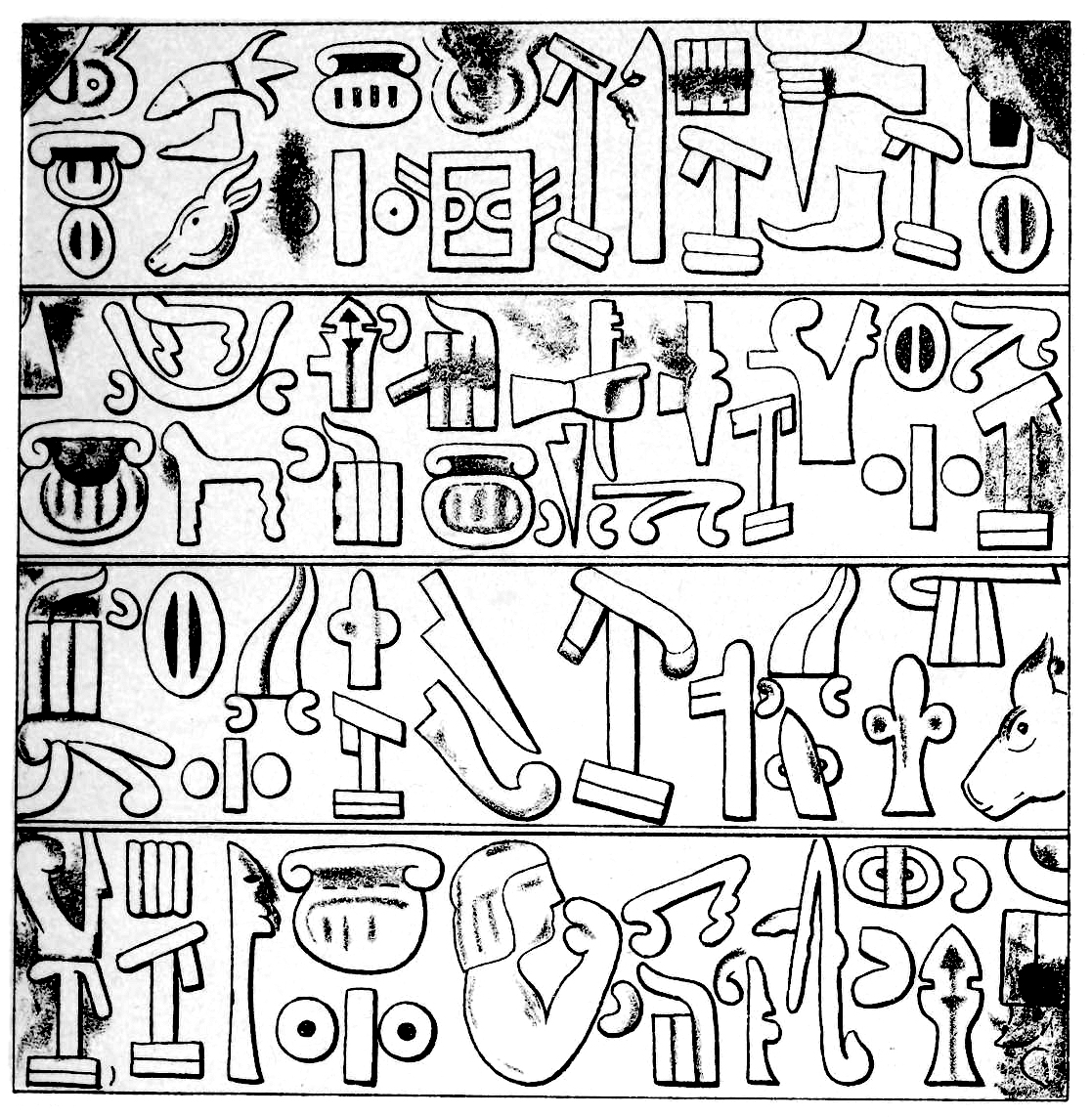
Anatolian hieroglyphs are an indigenous logographic script native to central Anatolia, consisting of some 500 signs. They were once commonly known as Hittite hieroglyphs, but the language they encode proved to be Luwian, not Hittite, and the term Luwian hieroglyphs is used in English publications. They are typologically similar to Egyptian hieroglyphs, but do not derive graphically from that script, and they are not known to have played the sacred role of hieroglyphs in Egypt. There is no demonstrable connection to Hittite cuneiform.
Individual Anatolian hieroglyphs are attested from the second and early first millennia BC across Anatolia and into modern Syria. A biconvex bronze personal seal was found in the Troy VIIb level (later half of the 12th century BC) inscribed with Luwian Hieroglyphs. The earliest examples occur on personal seals, but these consist only of names, titles, and auspicious signs, and it is not certain that they represent language. Most actual texts are found as monumental inscriptions in stone, though a few documents have survived on lead strips.
The first inscriptions confirmed as Luwian date to the Late Bronze Age, ca. 14th to 13th centuries BC. After some two centuries of sparse material, the hieroglyphs resume in the Early Iron Age, ca. 10th to 8th centuries BC. In the early 7th century BC, the Luwian hieroglyphic script, by then aged some 700 years, was marginalized by competing alphabetic scripts and fell into oblivion.
While almost all the preserved texts employing Anatolian hieroglyphs are written in the Luwian language, some features of the script suggest its earliest development within a bilingual Hittite-Luwian environment. For example, the sign which has the form of a "taking" or "grasping" hand has the value /ta/, which is precisely the Hittite word ta-/da- "to take," in contrast with the Luwian cognate of the same meaning which is la-. There was occasionally some use of Anatolian hieroglyphs to write foreign material like Hurrian theonyms, or glosses in Urartian (such as  á – ḫá+ra – ku for
  aqarqi or
  tu – ru – za for
  ṭerusi, two units of measurement).
As in Egyptian, characters may be logographic or phonographic—that is, they may be used to represent words or sounds. The number of phonographic signs is limited. Most represent CV syllables (CV = consonant vowel), though there are a few disyllabic signs. A large number of these are ambiguous as to whether the vowel is a or i. Some signs are dedicated to one use or another, but many are flexible.
Words may be written logographically, phonetically, mixed (that is, a logogram with a phonetic complement), and may be preceded by a determinative. Other than the fact that the phonetic glyphs form a syllabary rather than indicating only consonants, this system is analogous to the system of Egyptian hieroglyphs.
A more elaborate monumental style is distinguished from more abstract linear or cursive forms of the script. In general, relief inscriptions prefer monumental forms, and incised ones prefer the linear form, but the styles are in principle interchangeable. Texts of several lines are usually written in boustrophedon style. Within a line, signs are usually written in vertical columns of two to four signs, but as in Egyptian hieroglyphs, aesthetic considerations take precedence over correct reading order. Many texts also employ an explicit word divider character.
One peculiarity of the Luwian writing system is that in some texts vowel signs, usually repeating the vowel of the preceding syllable, were used to fill up sign columns, so that new words would always start at the top of the line. Some texts also exhibit the so-called "initial-à-final" pattern, where the word-initial a character is moved either to the top of the second column of signs or to the end of the word.
Hub AI
Anatolian hieroglyphs AI simulator
(@Anatolian hieroglyphs_simulator)
Anatolian hieroglyphs
Anatolian hieroglyphs are an indigenous logographic script native to central Anatolia, consisting of some 500 signs. They were once commonly known as Hittite hieroglyphs, but the language they encode proved to be Luwian, not Hittite, and the term Luwian hieroglyphs is used in English publications. They are typologically similar to Egyptian hieroglyphs, but do not derive graphically from that script, and they are not known to have played the sacred role of hieroglyphs in Egypt. There is no demonstrable connection to Hittite cuneiform.
Individual Anatolian hieroglyphs are attested from the second and early first millennia BC across Anatolia and into modern Syria. A biconvex bronze personal seal was found in the Troy VIIb level (later half of the 12th century BC) inscribed with Luwian Hieroglyphs. The earliest examples occur on personal seals, but these consist only of names, titles, and auspicious signs, and it is not certain that they represent language. Most actual texts are found as monumental inscriptions in stone, though a few documents have survived on lead strips.
The first inscriptions confirmed as Luwian date to the Late Bronze Age, ca. 14th to 13th centuries BC. After some two centuries of sparse material, the hieroglyphs resume in the Early Iron Age, ca. 10th to 8th centuries BC. In the early 7th century BC, the Luwian hieroglyphic script, by then aged some 700 years, was marginalized by competing alphabetic scripts and fell into oblivion.
While almost all the preserved texts employing Anatolian hieroglyphs are written in the Luwian language, some features of the script suggest its earliest development within a bilingual Hittite-Luwian environment. For example, the sign which has the form of a "taking" or "grasping" hand has the value /ta/, which is precisely the Hittite word ta-/da- "to take," in contrast with the Luwian cognate of the same meaning which is la-. There was occasionally some use of Anatolian hieroglyphs to write foreign material like Hurrian theonyms, or glosses in Urartian (such as á – ḫá+ra – ku for aqarqi or tu – ru – za for ṭerusi, two units of measurement).
As in Egyptian, characters may be logographic or phonographic—that is, they may be used to represent words or sounds. The number of phonographic signs is limited. Most represent CV syllables (CV = consonant vowel), though there are a few disyllabic signs. A large number of these are ambiguous as to whether the vowel is a or i. Some signs are dedicated to one use or another, but many are flexible.
Words may be written logographically, phonetically, mixed (that is, a logogram with a phonetic complement), and may be preceded by a determinative. Other than the fact that the phonetic glyphs form a syllabary rather than indicating only consonants, this system is analogous to the system of Egyptian hieroglyphs.
A more elaborate monumental style is distinguished from more abstract linear or cursive forms of the script. In general, relief inscriptions prefer monumental forms, and incised ones prefer the linear form, but the styles are in principle interchangeable. Texts of several lines are usually written in boustrophedon style. Within a line, signs are usually written in vertical columns of two to four signs, but as in Egyptian hieroglyphs, aesthetic considerations take precedence over correct reading order. Many texts also employ an explicit word divider character.
One peculiarity of the Luwian writing system is that in some texts vowel signs, usually repeating the vowel of the preceding syllable, were used to fill up sign columns, so that new words would always start at the top of the line. Some texts also exhibit the so-called "initial-à-final" pattern, where the word-initial a character is moved either to the top of the second column of signs or to the end of the word.
Recent media