


Community Hub0 Subscribers
Community hub
Angler's loop
View on Wikipediafrom Wikipedia
| Angler's loop | |
|---|---|
 | |
| Names | Angler's loop, Perfection loop |
| Category | Loop |
| Releasing | Jamming |
| Typical use | Fishing, forming a fixed loop in bungee cord |
| ABoK | #1017, #1035, #2067 |
| Instructions | [1] |
An angler's loop, otherwise known as a perfection loop, is a type of knot which forms a fixed loop. Useful for fine or slippery line, it is one of the few loop knots which holds well in bungee cord. It is quite secure, but it jams badly and is not suitable if the knot will need to be untied. [1]
Tying
[edit]Angler's loop may be tied
- alone and then used,
- it may be tied in the bight or at the working end
- it may be tied one handed
- it may be fashioned with several loops
- it may be locked for additional stability
- it may be tied at high speed in an emergency
- it may be tied through an object (typically a ring).


-
 Start with a loop near the working end
 -
 Continue with two loops around standing end
 -
 one large and one small in the middle
 -
 Pull the large loop over the small (working end) and through the first loop
 -
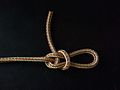 Tighten pulling in all three directions.


Angler's loop may be tied around the hand, it may also be tied this way one handed, or with several loops if need be:
-
 Hold the working end, loop the standing end 3 times around the palm
 -
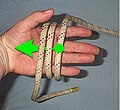 Pull the outmost loop inwards under the first two
 -
 Pull the next outmost over the one(s) in the middle and under the now innermost loop
 -
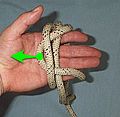 Pull the now innermost loop(s) and the standing end to tighten.
 -
 Done.
Done.


- Angler's loop may be locked additionally with half hitches

- Angler's loop may be fashioned with several loops (then locking may be necessary)

- A version with an additional locking turn of the tail called Double Dragon is shown in this video:
Structure
[edit]Overhand knot on standing part and half-hitch by the working end.
See also
[edit]References
[edit]- ^ "Anglers loop or Perfection loop". Knots and Climbing. 2025. Archived from the original on 13 May 2025. Retrieved 13 May 2025.
- Blandford, Percy W. (2012). Practical Knots and Ropework, page 92, Courier Corporation. ISBN 9780486148656.
- Bloomsbury Publishing (2013). The Knot Bible: The Complete Guide to Knots and Their Uses, page 143. A & C Black. ISBN 9781408155875.
- Budworth, Geoffrey (2012). The Knot Book Hachette UK. ISBN 9780716023159.
- Finazzo, Scott (2016). Prepper's Guide to Knots: The 100 Most Useful Tying Techniques for Surviving any Disaster, page 117, Ulysses Press. ISBN 9781612436302.
- Popular Mechanics (2008). How to Tempt a Fish: A Complete Guide to Fishing, page 78, Sterling Publishing Company. ISBN 9781588167262.
- Toss, Brion and Gae Pilon (2009). Chapman Knots for Boaters, pages 68–68, Sterling Publishing Company. ISBN 9781588167781.
- Whippy, Jim (2013). Reeds Knot Handbook: A Pocket Guide to Knots, Hitches and Bends, pages 82–83, A & C Black. ISBN 9781472902610.
External links
[edit]- Perfection (Angler's) Loop Knot. animatedknots.com.


 | This knot-related article is a stub. You can help Wikipedia by expanding it. |
Angler's loop
View on Grokipediafrom Grokipedia
Overview
Description
The Angler's loop is a fixed loop knot that creates a small, inline loop at the end of a line or rope.[1] It is particularly suitable for slender or slippery materials, such as monofilament fishing line, where it forms secure, non-adjustable attachments for leaders, lures, or other terminal tackle.[6] Also known as the Perfection Loop, it is illustrated as #1017 in The Ashley Book of Knots.[1] Visually, the knot features a compact structure resembling an overhand knot with an integrated loop, resulting in a flat and streamlined profile that aligns closely with the standing part of the line.[7] This design minimizes bulk and drag, making it ideal for applications requiring a low-profile connection.[8] A defining characteristic of the Angler's loop is its tendency to jam under load, rendering it non-releasing once tightened but highly reliable for permanent or semi-permanent setups.[9] This behavior ensures strength and security in demanding conditions, though it may complicate untying after heavy use.[10]Nomenclature
The Angler's Loop is primarily known by two names that reflect its utility in fishing and general knot-tying: Angler's Loop, emphasizing its widespread adoption among anglers for creating secure leader connections, and Perfection Loop, named for its ability to form a neat, aligned loop with minimal bulk that extends straight from the standing end.[1][9] The term "Angler's" derives from its popularity in angling contexts, where it provides a reliable fixed loop for attaching flies or leaders without compromising line strength.[5] Similarly, "Perfection" highlights the knot's clean formation and low profile, making it ideal for applications requiring precise alignment, such as in monofilament lines.[1][9] In broader knot-tying resources, the knot is occasionally referred to as an inline loop or end loop due to its configuration at the rope's terminus, forming a stable eye that maintains the line's direction.[11] These synonyms appear in technical glossaries and instructional materials, underscoring its role as a versatile fixed loop knot suitable for both end and mid-line applications.[11] Naming variations also emerge across disciplines; for instance, in knot theory and climbing discussions, it is described as a fixed eye knot, recognizing its secure, non-slipping loop structure akin to bowline variants.[12] This terminology shift illustrates how the knot's nomenclature adapts to emphasize structural reliability in non-fishing contexts, such as rope work or safety applications.[11]History
Origins
The Angler's loop, also known as the perfection loop, emerged within practical angling practices, particularly among fly fishers using leaders made from horsehair or silkworm gut. These materials required reliable knots to form secure attachments without compromising the line's integrity, and the loop's design addressed the need for a compact eye at the leader's end. Horsehair leaders, common since the 18th century, transitioned to gut by the mid-19th century, prompting anglers to refine knot techniques through hands-on experimentation in both freshwater and saltwater environments.[13] No definitive inventor is known, and the exact origins of the knot remain undocumented, as it arose from trial-and-error in fly fishing communities seeking efficient ways to form small eyes that maintained line strength and presentation.[9] This practical refinement occurred primarily in fieldwork, where anglers prioritized knots that resisted slippage on natural materials like gut while enabling quick connections for varying fishing conditions. Following World War II, the introduction of slippery nylon monofilament lines necessitated further adaptations of existing knots, including the Angler's loop, to handle the new material's properties. Older knots designed for cotton, linen, or gut often failed with nylon, spurring a broader evolution in fishing knot techniques during the late 1940s and 1950s.[14] The loop's inline structure proved particularly valuable for early informal applications in both saltwater and freshwater angling, facilitating leader-to-fly-line attachments amid this material shift. Its entry into formal knot literature came later, solidifying its role in angling traditions.Documentation
The Angler's loop received its first major documentation in Clifford W. Ashley's comprehensive reference work, The Ashley Book of Knots, published in 1944, where it is illustrated and described as knot #1017 under the name "Angler's Loop," praised for its superior lead and suitability for small lines like fishline.[15] Ashley also references variations of the knot, including the Double Angler's Loop as #1035, which employs the same form but doubled for added security, and #2067, which recommends the Angler's Loop for tying in twine as an alternative to the bowline due to its ease and reliability.[16] This publication established the knot within formal knot-tying literature, distinguishing it from earlier, less standardized references to generic loop knots in angling practices. In the mid-20th century, the knot gained prominence in fishing-specific guides, where it is included among essential knots for its strength and effectiveness in fly fishing leader connections.[17] In modern resources, the Angler's loop appears extensively in online knot databases and angling manuals, such as Animated Knots by Grog, which features step-by-step animations under the name "Perfection Loop" (noting it as an alternative name for the Angler's Loop) and emphasizes its alignment with the standing line for leader work.[1] Similarly, resources from the International Guild of Knot Tyers (IGKT), including tutorials from IGKT Solent, document the knot as both "Angler's Loop" and "Perfection Loop," underscoring its fixed-loop utility in fine lines and its reputation for "perfection" in maintaining line integrity during fishing.[18] Contemporary angling manuals continue to position it as an ideal choice for leader loops due to its compact form and resistance to slippage.[17] Post-1944 documentation reflects an evolution in nomenclature, transitioning from Ashley's specific "Angler's Loop" to the more widely adopted "Perfection Loop" in fishing literature and databases, reflecting its refined status among specialized loop knots rather than generic end-loop variants.[1] This shift, evident in resources from the 1970s onward, aligns the name with its practical "perfection" in angling applications, while retaining the original designation in broader knot catalogs.[18]Uses
In Fishing
The Angler's loop, also known as the perfection loop, is used to form a small, inline loop at the end of a leader, tippet, or line, enabling secure attachments such as loop-to-loop connections to the fly line or for lures and swivels in various fishing methods including fly fishing, spinning, and baitcasting.[1] This application is particularly valued in tapered leader systems, where the knot ensures a smooth transition between the thicker fly line and the finer leader material without disrupting the overall line profile.[19] In fly fishing setups, the knot facilitates attaching droppers or multiple flies by creating reliable end loops that maintain unimpeded line flow during casts and retrieves, allowing for versatile rigging such as dry-dropper or nymphing configurations.[20] Its design aligns the loop directly with the standing line, preserving straightness and minimizing resistance in the water, which enhances presentation and reduces drag on subsurface flies.[1] It is also employed in saltwater fishing for connecting leaders or swivels to handle corrosive environments and heavy loads.[20] The Angler's loop demonstrates strong suitability for monofilament, fluorocarbon, and braided lines, owing to its secure grip on slippery surfaces that prevents slippage under tension.[19] Key benefits include reduced bulk at connection points compared to bulkier knots, which lowers the risk of tangles and improves casting efficiency, as well as enabling rapid fly changes through simple loop interlocks without retying the entire leader.[20][1]Other Applications
The Angler's loop finds application in securing loops within bungee cords or elastic lines, where its structure prevents slippage under stretch and contraction, making it suitable for tethers such as knives.[21] In general outdoor pursuits, the Angler's loop is employed with paracord for forming small, permanent loops in lashing or tent guy lines, facilitating quick attachments in camping and bushcraft setups.[3] This utility stems from its ease in fine lines, allowing efficient rigging for shelters or equipment without bulky profiles.[22] However, the knot's tendency to jam tightly after loading limits its practicality in thicker ropes, confining it primarily to niche roles with slender or elastic cords where untying is secondary to security.[23]Tying
Standard Procedure
The standard procedure for tying the Angler's loop, a fixed loop knot formed at the end of a fishing line, begins by preparing the line for a secure, in-line attachment suitable for leaders or lures.[1] This method creates a small, strong loop without significantly weakening the line, and it can be executed one-handed for convenience during fishing.[8] To tie the knot:- Form an initial loop in the line by passing the working end (tag end) behind the standing part, holding the base of this loop between your thumb and index finger to maintain its shape.[1]
- Wrap the working end around the standing part to form a second loop beside the initial loop; in the one-handed method preferred by anglers, use your index finger to guide and hold the initial loop open while making this wrap.[1][6]
- Pass the second loop through the initial loop from the near side, ensuring it enters cleanly to avoid twists.[8]
- Wet the line with saliva or water to reduce friction, then pull the standing part and the new loop in opposite directions while holding the structure to cinch the knot securely; adjust the loop size before fully tightening, and trim the excess working end.[1][6]