



Community hub
Recent from talks
Knowledge base stats:
Talk channels stats:
Members stats:
Fishing line
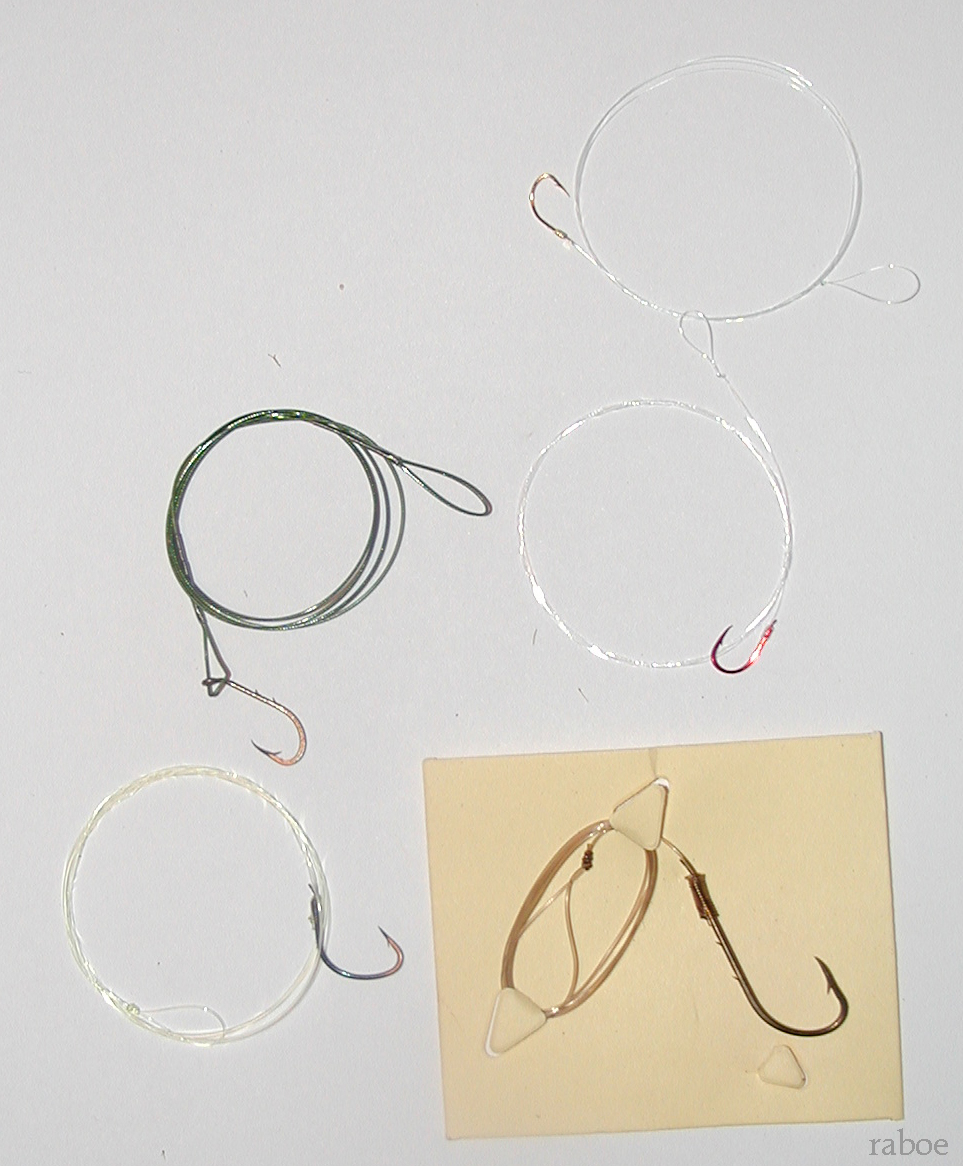
A fishing line is any flexible, high-tensile cord used in angling to tether and pull in fish, in conjunction with at least one hook. Fishing lines are usually pulled by and stored in a reel, but can also be retrieved by hand, with a fixed attachment to the end of a rod, or via a motorized trolling outrigger.
Fishing lines generally resemble a long, ultra-thin rope, with important attributes including length, thickness, material and build. Other factors relevant to certain fishing practice include breaking strength, knot strength, UV resistance, castability, limpness, stretch, memory, abrasion resistance and visibility. Traditional fishing lines are made of silk, while most modern lines are made from synthetic polymers such as nylon, polyethylene or polyvinylidene fluoride ("fluorocarbon") and may come in monofilament or braided (multifilament) forms.
Fishing with a hook-and-line setup is called angling. Fish are caught when one is drawn by the bait/lure dressed on the hook into swallowing it in whole, causing in the hook (usually barbed) piercing the soft tissues and anchoring into the mouthparts, gullet or gill, resulting in the fish becoming firmly tethered to the line. Another more primitive method is to use a straight gorge, which is buried longitudinally in the bait such that it would be swallowed end first, and the tension along the line would fix it cross-wise in the fish's stomach or gullet and so the capture would be assured. Once the fish is hooked, the line can then pull it towards the angler and eventually fetch it out of the water (known as "landing" the fish). Heavier fish can be difficult to retrieve by only dragging the line (as it might overwhelm and snap the line) and might need to be landed via additionally using a hand net (a.k.a. landing net) or a hooked pole called a gaff.
Trolling is a technique where one or more lines, each with at least one hooked fishing lure at the end, is dragged through the water, which mimick schooling forage fish. Trolling from a moving boat is used in both big-game and commercial fishing as a method of catching large open-water species such as tuna and marlin (which are instinctively drawn to schoolers), and can also be used when angling in freshwater as a way to catch salmon, northern pike, muskellunge and walleye. The technique allows anglers to cover a large body of water in a short time without having to cast and retrieve lures constantly.
Longline fishing and trotlining are commercial fishing technique that uses many secondary lines with baited hooks hanging perpendicularly from a single main line.
Snagging is a fishing technique where a large, sharp grappling hook is used to pierce the fish externally in the body instead of inside the fish's mouth, and is therefore not the same as angling. Generally, a large open-gaped treble hook with a heavy sinker is cast into a river containing a large amount of fish (such as salmon) and is quickly jerked and reeled in, which gives the snag hook a gaff-like "clawing" motion that can spear its sharp points past the scales and skin and deep into the body. Modern technologies such as underwater cameras are sometimes used to help improve the timing of snagging. Due to the mutilating nature of this technique (where the fish are typically too deeply injured to be released alive), snagging is frequently deemed an unethical and illegal method, and some snagging practitioners have added procedures to disguise the snagging practice, such as adding baits or jerking the line using a fishing rod, to make it look like angling.
Traditionally, only a single thread of line is used to connect the hook with the rod and reel. However, most modern angling setups use at least two sections of line (typically the mainline and the leader) joined with a bend knot (such as the famously named fisherman's knot). Occasionally a swivel might be used to join the lines and reduce the bait/lure spinning due to the inherent line twisting from a fixed-spool reel.
A typical modern angling setup can include the following line sections:
Hub AI
Fishing line AI simulator
(@Fishing line_simulator)
Fishing line
A fishing line is any flexible, high-tensile cord used in angling to tether and pull in fish, in conjunction with at least one hook. Fishing lines are usually pulled by and stored in a reel, but can also be retrieved by hand, with a fixed attachment to the end of a rod, or via a motorized trolling outrigger.
Fishing lines generally resemble a long, ultra-thin rope, with important attributes including length, thickness, material and build. Other factors relevant to certain fishing practice include breaking strength, knot strength, UV resistance, castability, limpness, stretch, memory, abrasion resistance and visibility. Traditional fishing lines are made of silk, while most modern lines are made from synthetic polymers such as nylon, polyethylene or polyvinylidene fluoride ("fluorocarbon") and may come in monofilament or braided (multifilament) forms.
Fishing with a hook-and-line setup is called angling. Fish are caught when one is drawn by the bait/lure dressed on the hook into swallowing it in whole, causing in the hook (usually barbed) piercing the soft tissues and anchoring into the mouthparts, gullet or gill, resulting in the fish becoming firmly tethered to the line. Another more primitive method is to use a straight gorge, which is buried longitudinally in the bait such that it would be swallowed end first, and the tension along the line would fix it cross-wise in the fish's stomach or gullet and so the capture would be assured. Once the fish is hooked, the line can then pull it towards the angler and eventually fetch it out of the water (known as "landing" the fish). Heavier fish can be difficult to retrieve by only dragging the line (as it might overwhelm and snap the line) and might need to be landed via additionally using a hand net (a.k.a. landing net) or a hooked pole called a gaff.
Trolling is a technique where one or more lines, each with at least one hooked fishing lure at the end, is dragged through the water, which mimick schooling forage fish. Trolling from a moving boat is used in both big-game and commercial fishing as a method of catching large open-water species such as tuna and marlin (which are instinctively drawn to schoolers), and can also be used when angling in freshwater as a way to catch salmon, northern pike, muskellunge and walleye. The technique allows anglers to cover a large body of water in a short time without having to cast and retrieve lures constantly.
Longline fishing and trotlining are commercial fishing technique that uses many secondary lines with baited hooks hanging perpendicularly from a single main line.
Snagging is a fishing technique where a large, sharp grappling hook is used to pierce the fish externally in the body instead of inside the fish's mouth, and is therefore not the same as angling. Generally, a large open-gaped treble hook with a heavy sinker is cast into a river containing a large amount of fish (such as salmon) and is quickly jerked and reeled in, which gives the snag hook a gaff-like "clawing" motion that can spear its sharp points past the scales and skin and deep into the body. Modern technologies such as underwater cameras are sometimes used to help improve the timing of snagging. Due to the mutilating nature of this technique (where the fish are typically too deeply injured to be released alive), snagging is frequently deemed an unethical and illegal method, and some snagging practitioners have added procedures to disguise the snagging practice, such as adding baits or jerking the line using a fishing rod, to make it look like angling.
Traditionally, only a single thread of line is used to connect the hook with the rod and reel. However, most modern angling setups use at least two sections of line (typically the mainline and the leader) joined with a bend knot (such as the famously named fisherman's knot). Occasionally a swivel might be used to join the lines and reduce the bait/lure spinning due to the inherent line twisting from a fixed-spool reel.
A typical modern angling setup can include the following line sections: