


Community hub
Recent from talks
Contribute something to knowledge base
Content stats: 0 posts, 0 articles, 1 media, 0 notes
Members stats: 0 subscribers, 0 contributors, 0 moderators, 0 supporters
Subscribers
Supporters
Contributors
Moderators
Hub AI
Anglophone Crisis AI simulator
(@Anglophone Crisis_simulator)
Hub AI
Anglophone Crisis AI simulator
(@Anglophone Crisis_simulator)
Anglophone Crisis
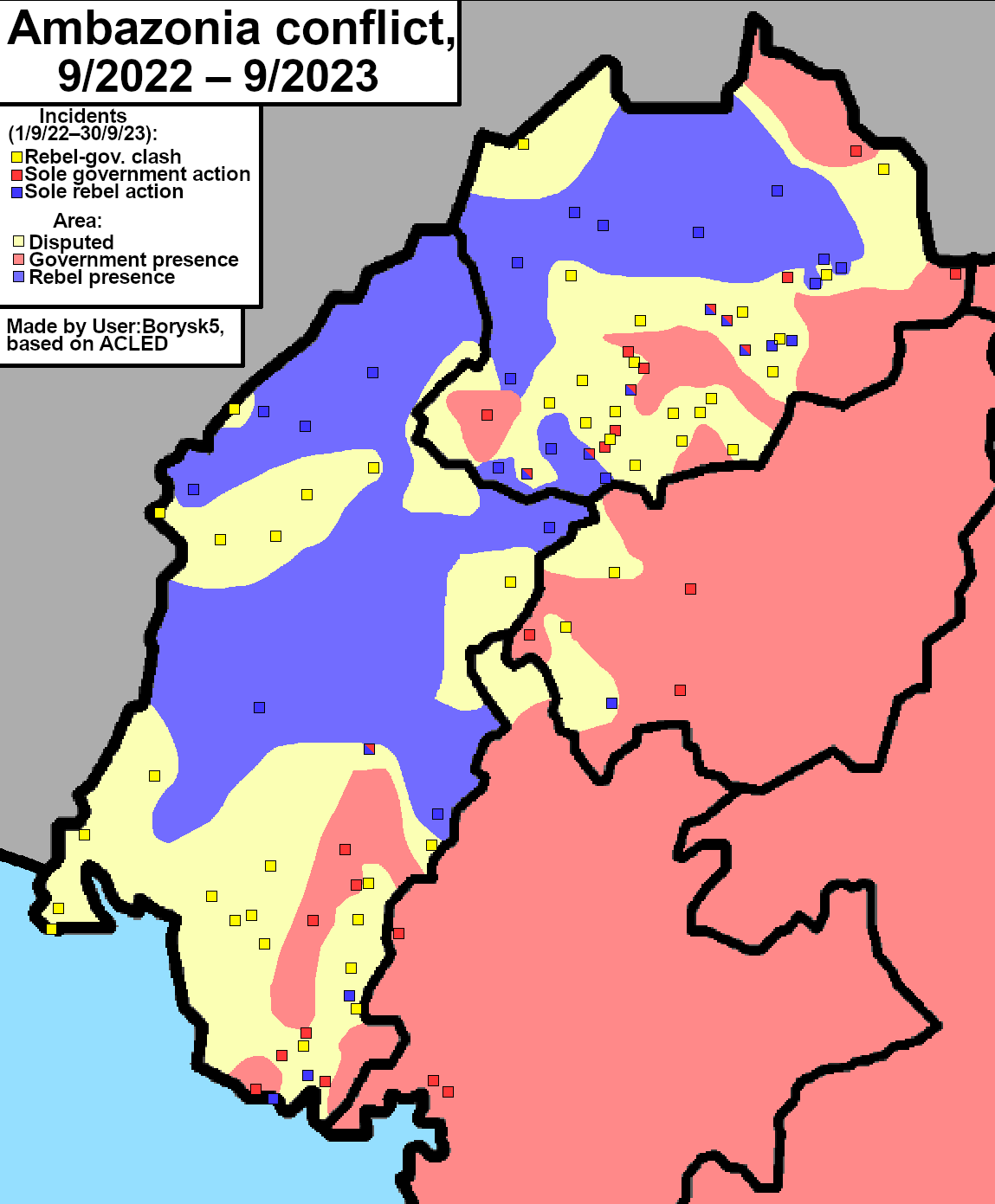
The Anglophone Crisis (French: Crise anglophone), also known as the Ambazonia War, is an ongoing armed conflict in the English-speaking Northwest and Southwest regions of Cameroon, between the Cameroonian government and Ambazonian separatist groups, part of the long-standing Anglophone problem. Following the suppression of 2016–17 protests by Cameroonian authorities, separatists in the Anglophone regions (formerly collectively known as the Southern Cameroons) launched a guerrilla campaign and later proclaimed independence. Within two months, the government sent its army into the Anglophone regions.
Starting as a low-scale insurgency, the conflict spread to most parts of the Anglophone regions within a year. By the summer of 2019, the government controlled the major cities and parts of the countryside, while the Ambazonian nationalists held parts of the countryside and regularly appeared in the major cities. Separatists have occasionally carried out raids into the neighboring Francophone regions of Littoral and West. Thousands of people have been killed in the war, and more than half a million have been forced to flee their homes. The Cameroonian government was supported by the Buhari administration in Nigeria, while at least one Ambazonian group is allied to Biafran separatists.
Talks mediated by Switzerland in 2019 ultimately failed, and the Ambazonian leadership crisis has complicated any diplomatic process. Separatist leaders who were extradited from Nigeria in 2018 were in 2019 handed life sentences by a military tribunal. Facing mounting international pressure for a global ceasefire, in July 2020, Cameroon began negotiating with these imprisoned leaders. The talks were held between Sisiku Julius Ayuk Tabe and other imprisoned leaders and representatives of the Cameroonian government. The talks outlined a series of conditions for the Cameroonian government to accept, which Ayuk Tabe said would create an "enabling environment" for substantial negotiations to occur. These talks ultimately failed, and fighting continued.
The name "Ambazonia" is taken from Ambas Bay and Ambozes, the local name of the mouth of the Wouri River. This is where the English language was permanently established for the first time in Southern Cameroons, when missionary Alfred Saker founded a settlement of freed slaves by Ambas Bay in 1858, which was later renamed Victoria (present-day Limbe). In 1884, the area became the British Ambas Bay Protectorate, with Victoria as its capital. Britain ceded the area to the German territory of Kamerun in 1887. Germany had some trouble establishing control over the hinterlands of Victoria, and fought the Bafut Wars against local fondoms until 1907.
Following World War I and the Treaty of Versailles, Kamerun was divided between a French and a British League of Nations Mandate. The French mandate was known as Cameroun, and comprised most of the former German territory. The British mandate was an elongated strip of land along the border of Colonial Nigeria, consisting of Northern Cameroons and Southern Cameroons, including the historical Ambas Bay Protectorate. This territory was organized as British Cameroons.
The British administered the territories through indirect rule, allowing native authorities to administer the population according to their own traditions. In 1953, the Southern Cameroons delegation at a conference in London asked for a separate region. The British agreed, and Southern Cameroons became an autonomous region with its capital still at Buea. Elections were held in 1954 and the parliament met on 1 October 1954, with E. M. L. Endeley as Premier.
The United Nations organised a plebiscite in the region on 11 February 1961 which put two alternatives to the people: union with Nigeria or union with Cameroon. The third option, independence, was opposed by the British representative to the UN Trusteeship Council, Sir Andrew Cohen, and as a result was not listed. In the plebiscite, 60% of voters in the Northern Cameroons voted for union with Nigeria, while 70% of voters in the Southern Cameroons opted for union with Cameroon. The results owed partly to a fear of domination by much larger Nigeria. Endeley was defeated in elections on 1 February 1959 by John Ngu Foncha.
Southern Cameroons federated with Cameroon on 1 October 1961 as "West Cameroon", with its own prime minister. However, the English-speaking peoples of the Southern Cameroons did not believe that they were fairly treated by the 80% majority French-speaking government of the country. Then-president Ahmadou Ahidjo feared that Southern Cameroons would secede from the union, taking its natural resources with it. Following a French Cameroon unilateral referendum on 20 May 1972, a new constitution was adopted in Cameroon which replaced the federal state with a unitary state, and also gave more power to the president. Southern Cameroons lost its autonomous status and became the Northwest Region and the Southwest Region of the Republic of Cameroon. Pro-independence groups claimed that this violated the constitution, as the majority of deputies from West Cameroon had not consented to legitimize the constitutional changes. They argued that Southern Cameroons had effectively been annexed by Cameroon. Shortly afterwards, French Cameroun's political leadership changed the constitution again, appointed French-speaking Paul Biya as Prime Minister and successor to Ahmadou Ahidjo.
Anglophone Crisis
The Anglophone Crisis (French: Crise anglophone), also known as the Ambazonia War, is an ongoing armed conflict in the English-speaking Northwest and Southwest regions of Cameroon, between the Cameroonian government and Ambazonian separatist groups, part of the long-standing Anglophone problem. Following the suppression of 2016–17 protests by Cameroonian authorities, separatists in the Anglophone regions (formerly collectively known as the Southern Cameroons) launched a guerrilla campaign and later proclaimed independence. Within two months, the government sent its army into the Anglophone regions.
Starting as a low-scale insurgency, the conflict spread to most parts of the Anglophone regions within a year. By the summer of 2019, the government controlled the major cities and parts of the countryside, while the Ambazonian nationalists held parts of the countryside and regularly appeared in the major cities. Separatists have occasionally carried out raids into the neighboring Francophone regions of Littoral and West. Thousands of people have been killed in the war, and more than half a million have been forced to flee their homes. The Cameroonian government was supported by the Buhari administration in Nigeria, while at least one Ambazonian group is allied to Biafran separatists.
Talks mediated by Switzerland in 2019 ultimately failed, and the Ambazonian leadership crisis has complicated any diplomatic process. Separatist leaders who were extradited from Nigeria in 2018 were in 2019 handed life sentences by a military tribunal. Facing mounting international pressure for a global ceasefire, in July 2020, Cameroon began negotiating with these imprisoned leaders. The talks were held between Sisiku Julius Ayuk Tabe and other imprisoned leaders and representatives of the Cameroonian government. The talks outlined a series of conditions for the Cameroonian government to accept, which Ayuk Tabe said would create an "enabling environment" for substantial negotiations to occur. These talks ultimately failed, and fighting continued.
The name "Ambazonia" is taken from Ambas Bay and Ambozes, the local name of the mouth of the Wouri River. This is where the English language was permanently established for the first time in Southern Cameroons, when missionary Alfred Saker founded a settlement of freed slaves by Ambas Bay in 1858, which was later renamed Victoria (present-day Limbe). In 1884, the area became the British Ambas Bay Protectorate, with Victoria as its capital. Britain ceded the area to the German territory of Kamerun in 1887. Germany had some trouble establishing control over the hinterlands of Victoria, and fought the Bafut Wars against local fondoms until 1907.
Following World War I and the Treaty of Versailles, Kamerun was divided between a French and a British League of Nations Mandate. The French mandate was known as Cameroun, and comprised most of the former German territory. The British mandate was an elongated strip of land along the border of Colonial Nigeria, consisting of Northern Cameroons and Southern Cameroons, including the historical Ambas Bay Protectorate. This territory was organized as British Cameroons.
The British administered the territories through indirect rule, allowing native authorities to administer the population according to their own traditions. In 1953, the Southern Cameroons delegation at a conference in London asked for a separate region. The British agreed, and Southern Cameroons became an autonomous region with its capital still at Buea. Elections were held in 1954 and the parliament met on 1 October 1954, with E. M. L. Endeley as Premier.
The United Nations organised a plebiscite in the region on 11 February 1961 which put two alternatives to the people: union with Nigeria or union with Cameroon. The third option, independence, was opposed by the British representative to the UN Trusteeship Council, Sir Andrew Cohen, and as a result was not listed. In the plebiscite, 60% of voters in the Northern Cameroons voted for union with Nigeria, while 70% of voters in the Southern Cameroons opted for union with Cameroon. The results owed partly to a fear of domination by much larger Nigeria. Endeley was defeated in elections on 1 February 1959 by John Ngu Foncha.
Southern Cameroons federated with Cameroon on 1 October 1961 as "West Cameroon", with its own prime minister. However, the English-speaking peoples of the Southern Cameroons did not believe that they were fairly treated by the 80% majority French-speaking government of the country. Then-president Ahmadou Ahidjo feared that Southern Cameroons would secede from the union, taking its natural resources with it. Following a French Cameroon unilateral referendum on 20 May 1972, a new constitution was adopted in Cameroon which replaced the federal state with a unitary state, and also gave more power to the president. Southern Cameroons lost its autonomous status and became the Northwest Region and the Southwest Region of the Republic of Cameroon. Pro-independence groups claimed that this violated the constitution, as the majority of deputies from West Cameroon had not consented to legitimize the constitutional changes. They argued that Southern Cameroons had effectively been annexed by Cameroon. Shortly afterwards, French Cameroun's political leadership changed the constitution again, appointed French-speaking Paul Biya as Prime Minister and successor to Ahmadou Ahidjo.
Recent media
Recent media