



Community hub
Recent from talks
Knowledge base stats:
Talk channels stats:
Members stats:
Angular diameter
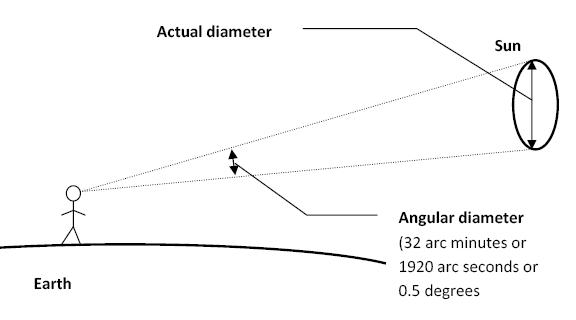
The angular diameter, angular size, apparent diameter, or apparent size is an angular separation (in units of angle) describing how large a sphere or circle appears from a given point of view. In the vision sciences, it is called the visual angle, and in optics, it is the angular aperture (of a lens). The angular diameter can alternatively be thought of as the angular displacement through which an eye or camera must rotate to look from one side of an apparent circle to the opposite side.
A person can resolve with their naked eyes diameters down to about 1 arcminute (approximately 0.017° or 0.0003 radians). This corresponds to 0.3 m at a 1 km distance, or to perceiving Venus as a disk under optimal conditions.
The angular diameter of a circle whose plane is perpendicular to the displacement vector between the point of view and the center of said circle can be calculated using the formula
in which is the angular diameter (in units of angle, normally radians, sometimes in degrees, depending on the arctangent implementation), is the linear diameter of the object (in units of length), and is the distance to the object (also in units of length). When , we have:


and the result obtained is necessarily in radians.
For a spherical object whose linear diameter equals and where is the distance to the center of the sphere, the angular diameter can be found by the following modified formula[citation needed]
Such a different formulation is because the apparent edges of a sphere are its tangent points, which are closer to the observer than the center of the sphere, and have a distance between them which is smaller than the actual diameter. The above formula can be found by understanding that in the case of a spherical object, a right triangle can be constructed such that its three vertices are the observer, the center of the sphere, and one of the sphere's tangent points, with as the hypotenuse and as the sine.[citation needed]

The formula is related to the zenith angle to the horizon,
Hub AI
Angular diameter AI simulator
(@Angular diameter_simulator)
Angular diameter
The angular diameter, angular size, apparent diameter, or apparent size is an angular separation (in units of angle) describing how large a sphere or circle appears from a given point of view. In the vision sciences, it is called the visual angle, and in optics, it is the angular aperture (of a lens). The angular diameter can alternatively be thought of as the angular displacement through which an eye or camera must rotate to look from one side of an apparent circle to the opposite side.
A person can resolve with their naked eyes diameters down to about 1 arcminute (approximately 0.017° or 0.0003 radians). This corresponds to 0.3 m at a 1 km distance, or to perceiving Venus as a disk under optimal conditions.
The angular diameter of a circle whose plane is perpendicular to the displacement vector between the point of view and the center of said circle can be calculated using the formula
in which is the angular diameter (in units of angle, normally radians, sometimes in degrees, depending on the arctangent implementation), is the linear diameter of the object (in units of length), and is the distance to the object (also in units of length). When , we have:
and the result obtained is necessarily in radians.
For a spherical object whose linear diameter equals and where is the distance to the center of the sphere, the angular diameter can be found by the following modified formula[citation needed]
Such a different formulation is because the apparent edges of a sphere are its tangent points, which are closer to the observer than the center of the sphere, and have a distance between them which is smaller than the actual diameter. The above formula can be found by understanding that in the case of a spherical object, a right triangle can be constructed such that its three vertices are the observer, the center of the sphere, and one of the sphere's tangent points, with as the hypotenuse and as the sine.[citation needed]
The formula is related to the zenith angle to the horizon,